

AI has quietly turned modern CRMs from “static databases” into living systems that listen, predict, and act on your behalf. Instead of your sales or support teams spending hours logging calls, updating fields, or guessing which deal to chase next, AI‑powered CRMs now handle data entry, surface the right accounts, and even draft the next email or follow‑up for you.
In this guide, we’ll look at the 5 best AI tools for CRM management, what makes each one stand out, and when it actually makes sense to pick one over the other.
Quick overview: Top 5 AI CRM tools
| Tool | Best suited for | AI highlight feature |
| Salesforce Sales Cloud + Einstein | Mid‑market & enterprises with complex sales cycles | Deep predictive insights & next actions |
| HubSpot CRM + HubSpot AI | Growing SMBs and B2B teams wanting all‑in‑one GTM | AI content & customer service agent |
| Zoho CRM + Zia | Cost‑conscious teams needing broad business suite | AI assistant across many Zoho apps |
| monday CRM with AI | Teams wanting visual workflows and no‑code automations | AI workflow blocks & deal intelligence |
| Lightfield (AI‑native CRM) | Modern sales teams wanting “self‑updating” CRM | Automatic activity capture & AI copilots |
1. Salesforce Sales Cloud + Einstein
Salesforce Sales Cloud combined with Einstein AI is one of the most mature AI CRM stacks on the market, especially for large sales organizations and multi‑stage deal cycles. It uses your historical CRM data to forecast revenue, highlight risky opportunities, and suggest the next best action for reps working complex accounts.
Key features
● Predictive lead and opportunity scoring that ranks which deals are most likely to close.
● Guided selling: Einstein surfaces next‑best actions, recommended follow‑ups, and upsell paths.
● Conversation intelligence that summarizes calls, emails, and meetings into concise notes.
● Forecast risk analysis, showing whether your current pipeline supports the target and where risk sits.
● Einstein Copilot, a conversational assistant embedded across Salesforce clouds to answer questions and trigger actions.
Best for
Salesforce with Einstein is ideal for mid‑sized to enterprise teams with long deal cycles, multiple stakeholders, and a need for robust governance and customization. If you already have strong Salesforce adoption, turning on Einstein can unlock significant lift in productivity and forecast accuracy.
Pricing (high level)
Salesforce sells Einstein capabilities on top of core Sales Cloud editions, with pricing varying by edition and AI add‑on, and enterprises should also factor in implementation and partner costs.
Typical use cases
● Enterprise B2B sales forecasting and pipeline reviews.
● Detecting at‑risk deals and churn in large customer portfolios.
● Standardizing call notes and follow‑ups across big sales teams.
2. HubSpot CRM + HubSpot AI
HubSpot started as a marketing automation and inbound marketing platform and now offers a full CRM suite, with AI woven into marketing, sales, and service hubs. It focuses heavily on ease of use, making AI accessible to smaller teams who don’t have admins or data scientists.
Key features
● AI content generation for emails, landing pages, blogs, and social posts directly inside the editor.
● AI customer agent that can resolve a substantial portion of customer queries via chat or knowledge base automation.
● Predictive lead scoring and send‑time optimization for email campaigns.
● AI‑powered sales sequences and personalization to adapt messages to buyer behavior.
● Natural‑language analytics to generate reports and answer “What happened this month?” type questions.
Best for
HubSpot CRM is best for growing SMBs and mid‑market companies that want one unified platform for marketing, sales, and service with AI helping across the entire funnel. Teams with limited technical resources appreciate its friendly UI and lighter implementation footprint compared to heavy enterprise CRMs.
Pricing (high level)
HubSpot offers a free tier plus Starter, Professional, and Enterprise plans; AI features are bundled into many paid tiers with usage limits, and total cost scales with contacts and seat counts.
Typical use cases
● Inbound marketing teams using AI to draft blogs, emails, and nurture campaigns.
● Support teams using AI agents and knowledge base suggestions to deflect tickets.
● Sales teams running automated, personalized outreach in one place.
3. Zoho CRM with Zia AI
Zoho CRM is part of a broader suite of Zoho business applications, and its AI assistant, Zia, appears across CRM, analytics, support, and other tools. It is a good fit for cost‑sensitive teams that want many functions—CRM, email, analytics, finance—under one vendor.
Key features
● Zia AI assistant provides predictive lead and deal scoring plus sales trend insights.
● Conversational AI lets users ask questions via text or voice like “Show me deals closing this month.”
● Anomaly detection that flags unusual changes in sales or support metrics.
● Data enrichment to auto‑update incomplete or outdated customer records.
● Sentiment analysis on emails and tickets to prioritize urgent communication.
Best for
Zoho CRM is ideal for small and mid‑sized businesses that want an affordable CRM with broad functionality and AI layered across multiple Zoho apps. It works especially well when you also adopt Zoho Desk, Zoho Campaigns, or Zoho Books and want one integrated environment.
Pricing (high level)
Zoho CRM offers several editions (Standard to Ultimate), with Zia AI available on higher‑tier plans; compared with big‑name CRMs, total cost per user is usually lower, especially at scale.
Typical use cases
● Sales teams that need predictive insights but operate on tighter budgets.
● Support and success teams using sentiment and anomaly detection across Zoho Desk.
● Multi‑function SMBs running finances, marketing, and CRM under Zoho’s ecosystem.
4. monday CRM with AI
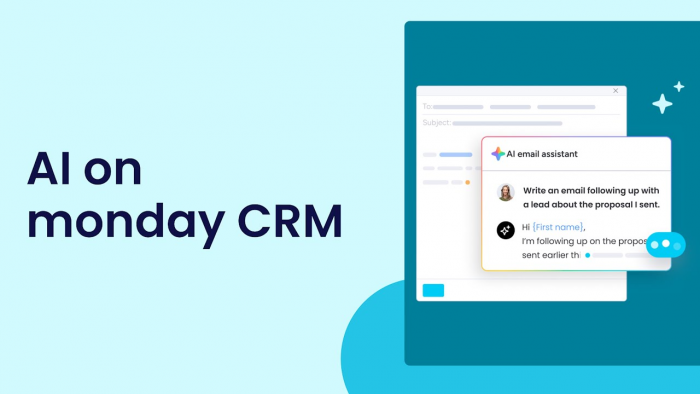
monday CRM extends the monday.com Work OS into sales and customer management with heavy emphasis on visual boards and no‑code automations. Its AI features help teams build custom workflows, summarize communication, and trigger actions using “AI Blocks.”
Key AI features
● AI‑powered workflow blocks that can run actions like sentiment analysis or auto‑task generation based on triggers.
● Deal insights that summarize long email threads and highlight risks or next steps.
● AI assistants for drafting emails or updating records directly from boards.
● Automation of repetitive tasks like notifications, status updates, and hand‑offs between teams.
Best for
monday CRM is best for teams that live in visual project boards and want CRM, projects, and operations aligned in one interface. It particularly suits agencies, startups, and non‑traditional sales teams that value flexibility and easy configuration over heavy CRM complexity.
Pricing (high level)
monday CRM pricing is tiered per seat with a minimum seat bundle; AI capabilities are included in current CRM plans with feature limits depending on tier, and total spend depends on board volume and team size.
Typical use cases
● Startups aligning sales pipeline boards with product and customer success projects.
● Agencies managing client pipelines, scopes, and delivery in one workspace.
● Teams needing quick, visual automation without developer involvement.
5. Lightfield – AI‑native CRM
Lightfield positions itself as an AI‑native CRM designed to “remember everything” and keep the system automatically updated based on real interactions. Instead of reps manually logging every meeting or email, Lightfield captures, structures, and uses this data to generate insights and actions.
Key features
● Automatic capture and summarization of meetings, emails, and conversations with a built‑in call recorder.
● Context‑aware answers: you can ask questions about accounts, deals, or history and get responses backed by citations.
● Personalized email outreach at scale using past conversation context.
● Reactivation of dormant deals via AI‑generated follow‑ups tailored to each contact.
● Bulk pipeline edits and account updates driven by AI rather than spreadsheet uploads.
Best for
Lightfield is ideal for modern sales teams that want a CRM that “does the admin” for them, especially in fast‑moving B2B environments where reps are constantly on calls and in meetings. It suits teams that want to minimize manual data entry and treat the CRM as an AI assistant rather than a static database.
Pricing (high level)
Lightfield operates on custom or usage‑based pricing targeted at mid‑market and enterprise sales teams; AI features are core to the product rather than optional add‑ons.
Typical use cases
● High‑velocity outbound teams that can’t afford to lose details between calls.
● Revenue teams who want a single source of truth built automatically from interactions.
● Leaders wanting AI‑driven coaching and call insights without extra tools.
How to choose the right AI CRM
When you evaluate AI CRMs, the smartest move is to match the tool not just to features, but to your team’s size, complexity, and tech comfort.
Consider these factors:
● Team size & complexity: Enterprises with layered approvals and long cycles often get the most value from Salesforce Einstein or Microsoft Dynamics 365 with Copilot, while smaller teams lean toward HubSpot or Zoho.
● Ecosystem fit: If you already live in Microsoft 365, Dynamics might be attractive; if you already use Zoho apps, Zoho CRM + Zia is a natural extension.
● Implementation effort: HubSpot and monday CRM typically require less consulting and admin overhead than Salesforce.
● Budget & pricing model: Salesforce and enterprise AI add‑ons tend to cost more and require larger contracts, while Zoho and monday CRM offer more affordable entry points.
● AI maturity: If you are new to AI, starting with native, guided capabilities in HubSpot or monday CRM may be less overwhelming than jumping straight to highly configurable enterprise setups.
A simple practical approach:
1. Shortlist 2–3 tools that match your size and existing stack.
2. Run a 30‑day pilot focused on one clear outcome (e.g., improve win rate on late‑stage deals, reduce ticket resolution time, or increase qualified meetings).
3. Compare baseline vs pilot metrics and decide whether to scale or switch.
Final thoughts
AI tools for CRM management are no longer experimental, they’re becoming the default way modern teams manage relationships, revenue, and customer experience. Whether you pick Salesforce, HubSpot, Zoho, monday CRM, or an AI‑native option like Lightfield, the real advantage comes when you design your workflows around AI: let it handle data capture, prioritization, and first‑draft work so your humans can focus on high‑value conversations.
Comments