

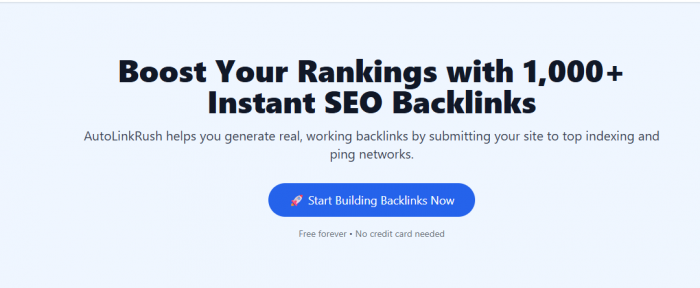
The promise of “1,000+ instant backlinks in seconds” is attractive, especially for new website owners struggling with indexing and visibility. AutoLinkRush markets itself around this exact promise.
Why AutoLinkRush Needs Investigation
Backlink automation tools sit at the most controversial edge of SEO. Google’s guidelines clearly discourage manipulative link schemes, yet dozens of tools continue to sell “instant backlinks” using technical loopholes rather than editorial value.
AutoLinkRush is one such tool.
Its homepage language suggests:
- Speed
- Scale
- Safety
- Simplicity
But SEO outcomes are determined by link quality, relevance, authority, and trust, not volume. This investigation evaluates AutoLinkRush against those standards.
What AutoLinkRush Claims on Its Website
According to its own marketing copy, AutoLinkRush claims to:
- Generate real, working backlinks
- Submit URLs to 1,000+ trusted indexing & ping services
- Improve rankings through faster discovery
- Work without downloads or technical setup
- Offer free and one-time pricing, avoiding subscriptions
- Be “safe” and usable for all websites
The wording strongly implies ranking improvement, despite never clearly explaining what type of backlinks are being created.
How AutoLinkRush Works
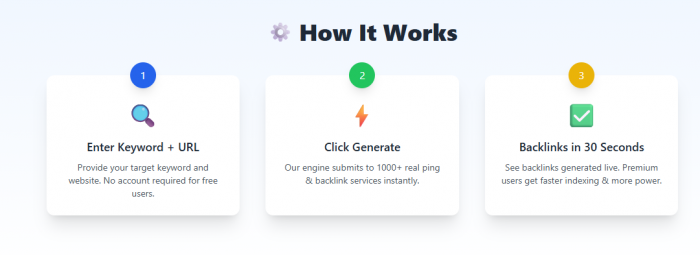
AutoLinkRush operates as a ping-based URL propagation engine.
Step-by-Step Breakdown
- User submits a keyword + URL
- System fires automated ping requests to:
- RSS ping servers
- Feed aggregators
- Syndication endpoints
- Legacy indexing services
These endpoints generate:
- Crawl logs
- Feed references
- Auto-generated acknowledgment URLs
These URLs are then displayed inside the dashboard as “backlinks”.
Important distinction:
These are machine-generated references, not editorial links.
The Truth About “1,000+ Backlinks”
From a search engine perspective, most links generated are:
- No-content pages
- Auto-generated system logs
- Low-authority endpoints
- Often noindexed or ignored
They exist, but they do not carry SEO authority.
Google treats these as:
- Crawl hints at best
- Noise at worst
Calling them “backlinks” is technically correct, but SEO-misleading.
Indexing vs Ranking: Where Users Get Confused
AutoLinkRush primarily influences index discovery, not rankings.
What It Can Do
- Help Google notice a new URL faster
- Trigger crawl attempts
- Populate Search Console activity
What It Cannot Do
- Improve keyword rankings long-term
- Increase domain authority
- Replace link earning
- Build topical relevance
Indexing ≠ Ranking
Many users confuse visibility in Search Console with ranking gains, this is where disappointment begins.
“Trusted & Integrated With”: A Claim Breakdown
AutoLinkRush lists major search engines and platforms as integrations.
Reality:
- These are public ping endpoints
- No partnerships exist
Many endpoints are:
- Deprecated
- Rate-limited
- Ignored by Google
Google itself has stated that mass pinging does not improve rankings.
This claim is marketing framing, not technical endorsement.
Google Algorithm Compatibility and Risk Analysis
AutoLinkRush falls under Grey Hat SEO.
Penalty Risk
- Low chance of manual action
- Google usually ignores such links rather than penalizing them
Algorithmic Handling
- SpamBrain filters mass automation
- Penguin neutralizes artificial link patterns
- Links are discounted, not rewarded
Risk increases when:
- Used aggressively
- Applied to money pages
- Combined with other manipulative tactics
Pricing Model: What It Tells Us
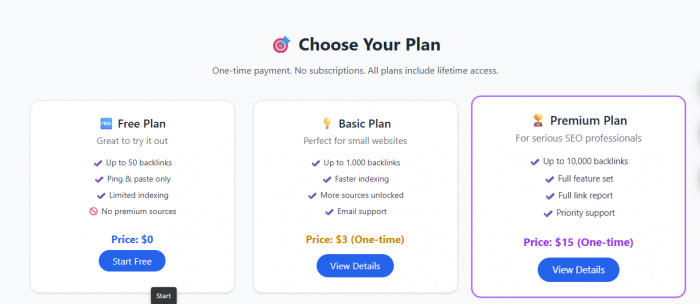
One-time pricing ($0–$15 lifetime) indicates:
- Fully automated scripts
- No human oversight
- No editorial cost
- No quality vetting
Real backlinks cannot be produced sustainably at this price.
Transparency, Trust, and Red Flags
Investigative concerns include:
- No verified third-party reviews
- Anonymous testimonials
- Gmail-based support email
- No disclosed company registration
- Irrelevant gambling and foreign-language links in the footer
- No legal refund framework
These issues reduce buyer protection, not necessarily legality.
Practical Use Cases
Possibly Acceptable
- New test websites
- Temporary landing pages
- Tier-2 / Tier-3 link layers
- Indexing experiments
- Learning SEO mechanics
Strongly Discouraged
- Client SEO projects
- Branded companies
- Authority blogs
- E-commerce money pages
- Reputation-sensitive domains
Using this tool for clients without disclosure would be unethical.
Comparison With Legitimate SEO Methods
AutoLinkRush does not replace:
- Content marketing
- Digital PR
- Guest posting
- Outreach
- Brand mentions
- Topical authority building
It operates below strategic SEO, not within it.
AutoLinkRush SEO Scorecard
| Category | Score (out of 10) |
| Transparency | 3 / 10 |
| Backlink Quality | 2 / 10 |
| Indexing Assistance | 6 / 10 |
| Ranking Impact | 1 / 10 |
| Algorithm Safety | 6 / 10 |
| Long-Term Value | 2 / 10 |
| Pricing Fairness | 7 / 10 |
| Overall SEO Usefulness | 3.9 / 10 |
Final Conclusion
AutoLinkRush is not a scam, but it is misrepresented.
It is:
- A low-cost ping and URL propagation tool
- Marketed as a backlink generator
- Useful only for basic index discovery
It does not:
- Build authority
- Improve competitive rankings
- Deliver sustainable SEO growth
For serious SEO work, AutoLinkRush should be treated as:
A minor indexing utility, not an SEO strategy.
Comments