

Google’s own automation (Smart Bidding, Performance Max, broad match, auto-apply recommendations) is powerful but it’s also a black box that often favors spend over profitability. Third‑party AI tools help you regain control: they audit waste, surface hidden opportunities, generate better creatives, and automate the grunt work so you can focus on strategy.
In 2026, the most useful AI stack for Google Ads usually combines three layers: campaign optimization, creative and copy, and competitive/market intelligence. This article covers eight standout tools across those layers, with use cases, examples, and how to choose the right mix for your account.
1. Optmyzr – Pro‑Level Optimization Engine
Optmyzr is a specialist PPC optimization suite built for advertisers and agencies that want automation without giving up control. It sits on top of Google Ads and layers AI‑driven recommendations, rule engines, and advanced reporting on your existing campaigns.
Key features
1. Rule Engine for custom, rule‑based automation and alerts.
2. Bid and budget management across campaigns and accounts.
3. Responsive Search Ads (RSA) and Shopping optimizers, including scripts support.
4. Advanced reporting and dashboards for agencies managing many accounts.
Best use case (with example)
● Agencies or in‑house teams managing multi‑campaign, multi‑geo accounts that need granular control.
● Example: An agency handling 20 e‑commerce clients uses Optmyzr’s Rule Engine to automatically pause keywords with low Quality Score and high CPA, while shifting budget to campaigns hitting target ROAS.
Main strength
Deep, PPC‑native toolkit with highly configurable automation for power users.
Limitation
Steep learning curve and best suited to experienced PPC managers; non‑specialists may find it overwhelming.
2. WordStream Advisor – Guided PPC for SMBs
WordStream Advisor is designed to help small and mid‑sized businesses manage PPC across Google Ads and other platforms without hiring a full‑time expert.
Key features
1. Weekly performance report with prioritized to‑do list.
2. AI recommendations for budget shifts, keyword tweaks, and ad copy improvements.
3. Cross‑platform support (Google, Microsoft, sometimes social) from a single interface.
Best use case (with example)
● Local businesses or lean teams who need a “coach‑like” tool.
● Example: A local plumbing business spends 20 minutes weekly in WordStream, accepting suggestions to add negative keywords (e.g., “DIY repair”) and increasing bids on high‑intent queries like “emergency plumber near me,” improving lead volume without a PPC specialist.
Main strength
Extremely approachable, with clear, bite‑sized recommendations non‑experts can action quickly.
Limitation
Less flexible for complex, enterprise‑level strategies and testing; advanced users may outgrow it.
3. Adzooma – Simple AI Audits and Opportunities
Adzooma focuses on making optimization easy through an AI‑driven “opportunity engine” and user‑friendly interface.
Key features
1. AI opportunity engine scanning for wasted spend and missed features.
2. Campaign health scores and quick‑apply recommendations.
3. Support for Google Ads and other PPC platforms with centralized dashboards.
Best use case (with example)
● SMBs and general marketers who want fast wins and cleanliness.
● Example: An online course creator connects Adzooma and accepts recommendations to add sitelink and callout extensions, raising CTR on core campaigns without extra manual analysis.
Main strength
Easy, fast account audits that surface obvious fixes many advertisers miss.
Limitation
Less depth than specialist tools for advanced bid strategy, testing, and scripting.
4. Adsroid – Conversational AI Agent for Google Ads
Adsroid positions itself as a true AI agent for Google Ads—less about rules and dashboards, more about asking questions and getting tactical recommendations.
Key features
1. Native integration with Google Ads for data ingestion.
2. Conversational interface to query performance, anomalies, and opportunities.
3. Cross‑platform analysis (Google, Meta, more) with unified insights.
Best use case (with example)
● Advertisers and agencies who want “PPC in plain English” and fast decision support.
● Example: A freelancer asks, “Why did my conversions drop last week?” and Adsroid responds with a breakdown by campaign, highlights a budget cap on a top‑converting ad group, and proposes a new budget allocation plus negative keywords.
Main strength
Natural‑language, analyst‑like experience that reduces time spent digging through interfaces and reports.
Limitation
Comparatively new; still relies on the user to sense‑check and implement recommendations inside Google Ads or via its workflows.
5. PPCrush.ai – Deep Optimization Based on Historical Data
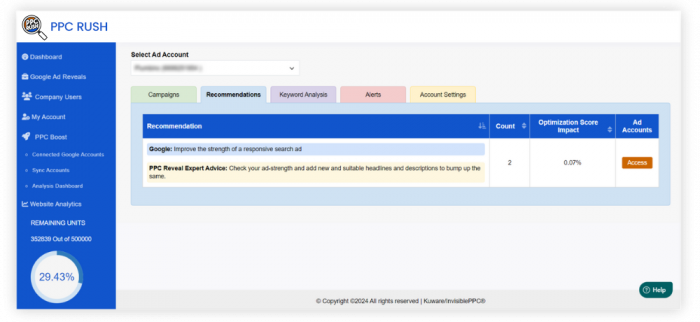
PPCrush.ai is built on more than a decade of Google Ads data, focusing on using machine learning to identify high‑impact optimization opportunities.
Key features
1. Actionable optimization insights prioritizing advertiser interests over default Google suggestions.
2. Automated performance enhancements and anomaly detection.
3. Strong fit for both new and large accounts needing consistent monitoring.
Best use case (with example)
● Accounts with enough data volume where subtle, data‑driven tweaks compound into big gains.
● Example: A D2C brand running dozens of campaigns uses PPCrush.ai to automatically down‑bid device/geo combinations with poor ROAS and highlight search terms driving profitable conversions that are not yet added as keywords.
Main strength
Data‑rich, long‑term model trained specifically on Google Ads behavior, not generic AI.
Limitation
Works best when you already have meaningful traffic and conversion data; very small or brand‑new advertisers may see limited early benefit.
6. PPC Reveal – Competitor Intelligence for Google Ads
PPC Reveal focuses on competitive intelligence for Google Ads, especially in local markets.
Key features
1. Competitor discovery across chosen keywords and locations.
2. Ad copy and messaging analysis from rivals.
3. Ad scheduling insights and keyword performance metrics for competitors.
4. Detailed competitor activity reports to inform positioning.
Best use case (with example)
● Agencies and local businesses fighting in crowded verticals.
● Example: A dental clinic uses PPC Reveal to identify three main local competitors, analyze their ad angles (emergency, cosmetic, family‑friendly), and then launches differentiated messaging focused on “pain‑free same‑day appointments” during peak hours.
Main strength
Clear visibility into competitor tactics, timings, and messaging that Google Ads alone does not expose.
Limitation
It doesn’t optimize your campaigns directly; it needs pairing with another tool to execute on the insights.
7. Adalysis – Heavyweight Testing and Quality Score Fixer
Adalysis is a PPC platform focused on deep analysis, automation, and especially ad testing and Quality Score improvement.
Key features
1. Continuous statistical A/B testing for ads.
2. Automation rules for pausing losers and promoting winners.
3. Detailed Quality Score analysis and alerts on performance anomalies.
Best use case (with example)
● Performance marketers who prioritize systematic testing and QS improvements.
● Example: A B2B SaaS advertiser runs 20+ RSA variations per key group; Adalysis automatically identifies statistically significant winners, pauses low performers, and surfaces landing pages dragging down QS, cutting CPCs over time.
Main strength
Rigorous, statistically sound testing and QS diagnostics that many tools gloss over.
Limitation
Requires a testing mindset and enough volume; low‑traffic campaigns may not reach statistical significance quickly.
8. Semrush PPC Toolkit & AI Ad Copy Generator
Semrush is best known for SEO, but its PPC Toolkit and AI Ad Copy Generator are strong companions for Google Ads advertisers.
Key features
1. PPC keyword research and competitive ad research.
2. AI Ad Copy Generator to build responsive search ads from your keyword list.
3. Strong synergy for brands running integrated SEO + PPC strategies.
Best use case (with example)
● Marketers who handle both SEO and PPC and want unified data.
● Example: An online retailer uses Semrush to discover competitors’ high‑performing PLA and text ad keywords, then feeds those into the AI Ad Copy Generator to create RSA assets that mirror top‑performing angles, and exports them into Google Ads.
Main strength
Holistic view across SEO, competitors, and PPC, with AI to accelerate ad copy creation.
Limitation
PPC features are strong but still secondary to its SEO suite; some advanced PPC workflows may require additional tools.
Quick Comparison of the 8 AI Tools
| Tool | Best for | Core strength | Key limitation |
| Optmyzr | Agencies, advanced PPC managers | Highly configurable optimization | Steep learning curve for beginners |
| WordStream | SMBs, non‑experts | Guided weekly recommendations | Limited depth for complex accounts |
| Adzooma | SMBs needing quick audits | Simple opportunity engine | Less advanced automation |
| Adsroid | Conversational, analyst‑style support | Chat‑based AI agent for Google Ads | Newer tool, requires human oversight |
| PPCrush.ai | Data‑rich accounts | Deep‑learning optimization | Needs sufficient traffic/history |
| PPC Reveal | Competitor‑heavy local markets | Detailed competitor intel | Insight only, no direct optimization |
| Adalysis | Testing‑focused performance marketers | A/B testing and QS diagnostics | Requires volume and testing discipline |
| Semrush PPC AI | SEO + PPC marketers | Integrated SEO/PPC + AI copy | PPC not as deep as SEO |
How to Choose the Right AI Tool for Your Google Ads
1. Know your main goal
If you want to cut waste and fix basics, go for Adzooma or WordStream. If you want advanced scaling and tighter control, choose Optmyzr or Adalysis. For strategy explanations and “why did this happen?” insights, pick Adsroid. For beating competitors, pair PPC Reveal with the Semrush PPC toolkit.
2. Match it to your skill level
If you’re new to PPC, use tools with simple, guided recommendations (WordStream, Adzooma). If you’re experienced, pick tools with rules, scripting, and deep controls (Optmyzr, Adalysis, Semrush PPC).
3. Factor in account size
Small or low‑volume accounts work best with guided tools and quick audits (WordStream, Adzooma). Big, data‑rich accounts benefit more from AI engines that learn from history (PPCrush.ai, Optmyzr, Adalysis).
4. Fit it to your workflow
If you live inside Google Ads, Optmyzr, Adalysis, and Adsroid will feel more natural. If you handle SEO + content + PPC, Semrush’s unified environment is more efficient.
5. Always test before you commit
Use free trials, run a 30–60 day test on a few campaigns, and track CPA, ROAS, conversions, and time saved. Keep the tool only if you see clear, measurable improvement.
Final Verdict: Build a Small, Focused AI Stack
No single AI tool can “do” Google Ads for you; the real leverage comes from combining 2–3 complementary tools around a clear strategy. A practical 2026 stack for many advertisers is: one optimization engine (Optmyzr or WordStream/Adzooma depending on skill), one testing/creative or conversational layer (Adalysis, Semrush AI copy, or Adsroid), and one intelligence layer (PPC Reveal or PPCrush.ai).
Treat these AI platforms as accelerators, not autopilots: the brands that win are still the ones that understand their audience, craft strong offers, and use AI to execute and learn faster not to replace strategy.
Comments