

If you’ve been following the rise of AI companion and roleplay apps, you’ve probably seen Dopple AI mentioned alongside names like Character.AI. The headlines usually focus on engagement numbers or “uncensored chat,” but that doesn’t really explain what Dopple AI is actually like to use, or why it’s gaining traction in some regions while struggling in others.
This article isn’t a pitch. It’s a ground-level walkthrough of how Dopple AI operates what the data says about its growth, and where the platform clearly shines, or falls short, when you look past marketing language.
What Dopple AI Is
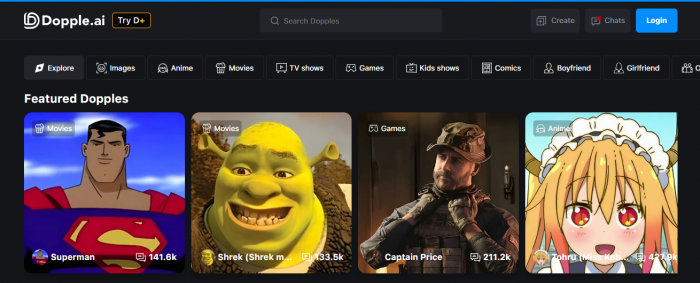
Dopple AI is not a productivity assistant, research tool, or general chatbot. It is best understood as an AI character interaction and roleplay platform.
Users don’t come here to automate tasks or retrieve facts. They come to:
- Interact with persistent AI characters
- Engage in narrative or emotional conversations
- Explore roleplay scenarios and fictional personas
The platform’s core promise is simple:
longer, more continuous conversations that feel less rigid than standard chatbots.
Whether that promise holds depends heavily on user expectations.
Adoption & Growth: What the Numbers Actually Suggest
Based on late-2024 and 2025 indicators, Dopple AI has clearly crossed the “experiment” stage.
User Engagement Signals
One of the strongest signals isn’t downloads, it’s message volume. Popular characters on Dopple routinely reach millions of exchanged messages, which points to:
- Repeat usage
- Long session times
- Emotional or narrative continuity
That kind of engagement is hard to fake and usually means users are returning for ongoing conversations, not one-off novelty chats.
Market Position
Within the AI companion / roleplay niche:
- Dopple AI ranks among the top ~20 apps globally by monthly active users
- It competes directly with Character.AI rather than utility-focused AI tools
This doesn’t mean mainstream dominance, but it does indicate strong niche adoption.
Geography & Audience
Traffic and usage skew toward:
- Brazil
- United States
- Southeast Asia
Usage patterns suggest Dopple resonates more in mobile-first and entertainment-driven markets than in corporate or enterprise contexts.
Who Actually Uses Dopple AI
From usage patterns and category breakdowns, Dopple AI’s audience isn’t monolithic.
Roughly:
- Entertainment & roleplay users (~30%) – storytelling, fictional characters, emotional interaction
- Business / tools-adjacent (~27%) – experimental use cases like brainstorming personas or simulated conversations
- The rest spread across casual chat, creative writing, and curiosity-driven use
This mix explains why the platform sometimes feels unclear in identity, it’s trying to serve multiple motivations with the same interface.
Core Features, Without the Buzzwords
Character Creation (“Dopples”)
Users can create custom AI characters with:
- Backstories
- Personality constraints
- Behavioral traits
- Optional voice layers
In practice, this works well for consistent tone and role adherence, though it still breaks down under long or contradictory prompts.
Memory & Context
Dopple emphasizes longer conversational memory compared to basic bots. It’s not perfect, but it does better than many generic chat models at:
- Remembering prior emotional states
- Continuing story arcs
- Maintaining character voice
This is one of its genuine strengths.
Voice & Calling
Voice messages and simulated calls add immersion, but they’re still:
- Latency-sensitive
- Less stable than text
- More novelty than necessity
Most heavy users still default to text.
Image Generation
Built-in image generation supports roleplay and character visualization, but quality varies. It’s functional, not industry-leading.
Dopple Vault
This premium feature acts as a storage and gallery layer for exclusive or saved content. Useful for power users, irrelevant for casual ones.
Pricing: Where the Friction Appears
Dopple AI uses a familiar freemium model.
Free Tier
- Unlimited messaging in theory
- Queues and wait times during peak usage
This creates a clear tension: the app invites long conversations, but occasionally interrupts them.
Dopple+ (~$9.99/month)
Paid users get:
- No queues
- Access to Dopple Vault
- Cosmetic customization
- Early access to experimental models
This pricing is in line with competitors, but some users feel the value depends heavily on how emotionally invested they are in specific characters.
Company and Team: What’s Known
Dopple AI is a relatively young company.
Founded: 2023
Headquarters: Wilmington, Delaware (USA)
Team size: roughly 10–50 employees
It’s part of a newer wave of startups exploring agentic AI, systems designed to feel proactive and lifelike, rather than reactive question-answer tools.
Funding of around $38.9 million suggests strong investor belief, but also pressure to scale fast.
Technology and Safety
Model Design
Dopple uses a proprietary LLM, fine-tuned with Reinforcement Learning from Human Feedback (RLHF) to improve conversational flow and emotional realism.
This does make interactions feel smoother, but it also increases the risk of:
- Hallucinated emotional continuity
- Over-personalization
- Users attributing more “understanding” than actually exists
Privacy & Data Use
Dopple states that user-created content remains owned by users, though interaction data is used to improve models. This is standard practice, but still worth noting for privacy-conscious users.
Where Dopple AI Struggles
A realistic review needs to address the downsides.
Consistency Over Time
Long conversations can still drift:
- Characters forget key constraints
- Tone can shift subtly
- Memory isn’t truly persistent across all sessions
Platform Stability
Community feedback (especially on Reddit) highlights:
- Occasional downtime
- Model regressions after updates
- Feature changes without clear communication
Identity Ambiguity
Dopple sits awkwardly between:
- Entertainment platform
- Creative tool
- Emotional companion
That makes expectations hard to manage, and disappointment more likely for some users.
How I’d Frame Dopple AI Honestly
Dopple AI isn’t a breakthrough in intelligence. It’s a refinement of experience.
It works best when you treat it as:
- A narrative or roleplay environment
- A creative sandbox
- A conversational experiment
It works poorly when you expect:
- Emotional understanding
- Long-term memory like a human
- Reliability as a decision-making assistant
Dopple AI Reality Check Scorecard
Before drawing final conclusions, it helps to evaluate Dopple AI across the areas that actually matter to users—not marketing claims, but real-world performance.
| Evaluation Area | Score (Out of 5) | Reality Check |
|---|---|---|
| Core Experience (Roleplay & Chat) | ⭐⭐⭐⭐☆ (4/5) | Conversations feel fluid and engaging, especially in short to medium sessions. One of Dopple’s strongest areas. |
| Character Consistency | ⭐⭐⭐☆ (3/5) | Characters hold tone and personality initially but can drift over longer interactions or conflicting prompts. |
| Memory & Continuity | ⭐⭐⭐ (3/5) | Better than basic chatbots, but memory is not reliably persistent across sessions. |
| Voice & Immersion Features | ⭐⭐☆ (2.5/5) | Voice and calls add novelty but remain less stable than text-based interaction. |
| Image Generation | ⭐⭐⭐ (3/5) | Functional for character visualization, but quality is inconsistent and not industry-leading. |
| Platform Stability | ⭐⭐☆ (2.5/5) | Reports of downtime, regressions, and feature changes reduce reliability for heavy users. |
| Pricing Value | ⭐⭐⭐ (3/5) | Fair for engaged users; questionable value for casual users due to queues and feature gating. |
| Transparency & Trust | ⭐⭐⭐ (3/5) | Basic company info is available, but clearer communication around updates and limitations would help. |
| Safety & Expectation Management | ⭐⭐☆ (2.5/5) | The platform does not always clearly signal its limitations, increasing risk of over-attachment. |
Overall Reality Score: ⭐⭐⭐☆ (3.0 / 5)
What This Score Actually Means
Dopple AI performs above average within the AI companion and roleplay niche, particularly in engagement and immersion. However, it falls short in areas that matter for long-term use, consistency, stability, and expectation management.
This score reflects a platform that is:
- Engaging, but not dependable
- Immersive, but not emotionally intelligent
- Innovative in experience, not in underlying intelligence
Final Takeaway
Dopple AI reflects a broader shift in AI use: people don’t just want answers. they want presence, continuity, and personality.
The platform succeeds at:
- Engagement
- Character immersion
- Lowering the barrier to creative interaction
It struggles with:
- Consistency
- Clear positioning
- Managing user expectations responsibly
The safest way to think about it:
Dopple AI is a conversation space, not a companion.
It feels personal, but it isn’t.
Used with that understanding, it can be engaging and even impressive. Used without it, it risks disappointment or over-attachment.
Comments