

Picture this. You’re sitting in front of your screen, staring at a single photograph. A smiling face. A first message. A big promise. Somewhere between that JPEG and your gut feeling, there’s a question:
“Who are you really?”
FaceCheck ID steps into that tiny gap and offers something almost mythic: “Give me the face, and I’ll give you the story.” This is not just another AI tool review; it’s a guided tour through a machine that turns human faces into searchable evidence
Chapter 1: A search engine that starts with a face
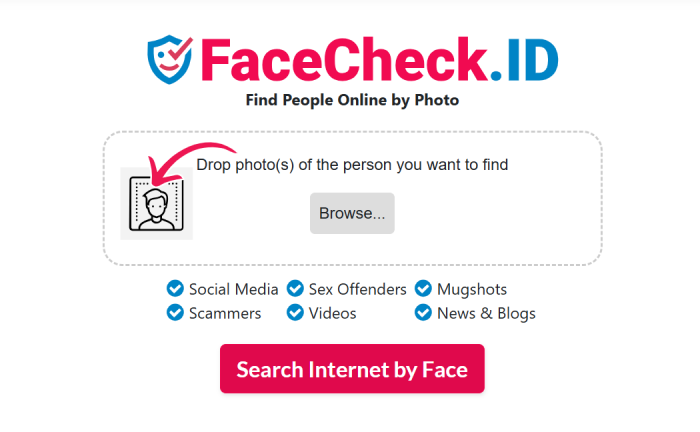
Most search engines begin with words. FaceCheck ID begins with skin, bone structure, eye distance, cheek curves, jawline. You upload a photo, and you’re effectively saying: “Forget what this person says about themselves. Show me where this face has been.”
Once the image hits the system, the platform:
● Strips the photo down to facial features and converts them into a numerical signature.
● Combs through a massive index of faces scraped from public, visible corners of the internet—social profiles, blogs, forums, news images, and more.
● Brings back a gallery of faces that look like the one you uploaded, sorted by how likely they are to be the same person.
The interface doesn’t bombard you with technical jargon. Instead, it tells a story visually: strong matches, weaker look‑alikes, and sometimes the dark side of someone’s digital trail.
Chapter 2: The machine’s language – scores, threats, and stories
FaceCheck ID doesn’t talk like a person. It talks in hints.
Instead of saying, “This is definitely John Doe,” it speaks in three layers:
● Match strength : a spectrum from “almost certainly the same person” to “could just be a look‑alike.”
● Visual confirmation: multiple images lined up, inviting your own judgment: are those the same eyes, the same nose, the same face plus ten years?
● Threat signals : subtle but loaded tags that say this face appears in scam reports, crime‑related posts, or explicit content.
With a few clicks, a stranger’s face becomes an ecosystem of context. Profiles with different names. Countries that don’t match their story. Old social posts that quietly contradict their “new” life. The platform doesn’t make accusations; it hands you evidence and whispers: “Look again.”
Chapter 3: The feature lab – what this thing can actually do
Strip away the drama for a moment, and under the hood you find a layered toolset. If you were to dissect FaceCheck ID on a workbench, you’d find several distinct “organs” working together, each serving a different job.
3.1 The core engine: face search
At its core is the face search engine:
● You upload a single clear face.
● The system compares it against a vast collection of publicly available faces.
● It returns a gallery of candidate matches with confidence levels and source links.
This alone transforms how people verify others online. It’s not just, “Have I seen this exact photo before?” but “Have I seen this person’s face before, anywhere?”
3.2 The risk radar: threat and red‑flag analysis
FaceCheck ID doesn’t stop at showing you matches. It adds a layer of risk intelligence:
● Tags matches that appear in scam reports or fraud‑related discussions.
● Highlights links to crime‑related or controversial mentions.
● Surfaces associations with adult or explicit content.
The point is not just to find someone, but to warn you if their digital footprint is soaked in potential trouble.
3.3 The verifier: profile consistency checks
Faces travel. The same face may appear:
● On multiple profiles with different names and biographies.
● In different countries or cities that don’t match the story you’re being told.
● On both legitimate and obviously fake accounts.
By following the chain of appearances, FaceCheck ID becomes a map of where that face has been, helping you separate the original identity from copy‑paste catfish versions.
3.4 The archivist: reports and saved searches
For those on richer plans, the platform turns searches into artifacts:
● It lets you save past searches and revisit them later.
● It can generate exportable reports that bundle images, matches, links, and risk notes into a neat dossier.
Casual users may never need this, but investigators, journalists, or anyone documenting a pattern of abuse or fraud will find it essential.
3.5 The portal: web and mobile access
Finally, there is the portal aspect. FaceCheck ID lives in:
● A browser tab you open like any other website.
● A mobile app you can use the moment someone sends you their “recent selfie.”
It feels less like a high‑security lab and more like a normal app—with very abnormal power.
Chapter 4: The price of seeing too much – plans, credits, and value
Every vision has a price tag, and FaceCheck ID structures that price around how often you want to look.
The free gate is where most people start. You get a small number of searches per day, enough to test the waters or run the occasional “Is this person real?” check. It’s a short leash, but it asks for no money upfront, which makes it attractive to the curious and the cautious.
Beyond that, credit packs appear with names that sound like character classes in a mystery game. Light packs suit people who need just a few searches to check dates or one‑off connections. Mid‑range packs are for those who screen regularly, maybe because they get many incoming contacts. Heavy packs cater to people who treat this like a professional tool independent investigators, journalists, or security‑conscious power users. In all these cases, credits usually equate to searches: one face search consumes one unit of your purchased attention.
Then you have the monthly guilds: subscription tiers with recurring credits. Each month, your search “ration” resets. These plans often include extras such as deeper search options, more matches per query, or downloadable reports. Higher tiers are clearly designed for users who probe faces as part of daily work rather than one‑off curiosity.
Aggregate pricing overview
| Plan name | Approx. price (USD, in crypto) | Credits included | Cost per search (approx.) | Credit expiry |
| Just a Peek | $6 | 36 credits | ~$0.50 per search | 2 days |
| Rookie Sleuth | $19 | 150 credits | ~$0.38 per search | 14 days |
| Private Eye | $47–49 | 400 credits | ~$0.35 per search | 2 months |
| Deep Investigator | $197 | 2000 credits | ~$0.30 per search | 6 months |
| The Professional | $597 | 10000 credits | ~$0.18 per search | 1 year |
The unspoken question for your reader is simple: are you buying a flashlight for the odd dark alley, or a floodlight for an entire neighborhood? The answer determines whether the free tier is enough, or whether you graduate to credit packs and subscriptions.
Chapter 5: Where people actually use it – life scenarios, not just features
Tools are boring in isolation. They become interesting when you drop them into real life, into actual moments where someone has to decide whether to trust or walk away.
Scene 1: The first date that might be a setup
You’ve been chatting with someone for weeks. They’re charming, quick with replies, and their photos look almost stock‑photo perfect. They rarely video call, and something feels off. You quietly save one of their photos and run it through FaceCheck ID. The same face shows up under three different names, in three different cities, plus a mention on a romance‑scam warning forum.
Now your unease isn’t just a feeling. It’s a pattern.
Scene 2: The “too good to be true” opportunity
A new “recruiter” reaches out with a dream job. Or a “mentor” promises to guide your investments. Their profile looks sleek but curiously thin. You screenshot their picture, feed it to FaceCheck ID, and discover that it belongs to a model whose photos have been stolen repeatedly for fake LinkedIn and Telegram accounts.
In seconds, the glossy narrative collapses into what it really was: a lure.
Scene 3: The creator who feels duplicated
You’re a content creator or public‑facing professional. People recognize your face, but lately you suspect your image is being used elsewhere without your consent—fake accounts, impersonators, maybe even explicit or scammy content.
FaceCheck ID lets you point its lens at yourself:
● You find accounts pretending to be you, using your photos to solicit money or private content.
● You spot your face embedded in contexts you never chose or approved.
Suddenly, you’re not guessing. You have URLs, screenshots, and proof you can take to platforms or to legal counsel.
Scene 4: The investigator’s notebook
A journalist receives a tip: the same individual appears in photos from protests, conferences, and controversial events, each time under a different name. By feeding those images into FaceCheck ID, they begin to see a pattern of matches.
The tool:
● Aggregates instances of the same face across unrelated sites and events.
● Hints at how one person may be moving through multiple stories, roles, and locations.
FaceCheck ID doesn’t deliver a final judgment. It delivers leads that would otherwise stay invisible.
Chapter 6: The bright side – why people love it
FaceCheck ID gets traction because, at its best, it does something ordinary search never could.
First, it levels the playing field. For years, scammers and abusers have operated with an advantage: they can spin up fake profiles in minutes, recycle stolen images at scale, and vanish as soon as they’re exposed. A tool like FaceCheck ID hands some power back to ordinary users. It gives them a near‑forensic way to test stories and identities before they invest emotionally or financially.
Second, it translates complexity into intuition. Underneath, facial recognition is mathematically heavy, but the user sees simple cues instead:
● “These photos look very likely to be the same person.”
● “These ones are less certain.”
● “These show up in places you should at least know about.”
The heavy computation happens out of sight, while the experience feels like an upgraded gut check.
Lastly, it fits naturally into how people think. Most users don’t frame things in terms of biometrics and embeddings; they frame them in questions like, “Is this safe?”, “Is this real?”, “Have I seen this before?” FaceCheck ID is structured around exactly those questions, which is why it spreads so quickly among online daters, creators, and people who have been burned once and don’t want to be blindsided again.
Chapter 7: The dark mirror – what this tool threatens
Now flip the lens. Everything that makes FaceCheck ID compelling also makes it dangerous.
The first problem is consent as an afterthought. Consider your own images online. Did you ever explicitly agree to have your face indexed in a global face search engine? When you posted a photo publicly, did you imagine it would become a biometric anchor anybody could use to trace you? The platform rests on the idea that if an image is publicly visible, it’s fair game to be processed, embedded, and made searchable. Legally, that logic is contested; ethically, it is deeply unsettling.
Surveillance also becomes a DIY hobby. Not long ago, tracking someone by face required:
● State‑level resources.
● Specialized software and infrastructure.
● Access to large, controlled datasets.
Now, a browser and a credit pack are enough to:
● Try to identify protestors in a crowd photo.
● Attempt to unmask anonymous creators.
● Tie real names to pseudonymous accounts.
The line between “I’m just curious” and “I’m quietly surveilling someone” becomes dangerously thin.
False positives form another quiet hazard. No facial recognition system is perfect. A strong match that links a face to crime or explicit content can be misread as absolute truth. A user might confront, expose, or silently condemn someone based solely on that match. If the system is wrong or the context is misunderstood, an innocent person gets dragged into a story they never chose.
Overlaying all of this is a legal patchwork. In some regions, biometric data is treated as highly sensitive, requiring strict consent and controls. In others, regulations are vague or emerging. That means the same FaceCheck ID search might be benign in one jurisdiction, questionable in another, and outright illegal in a third. The tool doesn’t warn you when you cross those invisible borders; the burden sits with the user.
Chapter 8: Ethics in the age of face search – the internal courtroom
You can’t review FaceCheck ID honestly without staging a quiet trial inside your head.
On one side is the safety advocate. This voice insists that people deserve strong tools to fight scammers, that victims of romance fraud and sextortion have been outgunned for too long, and that if photos are already public, it’s only fair for individuals to use that visibility as a shield.
On the other side is the privacy guardian. This voice argues that public visibility does not equal consent for biometric indexing, that many people in public photos never chose that exposure, and that tools like this can chill anonymity, activism, and free expression by making it easier to unmask and monitor.
FaceCheck ID doesn’t silence either voice. It sits exactly in the tension between them, forcing you to pick a side every time you upload a face and click “search.” Each use is a small ethical decision, not just a technical action.
Chapter 9: Alternatives, neighbors, and the wider toolkit
FaceCheck ID is one instrument in a much larger verification toolkit, and a responsible review places it in context.
At the gentler end are non‑biometric checks. Before you ever touch a face search engine, you can:
● Run a standard reverse image search on the full picture.
● Cross‑check usernames and email addresses across platforms.
● Ask for a quick live video call.
● Examine mutual connections, work history, or social graphs.
These methods respect a different boundary: they don’t convert the face itself into a universal search key.
At another level are regulated, enterprise identity verification systems. Banks, fintech apps, and similar services use them to match a selfie to an official ID document under strict compliance rules and well‑defined use cases. They still raise questions, but they operate inside clearer governance structures.
Consumer face search engines like FaceCheck ID inhabit the wild layer. Access is open, power is high, and use cases are broad. That doesn’t make them inherently evil; it makes them inherently volatile. They’re powerful tools in hands that may or may not be ready to carry them responsibly.
Chapter 10: So, should you use it?
Here is the uncomfortable but honest shape of a verdict. FaceCheck ID makes sense when:
● You are actively being targeted, harassed, or scammed.
● Someone is asking for money, intimate content, or deep access to your life, and you want additional verification.
● You suspect your own face is being misused or impersonated online.
● You understand the legal and ethical stakes and intend to stay within them.
In those situations, it isn’t a toy; it is a shield and a flashlight in one.
It becomes part of the problem when you use it out of idle curiosity to stalk or snoop, when you treat its results as courtroom‑grade truth rather than investigative leads, when you let it replace consent and conversation, or when you quietly use it to profile tenants, applicants, or opponents. In those hands, the same tool turns into an instrument of quiet harm.
The most accurate way to describe FaceCheck ID is this: it is one of the most useful tools an ordinary person can wield against online deception, and at the same time one of the most unsettling tools an ordinary person can wield against other people’s privacy and anonymity.
If you choose to use it, you’re not just clicking “search.” You’re helping define a new social norm, a world where a face is no longer just something you show, but something that can always be looked up. In that world, the most important safety mechanism isn’t the AI at all. It’s you.
Comments