

“Public, But Not Really” isn’t just a theme for InSnoop, it’s the operating system behind the tool itself. InSnoop exists because Instagram Stories feel private enough to be intimate, yet public enough to be harvested, proxied, and replayed elsewhere without the creator ever knowing.
1. The Story We Tell Ourselves About “Public” Content
On Instagram, a public story feels like a controlled performance in a semi‑open room. You know strangers can walk in, but at least you see the guest list. That viewer list names, faces, order creates an illusion of awareness: “I know who was here.”
InSnoop quietly disproves that assumption.
● Stories from public accounts can be viewed and saved outside the Instagram app.
● The creator’s viewer list shows only people who watched through Instagram itself, not everyone who consumed that story via third‑party tools.
● Downloading and re‑sharing public stories becomes trivial when a tool is designed as a scraper‑style viewer rather than a social app.
The gap between “public by design” and “public in practice” is exactly the space InSnoop occupies.
2. InSnoop in Plain Terms: A Proxy Window on Instagram
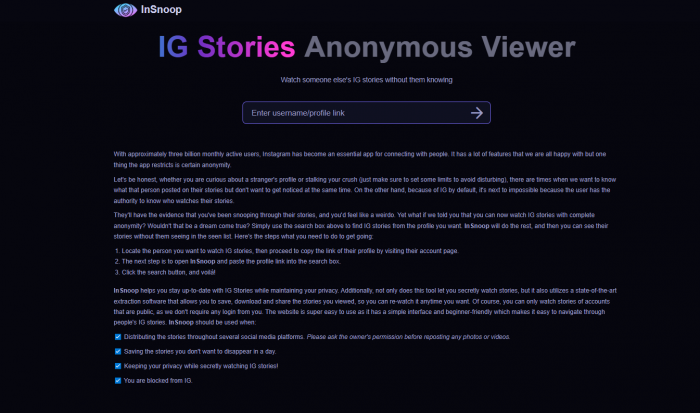
Strip away the branding, and InSnoop is essentially this:
● A browser‑based site.
● A search bar where you paste a public Instagram handle or profile link.
● A results page that shows that account’s active Stories and Highlights.
● Optional buttons to download stories as image or video files.
You don’t log in; you don’t grant app permissions; you don’t install anything. Instead of you going to Instagram, you ask InSnoop to go on your behalf and show you what it fetched.
That design has two important consequences:
● The account owner never sees your profile in their “seen” list, because you never visited through your own Instagram identity.
● InSnoop, not Instagram, becomes the party that knows what you looked at, when, and how often.
So the privacy you gain is directional: you become invisible to the creator, but more visible to the intermediary.
3. What InSnoop Offers Beyond the Buzzwords
Rather than listing features mechanically, it helps to pair each capability with what it actually means in use.
Anonymous viewing of public Stories and Highlights
● You can watch public accounts without appearing in their viewer list.
● Creators lose one of their only tools to understand who is repeatedly watching.
No login, no signup, no app
● Safer than services that demand Instagram credentials or app installs.
● Still means you’re interacting with a third‑party site whose internal data practices you don’t control.
Public‑profile‑only access
● It doesn’t pretend to unlock private accounts; that’s a good sign compared to scammy “private viewers.”
● It reinforces the core idea: public content is fair game—but who you think sees it may not match who actually does.
Download functionality
● Allows archiving of ephemeral content for research, documentation, or inspiration.
● Also makes it easier to preserve and circulate material the creator expected to disappear after 24 hours.
In other words, InSnoop is less about “more features” and more about re‑wiring who counts as your audience.
4. The User Journeys: Four Ways People Actually Use It
You get a more realistic picture of InSnoop when you walk through typical use cases instead of staying abstract.
The socially anxious observer
● Wants to check old classmates, acquaintances, or a crush without signaling interest by showing up in viewer lists.
● Sees InSnoop as a way to browse “harmlessly,” forgetting that repeated invisible watching can still change the relational dynamic—just without feedback.
The creator or influencer doing homework
● Studies peers’ hooks, pacing, highlight structure, and creative formats.
● Uses anonymous viewing to remove the awkwardness of their name appearing constantly in competitors’ analytics.
The marketer or brand strategist
● Tracks how rival brands use stories for launches, sales, and behind‑the‑scenes content.
● Saves story sequences to analyze campaign structure and messaging.
The researcher or journalist
● Observes how public accounts communicate around elections, crises, or social movements.
● Treats InSnoop as a passive observation instrument to archive ephemeral narratives.
All four scenarios revolve around the same pattern: the viewer wants the benefits of public content without the social cost of being seen.
5. The Safety Story: Safer Than Some, Not Safe in Absolute Terms
InSnoop leans heavily on “no login, no app, encrypted connection” as its safety pitch. That does matter:
● You’re not handing over your Instagram username and password.
● You’re not installing unknown software that could contain malware.
● The site uses standard HTTPS, so data between your browser and the site is encrypted in transit.
However, “not obviously dangerous” is different from “risk‑free.”
● Your traffic still flows through a third‑party server, which can log IP addresses, user agents, and browsing behavior.
● Trust‑check sites and reviewers flag anonymous viewer domains as unverified and sometimes low‑trust, especially when ownership and policies are opaque.
● Reports exist of anonymous viewer tools occasionally behaving unpredictably (stories not loading, pop‑ups, redirects), and even rare anecdotes of views still registering back on Instagram.
The healthier mental model is: InSnoop lowers some risks (no credential sharing) but introduces others (increased exposure to a lesser‑known middleman).
6. Legal and Platform Rules: Where People Get Confused
A lot of users conflate “not illegal” with “blessed by the platform,” but these are separate layers.
Law
● Viewing public content on the open web is generally lawful.
● Saving screenshots or downloads for personal use is rarely prosecuted, though copyright and misuse issues can arise if you re‑publish.
Platform terms and enforcement
● Instagram’s rules typically ban automated scraping, unauthorized tools, and circumventing its intended interfaces.
● Third‑party viewers run outside the official ecosystem, and there’s no guarantee that using them aligns with what Instagram wants or supports.
For a typical user, the practical risk isn’t handcuffs; it’s:
● Potential account issues if you ever connect credentials to shady tools (even if InSnoop doesn’t ask you to).
● Zero recourse if something goes wrong, because you stepped outside the platform’s supported environment.
So again, “public, but not really” shows up: public content is legally visible, but the way you view it sits in a more ambiguous zone.
7. Ethics: The Invisible Audience Problem
Ethically, InSnoop’s real impact is less technical and more relational.
Consider what the viewer list does for the person posting:
● It offers a sense of who is engaged, who’s drifting away, and who might be watching too closely.
● It provides informal social cues and boundaries: if someone keeps appearing, you might block them or adjust what you share.
Anonymous viewers break that feedback loop.
● People can watch habitually without ever being counted.
● The poster loses the ability to calibrate their sharing based on who they know is present.
● Power shifts subtly toward the viewer, who now has more information and less accountability.
There are contexts where that imbalance feels justified (researchers, at‑risk users needing to watch without exposing themselves) and others where it starts to resemble digital voyeurism. The challenge with InSnoop is that it makes both equally easy.
8. InSnoop Among Its Peers
| Tool | Core angle | Best for | Notable difference vs InSnoop |
| InSnoop | Anonymous viewing first, downloads second | Quietly watching public stories & highlights while staying off viewer lists. | Strong “spy/anonymous viewing” branding; reviews discuss safety/ethics more heavily. |
| AnonyIG | Anonymous viewing + reels | Users who also want to watch reels/clips anonymously. | Broader content support (reels/profile view), more “all‑round” viewer than niche story tool. |
| StoriesIG | Download‑first, viewing is incidental | People who mainly want to save stories for later. | Framed as a downloader, not as an “invisible viewing” tool; less emphasis on stealth. |
| AnonStories | Lightweight, no‑frills viewer/downloader | Quick, one‑off anonymous checks from any device. | Very minimal UI and branding; usually fewer claims about “100% anonymity.” |
9. Who Should Consider InSnoop and Who Probably Shouldn’t
Looking at all this, different types of users land in different risk–reward zones.
Reasonable use cases
● Creators studying patterns in their niche while staying discreet.
● Marketers benchmarking public campaigns and capturing reference material.
● Researchers documenting public narratives with appropriate data safeguards.
Risky or poor‑fit use cases
● Everyday users using anonymity to obsessively monitor specific individuals.
● Organizations that must comply strictly with policies and can’t justify using unapproved tools.
● Privacy‑conscious users who already dislike trackers, yet add another opaque site into their browsing mix.
The more your use case leans toward private interpersonal dynamics, the more InSnoop amplifies the illusion that “if they can’t see me, it’s harmless.”
10. How to Use InSnoop Without Lying to Yourself
If someone decides to use InSnoop despite the caveats, there are ways to stay aligned with the reality—not the illusion—of privacy.
Be honest about who you’re watching and why
● Limit usage to public figures, brands, and creators where your interest is professional or educational.
● Avoid using anonymous viewing to manage emotional relationships or conflicts.
Protect yourself from the third‑party layer
● Never enter passwords, emails, or any sensitive information into viewer sites.
● Keep it in a clean browser environment with strong ad‑blocking and, ideally, a VPN.
● Never mix this behavior with client or corporate accounts.
Assume your anonymity is partial, not absolute
● Treat “anonymous” as “less visible in one specific place,” not “invisible everywhere.”
● Remember there are already examples where anonymous viewing didn’t behave exactly as advertised.
By approaching InSnoop this way, you respect both sides of the equation: the reality that public content is widely accessible, and the reality that people still experience it as a semi‑private performance with a known audience.
Closing: InSnoop as a Symptom of a Bigger Pattern
InSnoop didn’t invent the illusion of privacy on social media; it exploits it and, in doing so, highlights it. Instagram Stories are officially public (on public accounts), yet every design cue from viewer lists to 24‑hour expiry whispers, “you have some control over who really sees this.”
A tool like InSnoop stands in the doorway and proves that whisper wrong. For some, that’s a useful reminder about how platforms actually work. For others, it’s a temptation to act as an invisible audience member in spaces that were never meant to be one‑way.
Either way, the real question isn’t “Is InSnoop good or bad?” It’s: “Now that we know ‘public’ doesn’t guarantee visibility symmetry, how do we choose to behave?”
Comments