

On Monday morning, your Slack pings six times before 10 a.m.
“Hey, did we send Q4 bonus cards yet?”
“Marketing needs 50 $20 Amazon codes, today.”
“Finance wants a report of all the ‘random’ rewards we handed out last year.”
You open three spreadsheets, four browser tabs, and one shared inbox full of untraceable gift card codes. At some point, someone says: “We should really systematize this.”
That moment when gifting stops being cute and starts being operational, is the moment Giftogram was built for.
Chapter 1: The Spreadsheet Era of “Thank You”
Before we get to Giftogram, it’s worth acknowledging the status quo most teams are quietly running:
● HR keeps a birthday/anniversary Google Sheet.
● Managers order gift cards ad‑hoc from whichever website they remember.
● Marketing collects survey incentives in a shared inbox.
● Finance gets an expense report titled “misc. gift cards.”
You already know the symptoms:
● People get missed.
● Some get rewarded twice.
● Nobody can answer “How much did we actually spend on rewards?” without a painful reconciliation.
Underneath the warm intentions, gifting is an ungoverned payment system duct‑taped together with spreadsheets.
Giftogram’s pitch is disarmingly simple: keep the warmth, delete the duct tape.
Chapter 2: What Giftogram Really Is (Under the Hood)
Strip away the marketing language and Giftogram is basically a rewards infrastructure layer that sits between your tools and the people you want to reward.
It does three things exceptionally well:
1. Turns your company money into flexible digital value (gift cards, prepaid cards, donations) that people actually want.
2. Connects that value to 250+ systems HR, payroll, ATS, CRM, marketing, survey tools, so rewards fire automatically instead of manually.
3. Keeps a clean ledger for HR and finance so every “thank you” has a timestamp, a budget, and a line item.
The twist: there is no platform subscription. You don’t pay for logins, seats, or “engagement licenses.” You only pay for the face value of what you send (and some shipping if you insist on paper and envelopes).
Giftogram is not trying to be a social recognition feed or a culture OS. It wants to be plumbing elegant plumbing, but plumbing nonetheless.
Chapter 3: Inside a Single Giftogram
Let’s zoom into one reward and watch it move through the system.
3.1. The Trigger
Something happens:
● A new hire hits 90 days.
● A sales rep closes a renewal.
● A customer finishes a 30‑minute research interview.
In your world, that event lives inside Workday, Salesforce, HubSpot, SurveyMonkey, or even a humble Google Sheet.
Giftogram plugs into those tools (directly or via Zapier) and listens. When your rule says “When X happens, send Y,” that’s the starting gun.
3.2. The Translation Layer
Giftogram turns that event into a structured reward:
● Campaign: “Q2 Renewal Bonus” or “Post‑Interview Thank You.”
● Audience: The specific person or list of people who triggered it.
● Value: $10, $20, $100—whatever you set as policy.
● Format: Multi‑brand digital gift card, single retailer, prepaid Visa/Mastercard option, or charity donation.
This is where the catalog flex kicks in: instead of deciding “Everyone gets Amazon,” you decide “Everyone gets a choice.”
3.3. The Moment of Delight (or Disappointment)
From the recipient’s point of view, there’s no API, no “infrastructure,” no automation.
There’s just:
● A clean email themed with your logo and colors.
● A short, human message (“Thanks for joining our beta and sharing brutally honest feedback.”).
● A link or code that opens a redemption page.
On that page, they get to decide: coffee, groceries, games, fashion, local merchants, or even a donation. Giftogram’s catalog covers 200+ visible brands and, through its global network, stretches to roughly 140,000 local and regional options across many countries.
This is the psychological shift: the “reward” is not your guess about what they might like. It’s the power to choose.
3.4. The Ledger Entry
While they decide between Starbucks and a local shop, Giftogram quietly writes a log line:
● Who received what
● Which campaign it belonged to
● When they opened it
● When (or if) they redeemed it
● Which department’s budget it hit
Later, you can answer the CFO’s favorite question “How much did we actually spend, and did people use it?” without excavating email archives.
Chapter 4: Smart Campaigns vs. “We Forgot Ben’s Birthday”
Consider two HR universes.
Universe A (Spreadsheet):
Someone in HR keeps a tab titled “Birthdays & Work Anniversaries.” Once a week, they scan the list, buy gift cards in bulk, and try to send them on time. They succeed sometimes. Other times, the reminder email gets buried.
Universe B (Giftogram):
You upload the same spreadsheet once, or sync dates directly from your HR system. Then you create Smart Campaigns:
● “Send a $25 Giftogram 3 days before every birthday.”
● “Send a $50 Giftogram on each work anniversary.”
From then on, you don’t “remember” anything. Giftogram does.
You can even split budgets:
● HR funds birthdays.
● Managers fund spot rewards out of their own departmental pots.
● Leadership funds promotion and performance review bonuses.
The difference is not just convenience; it’s consistency. Every “we value you” moment either happens or it doesn’t. Smart Campaigns move that from chance to certainty.
Chapter 5: Marketing, But With Actual Thank‑Yous
Marketers love clever campaigns and forget that people like two things even more: being seen and being rewarded on time.
Giftogram is weirdly well‑suited to that intersection.
● Run a webinar? Everyone who stays to the Q&A gets a $10 Giftogram, fired automatically from your marketing automation tool.
● Run a referral program? When a referral hits “qualified opportunity,” Salesforce pings Giftogram instead of making the SDR chase someone for approval.
● Run product research? Every completed survey triggers a small gift card—without an intern copy‑pasting codes into emails.
Behind the scenes, it’s the same engine HR is using, wired into different events.
The result is a quiet but powerful change: “Thanks for your time” stops being a sentence and becomes a reliably delivered asset.
Chapter 6: Physical Cards, Paper Feelings, and US‑Only Reality
Digital is efficient; paper is emotional. Giftogram tries to straddle both, but with clear constraints.
What you can do:
● Order physical Giftogram cards with your branding.
● Add printed greeting cards and envelopes (roughly $1 extra per card).
● Ship to US addresses with standard, priority, or express shipping tiers.
What you can’t ignore:
● There’s a 10‑card minimum for physical orders.
● Shipping is US‑only, with a flat standard rate (around $10, waived over $500), and more for rush options.
So if you’re a US‑heavy workforce planning one big end‑of‑year wave of mailers, Giftogram fits nicely. If your team is spread across Berlin, Bangalore, and Buenos Aires and you want everyone to hold the same physical card… this is not that.
Chapter 7: The Money Question (Without the Fine Print Headache)
Let’s talk cost structure, because this is where Giftogram quietly diverges from many “engagement platforms.”
Platform:
● No subscriptions.
● No per‑seat license.
● No “you’re on the Pro tier now” surprise.
Digital rewards:
● You pay face value - $10 is $10, $50 is $50.
● There is no minimum order for digital; send one gift or 10,000.
Physical rewards:
● 10‑card minimum per order.
● Shipping tiers from standard (flat $10, often waived at $500+ in value) to priority/express (~$25–$40) depending on speed.
● Optional greeting card/envelope add‑on at roughly $1 per recipient.
At scale:
● If your annual gifting budget crosses into “we’re basically a small bank” territory (think $250k+), you can discuss volume discounts with Giftogram directly.
Compared to platforms that charge subscriptions plus markups on rewards, the pricing philosophy here is refreshingly boring: pay only for what you send.
Chapter 8: What the Crowd Actually Says
If you scroll long enough through G2, and other review sites, you start seeing the same themes.
Patterns on the “happy” side:
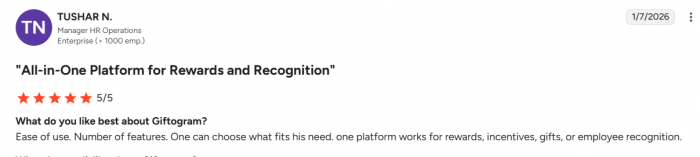
● “Our admins figured it out quickly.” Ease of use is mentioned repeatedly; the dashboard doesn’t require a manual.
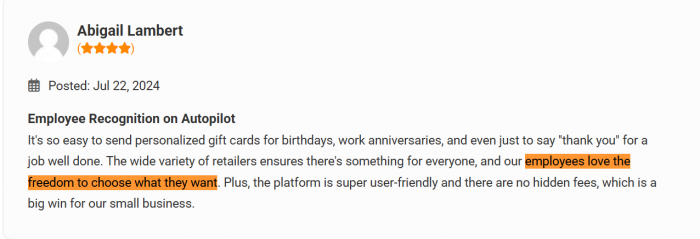
● “Employees like choosing where to spend.” The choice‑based catalog and global options land well with diverse teams.
● “We finally have one place for all this.” Consolidation and clean reporting make up a lot of the quiet enthusiasm.
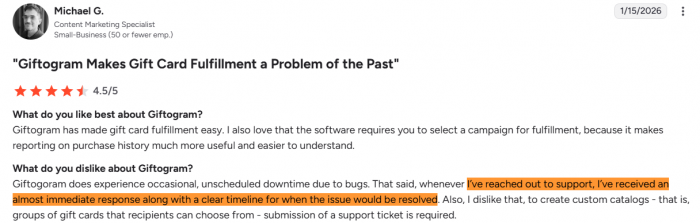
● “Support is responsive.” When things do go wrong (wrong email, wrong address, confused recipient), people report helpful, human support.
Patterns on the “could be better” side:
● “Physical constraints are annoying.” US‑only shipping and minimum orders are a real limitation for global orgs.
● “Sometimes emails get lost.” A handful of reviews mention redemption emails hitting spam folders or recipients needing help on the last mile.

● “This isn’t an all‑in‑one engagement platform.” If you wanted peer‑to‑peer shoutouts, recognition feeds, or curated experiences, Giftogram will feel functionally narrow by design.
The signal is clear: if you judge Giftogram as an automation‑driven gift card infrastructure, reviews are strong; if you expect it to be a culture app, you’re grading the wrong exam.
Chapter 9: The Competition Map (And Why Giftogram Doesn’t Look Nervous)
Imagine a simple grid in your head:
● Horizontal axis: “Catalog‑centric gift cards” → “Physical gifts & experiences.”
● Vertical axis: “Pay‑as‑you‑go plumbing” → “Heavy subscription platforms.”
Place a few names:
● Tremendous: Far into pay‑as‑you‑go, very API‑friendly, excellent for research panels and payouts, strongly catalog‑centric.
● Tango: Enterprise rewards infrastructure, also catalog‑driven, often chosen by big companies with serious volume.
● Guusto & culture platforms: More social, with recognition feeds, points, and subscriptions.
● Experience/swag players like Sendoso/Snappy, etc.: Heavier on physical boxes, curated gifts, marketing “wow,” often subscription‑leaning.
Giftogram sits in the square labeled “catalog‑centric, pay‑as‑you‑go, deeply integrated with HR and CRM.”
It doesn’t try to win on flashy experiences. It tries to win on:
● No subscription friction.
● Broad digital catalog, including lots of local/regional brands via partners.
● Smart Campaigns and integrations that let non‑technical teams automate the boring parts.
If that’s your criteria, it’s not fighting the same battle as a swag box platform at all.
Chapter 10: Governance, Security, and Why Finance Sleeps Better
Gift cards are money with a smiley face; you cannot treat them like stickers.
Giftogram’s answer to this:
● Every send, open, and redemption is logged and exportable.
● Budgets live at department and campaign levels, not in individual managers’ heads.
● Integrations and APIs reduce risky CSV exports and manual email merges.
● The platform emphasizes secure delivery and redemption flows over ad‑hoc code sharing.
You still need your own internal policies (who can send what, to whom, and why), but Giftogram gives you a single system to enforce and audit those policies.
Chapter 11: Who Giftogram Secretly Loves (and Who Should Swipe Left)
Giftogram quietly favors a certain kind of company:
● HR and People Ops teams who are serious about consistent recognition but allergic to more logins and license fees.
● Marketing and CX teams who send frequent, small rewards for surveys, demos, and events, and hate wasting time on one‑off codes.
● Finance leaders who want one ledger for all the “little” gifts that add up to big numbers.
It will not be a perfect fit if:
● Your recognition strategy revolves around physical swag and curated experiences, especially outside the US.
● You want a social recognition feed, points, badges, or a full “engagement platform” with its own internal community.
● You’re looking for a single vendor to own everything from swag boxes to travel experiences; Giftogram stays firmly in the digital/value lane.
Final Verdict
Giftogram is at its best when you treat it less like a “nice-to-have perk tool” and more like quiet financial infrastructure for gratitude: it turns messy, spreadsheet-driven gifting into a single, trackable rewards engine that plugs into the systems you already use, without charging you a subscription just for the privilege. If your real problem is making sure every birthday, renewal, survey, and small win is acknowledged on time—and your workforce is primarily digital and at least partly US-centric—its broad catalog, 250+ integrations, and pay-as-you-go model make it an easy yes, while teams chasing high-end physical swag, global paper mailings, or social “recognition feeds” will either need a second platform or should look elsewhere.
Comments