

1️⃣ What Is AI Governance?
AI governance refers to the set of policies, processes, controls, roles, and oversight mechanisms that a business uses to manage the risks associated with developing, deploying, and operating AI systems. It spans:
● Ethical use & fairness
● Data security & privacy
● Compliance with laws & standards
● Risk monitoring & incident response
● Accountability frameworks
2️⃣ The Risks AI Governance Must Address:
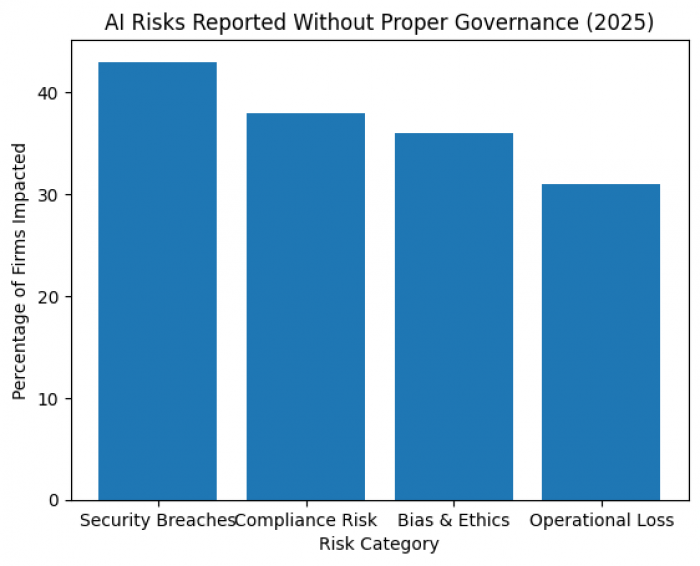
Before we dive into how governance helps, it’s essential to know what risks enterprises face without it. Recent enterprise surveys show the risk landscape is serious:
| Risk Category | Percentage of Organizations |
| Security breaches / data privacy threats | 43% |
| Reputational or legal damage due to non-compliance | 38% |
| Ethical risks (bias, discrimination) | 36% |
| Loss of human oversight | 31% |
| Loss of internal expertise due to third-party reliance | 29% |
3️⃣ How Poor Governance Creates Business Losses?
A large EY survey shows that most companies implementing AI suffered risk-related financial losses, particularly when governance was weak:
● Total estimated loss across surveyed firms: $4.4 billion
● Key causes: compliance issues, flawed outputs, bias, and operational risks
● Firms with robust Responsible AI practices saw better outcomes in cost savings and sales
Insight: Without governance, companies lose money even if their AI projects are technically successful.
4️⃣ How Many Companies Have Governance Today?
Despite widespread AI adoption, there is a large governance gap worldwide:
| Metric | Statistic (2025–2026) |
| Organizations using AI | 78–85% |
| Companies with fully implemented governance programs | ~25% |
| Firms that lack any AI governance | ~63–97% among governance failures |
| S&P 500 companies citing AI as a material risk | 72% (up from 12% in 2023) |
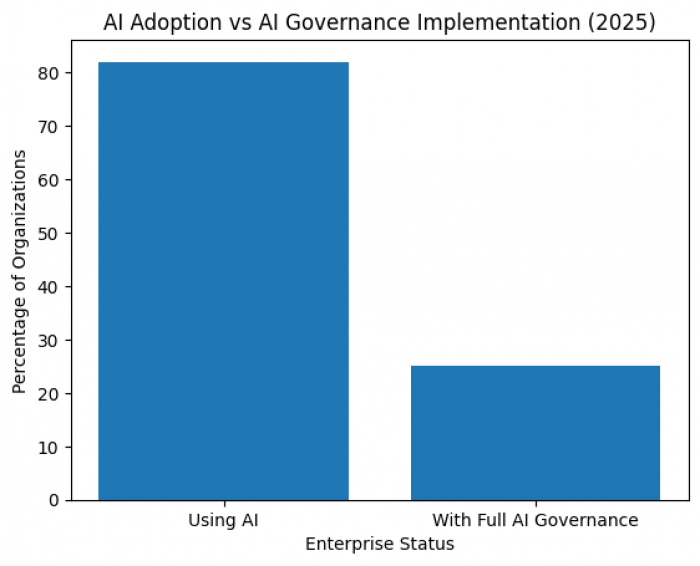
�� Insight: Most businesses use AI, but only a quarter have meaningful governance programs.
5️⃣ Why Governance Matters?
5.1 AI-Related Breaches Are Linked to Poor Governance
All AboutAI’s 2026 analysis found:
● 97% of organizations experiencing AI-related breaches lacked proper access controls
● 63% had no formal governance policy
● 72% of large U.S. companies report AI as a material risk
This shows governance execution gaps drive most incidents.
6️⃣ Business Benefits of Strong AI Governance :
When governance is implemented well, businesses gain measurable protection and strategic advantage.
6.1 Reduced Security & Compliance Risk
● AI governance reduces unauthorized access, bias-related impacts, and operational failures.
● Businesses with strong oversight report fewer governance failures — the difference between policies on paper versus operationalized controls can mean millions in savings.
6.2 Competitive Business Outcomes (Case Data)
According to governance impact modeling for Fortune 500 companies:
| Benefit Category | Quantified Impact |
| Productivity increase | +24.7% |
| Average cost savings | 15.7% |
| Reduction in security incidents | 73% |
| Time to market advantage | +47% |
| Customer trust improvement | +86% |
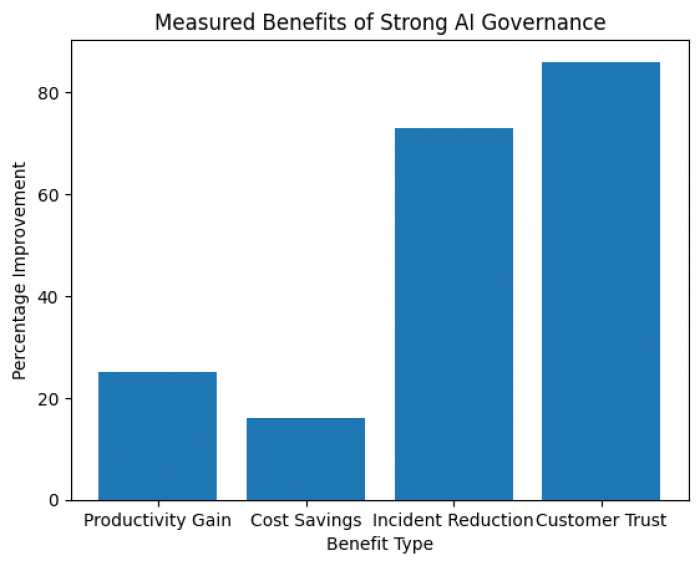
�� Governance doesn’t just reduce risk — it enables growth.
7️⃣ Regulatory and Compliance Frameworks :
Governance is also vital to meet evolving laws:
7.1 EU AI Act
● Categorizes AI by risk level
● Imposes compliance requirements
● Fines up to ~4% of global revenue for violations
7.2 U.S. Initiatives
● California’s AI transparency law (Transparency in Frontier AI Act) mandates risk documentation and safety incident disclosures
● Colorado AI Act sets obligations on “high-risk AI systems” from June 30, 2026 onwards
These laws create legal obligations that companies without governance will struggle to meet.
8️⃣ How AI Governance Protects Businesses :
8.1 Risk Identification & Prioritization
Governance frameworks help organizations identify:
● Data privacy risks
● Bias & discrimination risks
● Cybersecurity vulnerabilities
● Regulatory non-compliance gaps
Frameworks such as the five-layer governance architecture link global policy to actionable controls.
8.2 Policy & Standards Establishment
Good governance defines:
● Who can use which AI tools
● How models are trained and evaluated
● Data handling procedures
● Accountability matrices
These policies reduce misuse and align AI usage with business objectives.
8.3 Model Validation & Testing
Governance ensures AI systems are:
● Continuously tested
● Evaluated for fairness and accuracy
● Monitored for drift and errors
Without governance, organizations expose themselves to flawed decisions and legal penalties.
8.4 Monitoring, Incident Reporting & Response
Governance structures include:
● Real-time monitoring
● Incident escalation paths
● Post-incident review cycles
These mechanisms turn reactive responses into predictive risk mitigation.
9️⃣ Visual Summaries (Data Tables)
9.1 AI Governance vs. Risk Exposure (2025–2026)
| Indicator | Without Governance | With Governance |
| Breach likelihood | High (97% without access controls) | Significantly lower |
| Regulatory fines risk | High | Managed & compliant |
| Operational loss | Many $M | Reduced |
| Customer trust | Damaged | Strengthened |
| Board-level risk disclosure | Higher probability | Mitigated |
| Adoption readiness | Fragmented | Strategic |
1️⃣0️⃣ Challenges in Implementing AI Governance
Implementing governance isn’t trivial. Key obstacles include:
| Challenge | Impact |
| Shadow AI & unsanctioned use | Causes breaches & data misuse |
| Lack of policies | 63–97% governance failures |
| Skills shortage | 54% of firms cite lack of expertise |
| Human oversight need | 41% highlight maintenance challenges |
| Risk uncertainty | 39% identify ambiguity as barrier |
1️⃣1️⃣ Step-by-Step Governance Implementation Guide :
Step 1: Assess AI Usage & Risks
● Map existing AI tools
● Identify data sensitivity
● Measure compliance gaps
Step 2: Define Governance Roles
● Appoint AI risk owners
● Establish oversight committees
Step 3: Create Policies & Standards
● Data usage policies
● Model risk assessment procedures
● Incident response playbooks
Step 4: Implement Controls
● Access controls
● Logging & monitoring
● Automated compliance checks
Step 5: Training & Change Management
● Mandatory awareness programs
● AI ethics training
● Regular updates
Step 6: Continuous Monitoring & Audit
● Dashboard risk tracking
● Quarterly governance reviews
● Feedback loops for improvement
1️⃣2️⃣ Conclusion — Why AI Governance Is Not Optional?
AI governance protects businesses by:
● Reducing breaches and fines
● Ensuring compliance with major new laws
● Increasing trust with customers and partners
● Turning risk controls into competitive advantage
● Saving millions in operational losses
In the current era, governance is no longer a technical add-on — it’s central to risk management, compliance, and strategic growth.
Comments