

Imagine you are not buying “an EHR,” but a new brain for your behavioral health practice.
Valant IO is that brain: opinionated, data‑hungry, and sometimes expensive but capable of running almost everything from the first phone call to the final reimbursement.
This article walks through Valant IO not as a feature list, but as an infrastructure decision: how it rewires clinical work, cash flow, and patient relationships, and why some practices feel liberated by it while others feel overwhelmed.
1. Start Here: What Kind of Practice Is Valant IO Actually For?

Before talking about AI or billing rules, it’s worth being blunt about who Valant IO is designed around.
On paper, it’s a cloud‑based behavioral health EHR with built‑in practice management, billing/RCM, telehealth, and a patient portal called MYIO. In reality, its center of gravity is:
● Group and multi‑clinician practices
● Organizations that bill insurance at scale
● Clinics that care about outcomes data and revenue analytics
● Teams that can handle an implementation project, not just a sign‑up form
If you mainly want a simple calendar and progress note tool, Valant IO will feel like bringing an orchestra to a solo gig.
2. One System, Many Jobs: How Valant IO Replaces a “Tool Pile”
Most behavioral health organizations grow into a tool stack by accident: one system for notes, another for billing, a telehealth add‑on, a survey platform for outcome measures, something else for patient payments.
Valant IO is built to collapse that stack:
● Clinical care: specialized therapy/psychiatry templates, outcomes, AI‑assisted notes, e‑prescribing.
● Operations: multi‑provider scheduling, group sessions, intake workflows, document management, reporting dashboards.
● Billing and RCM: claims creation, clearinghouse connectivity, ERA auto‑posting, eligibility checks, denial tracking.
● Patient experience: MYIO portal/app for appointments, telehealth, forms, secure messaging, and online payments.
The technology choice, therefore, is not “Do we like this UI?” but “Are we ready to let one platform coordinate how clinicians, billers, front desk, and patients interact every day?”
3. Inside the Clinician’s Screen: AI, Templates, and the Way Notes Actually Change
3.1 Valant doesn’t see a “blank note”; it sees a pattern
Most systems give you blank text boxes with some checkboxes. Valant IO ships with rich behavioral‑health templates such as individual therapy, psychiatry, couples, groups, IOP/PHP, and more niche program types. These templates are engineered around payer expectations and measurement‑based care rather than generic SOAP blocks.
Behind the scenes, that means:
● Less ad‑hoc phrasing for each clinician
● More standardized fields feeding into analytics and outcomes reports
● Notes that can be reused programmatically in billing and compliance workflows
It moves the mental model from “I have to write something” to “I have to validate and customize what the system suggests.”
3.2 AI Notes Assist: co‑author, not ghostwriter
AI Notes Assist is the centerpiece of Valant’s newer clinical story. It takes structured and semi‑structured inputs (clinical scales, prior visits, dropdowns) and generates draft narrative notes for clinicians to review and finalize.
In practice, that looks like:
● Shorter time per note once clinicians learn the patterns
● More consistency across providers
● The possibility of tying documentation more tightly to appropriate codes
But one thing clear: this works only if clinicians treat AI output as a first draft, not a decision‑maker. There is a cultural adjustment from “I write every sentence” to “I verify and refine what the system proposes.”
3.3 Measurement‑based care baked into the workflow
Instead of leaving PHQ‑9s and other measures in a separate form tool, Valant lets you:
● Send measures through MYIO
● Auto‑score them
● Graph progression over time
● Pull scores into notes and outcome reports with minimal extra work
For practices in value‑based contracts or program negotiations, this becomes more than academic, it becomes evidence that your programs work, without exporting CSVs from a third‑party app.
4. The Money Engine: How Valant IO Treats Revenue as Part of the Clinical System
4.1 Documentation and billing as one conversation
In many systems, billing feels bolted on. In Valant IO, billing logic is woven through the clinical layer:
● Documentation templates designed around payer standards
● AI‑assisted narratives supporting code selection
● Claims generated from the same encounter record, not re‑entered or approximated elsewhere
The value is not that it can “submit claims” almost every system can. The value is that it reduces the distance between what happened in the session, how it’s documented, and how it gets paid.
4.2 Clearinghouse, ERAs, and fewer manual touchpoints
Valant’s integrated clearinghouse and ERA auto‑posting mean:
● Claims can be scrubbed, sent, and tracked inside the system
● Electronic remittances are posted automatically in many cases
● Billers spend more time on genuine problems (denials, policy issues) and less on data entry
Practices that have run billing in standalone tools often report that this is where they start seeing tangible ROI: faster cycles, fewer dropped claims, more visibility into what’s stuck and why.
4.3 Pricing: the part almost nobody loves
Valant follows the classic serious‑EHR model:
● Per‑provider subscription (typically higher than entry‑level tools)
● One‑time implementation fees
● Optional services and configurations that increase total cost
User reviews are clear on two points:
● Practices that lean hard into RCM, analytics, and portal features can justify the cost.
● Practices that only skim the surface feel like they’re overpaying for complexity they barely touch.
Valant IO is priced like infrastructure, not like a casual app. It makes financial sense only if you’re prepared to use it that way.
5. Patients Don’t See “Valant” - They Feel MYIO
5.1 MYIO as the real waiting room
To patients, Valant IO looks like MYIO, the portal and app where they:
● See upcoming appointments
● Join telehealth sessions
● Complete intake forms and ongoing assessments
● Read messages
● Pay balances without awkward conversations
That means your first impression, your reminders, your payment experience, and your telehealth reliability are all mediated by a non‑branded environment most patients will assume is “your system.”
When MYIO is adopted well, practices report:
● Fewer phone calls
● Cleaner intake data
● More consistent completion of forms and scales
● Better payment performance thanks to prompts and online options
When adoption is partial, staff end up running two worlds in parallel: the digital “ideal path” and the legacy phone‑and‑paper world.
5.2 Telehealth as a native behavior, not a bolt‑on
Telehealth sessions are launched from within the schedule; patients join from MYIO with no separate links. For a hybrid practice, that matters:
● One schedule for in‑person and virtual
● One place to troubleshoot when things go wrong
● One chart holding both visit types
Contrast that with practices juggling Zoom links, calendar invites, and ad‑hoc documentation. Valant IO doesn’t make telehealth “special”; it makes it ordinary, which is exactly what most clinics need.
6. Under the hood: Scheduling, Intake, and the Quiet Operations Layer
6.1 Scheduling for real‑world behavioral complexity
Behavioral health is not just 45‑minute individual appointments. It’s:
● Groups across weeks and months
● IOP tracks with attendance patterns
● Psych consults intertwined with therapy
Valant’s scheduling engine is built with that in mind: multi‑provider calendars, group session setups, repeating appointments, attendance tracking, and telehealth integration all wired into one view.
Front‑desk teams can see patterns of no‑shows, overbooked clinicians, and room usage in a way that’s difficult when you cobble together generic calendar tools.
6.2 Intake as a workflow, not an inbox
Instead of “forms attached to an email,” Valant uses workflows:
● New patient created
● Intake packet assigned
● Completed forms routed to the right chart and staff queue
● Insurance and demographics validated, often before the first visit
Done well, this turns your intake process into a repeatable pipeline instead of a series of one‑off rescues. Done poorly (for example, if you leave half your patients on paper), it becomes another underused feature you’re paying for.
7. Security, Compliance, and the “Single Vendor” Gamble
Behavioral health data is among the most sensitive data in healthcare. Valant’s pitch is straightforward: let us host the bulk of it in a HIPAA‑compliant, audited environment, sign a BAA with us, and reduce your patchwork risk.
From a risk perspective:
● You have one major platform to vet, monitor, and hold accountable.
● E‑prescribing and telehealth run within the same compliance framework.
● You still carry the responsibility for internal access controls, training, and device security.
Some organizations love the simplicity of this. Others prefer more modular setups where different vendors handle different data slices. With Valant IO, you’re clearly choosing the “deep integration, fewer external edges” philosophy.
8. Why Reviews Sound So Different: Two Realities in the Same Product
If you browse testimonials and third‑party reviews, you see two recurring narratives.
One group says:
● “Finally something built for behavioral health.”
● “We can run the whole practice from this.”
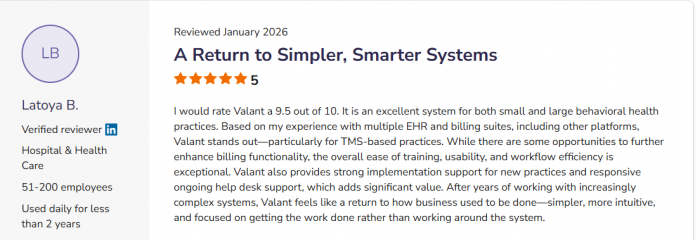
● “AI notes, outcomes, and RCM together are a game‑changer.”
The other group says:
● “Too many clicks.”
● “Expensive.”

● “Hard to learn; we use only a fraction of what it can do.”

The product didn’t change between those reviews. The practice context did.
● Mature or fast‑growing practices, already dealing with billing leaks and data demands, see a system that finally matches their complexity.
● Small or change‑averse practices see a system that asks too much in exchange for benefits they don’t urgently need.
Valant IO amplifies whatever operational posture you already have.
9. The Part Nobody Can Outsource: Implementation and Governance
There’s no way to use Valant IO seriously without treating implementation as a project.
Expect to:
● Clean up and migrate data from older systems.
● Configure templates and workflows so they reflect how you actually operate.
● Train clinicians on AI Notes Assist and measurement workflows.
● Train billers and front‑desk staff on new billing, scheduling, and portal processes.
Vendors and implementation teams can guide you, but they can’t decide:
● Which exceptions you’ll allow
● How strictly you enforce documentation standards
● Who owns ongoing system changes and training
Practices that assign a true internal owner — someone with both authority and time — tend to write the positive reviews. Those that treat it as “just another IT task” often do not.
10. A Decision Framework: Is Valant IO the Right Kind of Heavy?
Instead of asking “Is Valant IO good?” ask four sharper questions:
1. Are you already feeling the pain of fragmented tools, billing leaks, and inconsistent documentation , not just noticing them?
2. Do you have at least one person who can own configuration, training, and ongoing improvement, not just ticket logging?
3. Are you willing to let your documentation and workflows become more structured, more data‑driven, and less idiosyncratic?
4. Can you afford a system that behaves like core infrastructure, not like a cheap app and can you prove ROI in outcomes and revenue?
If your honest answers lean toward “yes,” Valant IO is worth a deep, skeptical, but serious demo and a conversation with references similar to your size and payer mix.
If you find yourself hedging on most of these, the platform is probably too heavy for your current stage not because it’s bad, but because it’s designed for a level of operational ambition you may not have (yet).
One Line Verdict
Valant IO is less a piece of software than a decision to run your behavioral health practice in a particular, structured, data‑driven way and for the right kind of clinic, that decision can be the difference between barely coping and actually scaling.
Comments