
After spending months bouncing between Janitor AI and Tavern AI, I stopped thinking of them as “two similar NSFW chatbots” and started seeing them as two completely different worlds. One is a plug‑and‑play platform that happens to be NSFW‑friendly; the other is a moddable cockpit for people who genuinely enjoy tinkering with models and prompts.
How Janitor AI feels when you actually live in it
Using Janitor AI day‑to‑day feels like logging into a familiar social app that just happens to be full of AI characters. I open the site, the home page throws a bunch of trending characters at me: waifus, husbandos, fandom crossovers, some original OCs and I can be mid‑conversation in under a minute. No installs, no configs, no reading docs.
The UX is straightforward: a clean chat window, a character avatar and description on the side, and a few controls for things like creativity and response length. When I want to try something new, I just scroll the gallery or search by tags “yandere”, “teacher”, “cyberpunk”, whatever and I’m in. For a casual mood or a quick NSFW session, that convenience is very hard to beat.
Where Janitor really shines is approachability. If a friend who’s never touched local models asks me for an uncensored Character.AI alternative, Janitor is usually the first link I send. It feels familiar: no one has to think about GPUs, context windows, or API keys. You create a character, you tweak their personality and example dialogues, and that’s about as technical as it gets.
That simplicity does have a ceiling. Once I started asking more from my sessions of longer arcs, more consistent world‑building, complex multi‑character setups I could feel the platform’s scaffolding. The character editor is good enough for personality, but not very rich for serious lore management. Memory feels fine for short to medium chats, but on longer threads you can see it forgetting past events unless you constantly remind it or carefully exploit its prompt structure.
And then there’s the “platform factor”: everything runs on their infrastructure. If the site is having a rough day, I feel it instantly. If they tighten a policy, I can’t just opt out. From a pure “fire and forget” standpoint, that’s acceptable; from a power‑user mindset, it’s a limitation I feel more and more over time.
Living with Tavern AI: the cockpit, not the car
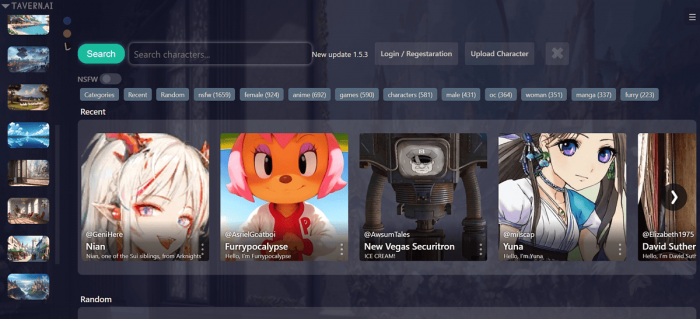
Tavern AI was a completely different experience for me. The first time I set it up, I realised this is not a website you visit; it’s more like a control panel you maintain. I had to care about which model I was using, where it was hosted, how much VRAM it needed, what sampling parameters made sense, and how big my context window was.
The payoff is that, once you push through that initial friction, Tavern feels less like “using a chatbot” and more like running your own interactive fiction engine. I’m not just chatting with a character; I’m curating a whole world:
● I define detailed character cards with quirks, secrets, and boundaries.
● I attach lorebooks so the system remembers locations, factions, timelines.
● I use author’s notes to dictate the storytelling style: slow‑burn, dark, comedic, whatever.
Because Tavern doesn’t bundle its own model, the quality of the experience scales directly with how well I choose and configure my backend. When I wired it to a decent local model on a GPU, the privacy and immediacy felt incredible: everything stayed on my machine, and I could go as NSFW or as niche as I wanted without worrying about a platform’s content policies. When I hooked it to a high‑end cloud LLM, the coherence and memory for my long campaigns jumped dramatically.
Tavern also has this “game dev” energy. The interface is more atmospheric, almost like a visual novel hub. Switching between characters, scenes, and storylines feels like loading save files and scenarios rather than opening random chats. It’s clearly designed for people who will stay with the same cast for weeks and months, not just roll through quick one‑off flings.
The obvious downside is that I wouldn’t hand Tavern to a newcomer and say “just figure it out.” Even with guides, there’s a learning curve. You will spend time reading setup instructions, picking models, and debugging weirdness. If you’re not the kind of person who enjoys tweaking things, that can be exhausting.
Side‑by‑side: how they actually compare in real use
Getting started and learning curve
From my own usage, the first big split is how quickly I go from “idea” to “actual conversation.”
| Category | Janitor AI | Tavern AI |
| Time to first chat | A few minutes from sign‑up to chatting with a character. | Anywhere from 30 minutes to a full evening, depending on how picky I am about models. |
| Required technical knowledge | Pretty much none. If you can use a browser, you’re done. | You need to understand basic installs, model endpoints, and some AI jargon. |
| Onboarding feel | Hand‑holding, familiar, similar to other web chat apps. | “Here’s the cockpit, hope you like switches.” Satisfying but intimidating at first. |
With Janitor, I’ve dropped links into chats and had friends up and running before we even finish the conversation. With Tavern, I’ve genuinely scheduled “setup sessions” for myself sitting down with coffee, deciding which model to pull, checking VRAM, tweaking configs.
UX, vibe, and immersion
In daily use, Janitor feels like a social platform; Tavern feels like a personal roleplay studio.
| Category | Janitor AI | Tavern AI |
| Overall vibe | Consumer web app. Feels like “AI Twitter meets AI Tinder” for characters. | Niche roleplayer’s toolbox. Feels closer to a modded game launcher. |
| Interface design | Clean, minimal, safe for anyone to glance at over your shoulder. | Thematic and dense; looks “gamey” and a bit intimidating to non‑techies. |
| Immersion | Good for short bursts and casual NSFW chats. | Excellent for long‑form campaigns and deep character arcs. |
Personally, when I just want to relax and flirt with a character for 20–30 minutes, I default to Janitor. When I’m in the mood to treat a session like an interactive novel that I’ll return to all week, I open Tavern.
Character creation and world‑building
I’ve built characters on both, and the process feels very different.
On Janitor, I mostly think in terms of “persona plus quirks.” I write a backstory, set some behavioral rules, maybe add sample dialogue, and I’m done. It’s quick and satisfying, and the characters are perfectly workable for loosely structured chats.
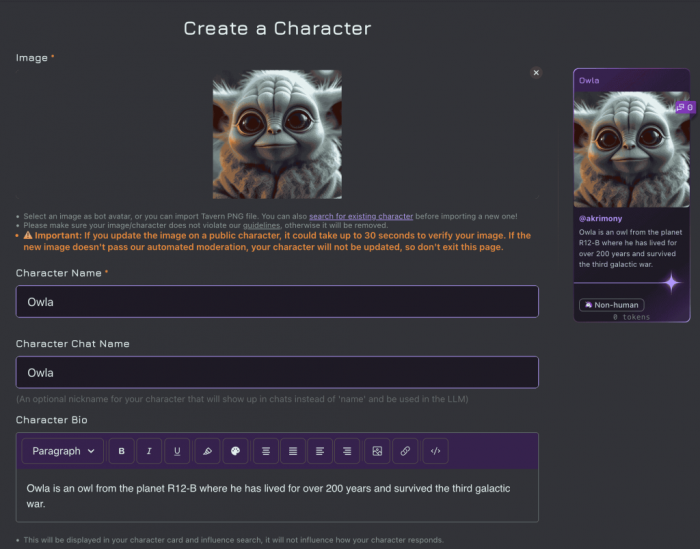
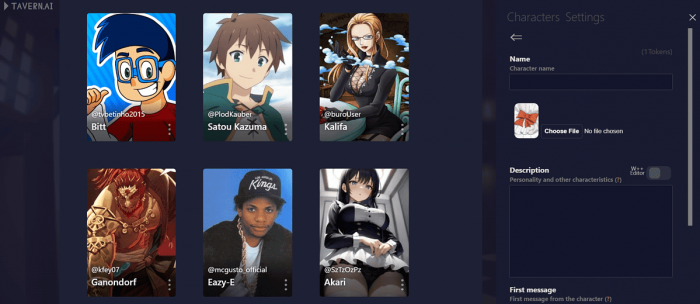
On Tavern, I treat characters as part of a bigger system. I spend more time:
● Planning how their description interacts with the lorebook.
● Deciding which tags or keywords should trigger extra context.
● Writing author’s notes that steer the tone of the entire story.
| Category | Janitor AI | Tavern AI |
| Character depth out of the box | Enough for distinctive personalities but “flat” in structure. | Deep, with multiple layers (persona, scenario, notes, lore). |
| Best use case | Quick OCs, obvious archetypes, fandom mash‑ups. | Complex, recurring characters in a shared universe. |
| Effort vs payoff | Low effort, decent payoff. | High effort, huge payoff for story‑driven users. |
The more serious I am about a world or storyline, the more I feel drawn to Tavern’s structure. For throwaway characters or one‑night scenarios, Janitor’s simplicity is a better match.
NSFW behavior and censorship in real life use
Let’s be honest: a huge part of why I and many others touched these tools at all is NSFW roleplay.
Janitor AI is clearly designed to be NSFW‑friendly, and in practice I rarely hit a hard “no” on common adult scenarios. It’s much more permissive than mainstream bots. That said, you can still sense there’s a line somewhere behind the scenes: it’s still a centralized platform with a reputation to protect. There’s always this background feeling that, if they ever decide to clean up their image, certain content could become awkward or disappear.
With Tavern, the limits are pretty much whatever I choose. If I connect it to a strict commercial model, I get filter‑like behavior. If I run it with an open, uncensored local model, there are effectively no hard blocks unless I impose them myself in the prompts. That freedom is both powerful and a bit sobering; it also means the legal and ethical responsibility lands squarely on me.
| Category | Janitor AI | Tavern AI |
| NSFW friendliness | Very permissive compared to mainstream, but still platform‑bounded. | Potentially completely uncensored, depending on model choice. |
| Consistency | Generally consistent within the platform’s comfort zone. | Depends entirely on model + config; you can tune it wildly. |
| Long‑term risk | Policies could change and clamp down. | Software itself is neutral; risk shifts to model providers and user. |
In practice, when I want predictable NSFW without fiddling, Janitor is fine. When I want full control, or when a scene is niche enough that I don’t want it stored on anyone else’s servers, I go back to a local Tavern setup.
Model choice, performance, and memory
This is the area where I felt Tavern start to outgrow Janitor for my heavier use.
On Janitor, I mostly accept what’s there. The platform may offer a few choices “faster vs smarter,” or some named models but it’s still their menu. When they switch a backend or tweak something, I just adapt. It’s easy, but I don’t get the last word.
On Tavern, I decide the stack. I can run a big local model if my GPU can handle it, or I can pay for a top‑tier API and watch my stories gain much better long‑range coherence. I can swap models per character, or even per mood. When a new model drops and the community says it’s great for RP, I can test it the same day.
Memory follows the same pattern. On Janitor, longer chats sometimes drift or forget older details in ways I can’t fully control. On Tavern, I combine a bigger context window with lorebooks and careful prompts, and I can sustain storylines over hundreds of messages with surprisingly few contradictions.
| Category | Janitor AI | Tavern AI |
| Who controls the model? | The platform; you select from curated options. | You; any compatible backend is fair game. |
| Performance ceiling | “Good enough” for most, but capped by vendor choices. | As high as your hardware and budget allow. |
| Long‑form memory | Acceptable but sometimes brittle on very long threads. | Can be excellent with the right model + lore setup. |
If you’re the kind of person who enjoys squeezing every last drop of performance from a system, Tavern is where that obsession actually pays off.
Privacy and where my data lives
The more I used NSFW roleplay for personal themes, the more I started thinking about where the text was going.
With Janitor, the answer is simple: onto their servers. They may promise certain safeguards, but fundamentally I’m trusting a third party with explicit chats and intimate scenarios. For light‑hearted stuff, I don’t overthink it. For deeply personal or dark content, I do.
With Tavern, I can run everything on my machine. In a fully local setup, no logs leave my system unless I back them up somewhere. If I decide to use cloud models, it’s my choice which provider gets the data and under what terms. That control feels significantly better when I’m exploring more delicate topics.
For me, Janitor is “good enough” privacy for casual RP. Tavern is where I go when I want zero third‑party eyes involved.
Pricing and what I actually end up paying
In terms of money, the two tools invert the usual expectations.
Janitor looks free or freemium, plus whatever extra tiers or model upsells exist. The value is that I don’t think about hardware or per‑token costs; I just see “this is included, this is premium.” It’s mentally cheap, even if it can become more expensive longer‑term if I get hooked on higher‑tier options.
Tavern, on the other hand, is free software but demands either:
● Upfront investment in hardware if I want solid local models.
● Ongoing per‑token spending if I go with premium cloud LLMs.
| Category | Janitor AI | Tavern AI |
| Software price | Free to start, paid features on top. | Free. |
| Cost hiddenness | Costs are abstracted and wrapped in the platform. | Transparent: you see hardware bills or API invoices. |
| Long‑term value | Great if you just want plug‑and‑play and can live within limits. | Great if you’re a heavy user and willing to invest in a proper setup. |
From my own wallet’s perspective, Janitor is affordable entertainment. Tavern becomes cheaper over time only because I already use the same hardware and/or APIs for other projects; it piggybacks on that existing investment.
Community and ecosystem (from the inside)
Community‑wise, the two ecosystems also feel different.
Janitor’s community gathers around the platform itself: public characters, forums, social media. It feels more like a user base. People share character links, complain about downtime, ask for features, and compare it against other platforms.
Tavern’s community lives everywhere: GitHub issues, Discords, guides, card repositories, model‑tuning threads. It feels more like a scene than a product: lots of informal experimentation, people sharing prompt structures, model benchmarks, and advanced configs.
| Category | Janitor AI | Tavern AI |
| Center of gravity | The official site and its gallery. | The broader open‑source and RP tooling ecosystem. |
| Type of users I meet | Casual NSFW enjoyers, some creative writers. | Power users, tinkerers, roleplay veterans, model nerds. |
| Ecosystem resilience | Tied to the company’s fate and policies. | Tied to open‑source health; forks and offshoots keep it alive. |
As someone who likes both writing and tooling, I feel more “at home” in the Tavern adjacent spaces, but Janitor’s user base is much easier to recommend to beginners.
Final verdict
If I had to boil down my lived experience into a single sentence: Janitor AI is where I go when I want things to just work; Tavern AI is where I go when I want things to work exactly the way I want.
● When I’m tired, just want fast NSFW banter, and don’t feel like wrestling with configs, I open Janitor, pick a character, and let the site do the heavy lifting.
● When I’m in “world‑builder” mode, planning multi‑session campaigns, caring about privacy, and willing to invest effort into models and prompts, I open Tavern and treat it like my personal story engine.
So my honest recommendation is this:
If you’re a casual user, or you’re just stepping into NSFW AI roleplay, start with Janitor AI. You’ll get 80% of what you want with 5% of the effort.
And if you're a tinkerer, a serious role‑player, or someone who cares deeply about long‑term immersion and privacy, grow into Tavern AI. It has a higher learning curve, but once you climb it, the ceiling is much higher and you are the one holding the keys.
Comments