

Artificial intelligence is rewriting the rules of content creation. What once required teams of animators, writers, editors, and software skills can now be produced with a single prompt. Among the wave of new AI video tools, MagicLight.ai stands out for one reason: it focuses specifically on turning written stories into long-form animated videos.
While most AI video models today excel at short clips or cinematic snippets, MagicLight’s value proposition is different, it aims to make it possible to publish full 5–50 minute narrative videos with voice, characters, scenes, and transitions.
What MagicLight.ai Offers
At its core, MagicLight.ai aims to solve a traditional bottleneck: storytelling video production. Normally, video storytelling requires:
● Writing a script
● Designing characters
● Animating scenes
● Adding voice-over
● Editing and timing footage
● Exporting for platforms
MagicLight compresses this entire pipeline into three user actions:
1. Provide a story/script/idea
2. Choose style & settings
3. Generate video
The pitch is accessibility: anyone who can write an idea could theoretically produce a full animated narrative video.
This positions MagicLight.ai as a tool for:
● YouTubers
● Kids content creators
● Educators
● Self-publishing authors
● Social media storytellers
● Religious and motivational channels
● Brand narrators
● Content agencies
This is uniquely strategic because storytelling content, especially kids' stories, is one of the fastest-growing categories on YouTube and OTT platforms.
Detailed Breakdown of Features
Let’s break down the platform’s main capabilities more thoroughly:
1. Story-to-Video Generation
This is MagicLight’s flagship feature. It takes text input and generates:
● Storyboards
● Characters
● Scene transitions
● Audio narration
● Animations
Users can either upload scripts or ask the AI to create narratives for them, which reduces creative workload for non-writers.
2. Long-Form Video Support (Up to 50 Minutes)
This is one of the platform’s rare advantages. While tools like Runway, Pika, or Luma focus on 2–15 second creative clips, MagicLight supports structured long-form content, making it feasible for:
● Series
● Episodes
● kids audiobooks
● bedtime stories
● educational explainers
The ability to export extended content is a major differentiator.
3. Character Consistency Tools
Long-form storytelling requires continuity. MagicLight’s character system attempts to preserve:
● Appearance
● Clothing
● Style
● Role
across scenes to avoid abrupt visual changes.
While not perfect especially with complex narratives this feature aligns with narrative needs unlike generic art models that generate one-off frames.
4. Multiple Content Templates
Templates simplify starting points for beginners. MagicLight includes categories such as:
● Kids Stories
● Religious / Moral stories
● Motivational / Inspirational
● Music & Visualizer videos
● Educational explainers
● Vlog-style animations
● Short tales for TikTok & Shorts
Templates reduce prompt complexity and encourage genre-based output.
5. Multilingual Narration & Voice Support
Voice narration plays automatically unless disabled. Voice quality varies but is improving, and multilingual support increases global accessibility.
6. Commercial Rights on Paid Plans
Paid users gain the ability to monetize content across platforms like:
● YouTube
● OTT platforms
● E-learning websites
This is crucial for agencies and creators building revenue channels.
Pricing System Explained
MagicLight uses a subscription + credit consumption model, one of the most debated aspects of the platform.
Free Tier
● Meant for testing
● Allows short preview clips
● Limited templates
● Watermark-free in some cases
Paid Tiers (Typical Range)
| Tier | Price (Approx.) | Best For |
| Standard | $10–$12/mo | Casual creators |
| Plus | $20–$26/mo | Regular content output |
| Pro | $30–$35/mo | Agencies & daily use |
| Enterprise | Custom | Studios |
What causes confusion for users is credit consumption, which varies by:
● Duration of video
● Render quality
● Animation model choice
● Revisions/regenerations
● Complexity of scenes
Some users report consuming credits faster than expected, making cost-per-video unclear without experimentation.
This is a common friction point seen in other AI tools as well (e.g., MidJourney’s GPU hours, Runway tokens, and Sora credits).
Real User Feedback: Aggregated Insights
Positive Feedback Themes
Users who enjoyed the platform highlighted:
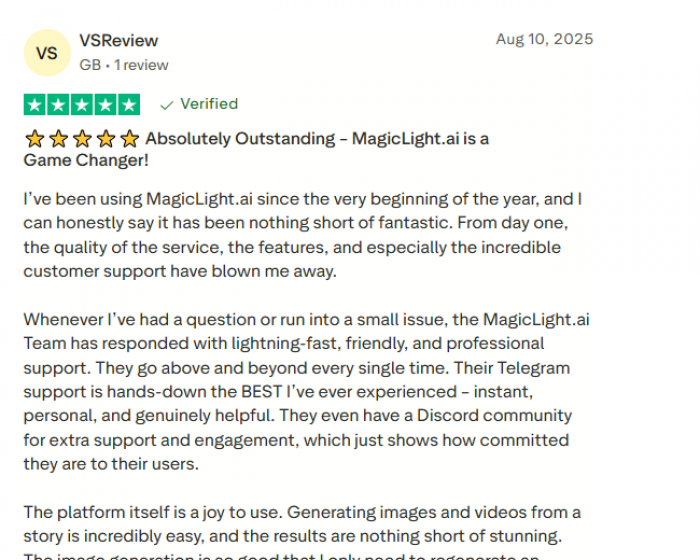
● Easy learning curve
● Fast draft creation
● Accessible for non-technical creators
● Unique long-form video capability
● Useful for YouTube kids channels
● Saves cost compared to hiring animators
● Good for ideation and prototyping
Some users were able to publish content and grow channels using it.
Negative Feedback Themes
The strongest recurring complaints involved:
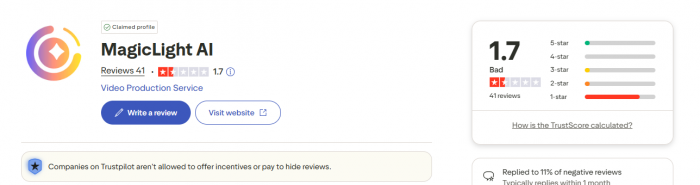
1. Pricing Transparency
Users felt unclear about how many credits are needed for:
1. Revisions
2. full-length videos
3. regenerations
This led to unexpected spending for some.
2. Technical inconsistencies
Users reported:
● character appearance shifts
● animation inaccuracies
● unexpected scene interpretations
● narration mismatches
This is expected in early-stage generative platforms.
3. Customer Support Challenges
Multiple users reported:
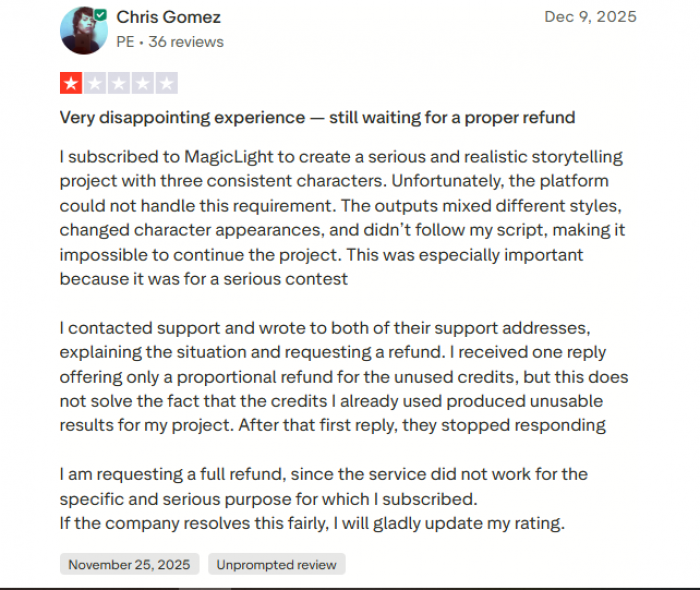
● slow responses
● difficulty cancelling plans
● refund disputes
This affected Trustpilot ratings significantly.
4. Marketing Expectation Gap
Some claimed demo videos looked higher quality than their generated output — a common gap seen in many AI companies where best-case outputs are showcased.
Comparing MagicLight to Competitors
MagicLight is not alone in the AI video ecosystem, but its market position is distinctive.
Here’s how it compares by category:
| Use Case | Best Tool |
| Long-form kids storytelling | MagicLight |
| Talking avatars for corporate | Synthesia / HeyGen |
| Cinematic clips | Runway / Pika / Sora / Luma |
| Easy template-based edits | Canva / VEED |
| Social short form | CapCut AI |
| Student-friendly explainers | Animaker / InVideo |
MagicLight is strongest where narrative automation matters, a niche with surprisingly little competition.
Ideal Use Cases for MagicLight.ai
MagicLight shines for:
1. Kids content channels
2. Audio-visual storybooks
3. Educational creators
4. Cultural or religious narratives
5. Motivational storytelling
6. Vlog-style animated explainers
7. Freelance content work
8. Content prototyping
These areas value storytelling > cinematic perfection, which aligns with MagicLight’s strengths.
Who Should Not Use It
Avoid or wait if you need:
✖ Pixar-level animation
✖ Fine-grained frame control
✖ Predictable cost-per-video
✖ Studio-grade fidelity
✖ Fully realistic motion capture
Professionals seeking ultra-realistic visuals should look to Runway, Sora, Luma, or custom models.
Conclusion
After evaluating MagicLight.ai from multiple angles not just from feature checklists, but from user experiences, pricing psychology, and market positioning the takeaway is this:
MagicLight.ai is not trying to become the next Pixar or Hollywood-grade engine. It’s trying to democratize storytelling for people who have ideas but lack animation skills, editing skills, or production budgets. And in that specific mission, it’s genuinely impactful.
However, as with most early-stage generative technologies, the platform still shows signs of immaturity: the credit system needs more transparency, customer support needs strengthening, and the output quality requires consistent refinement to align with promotional demos. These aren’t dealbreakers, but they are real considerations.
If you measure MagicLight against professional animation, you will be disappointed. If you measure it against the alternative for non-animators which is “never publishing because production is too hard” then MagicLight becomes empowering, even transformative.
For creators who want to publish kids stories, YouTube narratives, religious or educational content, or even just experiment with storytelling, MagicLight may not be perfect, but it lowers the barrier to entry in a way that traditional studios never could. And that is worth paying attention to as the AI video space evolves.
Comments