

A quick personal verdict
After spending time browsing MyTechArm.com across different sections: social media templates, app guides, finance-related posts, and tech snippets, my conclusion is simple:
MyTechArm.com is a convenience-first website, not an authority-first one.
It works best when you need something fast and low-risk: a caption idea, a basic “how to” answer, or a quick introduction to a topic. It does not work well when accuracy, depth, or independent evaluation actually matters.
Once I adjusted my expectations, the site made much more sense.
Why I originally landed on MyTechArm
Like most readers, I didn’t arrive there looking for journalism.
I landed on MyTechArm while searching for:
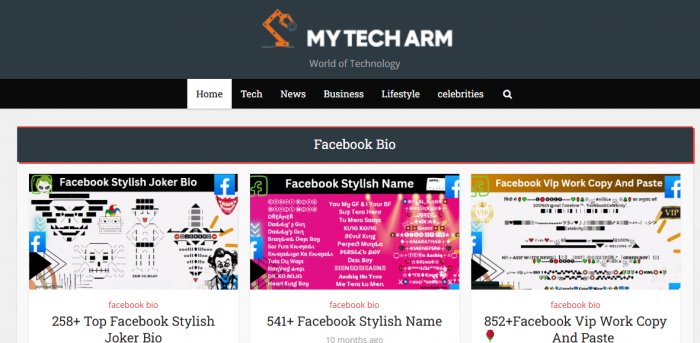
● Stylish name formats and bio ideas
● Quick explanations of common apps
● Short Hindi-language guides for everyday digital tasks
And in that role, the site delivered. The pages load quickly, the language is simple, and the content is designed to be consumed in under two minutes.
That usability is not accidental, it defines the entire platform.
What MyTechArm is genuinely good at
From a user’s perspective, these are the areas where MyTechArm performs reliably:
1. Social media text and templates
This is easily the site’s strongest segment.
Facebook bios, nickname styles, short captions, and name generators are exactly what most visitors are looking for and the site understands that.
2. Beginner-friendly app and software help
Articles usually avoid jargon and focus on:
● What the feature is
● Where to tap or click
● What result you should expect
For non-technical users, this simplicity is actually useful.
3. Discovery-level finance and service content
I treat these posts as directional, not advisory. They introduce platforms or apps but stop short of serious analysis. Used cautiously, they’re fine as starting points.
Where MyTechArm clearly falls short
Once you look beyond convenience, limitations become obvious.
No visible editorial depth
Most articles don’t show:
● Author expertise
● Testing methodology
● Source citations
That doesn’t make them “wrong,” but it does mean they’re not verifiable on their own.
Gadget content is surface-level
Specs are listed, features are summarized, but:
● No benchmarks
● No long-term usage insights
● No comparisons based on real testing
I would never make a purchase decision based on these posts alone.
Finance content requires extra caution
Some posts feel promotional in nature. That’s common across many blogs, but it means readers must independently verify claims especially for anything involving money.
What the site’s evolution tells us
Looking at archived versions of MyTechArm helped me understand its intent better.
The site didn’t begin as a newsroom or tech authority. Early versions were sparse, closer to a placeholder than a publication. The current multi-category format appears to be a deliberate expansion driven by discoverability and SEO, not investigative reporting.
That history explains:
● The wide topic spread
● The emphasis on short posts
● The openness to contributor-style content
It’s a growth strategy, not a credibility strategy.
How I personally use MyTechArm now
After understanding its role, I use MyTechArm like this:
● For quick ideas, captions, and basic explanations
● As an introductory reference
● Not for final decisions
● Not for financial or technical validation
Used this way, it saves time instead of creating risk.
Stronger alternatives
Many MyTechArm readers eventually look for something more dependable. Based on different use cases, here are better alternatives I personally recommend:
1. Techmeme: for real-time tech awareness

Techmeme doesn’t publish opinions, it aggregates reporting from trusted outlets.
If you want to know what’s actually happening in tech, it’s leagues ahead of MyTechArm.
Best for: industry updates, credibility, speed
2. TechCrunch: for startups and business tech

When MyTechArm touches business or startups, it feels introductory.
TechCrunch provides structured reporting, named authors, and editorial accountability.
Best for: funding news, startups, platform launches
3. The Verge: for consumer tech decisions

If you’re buying gadgets, The Verge’s testing, comparisons, and usability focus are far more reliable.
Best for: phones, laptops, wearables, consumer electronics
4. Wired: for depth and future-facing tech

Wired excels where MyTechArm doesn’t even attempt to compete: long-form analysis, ethics, AI, and technology’s societal impact.
Best for: AI, cybersecurity, technology trends
5. Localized Hindi tech YouTube channels & forums
For Hindi-speaking users who outgrow MyTechArm, well-reviewed YouTube educators and community forums often provide clearer demonstrations and real-world experience.
Best for: visual learners, practical walkthroughs
Final assessment: how readers should approach MyTechArm
MyTechArm.com is not misleading, but it is limited by design.
It succeeds as:
● A quick-access content hub
● A beginner-friendly guide site
● A traffic-driven utility platform
It fails as:
● A tech authority
● A financial advisory source
● A product review benchmark
If you treat it as a starting point, it can be genuinely helpful.
If you treat it as a decision-making authority, you’re expecting something it was never built to provide.
That distinction makes all the difference.
Comments