

When users ask whether a website like NoodleMagazine is “safe” or “legitimate,” they are often asking several different questions at once.
Is it legal to visit?
Is it secure to browse?
Can it be trusted with personal data?
Does it operate transparently?
This article breaks those questions apart and evaluates NoodleMagazine across three distinct dimensions: safety, legitimacy, and trustworthiness. Each dimension is assessed independently, because a site can meet one standard while failing another.
Safety: What Risks Exist When Using NoodleMagazine?
Safety, in this context, refers to technical and user-level risk, not moral judgment.
Browser and Device Safety
NoodleMagazine operates as a free, ad-supported platform. Sites in this category commonly rely on:
- third-party advertising networks
- redirects to partner pages
- aggressive pop-ups or overlays
This creates a higher baseline exposure to:
- misleading ads
- forced redirects
- potentially harmful external pages
While this does not mean every visit results in harm, it does mean users browsing without protections (updated browsers, ad blockers, DNS filtering) face greater risk than on mainstream platforms.
Malware and Malvertising Risk
There is no public evidence that NoodleMagazine itself distributes malware. However, malvertising—harm delivered through ads rather than site code, is a known risk pattern on large, free adult aggregation sites.
This makes the safety profile:
- Context-dependent (strong protections = lower risk)
- Environment-sensitive (mobile browsers generally face higher exposure)
From a safety standpoint, NoodleMagazine should be treated as higher-risk than licensed streaming services, but not automatically malicious.
Legitimacy: Is NoodleMagazine a “Legal” Website?
Legitimacy is often misunderstood. A site does not need to be “licensed” or “approved” to exist legally, but it must operate within certain frameworks.
Legal Positioning
NoodleMagazine presents itself as a service provider rather than a publisher. This is reflected in:
- the presence of a DMCA takedown process
- language framing the platform as reactive to copyright complaints
This positioning is common among aggregation platforms and is intended to place the site within safe-harbor provisions, where liability is limited as long as complaints are handled.
The Core Legitimacy Gap: Content Provenance
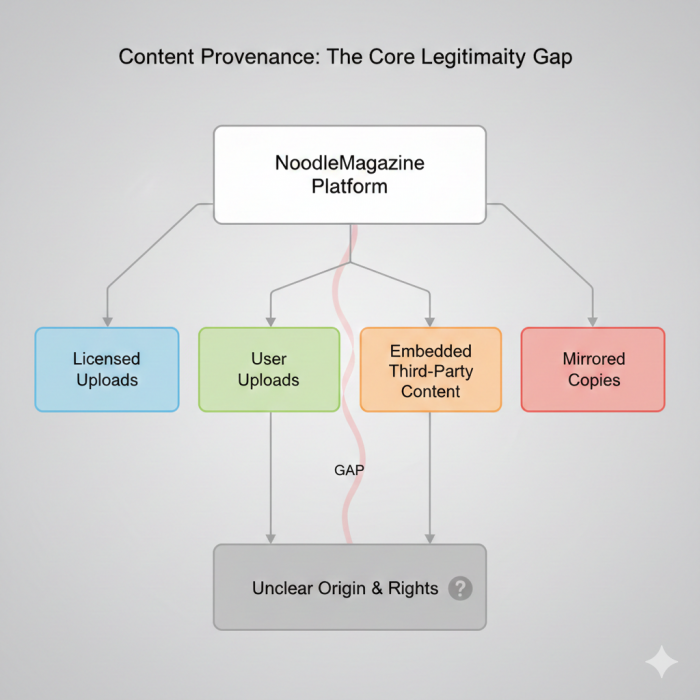
What remains unclear, and is central to legitimacy, is how content rights are handled.
From publicly available pages, users cannot easily verify:
- whether videos are licensed
- whether they are user-uploaded
- whether they are embedded from third-party hosts
- or whether they are mirrored copies
This lack of transparency does not automatically make the site illegal, but it does weaken legitimacy compared to platforms that clearly disclose licensing, partnerships, or creator ownership.
Bottom Line on Legitimacy
NoodleMagazine appears to operate in a legally gray but common aggregation model:
- not openly illegal
- not clearly licensed
- dependent on complaint-based enforcement
This places it closer to “tolerated” than “endorsed” in legal terms.
Trustworthiness: Can Users Trust the Platform?
Trustworthiness is not about whether a site works, it’s about whether users can reasonably rely on it to act in their interest.
Transparency and Accountability
Trustworthy platforms usually provide:
- clear ownership or operator identity
- visible governance standards
- proactive disclosure of practices
NoodleMagazine provides limited public accountability:
- ownership is not clearly disclosed
- decision-making structures are not visible
- responsibility is routed through policy documents rather than public engagement
This does not imply malicious intent, but it does mean users have little recourse or clarity if something goes wrong.
Data Handling and Privacy
The privacy policy allows for:
- broad data collection
- sharing with third parties and partners
- tracking consistent with ad-driven ecosystems
For users, this means:
- minimal control over data usage
- limited insight into who receives that data
- no clear value exchange beyond access
From a trust perspective, this is a weak position, especially for users concerned about anonymity or tracking.
Comparing Trust Signals Across Platforms
When compared to other categories:
Licensed, paid adult platforms
Higher transparency
Clearer accountability
Lower ad-related risk
Mainstream video platforms
Stronger safety controls
Clear governance
Strict moderation
Free adult aggregation sites (like NoodleMagazine)
High accessibility
Low transparency
Trust placed largely on user caution
NoodleMagazine fits squarely into the third category.
Who Should Be Especially Cautious?
Based on safety, legitimacy, and trust factors, extra caution is warranted for:
- users browsing on mobile devices without protection
- users concerned about data tracking or privacy
- users assuming content is licensed or curated
- users unfamiliar with adult aggregation ecosystems
For these users, risk is not theoretical, it is structural.
Overall Assessment
Safety: Medium–High risk (environment-dependent)
Legitimacy: Gray-area, complaint-driven
Trustworthiness: Low transparency, limited accountability
NoodleMagazine is not best described as a scam, but it also does not meet the standards of a trustworthy, user-first platform. It prioritizes access and scale over clarity, governance, and protection.
Users who understand and accept that trade-off may navigate it without incident. Users who expect transparency, privacy, or editorial responsibility are likely to find it lacking.
Final Perspective
NoodleMagazine exists because the modern web rewards aggregation at scale. Its risks are not unique, but they are real.
Evaluating it responsibly means separating curiosity from caution and understanding that “free access” often comes with hidden costs, paid not in money, but in exposure, uncertainty, and trust.
For users who value safety and legitimacy above convenience, NoodleMagazine is a platform to approach carefully, not casually.
Comments