

Imagine you’re standing outside a neon-lit building that advertises two things at once:
1. “Talk to characters like they’re real people.”
2. “Also… no filter.”
That building is PepHop AI’s public identity: a character-chat / AI companion platform that leans heavily into roleplay, including adult (NSFW) chat as a core use case.
Now let’s go room by room because with tools like this, the details matter more than the headline.
What PepHop AI Actually Is
At its foundation, PepHop AI is a web-based AI character chat platform.
You don’t log in to “ask questions.” You log in to enter conversations.
Those conversations can be:
● light roleplay
● emotional companionship
● flirtatious banter
● long-form fictional scenarios
● or explicitly adult (NSFW) roleplay, depending on settings and characters
The platform revolves around AI characters—either:
● characters created by other users and shared publicly
● or characters you create yourself with custom personalities, backstories, and conversational styles
Each character functions as a conversational lens. You’re not talking to “an AI.” You’re talking through a persona.
This distinction matters, because PepHop isn’t competing with productivity AI tools. It’s competing with loneliness, boredom, fantasy, and imagination.
The Core Service: Conversations That Try to Remember You
The defining feature PepHop emphasizes over and over is memory.
Not memory in the technical, academic sense. But memory in the human sense.
The idea is that:
● characters remember preferences
● conversations feel continuous
● references don’t reset every few messages
● relationships feel persistent instead of disposable
This is where many AI companion platforms succeed or fail.
A chatbot that forgets everything feels like a toy. A chatbot that remembers too imperfectly feels uncanny.
PepHop positions itself in the middle: better memory than basic chatbots, without claiming true long-term emotional continuity.
In practice, this works sometimes very well and sometimes inconsistently—a pattern echoed across user feedback.
Character Libraries, Creation, and the Culture Layer

PepHop doesn’t just sell a tool. It sells access to a culture of characters.
Public Character Library
Users can browse and interact with publicly shared characters, often designed around:
● archetypes (romantic partner, dominant persona, comforting listener)
● fandom-style personalities
● original fictional creations
The experience here depends heavily on discovery. Some users find characters they love quickly. Others report repetition and limited search depth.
Character Creation
For many users, the real value lies in creating private characters.
You can define:
● personality traits
● tone (gentle, sarcastic, intense, romantic)
● scenario context
● boundaries
This is where PepHop becomes less of a “site” and more of a sandbox. The better you design the character, the better the experience tends to be.
But this also shifts responsibility onto the user. Poor character design often leads to shallow conversations—something some reviewers blame on the platform when it’s actually a configuration issue.
Pricing: Where Fantasy Meets Math
PepHop operates on a freemium subscription model, but its structure is important to understand before using it seriously.
Unlike platforms that throttle usage by speed or queue time, PepHop largely uses monthly message limits.
This means:
● every message counts
● long roleplay exchanges burn through limits quickly
● pricing feels predictable—but also restrictive for heavy users
Typical tiers (subject to change, but commonly referenced):

If you’re a casual user, it feels reasonable. If you’re deeply invested in long conversations, it can feel expensive fast.
PepHop doesn’t hide this but it also doesn’t soften it.
Transparency, Policies, and the Reality of “Unfiltered”
PepHop markets itself as uncensored, but that doesn’t mean unregulated.
Age Restrictions
PepHop states that adult content is restricted to 18+ users and publishes an underage policy.
This is necessary—but readers should understand the difference between:
● having a policy
● and enforcing one
Like most platforms in this category, PepHop relies largely on self-assertion rather than hard identity verification.
Content Policies
Despite its “no filter” branding, PepHop still publishes blocked content rules. Certain categories are restricted, implying active moderation and content scanning at some level.
This matters for users who assume “uncensored” means “anything goes.” It doesn’t.
Privacy and Data
PepHop maintains a standard privacy policy outlining:
● data collection
● chat storage
● account information
● third-party service providers
What’s less clear and rarely is in this industry is:
● how long chats are stored
● whether conversations are used for training
● how deletion requests are handled in practice
This lack of deep transparency isn’t unique to PepHop but it’s something informed users should factor in.
Performance and Quality: Where Expectations Matter
PepHop’s performance tends to fall into three phases for users.
Phase 1: The Honeymoon
Early conversations often feel:
● responsive
● engaging
● emotionally coherent
● exciting
This is where many positive impressions come from.
Phase 2: The Stress Test
As conversations lengthen, users begin noticing:
● occasional repetition
● memory drift
● character inconsistency
● technical hiccups
This is also where expectations collide with reality. AI companions are not people—and the illusion breaks when continuity slips.
Phase 3: The Value Judgment
After weeks, users stop asking “Is this fun?” and start asking:
● Am I getting enough usage for the price?
● Are conversations evolving—or looping?
● Is discovery deep enough to keep me engaged?
User reviews suggest mixed outcomes here. Some stay. Some leave. Most complaints revolve around cost-to-value ratio, not total failure.
User Reviews: Reading Between Extremes
PepHop’s public reviews are limited in number but consistent in themes.
Positive feedback often mentions:
● engaging dialogue
● freedom compared to heavily filtered platforms
● emotional tone that feels less robotic
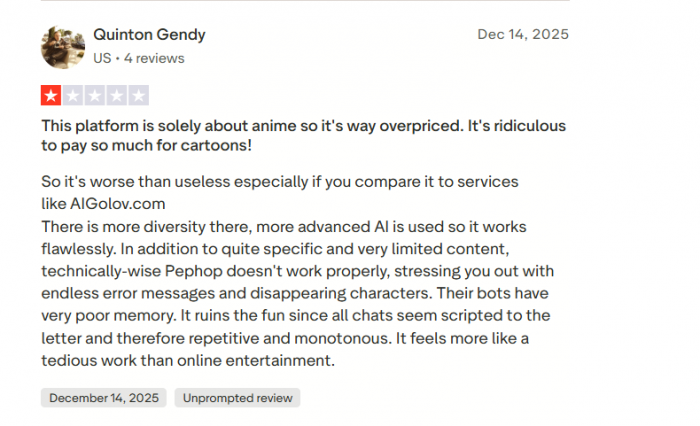
Negative feedback frequently points to:
● pricing frustration
● repetitive responses over time
● technical issues (missing chats, slowdowns)
● limited character variety without manual effort
The takeaway isn’t that PepHop is broken. It’s that PepHop rewards intentional users and disappoints passive ones.
What I can say confidently from public review sources
On Trustpilot, PepHop shows a small review count and a low-average rating, with reviews complaining about price, limited variety, and technical issues.

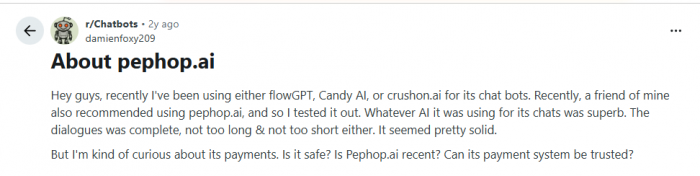
On Reddit, there’s at least one thread where a user praises the chat quality but asks whether payments are safe an extremely common “new platform” trust question.
How to interpret that fairly
● Small sample sizes mean volatility. A few angry users can swing the score.
● Still, the complaint themes (pricing vs limits, memory quality, stability) match what tends to matter most in this niche.
The “if not PepHop” shelf: competitor alternatives
PepHop sits in the AI character / companion category. Here are credible alternatives, each with a slightly different “trade”:
1) Character.AI — big ecosystem, stricter safety posture

● Strengths: huge community, lots of characters, generally strong roleplay culture
● Tradeoff: historically known for stricter filtering; also increased focus on safety and age restrictions (especially for minors).
● Pricing: c.ai+ commonly listed around $9.99/month (annual option exists).
2) CrushOn.AI — positioned as “no filter”

● Strengths: explicitly markets uncensored/NSFW roleplay
● Tradeoff: pricing models can be credit/message-based; quality varies by tier and model options.
3) Candy.ai — companion experience + media upsells

● Strengths: leans into “AI girlfriend” framing; often bundles chat with voice/media features
● Tradeoff: many services in this lane rely on subscriptions + token systems for images/voice.
4) SpicyChat.ai — NSFW community + tiered upgrades

● Strengths: uncensored positioning; creator/community angle
● Tradeoff: tiers focus on skipping queues, memory boosts, and extra features; quality depends on model access and site load.
Who PepHop AI Is Actually For
PepHop works best for users who:
● enjoy long-form roleplay
● want fewer content restrictions
● are comfortable managing limits and expectations
● understand that AI companionship is simulated, not reciprocal
It’s not ideal for users who:
● want unlimited casual chatting
● expect perfect memory
● are uncomfortable with ambiguous data practices
● want a purely wholesome or productivity-focused experience
PepHop doesn’t try to be universal. It tries to be specific.
Final Thought: PepHop AI as a Mirror, Not a Machine
PepHop AI isn’t just a chatbot. It’s a mirror for how people are beginning to use AI—not to do things, but to feel things.
That makes it powerful, complicated and worth examining carefully.
Whether PepHop feels liberating or disappointing depends less on the platform itself—and more on what the user brings into the conversation.
Comments