

Digital systems increasingly rely on numbers to evaluate performance, success, and progress. Productivity dashboards, engagement metrics, grades, rankings, and financial trackers have become default tools across work, education, and daily life. Disquantified.org positions itself within this broader conversation by examining how constant measurement affects behavior and mental well-being.
What Disquantified.org Is Trying to Examine

Disquantified.org functions primarily as a conceptual and reflective content platform. Its articles focus on the social and psychological effects of excessive measurement rather than on technical solutions, tools, or frameworks.
The site’s underlying question is not whether data is useful, but when measurement stops serving understanding and starts shaping behavior in unhealthy ways. This distinction appears repeatedly across its content.
Rather than offering alternatives or replacements for metrics, the site explores:
- How constant comparison influences self-worth
- How numerical targets affect motivation
- How performance tracking reshapes decision-making
Readers will not find optimization strategies or productivity systems. The material is exploratory rather than directive.
Position on Data and Metrics
A frequent misunderstanding is that platforms like Disquantified.org advocate abandoning data entirely. The site’s content does not support that interpretation.
Instead, the position can be summarized as:
- Metrics can be useful in limited, clearly defined contexts
- Problems arise when numbers become proxies for value
- Quantification often expands beyond its original purpose
The platform distinguishes between measurement as a tool and measurement as an identity framework, focusing on the latter as a source of stress and distortion.
Content Areas and How They Are Treated
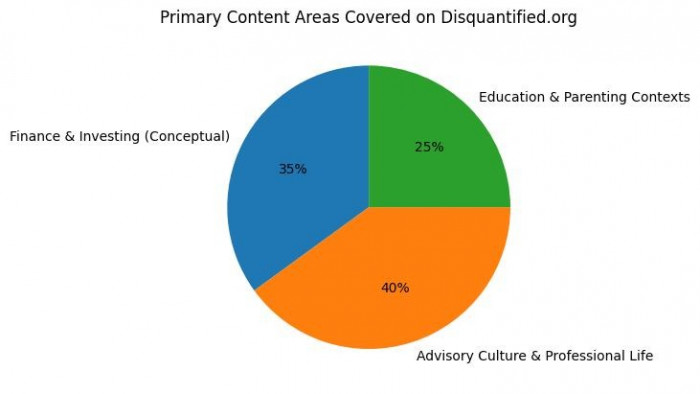
The site organizes its material into thematic categories. These categories are not instructional guides but discussion spaces.
a. Finance and Investing (Conceptual Focus)
Articles labeled under finance or investing do not provide:
- Market predictions
- Investment advice
- Performance benchmarks
Instead, they discuss:
- Anxiety created by constant portfolio tracking
- Social comparison driven by net-worth narratives
- The emotional impact of treating financial life as a scoreboard
This makes the content unsuitable for readers seeking financial guidance, but relevant for those examining the psychology surrounding money.
b. Advisory Culture and Professional Life
Another recurring theme is professional environments dominated by metrics, such as:
- Performance dashboards
- Output scoring
- Continuous evaluation systems
Rather than suggesting reforms or management practices, articles describe how these systems affect identity, motivation, and burnout from a worker’s perspective.
c. Education and Parenting Contexts
The site also examines:
- Grade-centric learning environments
- Developmental milestones framed as rankings
- Comparison-driven parenting norms
The content here is reflective, not instructional, and avoids proposing alternative educational models.
Writing Style and Content Depth
The site’s articles are generally:
- Essay-style rather than list-based
- Narrative rather than prescriptive
- Focused on framing questions, not delivering answers
This approach encourages slower reading but may frustrate readers looking for actionable takeaways. There are few summaries, checklists, or structured conclusions.
Traffic Patterns and Engagement Context
Available data suggests the platform operates at a moderate scale, with roughly:
- ~20,000 monthly visitors
- Average session durations are around five minutes
Traffic appears to come primarily from social sharing, indicating that articles circulate through interest-driven discovery rather than search optimization.
Longer session times suggest that readers engage with full articles rather than scanning headlines, though this does not necessarily indicate agreement with the ideas presented.
Audience Segments Observed
Based on interaction patterns and thematic focus, the readership broadly includes:
- Professionals experiencing fatigue from metric-heavy workplaces
- Students questioning performance-centric achievement models
- Parents reflecting on comparison pressures in child development
- General readers interested in philosophical or cultural critique
The site does not appear designed for a general mass audience; its tone assumes readers are already questioning metric-based evaluation systems.
Community Interaction
Disquantified.org intentionally avoids features common on modern platforms, such as:
- Like counts
- Activity scores
- Public engagement rankings
Discussion spaces, when present, emphasize written contributions over measurable participation. This design choice aligns with the site’s thematic focus but limits scalability and discoverability.
Use of Visuals and Illustrations
Visual elements on the site are minimal and conceptual. They are used to:
- Illustrate ideas
- Highlight contradictions in measurement culture
- Add interpretive context
Notably, the platform avoids charts, dashboards, or performance visuals, which would conflict with its critique of quantification.
What the Platform Does Not Provide
For clarity, Disquantified.org does not offer:
- Productivity tools
- Coaching programs
- Behavioral frameworks
- Measurable outcomes
- Structured interventions
Readers looking for solutions or methods may find the content incomplete. The site is better understood as analytical commentary, not applied guidance.
Practical Limitations for Readers
The platform’s approach introduces trade-offs:
- Concepts may feel abstract
- Arguments are qualitative rather than evidence-heavy
- Readers must draw their own conclusions
- No validation through empirical measurement is provided
These limitations are inherent to the platform’s philosophical stance rather than oversights.
Concluding Perspective
Disquantified.org can be read as a reflection space, not a solution platform. Its value lies in:
- Naming experiences that are often normalized
- Questioning assumptions embedded in metric-driven systems
- Encouraging readers to examine how numbers influence behavior
It is most useful for readers who already feel tension between measurement and meaning, and less useful for those seeking tools, metrics, or frameworks.
In environments where everything is tracked, ranked, and scored, the platform’s contribution is not instruction—but context.
Comments