

A Complete Scientific Explanation
At first glance, the question “Which is colder: −40°C or −40°F?” looks like a trick question. After all, Celsius and Fahrenheit are two different temperature scales with different starting points, different units, and different everyday meanings. Normally, the same number on each scale represents very different temperatures.
However, −40 is a rare and special exception.
In this article, we’ll break the concept down clearly, step by step, using science, math, and real-world examples, exactly the way a teacher would explain it to students preparing for exams or trying to build strong conceptual understanding.
The Short Answer (Before the Explanation)
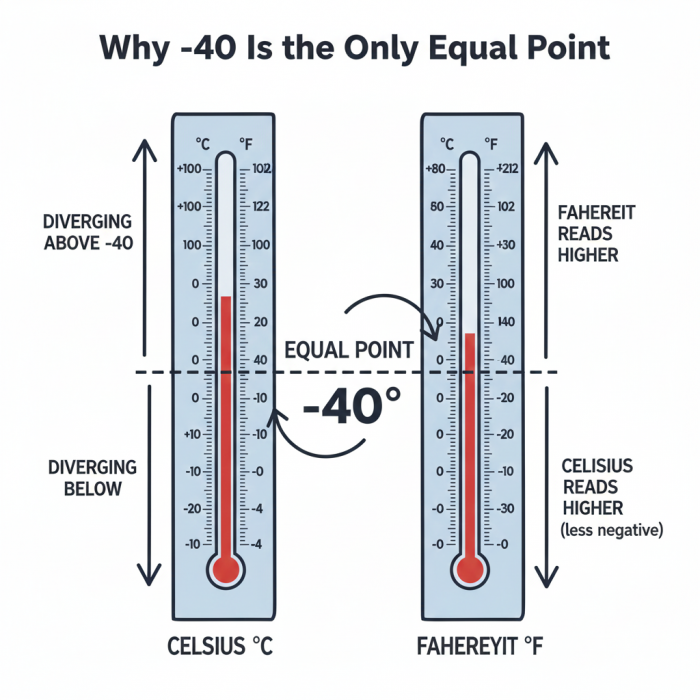
−40°C and −40°F are exactly the same temperature.
Neither one is colder than the other.
This is the only temperature where the Celsius and Fahrenheit scales give the same numerical value.
Now let’s understand why.
Understanding Temperature Scales First
To understand how two different scales can ever show the same value, we need to understand how each scale works.
Celsius Scale (°C)
Used in most countries around the world
- Based on water’s behavior
- Water freezes at 0°C
- Water boils at 100°C
- Scale increases in equal steps of 1 degree
Celsius is designed to be logical and closely connected to everyday physical phenomena.
Fahrenheit Scale (°F)
Used mainly in the United States
Water freezes at 32°F
- Water boils at 212°F
- Zero is not tied to water freezing
- Degrees are smaller than Celsius degrees
Because the two scales have different zero points and different step sizes, the same number usually means very different temperatures.
Why Numbers on Different Scales Can’t Be Compared Directly
A common mistake students make is assuming:
- A lower number always means colder
- Or one scale is “naturally colder” than the other
This is incorrect.
Temperature scales are measurement systems, just like kilometers and miles.
You wouldn’t compare 50 km and 50 miles directly without converting them first.
The same rule applies to Celsius and Fahrenheit.
The Conversion Formula (The Key to Everything)
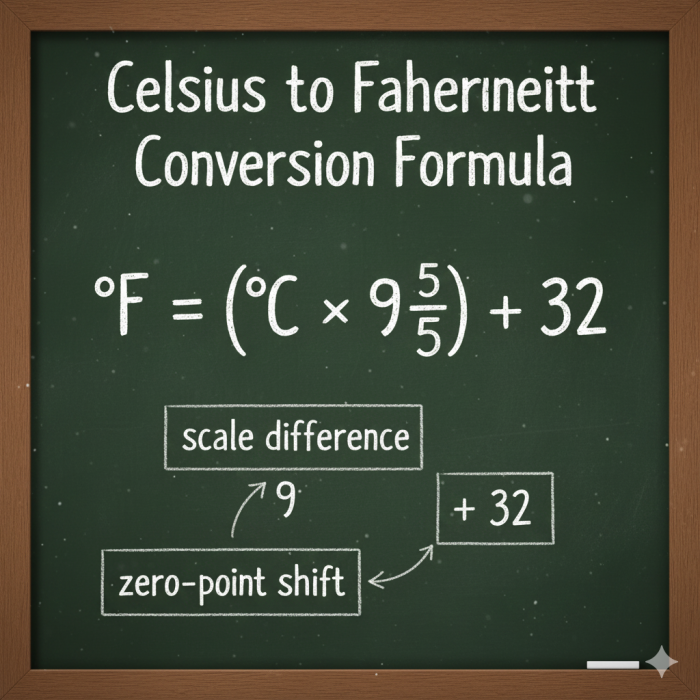
To convert Celsius to Fahrenheit, we use the standard formula:
°F=(°C×95)+32°F = (°C×59)+32
This formula accounts for:
The different step size (9/5)
The different zero point (+32)
Why Does This Happen Only at −40?
If we draw both temperature scales on a graph:
- Celsius increases faster (bigger degree steps)
- Fahrenheit starts higher but increases more slowly
As temperatures drop lower and lower, the two scales move closer together.
Eventually, they intersect at exactly one point.
That intersection point is −40.
At:
−30 → Celsius and Fahrenheit are still different
−20 → still different
−40 → they become equa
Below −40, the Fahrenheit value becomes numerically lower than Celsius.
Real-World Meaning of −40 Degrees
Whether measured in Celsius or Fahrenheit, −40 degrees is extremely cold.
At this temperature:
- Exposed skin can freeze in minutes
- Moisture in the air forms ice crystals
- Car batteries struggle to function
- Engine oil thickens
- Breathing feels sharp and painful
Such temperatures are commonly experienced in:
- Northern Canada
- Siberia
- Parts of Alaska
Meteorologists often point out −40 because it’s the only time they don’t need to specify the unit.
Common Student Confusions (Clarified)
“Celsius is colder because it’s used in science”
Not true. A scale doesn’t determine how cold something is.
“Fahrenheit is warmer because the numbers are bigger”
Numbers only matter within the same scale.
“−40°C is approximately equal to −40°F”
Incorrect. They are exactly equal, not approximately.
Exam-Oriented Key Point (Very Important)
−40 is the only temperature where Celsius and Fahrenheit are equal.
This fact is commonly tested in:
- School science exams
- Competitive exams
- General knowledge questions
Memorizing this one fact saves time and avoids confusion.
Summary Table
| Temperature | Celsius | Fahrenheit |
| Water Freezing | 0°C | 32°F |
| Water Boiling | 100°C | 212°F |
| Special Intersection | −40°C | −40°F |
Final Conclusion
The question “Which is colder: −40°C or −40°F?” has a unique and surprising answer.
Neither is colder.
They represent the same temperature.
This happens because:
- Celsius and Fahrenheit are linear scales
- They intersect at exactly one point
- That point is −40 degrees
Understanding this concept not only clears confusion but also strengthens your grasp of how measurement systems work in physics and science.
Comments