

If you’ve been drowning in tabs full of AI writers, social schedulers, and “growth hacks,” Blaze AI shows up with a bold promise: “What if your marketing just…ran itself?” It doesn’t quite reach that sci‑fi fantasy but it gets surprisingly close for the right kind of creator or business.
Blaze AI in One Sentence (That Actually Means Something)
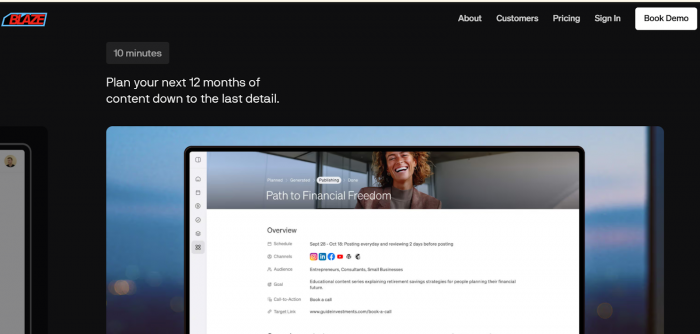
Blaze AI is not just another text generator; it’s a marketing cockpit where strategy, brand voice, content creation, scheduling, and performance live in the same space, aimed squarely at founders, creators, and small teams who want to act bigger than their headcount suggests.
Instead of handing you a pile of AI drafts and walking away, Blaze tries to sit across the whole journey: know your brand, plan your content, create the assets, push them live, and tell you what worked.
The Big Idea: “AI That Does Marketing For You”
Plenty of tools promise “AI for marketing.” Blaze flips the emphasis: AI that does marketing for you.
The platform wants to behave like a junior marketer who:
● Learns your tone and positioning.
● Suggests campaigns and content ideas.
● Drafts posts, emails, scripts, and product copy.
● Schedules them across your channels.
● Shows you what actually performed.
It doesn’t replace strategy or judgment, but it tries to automate everything that feels like drudgery: staring at blank docs, manually repurposing posts, hopping between social apps, and scrambling last minute to fill a content calendar.
Who Actually Feels the Difference?
In practice, Blaze is built for three archetypes:
● The “Do‑Everything Founder” who needs a marketing presence but lives in meetings, ops, and product.
● The Solo Creator who is active on multiple platforms and can’t afford to drop consistency.
● The Small Agency or Boutique Team that wants one hub for planning, creation, approvals, and publishing across multiple clients or brands.
For these people, Blaze is less of a “nice‑to‑try shiny tool” and more of a “please, just take this off my plate” decision.
If you’re a casual creator posting twice a month without monetization, Blaze can feel overpowered and overpriced. If you’re running a serious audience or brand, it starts to look like infrastructure rather than a toy.
The Engine Room: How Blaze Actually Works
1. It Learns to Talk Like You
Blaze doesn’t start with a blank personality. You feed it your existing materials—website copy, emails, social posts, maybe a blog or two. It builds a brand voice profile from this: tone, typical phrasing, level of formality, and key themes.
After the first round of training and corrections, most users report outputs that “sound like them” more often than not. It won’t capture every micro‑quirk (no AI does), but it’s good enough that many founders and creators feel comfortable publishing with light edits instead of rewrites.
You get the most out of this if you already have a decent library of content. If your brand is still a blank slate, Blaze will help you define a voice—but it will lean more on your prompts and feedback than on learned patterns.
2. It Turns Strategy into Assets
Once the voice is in place, Blaze switches roles—from listener to producer.
It can generate:
● Social posts and captions for platforms like Instagram, LinkedIn, Facebook, etc.
● Long‑form pieces such as blogs and thought‑leadership articles.
● Email newsletters and campaign sequences.
● Video scripts and outlines for YouTube, Reels, Shorts, or webinars.
● Promotional and product copy for launches, offers, and events.
You usually start with a goal (“launch a new product,” “educate audience on X,” “warm up cold leads”), give context, and let Blaze propose a set of content. You then keep what works, tweak what’s close, and discard what doesn’t.
The recurring theme in user feedback: drafting that used to take hours now takes minutes. The time shifts from “what do I even say?” to “which of these decent options do I polish and ship?”
3. It Repurposes Instead of Starting from Zero
One of Blaze’s most practical strengths is repurposing.
Instead of writing 10 separate pieces, you can:
● Feed it one long‑form asset (a blog post, a webinar outline, a podcast transcript).
● Ask it to create social posts, email snippets, short scripts, or promo blurbs from that source.
You still want to sanity‑check platform‑specific details (hooks for TikTok vs LinkedIn, lengths, CTAs), but the heavy lifting is handled. For content teams who believe in “one big piece → many smaller pieces,” Blaze fits their philosophy neatly.
4. It Schedules and Publishes, Not Just Suggests
Here’s where Blaze steps away from generic AI chat tools: it’s not content‑only, it’s content‑plus‑calendar.
Inside the platform, you get:
● A visual calendar to map out what goes live when.
● Connected social accounts so posts can be scheduled and auto‑published.
● A workflow that moves content from idea → draft → ready → scheduled → published.
That means you don’t copy‑paste everything into another scheduler; the tool that writes your posts is the same one that sends them out. For solo operators and small teams, this reduces the friction more than the marketing copy suggests.
Some users do wish the navigation and cross‑posting controls were smoother. If you’re used to a dedicated, polished social scheduler, you may notice Blaze’s edges. But if you’re coming from manual posting or spreadsheets, the integrated calendar feels like a serious upgrade.
5. It Watches Performance and Closes the Loop
Finally, Blaze offers basic performance insights so you’re not flying blind. You can see which posts or campaigns performed best, how engagement shifts over time and which channels seem to respond best to what type of content.
You won’t retire your advanced analytics stack if you’re running a large brand, but for small operations, having “good enough” analytics tied directly to your content workflow is better than chasing data across native dashboards.
Living with Blaze: UX, Learning Curve, and Friction
The first impression for many users is positive: the onboarding is guided, connecting your accounts is straightforward, and getting your first AI‑generated content out the door doesn’t take long.
But the daily reality sits somewhere in between “magically simple” and “power user tool”:
● The dashboard is reasonably clean, but once you stack multiple brands or more complex workflows, some users report that navigation can feel non‑obvious.
● On the performance side, many people love how much manual work it removes; others complain about slowness or functions that feel clunky in high‑usage scenarios.
● Like any AI system, it can ignore certain instructions, over‑simplify nuance, or repeat itself, requiring human oversight to maintain quality.
If all you know are minimal chat‑style AI tools, Blaze will feel “heavy.” If you’re used to juggling gravity‑defying spreadsheets, multiple apps, and a dozen logins, Blaze will feel surprisingly consolidated.
The Money Question: Pricing and Real Value
Blaze is not positioning itself as a cheap, casual purchase. Its pricing sits in what you could call the “serious tool” band:
The entry-level plan targets solo creators and individual professionals, typically priced in the low to mid double digits per month. Higher tiers—Pro, Startup/Team, and Agency move into the higher double-digit or low-hundred range, adding more users, greater limits, and enhanced support, with annual discounts and trial offers helping reduce the initial commitment.
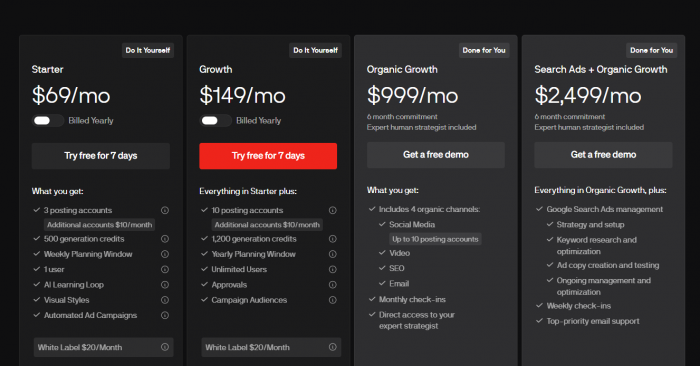
There’s a simple way to evaluate it:
● If Blaze saves you, say, 10+ hours a month (quite realistic for active marketers), its cost often lands below what you’d pay for a freelancer or part‑time assistant for the equivalent amount of work.
● If your revenue doesn’t move at all when you publish more or publish better, no tool’s going to justify itself—Blaze included.
For creators and businesses that monetise attention like courses, services, products, sponsorships, the time and consistency gains tend to stack in Blaze’s favour. For hobbyists, it’s overkill.
What People Actually Say About Blaze
Distilled from long review pages and public feedback, the story sounds like this.
The Love Letters
● “It saves me hours” is a recurring sentiment. People who used to stare at empty content calendars now see weeks of mapped‑out posts in one sitting.
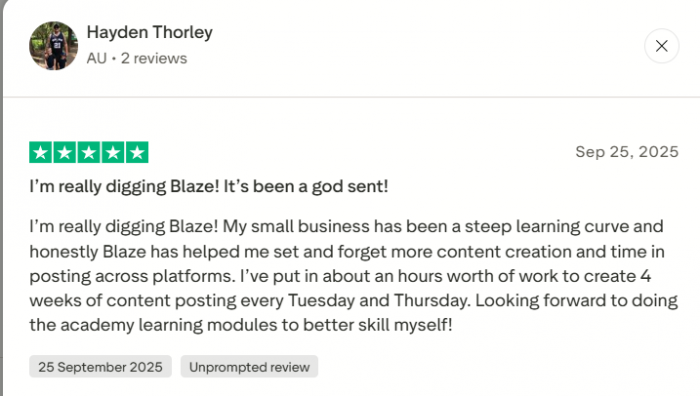
● Many praise its ability to hold a coherent, consistent brand voice over time, making feeds feel more intentional and professional.
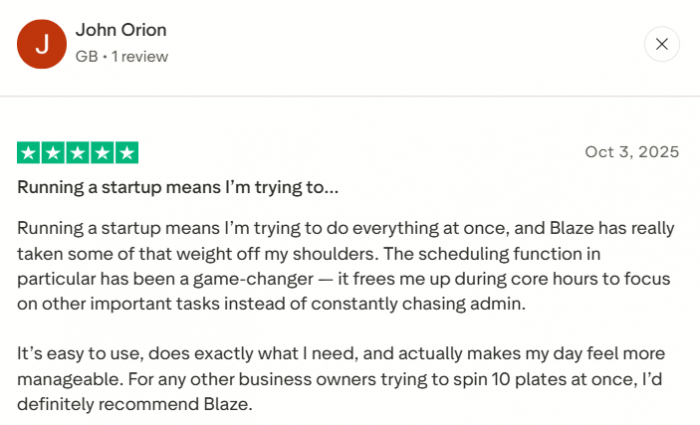
● The all‑in‑one design—ideas, writing, scheduling, analytics is a big win for those who hate duct‑taping four or five tools together.
The Eye‑Rolls
● Some users complain that the interface could be more intuitive, particularly when dealing with multiple brands or switching between views.
● Performance isn’t perfect: slow pages or laggy actions do show up in negative reviews.
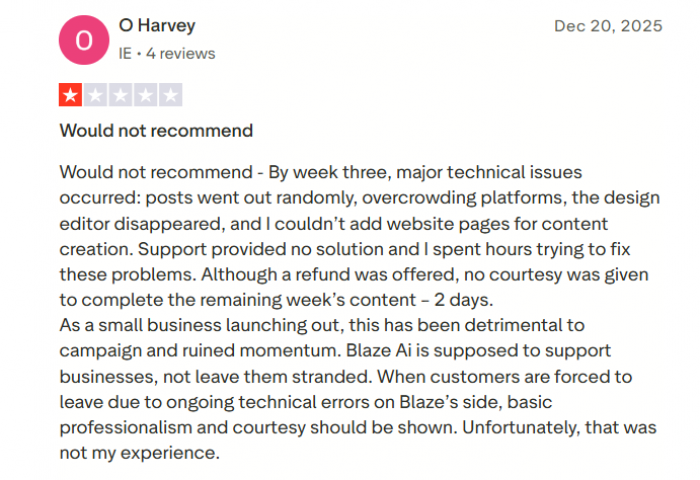
● Price sensitivity is real: compared to bare‑bones AI writers, Blaze is on the higher side, and “is this worth it for me?” becomes a very personal calculation.
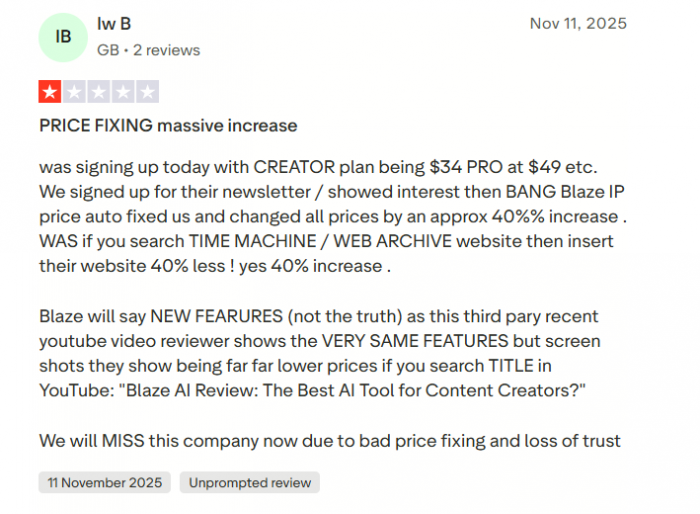
The pattern is clear: users who treat content as a serious, recurring business task are more likely to feel the tool is worth its weight. Users who wanted magic without effort or budget are more likely to walk away unimpressed.
Where Blaze Makes the Most Sense
Blaze hits its stride when three conditions are true:
1. Content volume matters: You publish frequently enough that batching and scheduling are non‑negotiable.
2. Brand matters: You care that everything feels unified and intentional, not random AI blurts.
3. Time is scarce but valuable: Every hour spent fiddling in Canva, Docs, and schedulers is an hour not spent on product, clients, or sales.
Ideal scenarios:
It’s ideal for a SaaS founder who needs a LinkedIn presence, a newsletter, and active social channels but doesn’t have a dedicated marketer, as well as for a coach or consultant juggling Instagram, email, and YouTube who wants to stay consistent without burning out. It also suits small agencies managing multiple client brands that need shared workflows, approval processes, and a centralized hub.
Less‑than‑ideal scenarios: It’s less suited for side-project creators who post occasionally and haven’t started monetizing, as well as for large teams already deeply embedded in enterprise-level platforms with advanced, custom analytics.
How Blaze Stacks Up Against “Everything Else”
● General AI chatbots: Great for raw text, cheap/free, but they don’t know your schedule, analytics, or channels. You get content, not a system.
● SEO‑first platforms: Brilliant for long‑form search‑optimized content, but they usually stop long before social posting or day‑to‑day campaign execution.
● Lightweight social AI tools: They’ll draft captions and queue posts, but lack deeper brand training, repurposing workflows, or campaign‑level thinking.
Blaze’s pitch is simple: instead of duct‑taping one of each together, use one environment that understands your voice, your publishing rhythm, and your basic performance signals.
If you enjoy picking the best‑in‑class tool for each slice and stitching them together yourself, Blaze will feel like a compromise. If you’d rather have one “good enough at most things” hub that drastically cuts down friction, Blaze fits that role.
Final Words: Is Blaze AI Worth Your Attention?
If your marketing is Strategic, Recurring, and Meaningful to your revenue then Blaze AI deserves at least a trial run.
It won’t completely remove the need for human judgment or editing but it dramatically reduces the number of blank pages, late‑night content scrambles, and disconnected workflows. For many founders, creators, and small teams, that alone is worth the subscription.
If, on the other hand, your content cadence is low, your budget is tight, and your expectations are that AI will handle everything end‑to‑end without your involvement, Blaze will likely feel like too much tool for not enough payoff.
Used well, it’s less a gadget and more an extra pair of marketing hands always on, always available, and increasingly fluent in the way your brand speaks to the world.
Comments