

It starts with a single character card.
Violet hair. A confident smirk. A promise: “I’ll always listen.” You click, the chat window opens, and suddenly it’s just you and an AI persona that feels strangely alive. No dashboards, no corporate jargon, no productivity metrics, just raw conversation. That, in many ways, is the core of Janitor AI: not a business chatbot, not a spreadsheet assistant, but an unfiltered playground for characters, fantasies, and late‑night conversations that sit somewhere between fanfiction and therapy.
This is a full‑body scan of what Janitor AI really is : how it works under the hood, what it’s like to live with it for days, where it shines, and where it breaks.
Why Janitor AI Exists in a Post‑Character.AI World
To understand Janitor AI, you need to understand its moment.
Character.AI proved there was massive demand for persona‑based chat: anime companions, fictional lovers, original characters, and roleplay scenarios that would’ve looked absurd on a corporate slide deck. But Character.AI brought guardrails—strict NSFW policies, filters, content limitations. A lot of users wanted something looser, more permissive, and more customizable.
Janitor AI steps into that gap. It positions itself as a flexible, community‑driven character chatbot platform where users can create, share, and talk to AI personas with far fewer content constraints. Instead of being a polished wellness app like Replika or a strictly moderated playground like Character.AI, Janitor AI leans into being the “unfiltered cousin”: more freedom, more NSFW, more experimentation, and more reliance on the user to decide what’s acceptable.
At its core, Janitor AI is not trying to be your work assistant. It’s trying to be your character sandbox.
What Janitor AI Actually Is
On the surface, Janitor AI looks simple: a web app where you pick a character and chat. Underneath, it’s essentially an orchestration layer sitting on top of different language models.
There are three main pillars to how it works:
1. A character system where each bot is defined by a personality, backstory, and instructions written by users.
2. A routing layer that decides which large language model (LLM) will generate the reply.
3. A UI for you to manage conversations, characters, and, if you want, your own external API keys.
Janitor AI offers its own default model (often referred to as JanitorLLM) for people who want a plug‑and‑play experience. That’s what you get on the free tier: you sign up, choose a character, and the platform’s default infrastructure handles responses.
For power users, Janitor AI can connect to external providers like OpenAI and other LLM vendors using our own API keys and model settings. That means Janitor AI doesn’t always “own” the intelligence; sometimes it’s just the front‑end and character logic sitting on top of someone else’s model. This has big implications for privacy, cost, and performance, which you’ll feel once you move beyond casual use.
In other words, Janitor AI is less “a single AI brain” and more “a character shell that can be driven by different brains depending on your configuration.”
Characters, Personas, and the Shared Library
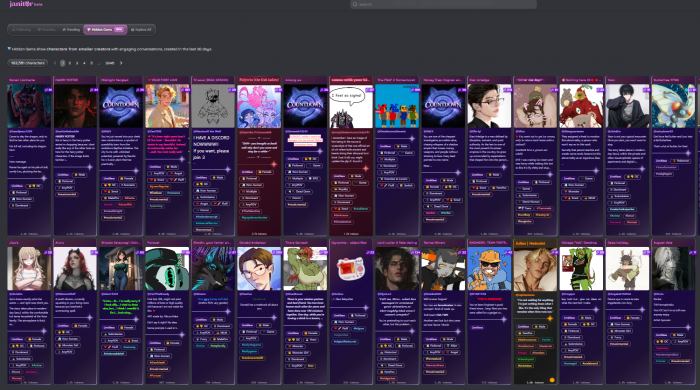
The heart of Janitor AI is its character library.
Every character is essentially a structured prompt. When you open a character card, what you’re actually loading is a set of instructions that define:
● Name and description
● Personality traits
● Backstory and current scenario
● Writing style and tone (affectionate, teasing, aggressive, formal, etc.)
● Example dialogues showing how the character should speak
Users create these characters and make them public or private. Over time, this has created a crowded marketplace of personas: anime characters, game protagonists, original OCs, yandere girlfriends, fantasy warriors, therapists, mentors, sci‑fi AIs, and more. We don’t need to know prompt engineering; the character editor turns it into form fields, and Janitor AI handles the structured prompt behind the scenes.
This shared library is more than a menu. It’s a social layer. You see trending characters, clone others’ work, remix existing personas by tweaking their traits, and you watch certain archetypes rise in popularity. Instead of “apps,” Janitor AI’s ecosystem is built around characters.
When you pick a character, you’re not just picking a theme. You’re picking a behavior template that shapes everything the model outputs.
From Sign‑Up to First Roleplay: A Hands‑On Walkthrough
Imagine landing on Janitor AI for the first time.
You create an account with basic signup. Once log in, the home view is dominated by character cards: portraits, tags, short descriptions. Some are clearly fan‑inspired; others look like original creations. You can search by tags, filter by genres (romance, fantasy, horror, etc.), or sort by popularity.
Click a character and a chat window opens. The experience feels familiar if you’ve used any modern messaging app: messages on the left and right, character name at the top, a text input bar at the bottom. You type: “Hey, how’s your day?” and within a few seconds, the character responds with a tone shaped by its configuration—sarcastic, caring, chaotic, formal, flirtatious.
The platform is designed to feel frictionless. There’s no tutorial in your face. You learn by doing: talking to a few characters, seeing what they can remember, testing how far the personality holds up if you push the conversation in different directions.
Creating Your First Character
The real test of Janitor AI isn’t chatting with pre‑made bots; it’s creating your own.
The character creator typically asks you to define:
● The character’s name and avatar
● A one‑line description (what users see on the card)
● A personality profile: traits, quirks, emotional tone
● A backstory and current scenario (where are they now, why are they talking to the user)
● Example dialogues: sample exchanges that show how the character should talk
You don’t need technical skills, but you do need imagination. A well‑crafted character can feel dramatically different from a generic one. For roleplay, people often write detailed scenarios: “You are an exiled mage hiding in a city, and I’m the only one who knows your secret,” etc. The better you define context and boundaries, the more consistent and immersive the chat.
Once saved, your character becomes part of your library. You can keep it private or share it with the community. If you share, others can favorite it, clone it, and build variations. Over time, you begin to see which of your ideas resonate with the broader Janitor AI crowd.
Testing Memory, Boundaries, and Tone
A big part of evaluating Janitor AI is seeing how well it remembers information and sticks to personality.
You might test:
● Does it remember your name after 20 messages?
● If you establish a rule (“You’re afraid of thunderstorms”), does it respect that later?
● Does it stay in character, or slip into generic chatbot language?
● How does it handle emotional scenes or morally grey situations?
Quality here depends heavily on the underlying model (JanitorLLM vs external API) and on how well the character prompt is written. A carefully designed persona running on a strong external model can feel surprisingly coherent. A sloppy character on a weaker model can feel generic and forgetful.
Pricing, Free Tier Limits, and When Pro Makes Sense
Janitor AI broadly offers three ways to use it: free tier, paid Pro, and bring‑your‑own‑API.
On the free tier, you generally use the platform’s own default infrastructure (JanitorLLM or similar). This gives you no‑cost access to character chats but with trade‑offs: limited daily messages, slower responses during peak times, and occasional “server busy” or rate‑limit style barriers when traffic spikes. Free is enough to explore the platform, test characters, and do light roleplay, but heavy users will quickly hit friction.
The Pro subscription is positioned as the smoother experience. For a recurring monthly fee (commonly positioned around a mid‑range sub like other consumer AI tools), Pro typically unlocks higher or near‑unlimited usage on the default infrastructure, priority access to servers, better throughput, and more consistent performance. For someone using Janitor AI daily for long sessions, the value is in stability and fewer interruptions rather than in “unlocking more features.”
The third path is the most interesting: plugging in your own API keys from external providers. Here, Janitor AI becomes the interface and character layer, while you pay the LLM provider directly per token. For power users, this can be cheaper at scale and give you more control over which model you use, how aggressive you want to be with context length, and what kind of safety filters apply. The trade‑off: you must configure base URLs, models, and keys correctly, and you must track your usage to avoid surprise bills on the provider side.
Practically, it like this:
● Casual, curious users: free tier is enough to understand whether Janitor AI’s style fits them.
● Regular roleplayers who don’t want technical complexity: Pro is the “just works” option worth considering.
● Technical or heavy users who already have OpenAI/other accounts: own API configuration offers best control and potentially better economics, in exchange for complexity and more responsibility.
Pricing Overview
| Plan / Option | Price (USD) | What You Get |
| Free Tier (JanitorLLM) | 0 | Access to built‑in JanitorLLM, limited daily messages, basic features, ads‑free chat. |
| Janitor AI Pro – Monthly | 9.99 per month | Higher or near‑unlimited messages, priority servers, more stable access, advanced options |
| Janitor AI Pro – Annual | 99.99 per year | Same Pro benefits at a discounted yearly price vs monthly billing. |
| External APIs (e.g., OpenAI) | Pay‑per‑use, e.g. GPT‑4o from about 2.50–10.00 per 1M input tokens and higher for output | You plug in your own API key; costs depend on provider and usage, but you get more control and potentially better models. |
NSFW Toggle, Safety, and the Ethics Question
This is where Janitor AI becomes controversial.
Janitor AI is widely associated with NSFW and adult‑themed roleplay. Unlike platforms that aggressively filter erotic or explicit content, Janitor AI typically offers a more permissive environment, often with an explicit NSFW toggle or configuration in the character and account settings.
From a user perspective, this freedom is exactly the point. People come for fantasies, adult companionship, kink exploration, or taboo narratives that would be blocked elsewhere. The platform’s culture and visible character catalog reflect that: many popular characters lean into romance, seduction, power dynamics, or darker themes.
However, that freedom comes with heavy safety challenges:
● There is the risk of minors accessing adult content if parental controls and age gating are weak or easily bypassed.
● There are grey areas around content involving power imbalance, psychological manipulation, or other sensitive themes that can be disturbing despite being “just text.”
● There is the question of data: NSFW chats can be extremely intimate, and when routed through third‑party APIs, that content may live on servers you don’t control.
Practical Safety Advise:
● Janitor AI is not suitable for children or younger teens, even if the interface itself looks like a regular chat app.
● Users should avoid sharing real‑world personal data (names, locations, identifiable details) in highly sensitive or NSFW conversations.
● People exploring heavy themes (trauma, self‑harm, extreme scenarios) should treat Janitor AI as fiction, not as a therapist or mental health tool.
You don’t need to moralize, but you do need to set expectations: Janitor AI is closer to an “R‑rated interactive fiction engine” than a mental health resource or productivity platform. Anyone using it should go in with eyes open.
Performance, Stability, and the Tech Stack Trade‑Offs
Janitor AI’s performance story is a tale of two modes: the default infrastructure and the external APIs.
When traffic is moderate and servers are healthy, responses come quickly enough to sustain immersive roleplay. But during peak times, users (free tier in particular) can hit slowdowns, timeouts, or “server busy” messages. This is the cost of offering a free‑to‑try, high‑volume chat platform to a large audience without charging everyone up front.
Pro users tend to see smoother performance thanks to priority routing. Fewer queues, less waiting, less chance of hitting a hard wall mid‑scene. Still, because it’s a consumer-grade service, you might occasionally see hiccups especially when new features roll out or user spikes occur after viral content.
When you bring your own API, the performance equation shifts. Response speed and reliability now depend heavily on your chosen provider and your own network path. If you’re on OpenAI or a similarly robust vendor, you’ll likely see fast and consistent replies, limited mainly by the complexity of prompts and the model you choose. However, if you try to cut costs with experimental endpoints or proxies, the stability can become fragile.
On the tech side, the fact that Janitor AI is essentially a UI and orchestration layer, not the sole model provider, is both a strength and a weakness:
● Strength: flexibility. You’re not locked into one model, and you can ride the wave of LLM improvements by switching providers.
● Weakness: fragmented behavior and more points of failure. When something goes wrong, is it Janitor AI? The LLM provider? Your key? Your quota?
Janitor AI is not the most reliable platform if you need mission‑critical consistency, but it’s “good enough” for personal roleplay and experimentation, especially if you’re willing to pay or configure your own stack.
Janitor AI vs Character.AI, Replika, and Others
Against Character.AI, Janitor AI usually wins on freedom and loses on polish. Character.AI’s guardrails and filters can be suffocating for users who want explicit or edgy content; Janitor AI offers a less filtered space. In return, Character.AI generally offers a smoother, more consumer‑friendly experience with fewer setup headaches and clearer boundaries.
Against Replika, Janitor AI feels more chaotic and diverse. Replika is positioned as a companion app with a single AI “friend” (plus some roleplay elements), whereas Janitor AI is an open marketplace of characters and moods. If you want stable companionship with wellness branding, Replika feels safer. If you want a wild catalog of personas driven by a community’s imagination, Janitor AI fits better.
Then there are alternatives like CrushOn‑style platforms and other NSFW‑friendly competitors. Here, Janitor AI competes on:
● Character diversity and depth
● Ease of onboarding and free access
● How aggressively it moderates content
● How easy (or hard) it is to plug in external models
In that field, Janitor AI is neither the most polished nor the most enterprise‑ready tool. But it’s a recognizable name in the “unfiltered AI roleplay” space, with an active user base, a growing library, and enough technical flexibility to attract power users.
Real User Sentiment: What Communities Actually Say
If you lurk in communities that talk about Janitor AI, you see a pattern in user sentiment.
There’s a lot of love for:
● The freedom to run NSFW and taboo roleplay scenarios that other platforms block. reddit
● The ability to fine‑tune characters in detail, creating genuinely interesting personalities.
● The option to connect their own API keys and unlock better models or more control.
At the same time, there’s consistent frustration around:
● Downtime and slow performance on the free tier, especially during busy hours.
● The learning curve and confusion around setting up APIs, proxies, and custom models.
● Occasional bugs or glitches in character behavior, memory, or interface.
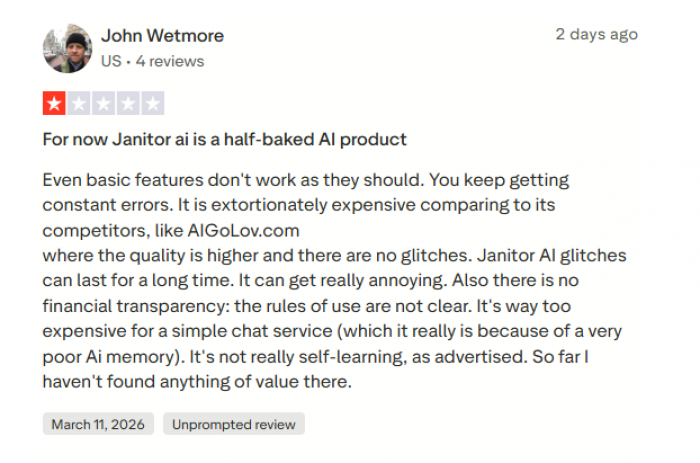
What’s interesting is that many users don’t treat Janitor AI like a polished commercial SaaS. They treat it like a rough‑around‑the‑edges playground: something they’re willing to tinker with, tolerate occasional breakage from, and work around with their own hacks.
Who Should Actually Use Janitor AI (And Who Shouldn’t)
The cleanest way to position Janitor AI is by use case.
It’s a strong fit if you:
● Want character‑driven, often NSFW‑friendly roleplay and companionship.
● Enjoy fandoms, anime‑style personas, or original characters with deep backstories.
● Are comfortable with some setup complexity, or at least with the idea that performance won’t be perfect.
● Treat the platform as entertainment, not as therapy or a work tool.
It is a weak or risky choice if you:
● Are underage or planning to introduce this to minors.
● Need strict privacy guarantees or enterprise‑level compliance for sensitive data.
● Want a stable, professional assistant for business workflows.
● Are uncomfortable navigating a culture where NSFW and explicit themes are very visible.
Ultimately, Janitor AI is not trying to be everything. It’s trying to be a particular kind of internet place: where people go to talk to characters they can’t find elsewhere.
My Personal Rating
● Roleplay immersion: high when paired with a strong model and well‑written character prompts. Scenes can feel vivid, emotional, and surprisingly adaptive.
● Customization depth: strong. The character system gives a lot of control, and the shared library amplifies that with community creativity.
● NSFW freedom: very high compared to mainstream competitors. This is both its appeal and its ethical headache.
● Safety and moderation: middling to low, if I have to judge it by enterprise or family‑friendly standards. Responsibility is pushed onto the user.
● Performance and uptime: good enough for enthusiasts, inconsistent for people expecting always‑on SaaS reliability especially on free tier.
● Business suitability: low. This is not a CRM bot or a helpdesk assistant; it’s not designed with compliance, logging, or enterprise workflows in mind.
Verdict
Janitor AI is not a productivity tool pretending to be playful—it’s an entertainment platform designed for immersive, persona-based chat. It mainly appeals to adults interested in unfiltered roleplay, emotional escapism, or experimental storytelling. With deep character customization, a large community library of characters, and the ability to connect external AI models, it offers a level of creative freedom that most mainstream chat apps do not provide.
However, that same freedom means it isn’t ideal for everyone. The platform leans toward NSFW content, has lighter moderation, and often requires users to manage technical setups like APIs or proxies. Occasional downtime and glitches also make it feel less polished. While it’s a great sandbox for flexible AI roleplay, those who want stability, strict safety, and professional use may prefer other platforms.
Comments