
Yoodli AI didn’t start for me as “an AI tool.” It started as a dare: what if I stopped guessing how I sound and actually measured it? The moment I saw my own voice as data speed, filler words, clarity, I realized I’d been driving my communication blind for years.
This is the story of what it’s like to live with Yoodli AI as a speaking lab, not just a one‑time toy. I’ll walk you through my own days with it, the good, the awkward, the parts that feel magical, and the parts that absolutely don’t.
Day 1 – Opening the black box of my voice
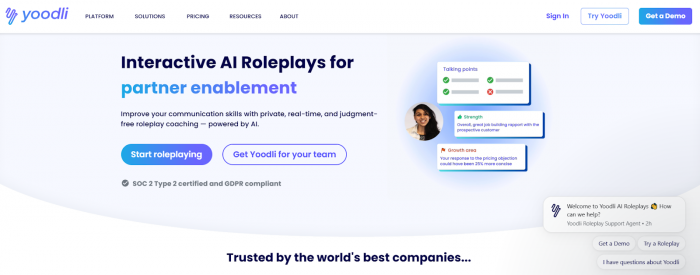
The first time I logged into Yoodli AI, I treated it like any other shiny AI thing. Quick signup, quick skim of the homepage, quick assumption that I’d close the tab in ten minutes.
Instead, I clicked into a job interview roleplay. The setup was simple: Yoodli on screen as an interviewer, me on mic as the candidate. It asked the classic “Tell me about yourself.” I launched into my usual safe monologue: where I work, what I do, some achievements, a half‑humble brag or two.
Then the AI did something subtle but important. It didn’t just move to the next question. It asked: “You mentioned X, can you give me a specific example with an outcome?” That little nudge exposed how fluffy my answer actually was. I realized I’d been skating on generalities.
When I finished and ended the session, Yoodli didn’t pat me on the back. It opened a dashboard that felt like a diagnostic scan: words per minute, filler word count, talk–listen balance, and timestamps where I failed to actually answer what was asked. I didn’t feel “coached” yet, but I definitely felt seen.
Day 3 – When practice becomes a rhythm, not an event
By the third day, I started structuring my time around Yoodli AI sessions. I’d do a ten‑minute roleplay before an important meeting, almost like warming up my voice at the gym.
The difference from traditional “practice” was the feedback loop. I wasn’t rehearsing blindly in front of a mirror; I was running sprints and then immediately checking my stats. Did I speak slower this time? Did my filler words drop? Did I stay on topic?
After a week of this, my dashboard wasn’t just a one‑off report anymore. It looked like a heartbeat: a line of ups and downs showing where I was improving and where I slipped. I stopped asking “Am I good at speaking?” and started asking “What am I working on this week?”
That mental shift from identity (“good speaker / bad speaker”) to training (“what’s today’s focus?”) was one of the biggest changes Yoodli brought into my life.
Switching genres – interviews, sales, and hard conversations
Yoodli AI feels like a set of different stages built on the same engine. I tried three repeatedly: the interview stage, the sales stage, and the “this conversation could go badly” stage.
On the interview stage, the AI played my hiring manager. It challenged vague claims, dug deeper into impact, and essentially forced me to speak in stories instead of bullet lists. After a few sessions, the difference showed up in real life: when actual interviewers asked me about my work, my answers were tighter, more concrete, and less apologetic.
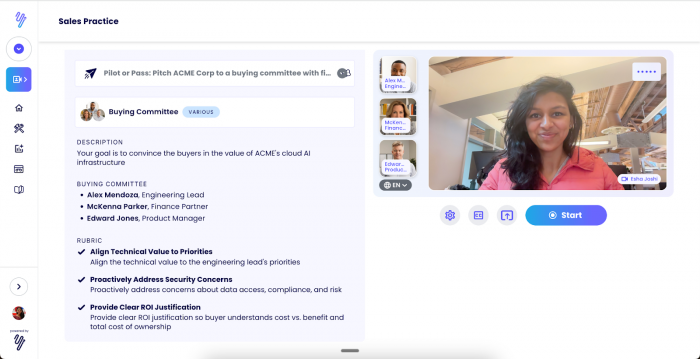
On the sales stage, I wasn’t technically a salesperson but I was still selling ideas, projects, and decisions. The AI became a skeptical stakeholder. It questioned ROI, nitpicked trade‑offs, and sometimes just said, “I don’t see why this matters.” That’s brutal when you’re attached to your proposal, but it’s exactly what tough real‑world stakeholders do. Practicing those conversations in simulation made high‑stakes meetings feel less like ambushes and more like reruns.
The hardest stage was the “difficult conversation” one: giving feedback to someone, saying no, resetting expectations. These were emotionally loaded scenarios, even in simulation. The AI responded with defensiveness or confusion in ways that felt uncomfortably real. Here, Yoodli’s value wasn’t only in data; it was in exposing my instinct to over-explain, to soften too much, or to avoid clear language when things got tense.
Behind the curtain – the metrics that quietly rewired me
Underneath all these scenes, Yoodli is counting and charting things most of us never track.
Speed was the first metric that changed my behavior. I always thought I spoke at a reasonable pace, until the dashboard told me I was accelerating as soon as I felt nervous. Seeing “You averaged X words per minute” after a session made it impossible to hide from that habit. I started deliberately inserting pauses, and watching the average shift downward became oddly satisfying.
Filler words were the second. Yoodli didn’t just say “You use fillers”; it showed where they clustered. They spiked during uncertain answers or when I tried too hard to impress. Once I saw that pattern, I could tie filler reduction to better preparation and more honest, simpler answers.
The third layer was about clarity. Yoodli flagged answers where I never really landed a point. I began to notice how often I gave context first and buried the actual answer in the middle. Over time, a new default emerged: answer first, then explain, then close cleanly. I wasn’t trying to “sound smart” anymore; I was trying to be understood.
None of this came from inspirational quotes or generic tips. It came from my own data, session after session, pushing me toward specific micro‑adjustments.
A week in my life with Yoodli AI
To understand how it actually fits into a routine, here’s what a typical week started to look like once I got serious.
On Monday, I would run a short roleplay for any big conversation on the calendar that week, a presentation, a tough update, an interview, or a tricky negotiation. I’d focus that session on structure: what’s my opening, what’s the core message, what does a strong close sound like?
Mid‑week, I’d use Yoodli almost like a stress test. I’d deliberately choose a scenario that made me uncomfortable: an overly skeptical customer, a defensive colleague, a rushed interviewer. The goal wasn’t to “win”; it was to see where my composure cracked and what my metrics did under pressure.
By Friday, I’d upload or recreate something real that already happened: a segment of a talk, a mock recitation of a call, a summary of the week’s key meeting. Then I’d compare those metrics with my earlier practice sessions. That’s where I could see whether the lab work was bleeding into my actual performance.
It wasn’t glamorous, but it was honest. Improvement stopped being a feeling and became a pattern I could point to.
What changes when a team plugs into Yoodli AI
Everything above is from an individual perspective. When you zoom out to a team, especially a sales or leadership team, Yoodli becomes a different kind of machine.
Instead of everyone practicing in their own chaotic way, leaders can encode shared scenarios that mirror real life: the new product pitch, the standard demo, common objections, recurring internal updates. Reps and managers can run those scenarios repeatedly, and the platform logs not just the content of answers but the delivery quality.
Suddenly, one‑to‑ones change. Instead of “How do you think that went?”, a manager can say, “Let’s look at how your pacing changed compared to three weeks ago,” or “You’re still dodging this one objection; let’s practice it.” The conversation moves from hand‑wavy feedback to concrete coaching.
For onboarding, this is a quiet revolution. New hires don’t have to learn only from live calls, where every mistake costs real trust or revenue. They can “crash safely” in simulations and show up to their first real calls already having felt the pressure and seen their weak spots.
Yoodli doesn’t replace a manager, but it pre‑loads the hard work. Managers don’t have to sit in every mock; they can let the AI handle repetition and use their time for nuance and strategy.
Money and value – the way it felt to me
From my own wallet’s perspective, the free tier was a strong audition: enough sessions to get humbled, fascinated, and hooked. It’s perfect if you have one big event, a major interview, a single presentation and you just want to do a handful of intense preparatory sessions.
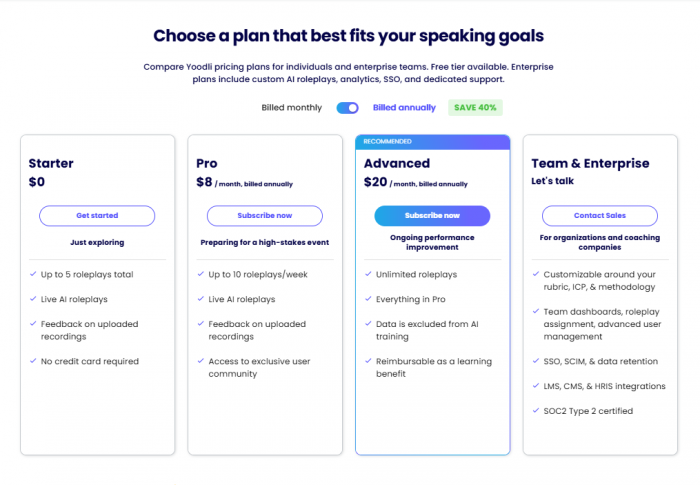
The calculus changes when speaking is a recurring part of your life. If you’re pitching regularly, interviewing often, presenting repeatedly, or leading teams, the paid plan stops being “another subscription” and starts feeling like a gym membership. The question shifts from “Is it cheap?” to “Will I actually use it enough that the progress justifies the cost?” For me, the answer became yes once I built it into a weekly routine.
On the team side, the only honest way to assess it is in terms of avoided pain. How many shaky calls can you prevent? How much faster can new hires become credible in front of customers? How much manager time can you reclaim by automating basic roleplay and leaving humans to focus on higher‑level coaching? If you don’t plug it into onboarding and enablement, it’s hard to justify. If you do, the value becomes obvious fast.
What Yoodli AI really gets right
If I had to make a shortlist of the things Yoodli nails, this would be it.
It turns vague self‑awareness into concrete evidence. Instead of “I think I talk too fast,” you see exactly how fast. Instead of “I probably use fillers,” you see how often, and where. That doesn’t just inform you; it invites you to experiment.
It makes practice realistic enough to hurt a little, but safe enough to not cost you anything. There’s a very specific feeling when the AI interviewer looks confused, or the AI customer pushes back. You feel tiny flares of stress, the same ones you feel in real life but this time they happen in a sandbox, where you can rewind and try again.
It scales human coaching instead of trying to erase it. Yoodli happily takes on the boring parts: counting, tracking, running basic roleplays 50 times. That frees up managers, mentors, and coaches to do the high‑leverage work: storytelling, strategy, mindset.
And it stays flexible. The same system handled my interview prep, my “sell this idea to leadership” rehearsals, my “tell this person something they don’t want to hear” simulations, and even quick dry runs of conference talks. That versatility matters if you’re trying to improve as a communicator across your whole life, not just in one narrow niche.
Where Yoodli AI stops and other things must begin
For all of that, Yoodli has clear boundaries and it’s important to respect them.
It doesn’t understand your history with another person, your cultural context, or your internal emotional landscape. If your problem is deep fear of conflict, or complicated office politics, or long‑standing confidence issues, data and roleplay alone aren’t enough. You’ll need human conversations, therapy, mentoring, and reflective work on top.
Privacy is not a theoretical concern. This is still a cloud‑based system. I quickly developed my own rule: I don’t speak full, real names, proprietary numbers, or unreleased strategies into any practice environment, no matter how trustworthy it seems. I rehearse structure, tone, and delivery, then map that onto specifics in my head.
It can also be confronting. Seeing your vocal habits in charts and numbers is not for everyone. Some people will find it empowering; others will feel exposed. I had to learn to treat the dashboard like a coach’s notebook, not a verdict on my worth.
And finally, if you’re expecting a single platform that covers everything from communication training to CRM, analytics, pipeline management, and content creation, Yoodli is not that. It’s deliberately narrow: a communication gym. It plays very well with other tools; it doesn’t try to replace all of them.
What changed in my real life (and not just inside the app)
The true test of any tool is what happens when you close it.
I started catching myself mid‑sentence in real meetings: “You’re speeding up. Breathe.” I noticed filler phrases as they came out of my mouth and cut them short. I organized answers into cleaner arcs without thinking about it statement, support, close because that shape had been drilled over dozens of sessions.
The stakes didn’t feel as lethal in high‑pressure conversations anymore. It wasn’t that I stopped being nervous; it was that I’d already “burned” the worst versions of my answers in practice and seen what better versions looked and felt like.
In other words, Yoodli didn’t give me a new personality. It gave me new defaults.
So, is Yoodli AI worth inviting into your life?
If you see speaking as a fixed trait “I’m just not good at communication” Yoodli might feel like punishment: a mirror that never blinks. But if you see speaking as a skill, the way you see fitness or writing or design, it becomes something else entirely: a long‑overdue training ground.
For occasional, low‑stakes speaking, you don’t need something this intense. But if interviews decide your opportunities, if presentations shape your reputation, if sales calls drive your income, or if leadership conversations define your relationships at work, then having a private, data‑driven lab for your voice stops being a luxury and starts looking like a sensible investment.
That’s what Yoodli became for me: not a magic wand, not a replacement for humans, but a relentless, patient lab that finally made my communication as measurable and improvable as any other skill I care about.
Comments