

An X formerly Twitter bio has only a few seconds to do its job. Someone notices a reply, opens the profile and quickly decides whether the account belongs in their feed. A vague line may sound pleasant, but it gives that visitor little reason to stay. A useful bio makes the account easier to understand.
The aim is not to appeal to everyone. It is to help the right people recognise the subject, perspective and value of the account. That requires more than listing a job title or adding a clever quote. The bio must connect the person behind the account with the content a follower can expect after clicking Follow.
The Wrong-Follower Problem
Many bios are written as if the main goal is to appear broadly interesting. They combine several roles, a motivational phrase, a hobby and a link, then expect visitors to work out what the account is really about. The result is usually not wider appeal. It is weaker positioning.
A person may discover an account through one strong post and visit the profile with a simple question: “Will I regularly find more of this here?” The bio should answer that question. If it says only “Founder, creator, learner and coffee lover,” the visitor still does not know whether the feed covers software, fitness, finance, design or personal reflections.
This is why follower relevance matters more than surface-level attractiveness. A bio that attracts people interested in the actual subject of the account is more useful than one that earns occasional follows from people who misunderstood the profile.
| Broad positioning | Follower-focused positioning |
| Helping people grow online | Practical X growth lessons for solo SaaS founders |
| Writer, creator and entrepreneur | Writing about freelance pricing, client systems and sustainable solo work |
| Sharing thoughts on technology | Explaining how AI products change everyday creative work |
| Marketing specialist and strategist | Breaking down paid social experiments for small ecommerce teams |
The stronger examples reduce uncertainty. They show what the account discusses, who benefits and what perspective appears in the feed. A good bio acts as a filter, giving relevant visitors a clearer reason to follow.
Define the Follower First
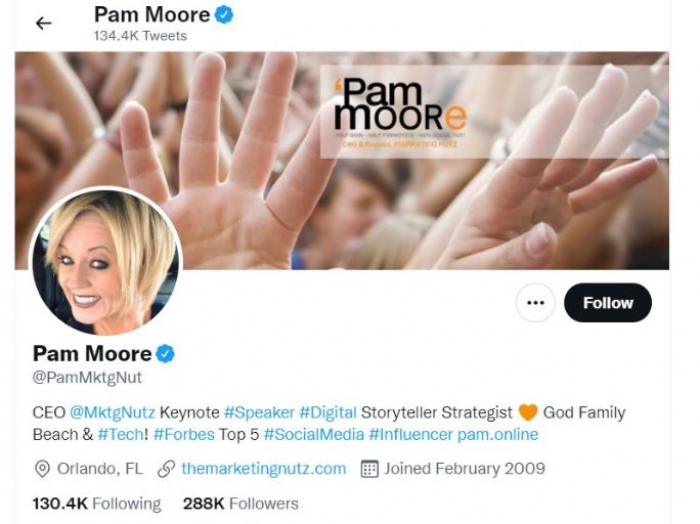
The easiest way to write a generic bio is to begin with the question, “How should I describe myself?” That question encourages a personal inventory: profession, interests, achievements, personality traits and side projects. Much of that information may be true, but not all of it helps a visitor decide whether to follow.
Begin with the intended follower instead. A product designer trying to attract clients needs a different bio from a product designer building an educational audience. The first profile should make the speciality, type of client and commercial relevance visible. The second should explain what design lessons, critiques or resources appear in the feed. The person is the same, but the reason to follow is different.
Before drafting the bio, answer three practical questions:
● Identify the people who should immediately recognise the profile as relevant. “Business owners” is usually too wide, while “independent restaurant owners opening their first location” gives the writing a usable direction.
● Name the recurring problem, ambition or interest that brings those people to the account. They may want to find clients, understand an industry, improve a skill, evaluate software or follow a project as it develops.
● Decide what the feed will repeatedly give them. That might include tutorials, original research, product updates, case studies, informed commentary, humour or carefully selected resources.
Turn those answers into a plain positioning sentence:
I publish [type of content] about [specific subject] for [intended audience], helping them [desired outcome].
For example:
I publish practical breakdowns of landing pages and onboarding emails for early-stage SaaS founders, helping them improve conversion without a large marketing team.
This sentence is too long for the final bio, and that is fine. Its purpose is to clarify the account before compressing it. Once the underlying position is clear, the writing becomes an editing problem rather than a guessing exercise.
Build With Clear Signals
X allows up to 160 characters in the profile bio, so every element has to earn its place. The limit should encourage prioritisation, not force the account owner to squeeze an entire résumé into one line.
A useful way to make those choices is to treat the bio as a collection of signals. Each signal answers a different question in the visitor’s mind.
1. The Identity Signal
The identity signal explains the role or perspective behind the account. It might be “independent journalist,” “B2B copywriter,” “climate researcher,” “SaaS founder” or “football analyst.”
A role is valuable when it changes how the content should be interpreted. “Employment lawyer explaining workplace disputes” gives useful context. Identity does not have to be a formal job title: “Building a budgeting app for freelancers” may reveal more than “software founder.”
2. The Subject Signal
This tells visitors what the account repeatedly covers. Specific subjects are easier to recognise than industries.
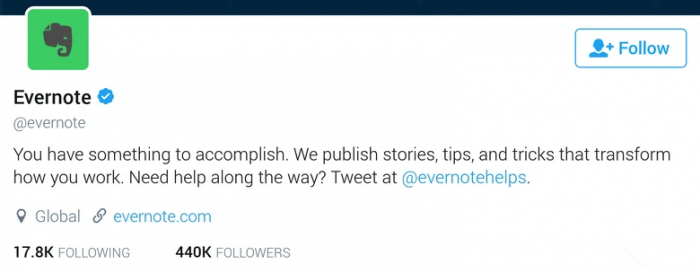
“Writing about marketing” leaves several possibilities open. “Analysing retention emails for subscription brands” creates a sharper expectation. The subject does not need to be microscopic, but it should be narrow enough to distinguish the profile from thousands of similar accounts.
3. The Value Signal
The value signal answers, “What will following this account help me understand, do or experience?”
Value does not need to promise a dramatic transformation. It can be practical explanations, tested workflows, informed criticism, useful discoveries or entertainment. “Daily secrets to guaranteed growth” is difficult to prove; “weekly breakdowns of ecommerce landing pages” describes an observable output.
4. The Proof Signal
Proof supports the account’s relevance. It may be a role, publication, product, qualification or concrete result. “Former newsroom editor covering misinformation” adds context; a string of awards may not. New accounts can use a current project as honest proof, such as “Building my first mobile game in public.”
5. The Personality Signal
Personality can make a bio memorable, but it should not hide the subject. “Product strategy, customer interviews and too many mechanical keyboards” adds a human detail while keeping the professional theme visible.
Most accounts need three strong signals rather than all five. A consultant may choose identity, audience and proof. A creator may prioritise subject, value and personality. A founder may combine product, intended user and build-in-public perspective.
Order by Follow Value
Even a bio containing the right information can underperform if that information appears in the wrong order. Visitors read from the beginning, and the opening words should carry the strongest reason to continue.
Many profiles start with low-value details: “Coffee lover,” “proud parent,” “opinions are my own” or a broad title such as “creator.” Those details may belong in the bio, but they rarely answer the visitor’s first question.
A reliable sequence is: Relevant subject or outcome → intended audience → proof or personality → next action
This sequence is not a rigid formula. It is a way to place the highest-value information first.
Consider this bio: Founder | Creator | Building cool things | Sharing my journey
Every phrase is broad. “Founder” does not identify the product. “Creator” does not identify the content. “Cool things” has no concrete meaning, and “my journey” asks for attention without explaining why the journey matters.
A more useful version is:
Building simple invoicing tools for independent designers. Sharing product decisions, pricing lessons and launch experiments.
The revised bio explains the product category, target user and expected content. It also reveals personality through the account’s willingness to show decisions and experiments.
Different account types can adapt the structure:
| Account type | Useful structure | Example |
| Educator | Topic + audience + teaching format | Practical Excel systems for small finance teams. Weekly walkthroughs with real business examples. |
| Professional | Role + speciality + commentary | Employment solicitor explaining workplace disputes, policy changes and tribunal decisions. |
| Founder | Product + intended user + building perspective | Building simpler inventory software for independent retailers. Sharing what works and what fails. |
| Creator | Content promise + subject + personality | Visual essays on architecture, public space and the strange things cities teach us. |
| Brand | Customer outcome + product distinction + direction | Bookkeeping for UK freelancers who want clear numbers without accounting jargon. Support below. |
The opening does not always need a role. It can lead with an outcome, such as “Helping first-time managers run clearer one-to-ones,” or a recognisable subject, such as “Deep dives into women’s football tactics and recruitment.”
Recognition Beats Cleverness
A witty bio can work, especially for comedians, entertainment brands and personality-led creators. The problem begins when cleverness delays understanding.
A visitor should not have to decode a metaphor to discover the account’s subject. Wordplay is most effective after relevance is established. A cybersecurity researcher can add dry humour, but the joke should not replace the fact that the account covers cybersecurity.
Concrete nouns and verbs improve almost every bio. Nouns identify real audiences, formats and subjects. Verbs reveal observable activity.
Compare these versions:
Generic: Passionate marketer helping brands achieve amazing results.
Specific: Breaking down paid social experiments for small ecommerce teams.
The first version relies on adjectives and an unmeasurable promise. The second names the work, content format and audience.
When editing, look closely at adjectives such as “passionate,” “innovative,” “visionary,” “results-driven” and “creative.” These words are not always wrong, but they often occupy space that could contain evidence. “Designing accessible banking apps” shows a form of design work. “Innovative designer” merely claims a quality.
Tone should match the feed. A research account does not need forced jokes, and a comedy writer does not need to sound like a consultancy. Separators and emojis may improve scanning, but decoration should remain secondary.
Connect the Whole Profile
An X bio does not work alone. X profiles can also include a display name, profile image, header image, location, website and pinned post. The platform allows users to pin a post so it is prominently visible to profile visitors.
Each element should have a separate job.
The display name establishes recognition. The profile image confirms identity or brand. The header can add visual context. The bio explains relevance. The website provides a destination. The pinned post supplies evidence.
A freelance writer can use the bio for speciality and intended client, the website field for a portfolio and the pinned post for samples, process and availability.
This creates profile continuity: The bio makes a promise. The pinned post and recent feed prove it.
If a bio promises “weekly software teardowns,” the pinned post and recent feed should demonstrate that work. Review the first screen as one unit and avoid repeating the same tagline in the header, bio and pinned post.
Match the Account Purpose
The same bio advice should not be applied to every account. A useful personal profile and a useful business profile solve different problems.
An independent creator needs a clear content promise. The visitor should understand the recurring subject and why this creator’s version of it is distinctive. A freelancer or consultant needs commercial relevance. Speciality, suitable client and credible evidence usually matter more than broad personality.
A founder’s bio should explain what is being built and for whom. “Founder at Acme” means little to outsiders; “Building scheduling software for mobile dog groomers” creates immediate context.
Professional accounts should distinguish employment from publishing purposes. A job title explains the person’s position, but not necessarily why someone should follow. “Data analyst at…” can be extended with “writing about experimentation and product metrics for early-stage teams.”
A publication or journalist should make the coverage area visible. A local business should prioritise product, service area and customer action. A personal account can rely more on interests and personality, but still benefits from recognisable themes.
The important question is not “Which bio format is best?” It is “What decision should this bio help the visitor make?” A client-facing profile should reduce uncertainty about expertise. An educational account should reduce uncertainty about content. A product account should reduce uncertainty about the product’s use.
Common Bio Failures
Trying to describe the whole person: A bio is not a complete identity statement. It only needs to explain the part of the person that matters to this account. Leaving out an interest is not dishonest. It is editorial focus.
Positioning the account for everyone: Phrases such as “helping people succeed” feel inclusive but remove the clues that create recognition. Naming an audience may reduce broad appeal while increasing relevance for the people who matter.
Using credentials without a content promise: Awards, employers and qualifications can establish authority, yet visitors still need to know what appears in the feed. Proof should support the reason to follow, not replace it.
Making promises the feed cannot support: “Daily insights” requires daily delivery. “Expert analysis” creates a higher standard than “notes from my research.” The bio should describe the account readers can actually see.
Adding an empty call to action: “Click below” does not explain the reward. “Read the free pricing guide” or “See current design work” gives the action context.
Five Bio Generator Tools
Bio generators are useful for exploring wording and structure, but they should not decide the account’s positioning. Vague inputs usually produce vague bios.
1. Smartpostly Twitter Bio Generator
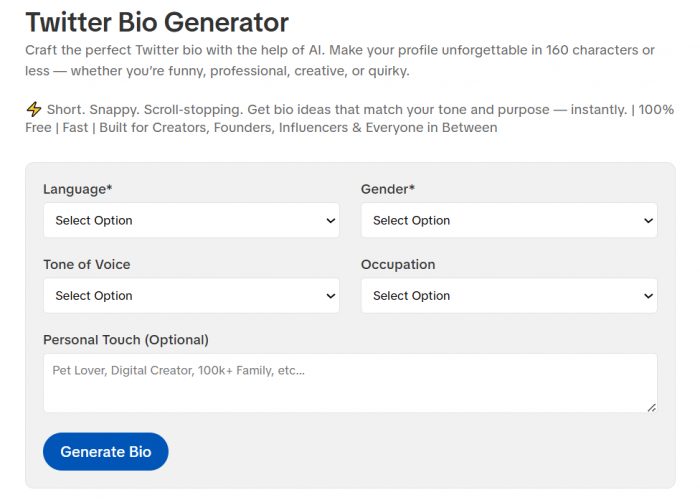
Smartpostly’s Twitter Bio Generator is a focused starting point for people who need to turn a role and a few personal details into a compact profile line. The tool provides controls for language, gender, tone of voice and occupation, plus an optional “personal touch” field. It frames the output around X’s 160-character limit and can generate variations for different types of profiles.
The guided form helps writers who are unsure how to structure a prompt. Specificity still matters. Entering only “marketer” may produce a polished but broad line. A stronger personal-touch instruction is: “I analyse retention campaigns for subscription food brands and share one teardown each week.”
Generate several directions, choose the strongest structure, then replace broad phrases with real topics, proof or publishing habits. This approach allows Smartpostly to handle the initial phrasing without surrendering control over the account’s actual positioning.
2. SuperX Bio Generator
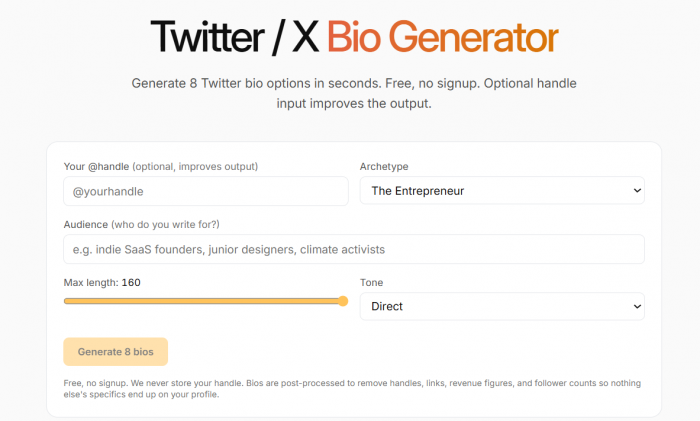
SuperX takes a more X-specific approach. Its generator asks for an archetype, intended audience, maximum length and tone, with an optional handle field that can use the current bio as reference. It produces eight drafts and says it post-processes results to remove items such as handles, links, revenue figures and follower counts.
The audience field is the most valuable part of the workflow because it pushes the user beyond self-description. It suits creators and professionals who want to compare several positioning styles rather than accept the first generated sentence.
3. Hootsuite Bio Generator
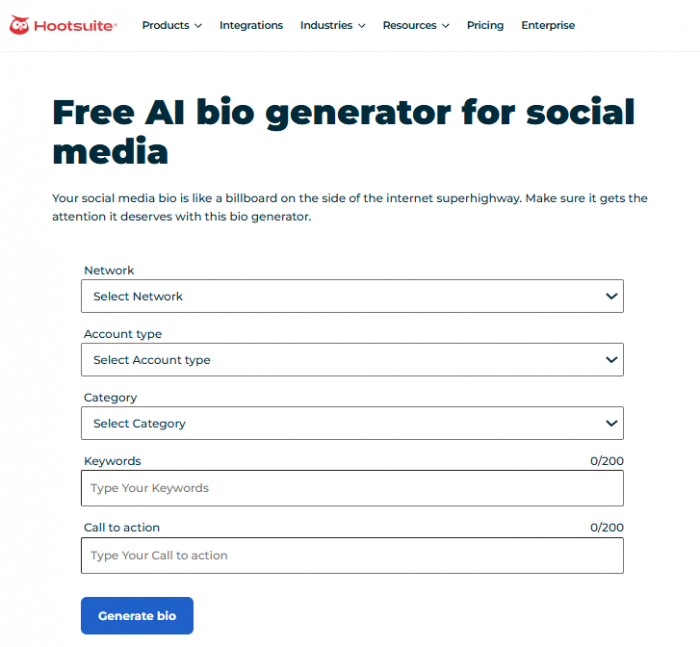
Hootsuite’s free social media bio generator supports several networks, including X. It asks users to choose a network, select personal or business use, define a category and enter keywords and a call to action.
This makes it practical for people maintaining profiles across several platforms. The same underlying identity can be adapted to different profile spaces rather than copied unchanged. Its structured call-to-action field is also useful for business accounts, although the generated CTA should still explain what sits behind the link.
4. Hopper HQ X Bio Generator
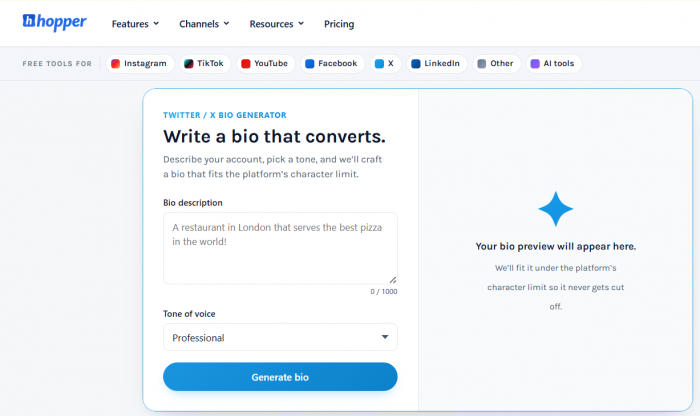
Hopper HQ keeps the process lighter. Users describe the account, choose a tone and generate a bio designed to fit the platform’s limit. The page includes a 160-character preview and an option to try a different description.
It works well for quick tone comparisons. The description should include the audience and recurring content, not merely a job title.
5. Mention Twitter Bio Generator
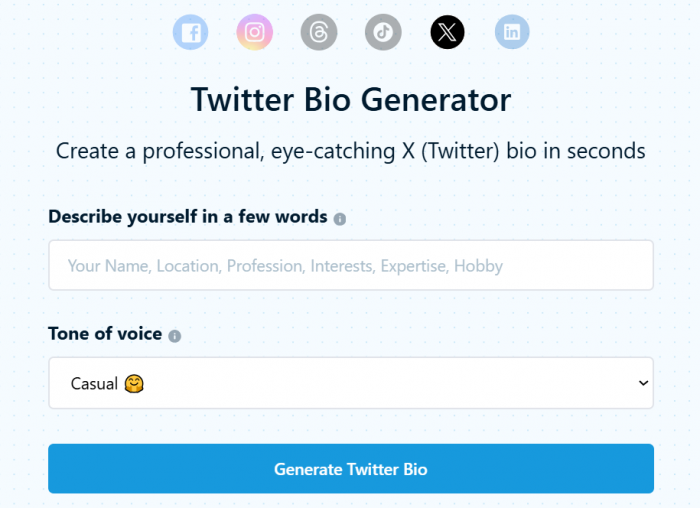
Mention’s tool asks users to describe themselves and choose a tone of voice before producing a personalised X bio. The suggested input can include details such as profession, interests, expertise, location and hobbies.
It suits personality-led accounts, but the output still needs editing. Keep details that make the profile recognisable and remove decorative language that does not improve the reason to follow.
| Tool | Strongest use | What to check before publishing |
| Smartpostly | Guided, platform-specific drafting with personalisation controls | Replace broad occupation language with a clear niche and audience |
| SuperX | Comparing multiple audience-aware X bio variations | Confirm that every proof point and description is accurate |
| Hootsuite | Keeping positioning consistent across several networks | Adapt the wording rather than using one bio everywhere |
| Hopper HQ | Testing concise drafts in different tones | Add enough detail to prevent polished but generic output |
| Mention | Blending professional identity with interests and personality | Remove filler and keep the main account subject visible |
Test Before Publishing
Review the bio as a stranger would read it. Familiarity can make weak wording seem clearer because the account owner already knows the missing context.
Use this final test:
● A new visitor should be able to identify the main subject without reading several posts first.
● The intended audience should be named directly or strongly implied through the problem and content.
● The bio should provide a concrete reason to follow rather than relying on status, enthusiasm or personality alone.
● The pinned post and recent feed should support the promise made in the bio.
● Every phrase should contribute meaning, evidence, voice or direction. Words included only because they sound impressive should be removed.
● The finished line should sound natural when read aloud and should resemble the voice used in the account’s posts.
Do not judge the bio by whether it fills all 160 characters. A shorter bio that creates a clear match is stronger than a crowded list. Test meaningful changes, such as a subject-led opening against an outcome-led one, rather than rewriting everything at once.
Follower growth cannot be credited to the bio alone. Posts, replies, recommendations, timing and external visibility all bring people to the profile. The bio influences what happens after they arrive. Its value lies in helping interested visitors understand the account quickly and follow for the right reason.
Final Take
The strongest X bios are selective. They do not attempt to capture a full career, personality and life story in 160 characters. They identify the part of the account that matters to a potential follower.
Start with the people the account is meant to serve. Make the subject and recurring value visible. Add proof where it improves trust and personality where it improves recognition. Then check that the rest of the profile delivers what the bio promises.
Specificity can make a profile appear narrower, but that is often the point. A bio that clearly states who the account is for will not appeal equally to every visitor. It gives the right visitor something more valuable: confidence that following will lead to content they actually want.
Comments