

Polls are the easiest engagement on the internet and the easiest to waste. A vote costs the audience a single tap, which is exactly why platforms weigh it lightly and why a thousand votes can leave a post exactly where it started.
The polls that actually move reach do something harder: they convert cheap taps into expensive actions. A comment takes effort. A share puts someone's reputation behind the content. Those are the signals algorithms reward, and they don't happen by accident; they happen when the poll is engineered for them from the first word.
This playbook covers nine poll strategies split across the two outcomes in the title five built to generate comments, four built to trigger shares plus the follow-up loop most creators skip, a platform decision matrix, five poll generator tools, and the metrics that separate a poll that worked from one that merely collected votes.
Why Polls Punch Above Their Weight
Before the strategies, it helps to understand why polls deserve a permanent slot in a content calendar at all because the mechanics are stronger than the format's casual reputation suggests.
The first advantage is the removal of the blank-box problem. Asking an audience to comment demands composition: they must decide what to say, how to phrase it, and whether it is worth the effort. A poll collapses all of that into one tap. Participation rates climb because the cost of participating approaches zero.
The second advantage is subtler and more valuable: micro-commitment. Behavioral research on the foot-in-the-door effect shows that people who take a small action become measurably more likely to take a larger, related one. A person who has voted is no longer a passive scroller; they hold a position. And holding a position makes defending it, explaining it, or broadcasting it feel natural rather than effortful. Every strategy in this playbook exploits that shift.
The third advantage is timing. Early interaction velocity and how much activity a post gathers in its first stretch influences how widely platforms distribute it. Because polls harvest interactions faster than any other format, they front-load exactly the signal that matters most.
The mental model worth keeping: a poll is the bottom rung of an engagement ladder tap, then comment, then share. Votes alone leave the audience on rung one. The nine strategies below exist to move people up.
One more point before the plays, because it reframes everything that follows: the ladder is not climbed by asking. Captions begging for comments and shares ("drop a comment below!", "share if you agree!") are requests for favours, and audiences ignore favours. The strategies in this playbook work differently; each one builds the comment or the share into the structure of the poll itself, so that participating fully requires the action. That structural difference is the entire gap between polls that collect taps and polls that build reach.
The Comment Engine: Five Strategies
Comments come from one place, the feeling that a vote is incomplete without an explanation. A poll that answers itself generates taps and silence. A poll that leaves something unresolved generates replies. These five plays create that unresolved feeling deliberately.
1. The Missing Option
The play: deliberately omit the answer a meaningful slice of the audience holds. A poll asking "Best editing app for Reels: CapCut / Premiere / DaVinci" will collect votes from those three camps and comments from every InShot and VN user who scrolled down expecting to find their tool.
The mechanic is simple: an unexpressed opinion is an itch. Voters whose option exists scratch it with a tap; voters whose option is missing can only scratch it in the comments. The omission must look like an oversight rather than bait leaving out an obscure option nobody uses achieves nothing, while leaving out the second-most-popular choice in the niche reliably fills a comment section.
2. The Defend-Your-Vote
The play: pair a binary poll with an explicit one-line justification prompt. "Cold DMs or content marketing vote, then drop the reason in one line."
This is a micro-commitment converted directly into words. The vote is the small action; the comment is the consistency behaviour that follows it. The phrasing matters more than it appears: "in one line" lowers the effort bar dramatically, because audiences who would never write a paragraph will happily write a sentence. Polls using this play without the effort cap ("explain your answer below") consistently underperform the request reads as homework.
3. The Wrong-on-Purpose
The play: build the poll's premise on a slightly incorrect "majority view." A caption stating "Most marketers agree long captions are dead agree or disagree?" will draw votes from the agreeable and paragraphs from everyone who knows the data says otherwise.
Correction is arguably the single strongest comment motivator on the internet; people who would never respond to a question will drop everything to fix an error. The play carries one hard constraint: the error must be defensible, a reasonable position someone could genuinely hold not an embarrassing factual blunder. A defensible error sparks debate; a careless one damages credibility, and the comments turn from discussion into ridicule.
4. The Split-the-Room
The play: engineer questions for a near-50/50 result. Genuine dilemmas "Take the ₹80K retainer with a nightmare client, or the ₹50K retainer with a dream one?" divide an audience into two camps of comparable size.
The reason lopsided polls fail is structural: a 90/10 result ends the conversation, because the losing side feels outnumbered into silence and the winning side has nothing to argue about. A 50/50 result starts an argument, and arguments are self-sustaining; each camp replies to the other, and every reply is an interaction the algorithm counts. Predicting the split takes practice; the reliable shortcut is choosing questions the creator personally finds hard to answer.
5. The Insider Poll
The play: ask a question only genuine practitioners can vote on meaningfully. "Which n8n error node setup do you run for API retries?" means nothing to a general audience and that is precisely the point.
Comments arrive through expertise-signalling: practitioners explain nuance the poll options could not capture, correct each other, and share configurations, because demonstrating knowledge in front of peers is its own reward. The side benefit is filtration insider polls select for the highest-value segment of an audience, and the comment section they produce doubles as market research no survey would surface. The trade-off is reach: these polls collect fewer votes, and that is acceptable, because the votes were never the goal.
The Share Engine: Four Strategies
Shares run on a different fuel entirely. Nobody shares a poll because it was well-written; they share it because it lets them say something about themselves to their own audience. Every play in this section builds that self-statement into the poll's structure.
6. The Identity Badge
The play: frame the options as self-labels. "Which type of founder are you: the 5 AM operator, the midnight builder, the delegator, or the firefighter?" The vote is not an opinion, it is a badge.
People broadcast badges. A voter who picks "midnight builder" is not sharing a poll with their story; they are announcing an identity, with the poll as the vehicle. The craft lies in the labels: each option must be something a person would be proud or amused to claim. A set containing one clearly undesirable option ("the procrastinator") collects votes from nobody and shares from nobody flattering or funny labels travel, unflattering ones die.
7. The Team Poll
The play: tribe-versus-tribe framing. iOS or Android. Remote or office. Chai or coffee. Star Wars questions in tech audiences, North vs South food debates in Indian audiences every niche has its ancient rivalries.
Sharing a team poll is an act of recruitment: the sharer is calling allies to the flag, hoping to swing the count. This gives team polls a property no other format has the result itself creates urgency, because a team that is losing 48/52 shares harder. The caveat is temperature control: rivalries work when they are playful, and backfire when they overlap with genuinely divisive territory. The line between banter and battleground is one a brand account should never test.
8. The Tag-Trigger
The play: write at least one option so that it is a person the voter knows. "Every friend group has one: the planner, the perpetually late one, the one who never checks the group chat, the one who cancels day-of. Tag yours."
The difference between this and the generic "tag a friend!" plea is structural. A request for tags is a favour; a tag-trigger makes the tag the answer the voter cannot fully participate without naming someone. Each tag drags a new person into the post, and that person frequently tags back, producing chains. The play performs best with affectionately teasing options; tags meant to genuinely embarrass someone get ignored.
9. The Shareable Result
The play: design the poll so the outcome becomes the content. "73% of freelancers in this audience said they would take less money for better clients" is not a poll anymore it is a statistic, and statistics get screenshotted, quoted, and reshared as insight by people who never saw the original vote.
This is the most advanced play in the set because it requires designing backwards: the question is chosen for how interesting its aggregate answer will be, not for the voting experience itself. Questions with a predictable outcome produce no shareable result; questions where the audience genuinely does not know what everyone else thinks about money, habits, unpopular opinions held privately produce numbers worth publishing. Which leads directly to the most neglected part of poll strategy.
The Poll Afterlife: The Follow-Up Loop Most Creators Skip
Here is the structural mistake behind most poll usage: treating a poll as one post. Executed properly, a poll is a three-post arc, and the second and third posts routinely outperform the first.
● Post one the poll itself, built on whichever strategy fits the goal. Its job is not just engagement; it is data collection and audience investment.
● Post two the results reveal, published after voting closes, with commentary: the surprise in the numbers, the argument that broke out, the best line from the losing side. This post inherits a pre-invested audience: everyone who voted has a stake in the outcome and a reason to return, and the camps that argued in post one resume the argument in post two.
● Post three content built from the data. "This audience voted 68% for X, so here is the complete breakdown of X." Audience-directed content carries a property nothing else has: the people who voted for it defend it in the comments, because it exists partly because of them.
The arc compounds in a second way that has nothing to do with reach: poll results are free content research. A creator who runs one strategic poll a week accumulates a private dataset on what their specific audience believes, struggles with, and wants the exact information competitors pay for and guess at. The poll is the cheapest research instrument in the content stack, and the afterlife is where its value gets banked.
Matching Strategy to Platform and Goal
Not every play fits every platform. The matrix below condenses the nine strategies into a working reference.
| Strategy | Primary goal | Strongest platforms | Watch-out |
| Missing Option | Comments | X, LinkedIn, Facebook Groups | Omission must look accidental, not baited |
| Defend-Your-Vote | Comments | LinkedIn, X | Cap the effort "one line," never "explain" |
| Wrong-on-Purpose | Comments | X, LinkedIn | Error must be defensible, never careless |
| Split-the-Room | Comments | All platforms | A predictable winner kills the argument |
| Insider Poll | Comments | LinkedIn, niche communities | Low votes by design judge by comment quality |
| Identity Badge | Shares | Instagram Stories, X | Every option must be claimable with pride |
| Team Poll | Shares | Instagram, X, Facebook | Keep rivalries playful, never political |
| Tag-Trigger | Shares | Instagram, Facebook | Teasing works; embarrassment gets ignored |
| Shareable Result | Shares | LinkedIn, X → all platforms | Needs a genuinely unpredictable outcome |
A few platform realities sit behind that table and deserve spelling out.
LinkedIn polls carry a reputation problem and a reach advantage simultaneously. The format is widely mocked for lazy questions ("Is culture important? Yes/No") yet continues to earn distribution which means the bar for a good LinkedIn poll is low-hanging opportunity. Insider polls and defensible-wrong premises perform disproportionately well there, because professional audiences comment to demonstrate competence.
Instagram Story polls are private-vote by design. Votes never appear publicly, so the comment engine cannot run inside the Story itself the workaround is using Story polls as the tap, then pulling the conversation into DMs ("voted B? tell me why") or carrying the result into a feed post where comments live. Identity and team plays suit Stories best because sharing there is one tap.
X polls run a maximum of seven days and sit inside a reply-native culture the quote-post mechanic effectively adds a second share layer no other platform has, which makes wrong-on-purpose premises unusually powerful there. YouTube Community polls, meanwhile, are best treated as a between-uploads retention tool: they keep a channel surfacing in feeds on non-upload days and hand the creator topic data for the next video, feeding the afterlife arc directly.
Five Poll Generator Tools Worth Knowing
Strategy decides what to ask; the blank page still stands between a chosen strategy and a phrased question. Generators solve that at volume producing ten candidate phrasings in the time it takes to write one and the selection judgment stays human. Five tools cover the full range of use cases.
1. Smartpostly Poll Generator
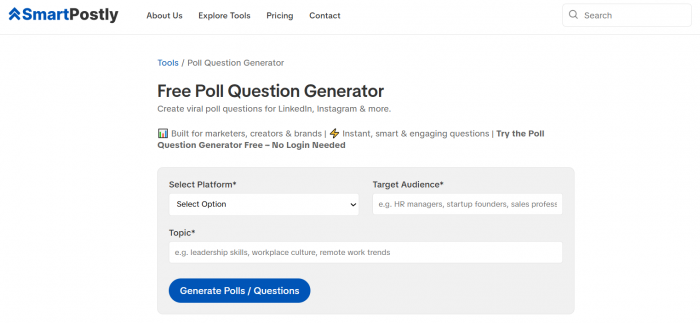
Smartpostly's Poll Generator is the quickest route from strategy to posted question, largely because nothing interrupts the workflow; the tool is free to use and requires no signup. The process mirrors the rest of the Smartpostly suite: enter a topic, select the platform and tone, and receive multiple ready-to-post poll questions written for interaction rather than information-gathering. Two things make it the natural first stop for social polls specifically. The platform selector shapes output to where the poll will live a LinkedIn-toned question reads differently from an Instagram Story one and the surrounding suite of 20+ tools (captions, hooks, scripts, content calendars) means the poll, its caption, and the results-reveal post of the three-post arc can all be drafted in one place. A PRO tier covers heavier usage. Best suited to creators and social media managers running the volume-and-select approach this playbook recommends.
2. StrawPoll
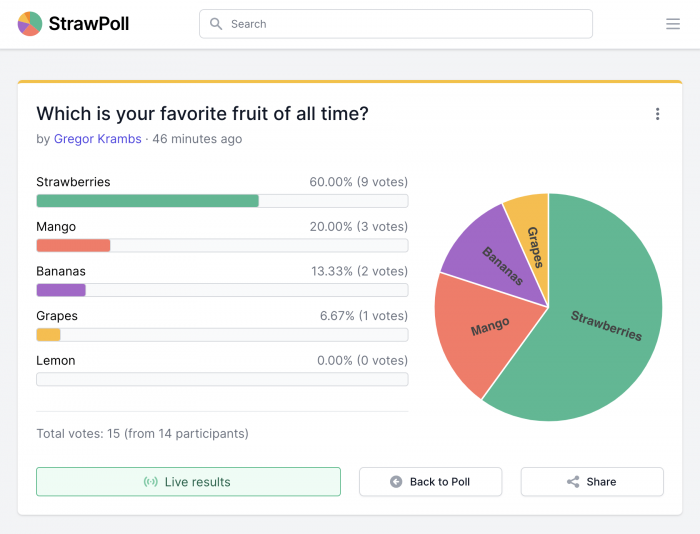
StrawPoll occupies the opposite end of the friction spectrum: instant, link-based polls with no account required, votable by anyone who opens the URL. Its natural habitat is everywhere native polls do not exist Discord servers, Telegram groups, forums, newsletters, WhatsApp communities. For creators whose audience lives partly off-platform, it is the simplest way to run the same poll strategies in those spaces. Best suited to community managers and anyone polling outside the major social feeds.
3. Opinion Stage
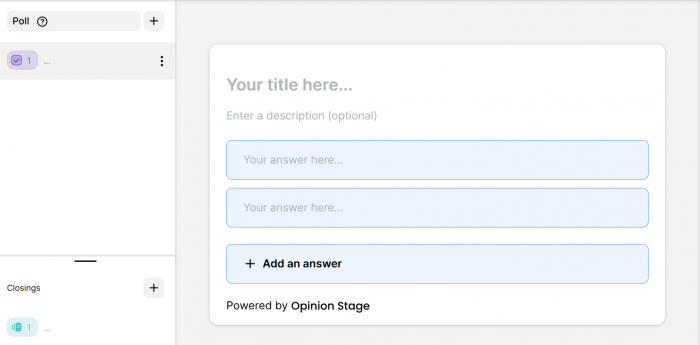
Opinion Stage builds visual, interactive polls designed to be embedded in websites and blog posts rather than posted to feeds. The relevance to a content operation is direct: an embedded poll turns passive article readers into participants, lifts time-on-page, and collects audience data at the exact moment of topical interest. For publishers running content sites, it effectively imports the engagement ladder into owned media. Best suited to bloggers, niche site operators, and publishers.
4. Mentimeter
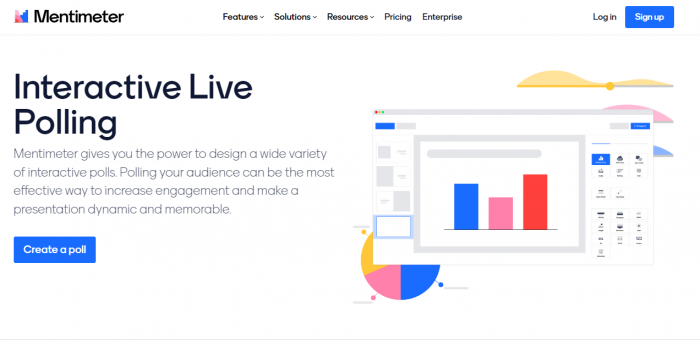
Mentimeter is the live-events specialist audiences vote from their phones while results animate on screen in real time. The format makes the results reveal a moment rather than a follow-up post, which suits webinars, workshops, LinkedIn Live sessions, and conference talks. The live reveal also produces naturally clippable content: an audience reacting to an unexpected split is short-form material ready-made. Best suited to speakers, educators, and anyone running live sessions.
5. SurveyMonkey Poll Maker
SurveyMonkey is the research-grade option of the five. Where the others optimise for speed and engagement, it optimises for clean data response analysis, audience targeting, and structured reporting. The right occasions are the ones where poll results feed genuine decisions: pricing research, product direction, content strategy audits. Heavier than a social poll requires, and exactly right when the stakes justify the weight. Best suited to businesses treating polls as research instruments first.
Reading the Numbers: What Poll Success Actually Looks Like
Vote count is the vanity metric of the format. A poll's real performance lives in two ratios:
● Comments per hundred votes the measure of how many voters climbed from rung one to rung two of the ladder. A 500-vote poll with 40 comments outperforms a 5,000-vote poll with six, in every way an algorithm or a business cares about.
● Shares per hundred votes the equivalent measure for the third rung, and the harder one to move, since a share spends the voter's own credibility.
Reading results this way changes which strategies look successful. Insider polls, judged on raw votes, appear to fail; judged on comment ratio and comment quality, they are frequently the best-performing format an account runs. The reverse is also true a team poll that collected enormous vote counts but produced no shares did not do its job.
Benchmarks should be internal, not borrowed. Industry-wide poll engagement figures are noisy and mostly unsourced; the useful baseline is an account's own trailing average across its last five polls, tracked in a simple sheet with four columns strategy used, votes, comments per hundred, shares per hundred. Within a month, that sheet reveals which plays move which ratio for a specific audience, and the guesswork ends.
One honest caveat closes the measurement discussion: poll fatigue is real. Audiences shown a poll every day stop voting within weeks, because novelty is part of the format's pull. The working frequency cap among creators who sustain poll performance sits around one to two strategic polls per week each one running its full three-post arc rather than daily taps that train the audience to scroll past.
The Verdict: A Seven-Day Poll Sprint
Everything above condenses into a one-week plan that any account can run starting Monday:
1. Day 1 Post a Split-the-Room poll on a genuine dilemma in the niche. Reply to early comments to keep both camps talking.
2. Day 2 Work the comment section: pin the sharpest take from each side, ask one follow-up question in replies.
3. Day 3 Publish the results reveal with commentary the final split, the surprise, and the best argument from the losing camp.
4. Day 4 Run an Identity Badge poll built for shares, with every option claimable and at least one option funny.
5. Day 5 Post a Tag-Trigger where one option is unmistakably someone the audience knows personally.
6. Day 6 Publish content built directly from Day 1's data: "This audience voted 64% for X here is the full breakdown."
7. Day 7 Review the week in ratios, not totals: comments per hundred votes, shares per hundred votes, and which strategy moved which number.
One week, three strategies, one complete afterlife arc, and a measurement habit that is the difference between an account that posts polls and an account that runs a poll system. The votes were never the point. The conversation and the broadcast are, and both can be engineered.
Comments