

Buffer and Hootsuite both help users schedule posts, manage social channels, and track performance, but they are built for different types of social media work. Buffer is lighter, cleaner, and more affordable. Hootsuite is broader, more advanced, and better suited to teams that need reporting, inbox management, social listening, competitor tracking, and approval workflows.
The better question is not which tool has more features. Hootsuite usually wins on feature depth. The real question is which platform fits your workflow without adding unnecessary cost or complexity.
For creators, small businesses, consultants, and lean marketing teams, Buffer is often the better choice because it keeps publishing simple. For agencies, growing brands, enterprise teams, and organizations where social media connects to customer care, reporting, and reputation management, Hootsuite is the stronger platform.
Quick Verdict: Buffer Is Simpler, Hootsuite Is Stronger
Buffer is best when the main job is planning content, scheduling posts, keeping a consistent publishing rhythm, and reviewing basic performance. Its interface is easier to understand, the pricing is more accessible, and the workflow feels built for people who want to get social media done without managing a complicated system.

Hootsuite is best when social media is no longer just about posting. It becomes more useful when a team needs shared inboxes, approvals, campaign reporting, social listening, competitor benchmarks, paid social support, and brand monitoring.
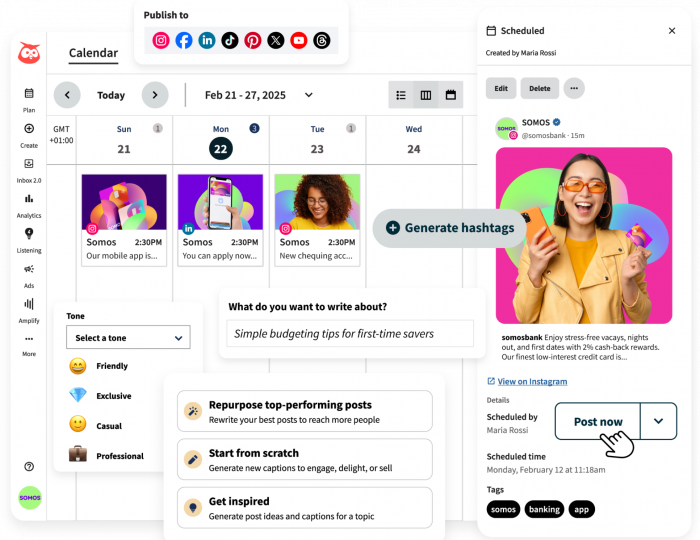
| Comparison Area | Buffer | Hootsuite |
| Best for | Creators, small businesses, lean teams | Growing brands, agencies, enterprises |
| Main strength | Simple publishing workflow | Full social media management suite |
| Pricing style | Per channel | Per user, higher entry cost |
| Free plan | Yes, up to 3 channels | Trial-based, no broad free plan |
| Scheduling | Clean and easy | Powerful and campaign-oriented |
| Analytics | Good for basic to mid-level reporting | Stronger for competitive and business reporting |
| Team workflow | Best on Team plan | Stronger for approvals, assignments, and departments |
| Social listening | Limited compared with Hootsuite | Much stronger |
| Ease of use | Cleaner and lighter | More capable but more complex |
| Best outcome | Faster publishing consistency | Better visibility, monitoring, and reporting |
The short version: Buffer is better for simple execution. Hootsuite is better for social media operations at scale.
Pricing Comparison:
Buffer Is Much Cheaper, Hootsuite Is Built for Bigger Budgets
Pricing is the first major difference. Buffer uses a channel-based model, which makes it easier for individuals and small teams to control costs. It offers a free plan for up to 3 channels, while paid plans start at a low monthly price per channel. That makes Buffer attractive for creators, freelancers, small businesses, and teams that only need a few accounts.
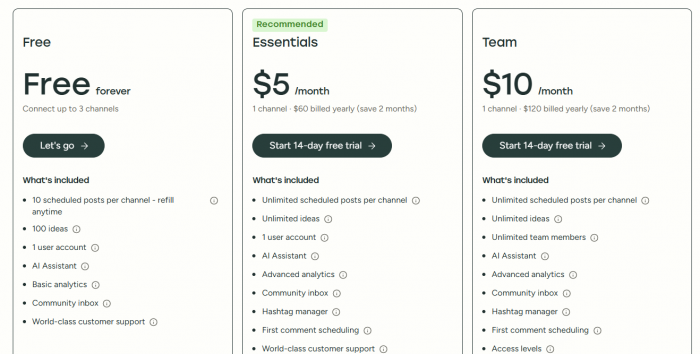
Hootsuite is much more expensive at entry level. Its pricing is built around users and larger feature bundles, so it starts to make sense only when the extra tools are actually needed. A small business that only wants to schedule posts may find Hootsuite too costly. A brand that needs inbox management, reporting, competitor tracking, and listening may find the price easier to justify.

Buffer is the obvious value winner for users managing a few accounts. Hootsuite becomes more reasonable when social media is part of a larger business function, not just a posting calendar.
Publishing and Scheduling:
Buffer Feels Cleaner, Hootsuite Feels More Operational
Buffer is excellent at the core task most users care about: creating posts, customizing them by platform, placing them into a calendar, and keeping a queue running. It supports major platforms and keeps the publishing experience straightforward.
The reason Buffer feels strong here is not because it has every advanced feature. It is because the workflow stays calm. Users can move from idea to scheduled post without feeling buried inside dashboards, reports, inboxes, or campaign modules.
Hootsuite’s publishing system is more powerful. It supports unlimited scheduling on paid plans, best-time recommendations, AI content help, content calendars, templates, bulk scheduling on higher plans, and approval workflows. This makes it better for agencies and teams managing high-volume publishing across multiple brands or departments.
Buffer is better when:
● One person or a small team manages content
● The priority is consistency, not complex campaign operations
● The workflow needs to stay clean and fast
Hootsuite is better when:
● Several users need to collaborate on publishing
● Posts require approvals, tagging, or reporting
● Social publishing is connected to campaigns, inboxes, and client work
Buffer wins for ease. Hootsuite wins for operational control.
Content Creation Workflow:
Buffer Helps You Stay Consistent, Hootsuite Helps You Scale
Buffer’s content workflow is built around consistency. Its idea management and AI writing support help users collect thoughts, shape posts, adapt copy for different platforms, and schedule content without overcomplicating the process. This is useful for creators and small teams that often struggle with one thing: keeping the calendar filled.
Hootsuite’s content workflow is more campaign-focused. Its AI tools, templates, content suggestions, trend features, and campaign planning options are more useful when a team needs to produce, review, publish, monitor, and report on content at scale.
The difference is simple. Buffer helps you avoid missed posts. Hootsuite helps you run a broader social media operation.
If your content process is mostly “plan, write, schedule, review,” Buffer is smoother. If your process includes campaigns, approvals, multiple users, reporting, paid posts, competitor checks, and customer response, Hootsuite has the stronger system.
Analytics and Reporting:
Hootsuite Goes Deeper, Buffer Is Easier to Digest
Buffer’s analytics are strong enough for small teams that want to understand what is working. You can review post performance, engagement, impressions, audience insights, best posting times, and export reports on paid plans. For creators and smaller brands, this is usually enough to improve the next month’s content.
Hootsuite goes further. It is built for teams that need performance reporting across networks, competitor benchmarking, scheduled reports, social performance scores, report exports, and more advanced analytics. This matters when reports go to clients, executives, departments, or campaign stakeholders.
| Analytics Area | Buffer | Hootsuite |
| Post performance | Strong enough for most small teams | Strong |
| Audience insights | Available on paid plans | Stronger across reporting workflows |
| Competitor benchmarking | Not a core strength | Strong |
| Report exports | Included on paid plans | Stronger export and scheduled reporting |
| Attribution and ROI | Limited compared with Hootsuite | Stronger on advanced tiers |
| Best for | Content improvement | Stakeholder reporting and strategic decisions |
Buffer tells you what worked. Hootsuite gives more context around why it worked, how it compares, and how it should be reported.
Engagement and Inbox: Hootsuite Is Better for Customer Care
Buffer includes useful engagement tools for replying to comments and managing basic community interactions. For creators and small teams, that is enough. It reduces the need to jump between platforms and helps users keep up with audience responses.
Hootsuite is stronger when engagement becomes a team responsibility. Its inbox tools, message assignment, saved replies, auto-responses, routing, tagging, and customer-care workflows make it more useful for brands that treat social media as a support and reputation channel.
This is where the tools separate clearly. Buffer helps users respond more easily. Hootsuite helps teams manage conversations at scale.
Hootsuite is the better choice if your social messages include customer complaints, support requests, sales inquiries, escalation issues, or reputation-sensitive conversations. Buffer is enough if engagement mainly means replying to comments and staying active with the audience.
Social Listening and Brand Monitoring: Hootsuite Wins Clearly
Social listening is one of Hootsuite’s strongest advantages over Buffer. Buffer is mainly focused on your own content workflow: planning, publishing, engagement, and performance. Hootsuite adds a stronger layer around what is happening outside your own posts.
Hootsuite’s listening features are useful for tracking brand mentions, competitor conversations, sentiment, trends, alerts, and broader market signals. This is especially important for larger brands, public-facing companies, agencies, and businesses where reputation risk matters.
Buffer can help you manage what you publish. Hootsuite can help you understand what people are saying about your brand, competitors, and category.
For small brands, Buffer’s lighter approach may be enough. For serious monitoring, Hootsuite is in a different league.
Team Collaboration and Approvals:
Buffer Works for Small Teams, Hootsuite Works for Complex Teams
Buffer’s Team plan is a strong option for small teams because it adds collaboration without making the tool feel heavy. It supports multiple team members, access controls, notes, and approval workflows. That is enough for many small businesses, agencies with light client review, and brands where one or two people approve content before publishing.
Hootsuite is better when collaboration is more layered. It supports stronger assignment workflows, message routing, tagging, reporting, approvals, and enterprise controls. Larger teams benefit from this because social media work often involves marketing, customer support, legal, brand, and leadership at the same time.
| Team Need | Better Choice | Why |
| Two-person content approval | Buffer | Lower cost and simple approvals |
| Freelancer plus client review | Buffer | Easier setup and less training |
| Agency managing many brands | Hootsuite | Better inbox, reports, bulk scheduling, and monitoring |
| Enterprise social governance | Hootsuite | Stronger permissions, compliance, and support |
| Customer care team | Hootsuite | Better routing, tagging, inbox, and automation |
| Small business with occasional help | Buffer | Cheaper and cleaner |
Buffer is enough when collaboration means content approval. Hootsuite is better when collaboration includes publishing, reporting, inbox management, escalation, governance, and monitoring.
User Experience: Buffer Feels Lighter, Hootsuite Feels More Complete
Buffer’s strongest product advantage is its simplicity. The interface feels clean, and the workflow does not demand much training. That matters because many social tools fail not because they lack features, but because users avoid them when they feel too complicated.
Hootsuite has more depth, but that depth comes with more learning curve. It can feel heavier if all you need is scheduling. But for teams that need multiple functions inside one platform, the extra complexity can be worth it.
Buffer is better for users who want a tool they can open daily without friction. Hootsuite is better for users who need a central command center for social activity.
The tradeoff is clear: Buffer removes friction. Hootsuite adds capability.
Performance and Product Outcome Quality
The outcome from Buffer is consistency. It helps users post more regularly, organize ideas, repurpose content, and review enough performance data to improve. It is strongest when the main problem is execution.
The outcome from Hootsuite is control. It helps teams connect publishing with analytics, engagement, listening, competitor tracking, reporting, and customer-care workflows. It is strongest when the main problem is coordination.
| Outcome Area | Buffer | Hootsuite |
| Posting consistency | Excellent | Excellent |
| Campaign visibility | Good | Stronger |
| Brand monitoring | Limited | Strong |
| Reporting quality | Good for small teams | Stronger for stakeholders |
| Response management | Good for basic comments | Stronger for teams and customer care |
| Strategic insights | Moderate | Stronger through listening and benchmarking |
| Overall output quality | Clean, consistent publishing | More informed, controlled social operations |
Buffer improves the publishing habit. Hootsuite improves the social media system.
Ratings and User Sentiment Across Platforms
User sentiment follows the same pattern as the product comparison. Buffer is usually liked for ease of use, affordability, and a clean scheduling workflow.
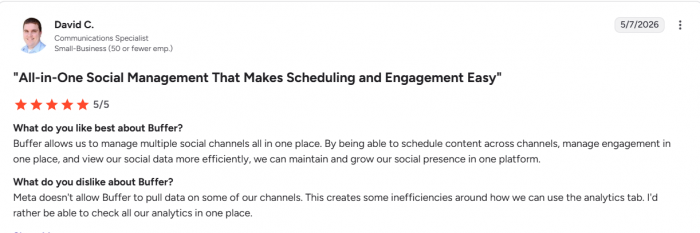
Hootsuite is respected for depth, analytics, inbox management, and large-team functionality, but its pricing and complexity attract more criticism.

| Platform | Buffer | Hootsuite | What the ratings suggest |
| G2 | Around 4.3/5 | Around 4.3/5 | Both are well-rated, but Hootsuite has a much larger review base |
| Capterra | Users often praise ease of use and scheduling | Users praise multi-account management and analytics | Buffer sentiment leans simplicity, Hootsuite leans power |
| Trustpilot | More mixed sentiment, often around limitations or support | Less useful for feature-level comparison | Trustpilot is better for support and billing signals than workflow quality |
| Google Play | Strong mobile rating signal | Solid mobile presence | Buffer’s app reputation is strong among mobile users |
| App Store | Positioned around planning and publishing | Strong iOS rating footprint | Hootsuite performs well for mobile management |
| Often recommended as a simpler option | Often discussed as powerful but expensive | Reddit is useful for pricing pain and real-user complaints |
The pattern is consistent across user feedback. Buffer feels easier to adopt. Hootsuite feels more powerful but harder to justify for small teams.
Use Case Comparison: Which Tool Fits Which User?
Buffer is better for creators, consultants, freelancers, coaches, small businesses, early-stage startups, and lean teams that need a dependable content calendar. It is especially strong when the goal is to avoid missed posts, organize ideas, schedule consistently, and review basic performance.
Hootsuite is better for agencies, marketing departments, public-facing brands, support-heavy businesses, multi-location companies, and enterprise teams. It makes more sense when social media connects to customer care, reporting, approvals, listening, paid social, and brand reputation.
| Use Case | Better Choice | Reason |
| Solo creator posting across 3 to 5 channels | Buffer | Simpler and cheaper |
| Small business scheduling weekly content | Buffer | Strong enough without heavy cost |
| Agency handling many client reports | Hootsuite | Better reporting, inbox, and monitoring |
| Brand tracking mentions and sentiment | Hootsuite | Stronger listening tools |
| Team needing approval workflows only | Buffer | Team plan covers this affordably |
| Enterprise with compliance needs | Hootsuite | Built for governance |
| Social support team managing DMs | Hootsuite | Better inbox and automation |
| Content-first team with limited budget | Buffer | Better value |
Buffer Pros and Cons
Buffer’s biggest advantage is that it stays focused. It does not try to be an oversized social media command center. That makes it easier for individuals and small teams to actually use it every day.
Pros: It is easy to use, affordable to start, offers a free plan, has a clean queue-based workflow, supports useful AI assistance, and works well for creators, small businesses, and lean teams.
Cons: Its analytics are not as deep as Hootsuite’s, brand monitoring is limited, advanced reporting is lighter, and it is not built for complex enterprise workflows.
Buffer is strongest when the goal is practical publishing, not full-scale social media governance.
Hootsuite Pros and Cons
Hootsuite’s biggest advantage is breadth. It can manage publishing, analytics, inboxes, listening, competitor tracking, campaign reporting, and team workflows from one platform.
Pros: It offers a broader feature set, stronger analytics, better inbox tools, social listening, competitor benchmarking, paid social support, and stronger fit for agencies and enterprises.
Cons: It is expensive for smaller teams, has a steeper learning curve, can feel heavy for simple scheduling, and many of its strongest features sit behind higher-priced tiers.
Hootsuite is strongest when social media is tied to reporting, customer response, brand monitoring, and larger team coordination.
Final Verdict: Buffer for Simplicity, Hootsuite for Scale
Buffer is the better choice if your social media workflow is mainly content-led. It helps you plan, organize, schedule, publish, respond, and review results without turning social media into an overbuilt process. For creators, small businesses, freelancers, consultants, and lean teams, Buffer is usually the smarter starting point.
Hootsuite is the better choice if social media is a serious business operation. It gives teams more control over reporting, inboxes, competitor tracking, listening, sentiment, paid social, approvals, and governance. It costs much more, but that cost can make sense when social media affects brand reputation, customer care, campaign reporting, and executive visibility.
Choose Buffer if you want a clean, affordable tool that makes publishing easier.
Choose Hootsuite if you need a full social media management platform that connects publishing, analytics, monitoring, engagement, paid social, and team operations.
For most small teams, Buffer is the better value. For larger organizations that need visibility, control, and scale, Hootsuite is the more complete platform.
Comments