

Most content does not lose its audience because the subject lacks value. It loses people because the opening makes them work too hard to discover that value.
A hook is not a decorative first line. It is the opening part of a retention system that identifies the right viewer, establishes useful tension and creates a clear path towards the result, lesson or story. The following approach treats hook writing as an editorial skill rather than a collection of viral phrases.
The Opening Is a Contract
Every hook makes an implicit contract with the audience. It says, in effect, “Continue and this content will resolve the idea I have just introduced.”
That contract may promise an answer, demonstration, comparison or change in perspective. Its value depends on the connection between the opening and the payoff.
Consider two versions of the same idea:
“This content mistake is killing your engagement.”
“My most polished Reel lost viewers faster than the rough version because the topic did not appear until the sixth second.”
The first line uses intensity but gives the audience little to evaluate. The second identifies the format, presents a result and opens a specific question: why did polish fail?
Some hooks produce initial views without improving watch time because they create stimulation without enough relevance. A strong hook attracts qualified attention: the viewer recognises the subject, understands why it matters and expects a worthwhile return.
TikTok’s current creative guidance reflects this need for early clarity. It recommends introducing the content proposition within the first three seconds and prioritising the hook within the first six. Meta similarly defines a Reels hook as a combination of text, visual and audio elements that captures and holds attention during the opening seconds.
The point is not to speak faster or force drama into three seconds. The content should establish its purpose before unnecessary setup consumes the audience’s patience.
Find the Friction First
Weak hook writing often begins with a template:
● “Three secrets nobody tells you…”
● “Stop doing this if you want…”
● “You will not believe what happened…”
The writer then pushes the topic into the formula. This reverses the useful order.
Begin with the audience friction instead. Friction is the point where the viewer’s current experience conflicts with a desired result. It may be a mistake they cannot identify, a result they cannot reproduce, an assumption that no longer holds or a choice they do not know how to make.
A creator writing about social media captions might identify the friction as follows:
People are shortening every caption because they believe shorter always performs better, but the correct length depends on the job the caption must perform.
That observation produces stronger openings than a generic template:
“Short captions are not automatically more engaging. They work when the visual has already done the explanatory work.”
The subject is clear. The contradiction is relevant. The body has an obvious direction. Useful friction usually appears in one of five places:
1. The audience is applying the correct tactic in the wrong situation. This produces hooks built around conditions and exceptions rather than simplistic rules.
2. The visible result hides a less obvious cause. This works well for audits, troubleshooting and educational content.
3. Two desirable outcomes conflict. A hook can explore why more clicks may reduce watch time or why cleaner editing may weaken credibility.
4. The audience is measuring the wrong signal. This is effective when views, likes, completion or conversions tell different stories.
5. A familiar process contains an unnecessary step. Removing delay creates a natural before-and-after structure.
The opening now grows from the argument rather than from a borrowed formula.
Build a Retention Spine
A hook needs a sequence behind it. A useful structure is the retention spine: recognition, tension, proof, progress and payoff.
Recognition
The opening should signal who the content is for or which situation it addresses.
“If viewers leave while you are still explaining what the video is about, the problem may be the order of your script.”
The line does not use a broad label such as “content creators.” It recognises the audience through a familiar event.
Tension
The next idea should introduce a meaningful gap between expectation and reality.
“The useful information may already be strong, but it appears after the audience has made its decision.”
This gives the viewer a reason to continue without hiding the topic.
Proof
Evidence should appear earlier than many scripts allow. It can be a visible demonstration, a result, a screenshot, a comparison, a brief example or a credible observation.
“In the stronger edit, the failed result appears in the first frame. The explanation begins while the viewer can already see the problem.”
Proof turns curiosity into confidence.
Progress
The content must continue moving. Each sentence or shot should add a new piece of the explanation rather than restating the hook in different words.
A common retention failure occurs after a strong opening:
“This is why your videos lose viewers.”
“A lot of people struggle with retention.”
“Retention is very important on social media.”
Nothing has advanced. The creator has spent three lines circling the topic.
Payoff
The content should deliver the promised result clearly enough that the audience can recognise it.
If the hook promises to explain why a Reel loses viewers, the payoff should identify the cause and show the correction. It should not end with a vague recommendation to “make better content.”
The same spine scales across formats, from a twenty-second Reel to a long YouTube essay or written article.
Five Hook Engines
Instead of memorising lines, learn the mechanisms that make a hook useful without making every post sound identical.
| Hook engine | Core question it creates | Best suited to | Main risk |
| Discrepancy | Why did the expected result not happen? | Experiments, audits and analysis | Manufacturing a contradiction the body cannot support |
| Consequence | What happens if this remains unchanged? | Advice, warnings and troubleshooting | Using fear without practical evidence |
| Evidence | What does this result or demonstration prove? | Case studies, tutorials and product content | Presenting one result as a universal rule |
| Transformation | How did the content move from one state to another? | Before-and-after stories and workflows | Hiding important conditions behind the result |
| Identity | Why does this matter to someone like me? | Community, professional and lifestyle content | Using broad labels instead of a real shared experience |
Discrepancy hooks
A discrepancy hook places two facts beside each other that do not appear to fit.
“The Reel with fewer cuts held attention longer.”
“The version with the highest click-through rate produced the weakest completion rate.”
They work because the viewer wants the missing explanation, especially when the comparison is shown rather than merely claimed.
Consequence hooks
A consequence hook shows the cost of a mistake, delay or misunderstanding.
“A vague opening does more than reduce views. It also attracts people who are unlikely to care about the payoff.”
Keep the consequence proportionate. Exaggerated danger weakens trust when the evidence is modest.
Evidence hooks
Evidence can lead the opening directly:
“I tested four openings on the same 22-second video. The demonstration-first version kept the largest share of viewers through the explanation.”
The visible method and scale are more credible than claiming to have found “the perfect hook.”
Transformation hooks
Transformation hooks show movement between two states:
“This tutorial became easier to follow after I removed the introduction and moved the mistake to the first frame.”
The value lies in both the change and its mechanism.
Identity hooks
Identity hooks help readers or viewers recognise themselves through a situation, not a generic category.
Weak: “This tip is for marketers.”
Stronger: “If your client approves the script but viewers still leave during the opening, the issue may be sequencing rather than copy.”
The second line earns attention through professional accuracy.
Write for the Ear and Eye
A video hook is not simply a sentence placed over footage. The spoken line, first frame, text overlay and edit must cooperate.
Assign each layer a separate job.
The first frame should establish evidence or context. Show the failed result, unusual detail, finished transformation, error message, disputed statement or key object.
The spoken line should interpret what the viewer sees. It can identify the tension or explain why the image matters.
The on-screen text should compress the subject into a phrase that remains legible on a small screen. It should not duplicate every spoken word.
The edit should remove the dead interval between recognising the subject and reaching the evidence.
For example, a software tutorial could open like this:
First frame: The error message is already visible.
On-screen text: “Why this export keeps failing”
Spoken line: “The file is not too large. One hidden colour setting is causing the rejection.”
The layers add information without competing. Meta’s current Reels guidance recommends putting the key message early and using motion or a compelling visual in the first frame. TikTok also recommends captions or overlays for context and suggests keeping text presentation readable rather than overcrowded.
Delivery also affects meaning. A forced pause, exaggerated expression or aggressive “stop scrolling” instruction can make a useful idea feel rehearsed. Read the hook aloud at normal speed. If the wording sounds like an advertisement when the content is educational, rewrite it.
Remove the Hidden Delay
Many weak openings contain information that belongs in the content but appears too early. Common sources of hidden delay include greetings, credentials, chronological background, definitions, disclaimers, logo animations and explanations of what the creator is “going to cover.”
The answer is not to delete all context. It is to move each piece to the moment when it becomes useful.
Instead of: “Hi everyone. I have worked in content marketing for eight years, and today I want to talk about three reasons your videos may have low retention.”
Try: “Most retention advice focuses on the first sentence. In the videos I audit, the larger drop often happens during the explanation that follows it.”
The experience is implied by the audit context. Credentials can appear later when they support the methodology.
A practical editing test is to remove the first sentence and ask whether the content becomes clearer. Repeat until removing another line would damage comprehension. The surviving opening is often closer to the real hook. Another test is to underline the first moment of proof. If that proof appears several sentences into a short video, consider moving it forward.
Adapt to the Platform
Hooks should preserve the same promise across platforms, but their shape changes with user behaviour and format.
Reels, TikTok and Shorts
Short-form video needs immediate orientation. Viewers should quickly see what is happening, hear why it matters or read enough context to understand the subject. TikTok recommends placing the proposition within three seconds and testing different hooks and visuals. Instagram says watch time, retention, shares, likes and comments help it predict which Reels people may enjoy.
Fast cuts are not compulsory. A slow visual can hold attention when the question is clear; pace should follow meaning rather than imitate a trend.
Long-form YouTube
The opening must confirm the thumbnail and title. A viewer who clicks “I Tested Five Caption Tools” should quickly learn what was tested, how it was judged and why the comparison matters.
YouTube measures the first thirty seconds as an introduction and identifies top moments, spikes and dips, helping creators separate a weak opening from a later structural problem. Long-form hooks need a clear viewing proposition, not surprise alone.
LinkedIn, X and Threads
Text-led platforms depend on line-to-line movement. The first sentence should provide enough context to make the second necessary. A useful professional hook often begins with an observed pattern, decision or trade-off:
“The campaign generated more leads after we reduced the number of people it tried to attract.”
The tension remains credible and businesslike.
Blogs and Newsletters
The headline earns the click; the introduction must confirm relevance without repeating it. Begin with the article’s real claim, not a broad history of social media. In newsletters, the subject line and preview text should form one promise rather than tease separate ideas.
Diagnose the Retention Curve
Hook performance should be judged through behaviour rather than instinct. A large early drop may indicate that the opening is unclear, too slow or inconsistent with the title. A drop immediately after the hook may point to a weak bridge. A spike may show that viewers found a section valuable or that the explanation was confusing enough to require replay.
YouTube explicitly notes that spikes can represent either increased interest or a need to rewatch for clarity, while dips show skipped sections or departures.
Read the curve as a sequence:
● When viewers leave before the subject is clear, rewrite the opening proposition.
● When they stay for the hook but leave during the setup, shorten the bridge and move proof forward.
● When they remain through the explanation but leave before the conclusion, the promised payoff may have arrived already or the ending may be repetitive.
● When a later section becomes a top moment, consider introducing its idea earlier or building a separate piece around it.
Do not assess hook quality through views alone. A broad controversial opening may increase plays while lowering average watch time, saves or qualified clicks. Match the metric to the purpose of the post.
For awareness, early retention and average watch time matter. For education, completion, saves and rewatches may reveal more. For commercial content, profile visits, click-through rate and conversion must be read beside viewing behaviour.
Testing should also involve meaningful alternatives. Compare a demonstration-first hook with a problem-led hook, not two versions that differ by one adjective. Keep the topic, length and core payoff as consistent as possible so the opening is the main variable.
A Professional Hook Audit
Before publishing, review the opening through seven questions:
1. Can the intended audience recognise the situation without being addressed by a generic label?
2. Does the hook introduce a real tension that the content is equipped to resolve?
3. Is the subject clear enough that curiosity has direction?
4. Does the first visible proof appear as early as the format allows?
5. Does the next sentence advance the argument rather than repeat the hook?
6. Would the wording still sound credible without dramatic adjectives?
7. Can the final payoff be traced directly back to the opening promise?
A hook that fails two or three of these checks usually needs structural work, not another power word.
Four Hook Writer Tools
AI hook tools are most useful during ideation. They can generate alternative angles quickly, but they cannot verify a claim, judge the strength of the evidence or know whether the body fulfils the promise.
1. SmartPostly Hook Writer
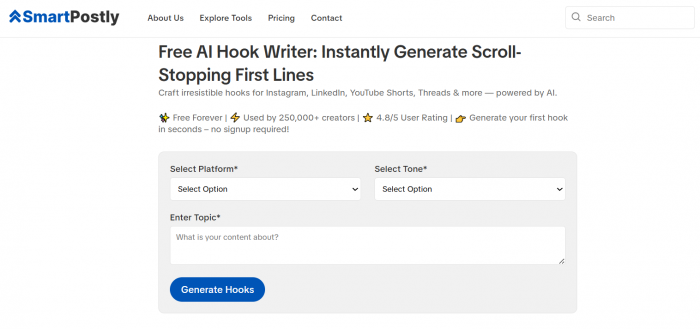
SmartPostly Hook Writer is the most practical first option for creators who want platform and tone controls without a complicated setup. The current tool allows users to enter a topic, select a platform and choose a tone. Its listed platform options include Instagram, LinkedIn, YouTube Shorts, Threads and others, and the basic generator is available without signup.
Its advantage is the input structure. Platform and tone controls produce more focused starting angles than a bare topic prompt. The strongest result should still be rewritten around a real example, evidence and a payoff the body can deliver.
2. Quso.ai Video Hook Generator

Quso.ai focuses specifically on video hooks. Its current generator accepts a topic and returns multiple openings organised around different approaches. The company says the tool ranks suggestions using its study of 121,820 hooks and more than 83,000 YouTube videos, so those figures should be understood as company-reported methodology rather than independent validation.
It suits creators seeking genuinely different video angles. Each result still needs to match the first frame, spoken rhythm and proof in the video.
3. Gimme A Hook
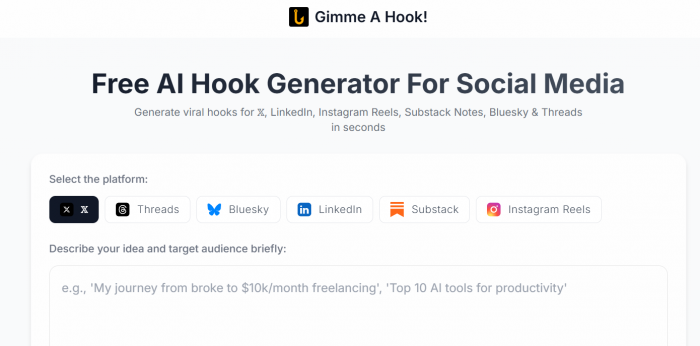
Gimme A Hook supports X, Threads, Bluesky, LinkedIn, Substack and Instagram Reels. Users select a platform, describe the idea and audience, and receive ten suggestions without creating an account.
Its strength is fast coverage of text-led platforms, although established brands may need substantial voice editing.
4. Copy.ai Hook Generator
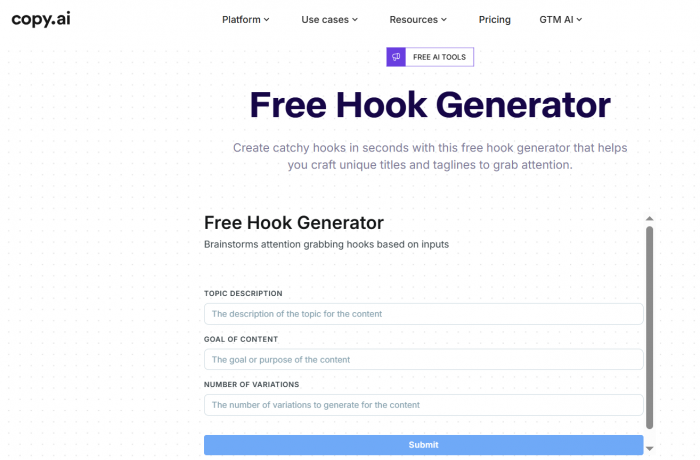
Copy.ai offers a free hook generator for titles, taglines, advertisements and social posts. It sits within a wider go-to-market writing platform rather than a tool built only for creator videos.
It suits marketers connecting hook ideas with broader campaign copy. Short-form video output will need extra work for speech, visual timing and the bridge into the body.
| Tool | Best suited to | Main strength | Editing still required |
| SmartPostly Hook Writer | Multi-platform social creators | Platform and tone selection create a focused starting point | Add evidence, brand voice and a precise payoff |
| Quso.ai Video Hook Generator | Short-form video ideation | Generates varied video-oriented approaches | Match wording with delivery, visuals and real proof |
| Gimme A Hook | Text posts and newsletters | Produces ten quick options across several platforms | Refine originality, tone and strategic depth |
| Copy.ai Hook Generator | Marketing and campaign copy | Connects hook ideation with wider copy workflows | Adapt for platform rhythm and retention structure |
Use these tools to generate contrasts: direct, diagnostic, demonstration-led and story versions. Select the angle the content can prove most convincingly.
A Better Production Workflow
A repeatable workflow reduces the temptation to invent an exaggerated line shortly before publishing.
First, define the payoff in one sentence. State what the audience will understand, see or be able to do by the end.
Second, locate the friction. Identify the mistake, trade-off, contradiction or missing step that makes the payoff necessary.
Third, create four different hook engines. Write one discrepancy hook, one evidence hook, one consequence hook and one transformation hook.
Fourth, choose the version with the clearest proof. The most dramatic option is not always the strongest. Select the line that leads naturally into evidence.
Fifth, design the first frame. Decide what viewers should see before polishing the spoken wording.
Sixth, write the bridge and first payoff together. Do not stop after producing an opening sentence. The next few seconds determine whether the hook develops into retention.
Seventh, remove hidden delay. Cut greetings, repeated context and claims that do not change the viewer’s understanding.
Finally, record what happened. Save the hook type, first-frame approach, early retention, average watch time and the action that mattered most. Over time, this record becomes a platform-specific library of audience behaviour rather than a collection of copied phrases.
Final Verdict
Effective hook writing is not a contest to produce the loudest opening. It is the discipline of making the value, tension and direction of a piece of content clear before the audience loses patience.
The best hooks do not conceal the subject. They reveal the right part of it. They establish a question the body can answer, introduce proof early and move into the payoff without restarting the content.
SmartPostly Hook Writer and other hook generators can widen the range of ideas considered during drafting. Performance data then shows which angle worked with the real audience. The final judgement still belongs to the creator: choose an honest promise, connect every opening element to that promise and deliver the answer while attention is still available.
Comments