

A TikTok bio is read after the interesting part has already happened. Someone watched a budgeting tip, a film breakdown or an unusual history story, then opened the profile to decide whether that video represents the whole account. For a niche or faceless page, the bio must answer that question without relying on a recognisable face, personal reputation or long introduction.
The strongest bio is therefore not the most clever one. It is the one that makes the account easy to classify, gives the viewer a reason to expect more and matches the evidence visible in the feed.
A Bio Is a Profile Handoff
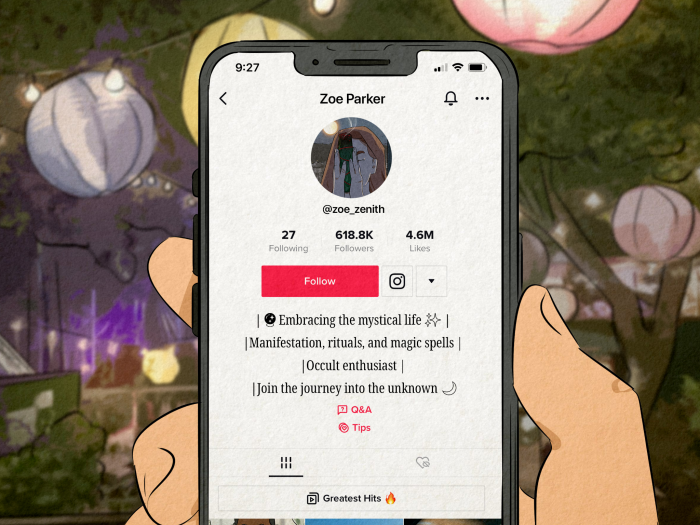
Creators often treat the bio as a discovery tool and try to pack it with keywords. That overstates its role. TikTok’s public explanation of recommendations and search highlights signals such as user interactions, query relevance, hashtags, sounds, language and location. It does not present the bio as a switch that makes an account rank or reach the For You feed.
The bio matters at a different point. It receives attention that a video has already earned and helps the visitor interpret the account. The handoff works like this:
Video promise → profile interpretation → feed proof → follow decision
A person who arrives through “three Excel fixes for monthly reports” may be interested in Excel, office productivity or that one specific problem. The bio narrows the meaning of the visit. “Excel shortcuts for office beginners” tells the visitor that the useful video belongs to a repeatable content system. “Helping you work smarter” does not.
This distinction matters for faceless pages because a successful video can attract a broader audience than the account intends to serve. A compelling crime story may bring general entertainment viewers to a page dedicated to historical court records. A product comparison may attract bargain hunters to an account focused on long-term product testing. The bio should qualify that interest rather than trying to appeal to everyone.
Find the Profile Gap
Before rewriting the bio, compare three things: the video that brings people in, the promise stated in the bio and the first six to nine posts visible on the profile. Most weak profiles contain a gap between at least two of them.
| Profile gap | What the visitor sees | Likely response |
| Scope gap | One specific video, followed by a bio that names a huge category | “I cannot tell what this page regularly covers.” |
| Format gap | The bio names the topic but not the type of content | “Will I get tutorials, opinions, news or entertainment?” |
| Evidence gap | The bio makes a strong promise that the visible feed does not prove | “This description sounds better than the account looks.” |
| Audience gap | The videos suit a defined group but the bio speaks to everyone | “This may not be intended for someone like me.” |
| Action gap | The bio asks for a click, follow or download without a clear payoff | “Why should I take that next step?” |
This audit changes the writing problem. Instead of asking, “What sounds good in a bio?” ask, “What uncertainty prevents the right visitor from following?”
For a faceless recipe page, the uncertainty may be whether recipes are actually cooked or merely collected. For an AI news page, it may be whether the account reports confirmed releases or repeats rumours. For a home-organisation account, it may be whether the ideas suit renters, homeowners or tiny apartments. The bio should spend its limited space on the uncertainty that matters most.
Write the Account Brief First
Trying to write directly inside a short bio field encourages slogans. Write a longer account brief first, then compress it. A useful brief contains four decisions:
1. Coverage: Define the exact territory the account owns, including what it deliberately leaves out.
2. Audience: Identify the viewer whose problem, taste or experience level shapes the content.
3. Editorial method: Explain how topics are selected, tested, researched or presented.
4. Repeatable payoff: State what a follower can reasonably expect to receive again.
Consider a generic “book account.” The category is too broad to guide a bio. A working brief might be:
A faceless recommendation account for adults trying to restart a reading habit. It covers literary fiction under 300 pages, explains the reading experience without major spoilers and avoids books that require extensive background knowledge.
That brief can produce a useful bio:
Short literary fiction for rebuilding your reading habit. No major spoilers.
The account brief also prevents false specificity. “Daily recommendations” sounds concrete, but it is a poor promise if the creator posts three times a week. “Tested tools” is persuasive only when tools are genuinely used. A bio should describe the operating reality of the page, not the version the creator hopes to become later.
The Repeatability Test
A strong niche can generate at least 20 to 30 recognisably related video ideas without abandoning its promise. “Interesting internet content” is too loose; “internet mysteries reconstructed from archived pages” has a clear method and still leaves room for many stories.
Before finalising the bio, list ten upcoming videos. If half of them do not fit the wording, either the bio is too narrow or the content plan is still unfocused. This test also reveals whether the niche is built around a lasting subject or one temporary trend.
Build Around Information Priority
Several current TikTok bio generators are designed around an 80-character field, which means an account cannot explain everything. The solution is not to shrink every idea. It is to rank information by importance.
Use four possible components:
● Territory: State what the account consistently covers in language the intended viewer will immediately understand.
● Filter: Add the audience, standard or boundary that makes the coverage more specific.
● Format: Show how the content is delivered, such as short demonstrations, narrated cases or tested comparisons.
● Direction: Tell the visitor what to watch, expect or do next after reading the bio.
Most bios need only two or three components. The right combination depends on what the username, profile image and visible feed already communicate.
Territory and Audience
Use this combination when the topic is familiar but the intended viewer is not.
Personal finance for UK students starting from zero
Strength training for adults exercising at home
These bios work because they let visitors qualify themselves. Someone looking for advanced investing or gym-based bodybuilding can see immediately that the page serves a different need.
Territory and Filter
Use this for recommendation and curation accounts where selection quality is the main reason to follow.
Horror films worth watching, without major spoilers
Budget desk gear tested for small home offices
The filter explains how the account reduces choice. “Movie recommendations” names an activity, while “horror films without major spoilers” establishes a usable editorial rule.
Territory and Format
Use this when the presentation method differentiates the page.
Forgotten history reconstructed through maps and archives
One-minute Excel fixes using real office examples
The format makes the promise easier to imagine. Visitors know whether they are following for narrated stories, screen recordings, fast tips or detailed analysis.
Territory and Direction
Use this when a pinned series, resource or publishing rhythm already carries the value.
Practical Canva lessons. Start with the pinned basics
Major AI updates explained every weekday
A bio does not need a decorative hook before the useful information. “Welcome to your new favourite corner of TikTok” spends space without reducing uncertainty. Place the strongest identifying phrase first, especially when the account name is abstract or aesthetic.
Use Search Language Without Stuffing

A niche term can improve clarity, but the bio should not be written like a list of search queries. TikTok says search results are influenced by how well content matches an inquiry, alongside signals such as hashtags, sounds, user behaviour, language and location. That does not justify turning a bio into “books | BookTok | reviews | recommendations | reading.”
Use the phrase your intended viewer would naturally use to describe the account. “Beginner Excel,” “small-space storage” or “spoiler-free horror reviews” carries both search language and meaning. Repeating near-identical terms wastes space and makes the profile look mechanically optimised.
TikTok’s Creator Search Insights can show frequently searched topics, content gaps and the search performance of posts. Use that information to refine the account’s vocabulary, then keep the bio readable. A search phrase belongs in the bio only when it accurately names the page’s recurring territory.
The goal is not to insert the largest possible keyword. It is to make the right classification obvious to a human visitor.
Bio Patterns That Solve Real Problems
Templates become useful only when they are tied to an account problem. The following patterns are designed for common faceless and niche account models.
The Knowledge Translator
This account takes a difficult subject and makes it easier to understand. The bio must name the subject, the audience’s level and the translation method.
Weak: Making complicated topics simple
Stronger: Employment law explained for first-time managers
More distinctive: Psychology research explained without therapy-speak
The weak version could describe thousands of accounts. The stronger versions identify both the knowledge territory and the point of translation. Avoid promising professional advice when the content is educational commentary. Clear boundaries strengthen the account rather than making it sound less authoritative.
An advanced account can reverse the formula. Instead of lowering the difficulty, it may signal that it serves experienced viewers:
Technical SEO experiments for people managing large sites
The important point is not to make every account sound beginner-friendly. It is to reveal the expected level before the viewer follows.
The Curator
A curator saves the viewer time by filtering a crowded category. The value is not “recommendations”; it is the standard used to decide what deserves attention.
Weak: The best apps, tools and websites
Stronger: Useful AI tools for solo creators, tested before posting
Alternative: Short mystery novels with no major plot spoilers
The category should be narrow enough that the viewer understands the taste behind the choices. If the account earns commissions, the profile or linked disclosure should make commercial relationships clear. The bio should not imply neutral testing when placement is paid.
A curation bio can also define what the account excludes:
Productivity tools without enterprise pricing
Weekend trips that do not require a car
Minimalist interiors without luxury furniture
An exclusion is often more informative than another positive adjective because it shows the judgement behind the recommendations.
The Evidence-Led Reviewer
This account compares products, services or techniques. Faceless review pages often look untrustworthy because viewers cannot see who is testing or how the verdict was reached. The bio should expose the method.
Budget microphones tested in untreated rooms
Skincare wear checks for humid weather and oily skin
Productivity apps used in real weekly workflows
These lines are stronger than “honest reviews” because honesty is a self-awarded label. A visible method gives the audience something they can inspect.
The method does not have to sound scientific. It only needs to match what the videos actually show. A home-cooking account could use “recipes cooked twice before posting,” while a software page might say “features tested on free and entry-level plans.”
The Archive or Story Page
Narrative accounts need a stable source of stories and a recognisable treatment.
Weak: Stories you were never taught
Stronger: Failed companies retold through filings and old ads
Alternative: Internet mysteries rebuilt from archived web pages
The method differentiates the account and signals that stories are not invented merely for dramatic effect. If reconstructions include speculation, the content should label it rather than blending assumptions with established facts.
A storytelling bio should also avoid promising a reaction. “Stories that will terrify you” depends on hype. “Unsettling folklore from coastal towns” describes the material and atmosphere without predicting how every viewer will feel.
The Utility Account
Utility pages help viewers complete a task. The bio should identify the task, starting level and practical constraint.
Canva workflows for non-designers with client deadlines
Phone photography fixes using ordinary indoor light
Five-minute Excel repairs for messy office sheets
“Tips and tricks” is rarely useful positioning because it names neither the problem nor the outcome. A constraint such as “without paid plugins,” “for small kitchens” or “using a phone” often creates the niche more effectively than adding another adjective.
Compare these two bios:
Social media tips for small businesses
Product-video ideas for shop owners filming alone
The second version narrows the audience, content format and production constraint. It gives a shop owner a much stronger reason to inspect the feed.
The Faceless News Desk
A news account should state its coverage and editorial boundary. Speed alone is not a credible position because nearly every update page claims to be fast.
Major EV updates with rumours clearly labelled
AI product releases explained beyond the launch post
Football business news from filings and confirmed reports
The bio should not imply official affiliation with a company, club or public body. It should also avoid “breaking news” if most posts are summaries published hours later. The strongest promise may be interpretation rather than speed.
For example: Cybersecurity news translated for small IT teams
This bio does not compete on being first. It competes on making the news usable for a defined audience.
The Mood-Led Page
Aesthetic, quote and motivation pages cannot rely on topic alone because the category is saturated. They need an emotional use case.
Weak: Daily motivation and positive vibes
Stronger: Quiet reminders for people rebuilding their routines
Alternative: Journal prompts for people who overthink decisions
The audience follows because the page repeatedly creates a particular emotional experience. The bio should name that experience without making medical or transformational claims the content cannot support.
Tone should also match the visual system. A page using muted visuals and reflective narration will feel inconsistent with an aggressive bio promising “daily discipline with no excuses.”
Make a Faceless Account Trustworthy
A faceless account removes identity from the foreground, but it should not remove accountability. Trust has to come from the work itself.
1. Show the Method : Describe how information enters the account. “Public records and archive footage” says more than “true stories.” “Bought, used and compared” is stronger than “top product picks” when it is accurate.
A short methodological phrase can carry more credibility than a credential-heavy description because the viewer can look for proof in the videos.
2. State the Boundary : A narrow boundary tells viewers what the page refuses to do. Examples include “no major spoilers,” “rumours labelled,” “beginner level only” and “no paid-placement rankings.”
Boundaries reduce the cost of following because viewers know what they will not have to filter out. They are particularly useful in crowded niches where many pages cover similar subjects but apply different standards.
3. Match Claims to Visible Proof : The first posts should demonstrate the bio immediately. If the description says “one-minute breakdowns,” the visible feed should not be dominated by unexplained clips. If it says “tested,” videos should show enough of the process to support that claim.
A bio cannot create credibility independently of the feed. It can only direct attention towards evidence that already exists.
4. Avoid Borrowed Authority : Do not imply professional qualifications, official access or first-hand testing that the account does not possess. A faceless page can still be useful by being precise about what it does: summarises public research, compares published specifications, demonstrates software workflows or curates reliable sources.
Trust grows when the account is easier to verify, not when the bio sounds more impressive.
Choose a CTA That Fits
The bio’s final instruction should reduce friction, not merely demand attention. A new account with no external link may be better served by “Start with the pinned guide” than “Follow for more.” A recurring story page can point to “Part one pinned,” while a tutorial account can direct visitors to a beginner sequence.
TikTok currently allows personal accounts with at least 1,000 followers and registered Business Accounts to add a website link, although availability can vary by account and region. Until a useful destination exists, do not write a link-led CTA.
| Profile situation | Useful CTA |
| New niche account | Start with the pinned introduction |
| Multi-part series | Part one is pinned |
| Tutorial library | Begin with the basics playlist |
| Research or review page | See the testing method |
| Account with a relevant link | Get the full guide below |
The CTA should change when the account’s next step changes. Remove “new videos daily” when the schedule slows, and replace campaign wording after a launch ends.
Five TikTok Bio Generators
TikTok bio generators are most useful after the account’s niche has been defined. They can shorten a positioning statement, test different tones and suggest alternative phrasing, but they cannot decide what makes the account worth following. Each tool below fits a slightly different stage of the writing process.
| Tool | Where it fits | Main advantage |
| SmartPostly TikTok Bio Generator | Early drafting | Turns niche details into concise bio directions |
| Pallyy TikTok Bio Generator | Quick rewriting | Produces short creator or business variations |
| Kontentino TikTok Bio Generator | Style testing | Compares languages, tones and emoji choices |
| SocialPilot TikTok Bio Generator | Voice development | Tests noticeably different brand personalities |
| Hootsuite Bio Generator | Brand adaptation | Converts a structured brief into platform-specific copy |
1. SmartPostly TikTok Bio Generator : Use it to shape the first draft
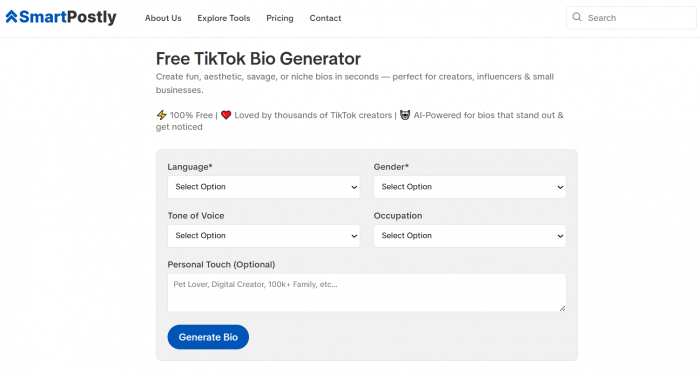
SmartPostly’s TikTok Bio Generator helps turn an account description into short bio ideas. It works best when the user provides more than a broad niche label. Instead of entering “history page,” describe the account as “a faceless page explaining failed companies through old advertisements and public records.”
That added context gives the generator a subject, content method and recognisable angle. Users can then compare several directions and keep the version that communicates the niche most clearly.
SmartPostly is particularly useful for creators who understand what their account covers but struggle to reduce that idea into a compact line.
Good fit for: Niche pages, faceless accounts and creators developing their initial profile wording.
2. Pallyy TikTok Bio Generator : Use it when the positioning is already clear
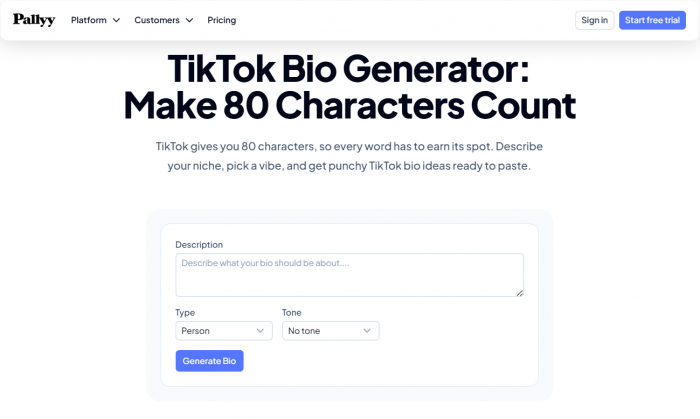
Pallyy asks users to describe the creator, business or niche, select the account type and choose a tone. Its simple setup makes it useful for turning one complete positioning statement into several shorter variations.
For example, a creator could enter “phone photography tutorials for shop owners filming products alone” and compare professional, friendly or casual versions. The central account idea remains the same while the wording changes.
Pallyy is less effective when the input is vague. A phrase such as “lifestyle account” may generate readable copy, but it will not reveal what makes the page different.
Good fit for: Creators who have already defined their niche and only need concise wording options.
3. Kontentino TikTok Bio Generator : Use it to compare presentation styles
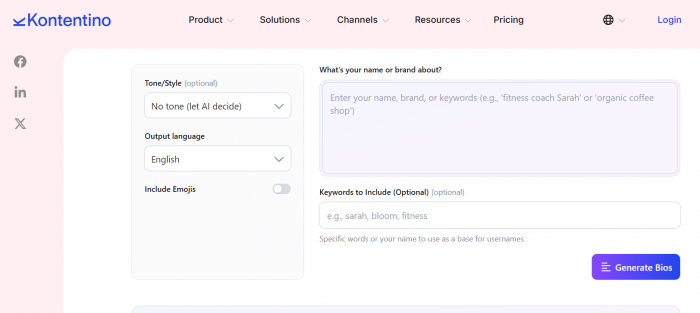
Kontentino is useful when the account promise is settled but the creator is unsure how it should sound. Its controls cover tone, language and emoji use, allowing users to generate several stylistic versions of the same bio.
This can help bilingual accounts compare natural wording across languages or let a creator see whether a playful bio fits better than a plain editorial version. The emoji option is also practical for testing structure without automatically filling the bio with unnecessary symbols.
Generated translations should still be reviewed manually. Correct grammar does not always mean the phrasing will sound natural to the intended audience.
Good fit for: Multilingual accounts and creators deciding between clean, expressive or emoji-led bios.
4. SocialPilot TikTok Bio Generator : Use it to develop the account’s voice
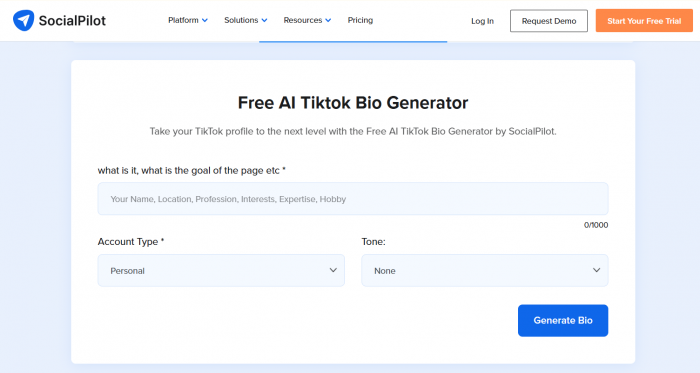
SocialPilot provides a wider range of tone choices, including professional, witty, bold, creative and casual styles. This makes it useful for accounts that know what they cover but have not yet settled on a clear personality.
A faceless productivity page, for instance, could compare an analytical bio focused on testing with a more conversational version aimed at solo creators. The comparison helps reveal which voice matches the narration, captions and editing style used in the videos.
Faceless accounts should focus the input on the niche, audience, content format and research method rather than personal interests that are not part of the public brand.
Good fit for: Brand pages and themed accounts testing noticeably different tones.
5. Hootsuite Bio Generator : Use it to adapt a broader brand brief
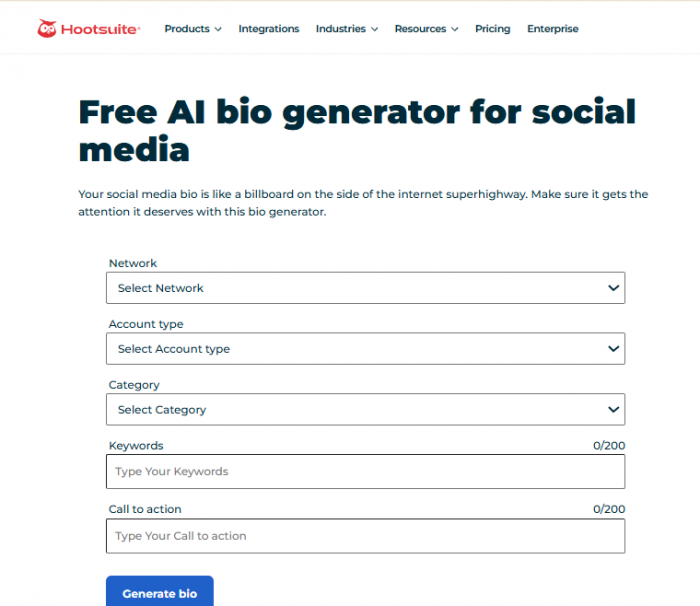
Hootsuite’s generator asks for structured information such as the social platform, account category, keywords and desired call to action. This makes it useful for creators or businesses managing the same identity across several networks.
A brand may emphasise expertise and services on LinkedIn, visual work on Instagram and recurring video formats on TikTok. Hootsuite can help translate the broader brand description into wording that better fits each platform.
The TikTok version should still be edited around the profile journey. Most visitors arrive after watching one video, so the bio needs to confirm what related content they will find next rather than repeat a general company introduction.
Good fit for: Businesses, multi-platform creators and accounts working from an established brand strategy.
Choosing the Right Generator
The best option depends on what is missing from the current bio. SmartPostly is a strong starting point for turning niche details into compact ideas, while Pallyy suits creators who only need quick rewrites. Kontentino helps with language and presentation choices, SocialPilot is useful for testing voice, and Hootsuite fits more structured brand briefs.
Whichever tool is selected, the final version should be checked against the visible feed. A polished bio is only useful when it accurately describes the content the account publishes.
Turn Generated Copy Into a Real Bio
Use a generator to create contrast, not to choose the final answer automatically. A practical workflow has four steps.
First, generate from constraints. Include the niche, audience, format, evidence standard, tone and any wording to avoid. “Faceless finance page” is a topic. “Thirty-second budgeting examples for Indian college students, calm tone, no income promises, no emojis” is a usable brief.
Second, score clarity before style. Hide the username and profile image, then ask whether the line still reveals what the account publishes. A witty line that depends on context is weaker than a direct one that survives on its own.
Third, remove self-praise. Replace “best,” “trusted,” “honest” and “must-follow” with a method, audience or boundary. “Apps tested in weekly client work” carries more information than “your trusted app guide.”
Fourth, check the feed. The bio and first visible posts should tell the same story. If the bio has become sharper than the content, the problem is no longer copywriting; it is profile consistency.
TikTok Studio provides account, content, viewer and follower analytics, including overall performance and net follower information. Use those metrics carefully when testing a bio. Change one element at a time, keep the content mix reasonably stable and compare a meaningful period rather than judging the result after a single post.
A bio cannot repair weak videos, but it can improve the quality of the handoff from a relevant video to the profile.
The Conclusion
A strong faceless TikTok bio is not a miniature mission statement. It is a precise label for a repeatable content system. It tells the visitor what territory the account covers, how that material is selected or presented and why the visible feed deserves another visit.
Start with the profile gap, not a slogan. Define the account before compressing it, replace vague authority with an inspectable method and choose a CTA that points somewhere useful. Generator tools can provide wording options, but the final bio should be built from the account’s real editorial behaviour.
Comments