

Chub AI Is No Longer the Only Game in Town
Chub AI made custom character chat and roleplay mainstream, but its users now fall into two camps: those who still love the concept and those who are frustrated by rough edges, instability, content rules, or lack of polish. If you’re in the second group, you don’t have to give up immersive AI conversations; you just need a platform that fits the way you actually use them.
In 2026, the “Chub AI replacement” question doesn’t have a single right answer. Some people want a plug‑and‑play browser experience. Others want total control with local models. Some care about mobile comfort; others want text plus images in the same scene. This guide walks you through eight strong alternatives, not as a flat list, but as eight different ways to move beyond Chub AI.
1. CrushOn AI : A More Polished Chub‑Style Experience
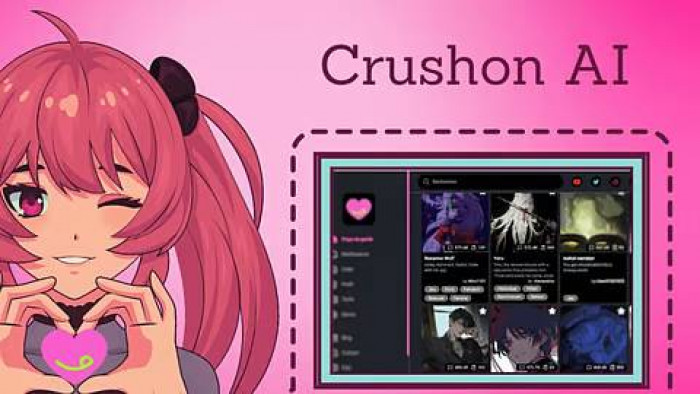
If you liked Chub AI’s core idea but felt like you were always babysitting it, CrushOn AI is the softer landing. You open the site, scroll through a modern catalog of characters, and you’re chatting in seconds. There’s no juggling API keys or obscure settings behind the scenes; the platform handles the plumbing so you can focus on personalities and stories.
The conversations themselves feel continuous. Characters can remember details you’ve shared, so long‑running relationships don’t reset every time you come back. Multi‑character scenes make it easy to orchestrate group dynamics, and trending sections help you find interesting bots without going off‑platform to hunt for links or presets. It captures the same “RP sandbox” energy that drew users to Chub AI in the first place, but wraps it in a more coherent UX.
The trade‑off is that the free tier is clearly a trial, not a permanent home for heavy roleplayers. Message limits come up fast once you’re emotionally invested. And CrushOn AI is unapologetically focused on chat and roleplay, so if you tried to use Chub as a general‑purpose assistant for writing, coding, or research, this isn’t meant to replace that part of your stack. It also doesn’t have the massive, mainstream ecosystem of a Character.ai, though for many former Chub users, that’s an acceptable price for familiarity plus stability.
CrushOn AI pricing
| Plan | Approx. price (USD/month) | Best suited for |
| Free | 0 | Testing the vibe, light casual sessions |
| Premium | ~9–15 | Regular RP, longer stories, daily chatting |
2. SpicyChat : For People Who Want Constant RP Energy

Where CrushOn AI feels like a slick app, SpicyChat feels more like a bustling roleplay hangout. The entire experience leans into community energy: users constantly create, tweak, and refine characters that range from wholesome to wildly experimental. You spend more of your time exploring and jumping into new situations than fiddling with settings.
A typical session might start with you opening a trending character, reading a snappy description, and finding yourself in a scene within a handful of messages. The platform invites you to bounce between relationships, try fresh archetypes, and follow what’s hot, which keeps the experience feeling “alive” in a way that more static libraries often don’t.
On the downside, quality can vary. Some characters are brilliantly written and tuned; others are clearly experiments or half‑finished ideas. If you’re sensitive to inconsistency, you may have to curate your own shortlist of favorites before it feels truly reliable. And, like most RP‑first platforms, SpicyChat isn’t meant to double as a productivity tool. This is where you go to unwind, not to get work done.
SpicyChat pricing
| Plan | Approx. price (USD/month) | Best suited for |
| Free | 0 | Casual exploration, low‑volume chatting |
| Plus | ~5–10 | Frequent RP, trying many characters |
3. JanitorAI : The Bridge Between Casual and Power User
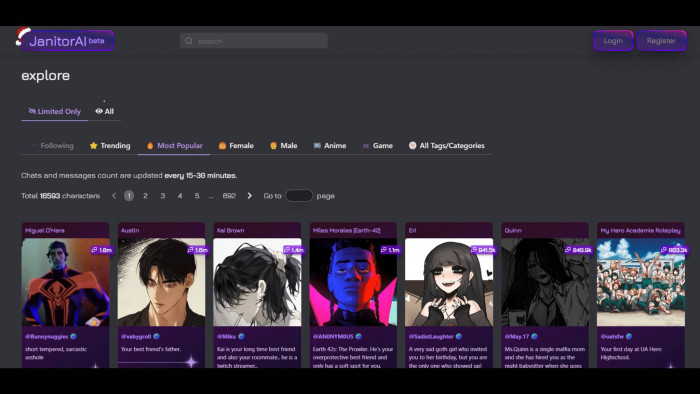
JanitorAI occupies a comfortable middle ground. For most people, it behaves like a typical character‑chat website: you open it in a browser, browse a large library of bots, and maintain persistent chats that evolve over time. If that’s all you want, you never have to look under the hood.
The interesting part is what happens when that’s not all you want. When you start caring about which models run your characters, how much they cost, and how they behave, JanitorAI doesn’t force you to abandon ship. You can plug in external APIs, experiment with different backends, and keep your favorite characters while upgrading the brains behind them. This makes it attractive for users who started casual on Chub AI and slowly became fascinated with customization.
There are rough spots: the interface isn’t as polished as newer platforms, and more advanced setups add complexity that beginners can find intimidating. But for people who want to grow their skills over time rather than jump straight into full self‑hosting, JanitorAI is one of the more forgiving steps on that ladder.
JanitorAI pricing
| Mode | Typical cost | Who it’s for |
| Hosted – Free | 0 | New users testing the platform |
| Hosted – Paid | ~10–20 USD/month | Regular users who don’t want to maintain APIs |
| BYO API/backends | Pay model providers | Power users managing their own model spend |
4. SillyTavern : The Control Panel for Serious Tinkerers

SillyTavern is where you go when you’ve decided you’re not just “using AI chat”, you’re running it. Instead of a hosted website, it’s a client you install and connect to whatever models you want: local LLMs on your GPU, cloud APIs on remote servers, or a mix of both. It’s essentially a cockpit for AI chat, and you’re the pilot.
Because it’s self‑hosted (in the broad sense), there’s no single platform imposing rate limits, filters, or usage patterns on you. You set up characters, define system messages and prompts, tweak sampling parameters, integrate jailbreak techniques, and generally shape the behavior as deeply as your technical comfort allows. For former Chub AI users who ended up obsessing over prompts and proxies, this feels like finally getting the keys to the entire system.
Of course, the trade‑off is that you’re responsible for everything. Installation takes some reading and patience. You decide which models to run, how to keep sessions stable, and where to draw your own safety lines. There’s no “log in from any phone” convenience unless you build it yourself via remote access. SillyTavern is overkill for casual users, but incredibly liberating for the cohort that outgrew Chub AI’s hosted constraints.
SillyTavern cost model
| Component | Cost | Notes |
| Client | Free (open source) | No subscription for the tool itself |
| Models/APIs | Varies by your choices | You pay for hardware or external APIs |
5. Backyard AI : Keeping Your RP on Your Own Hardware
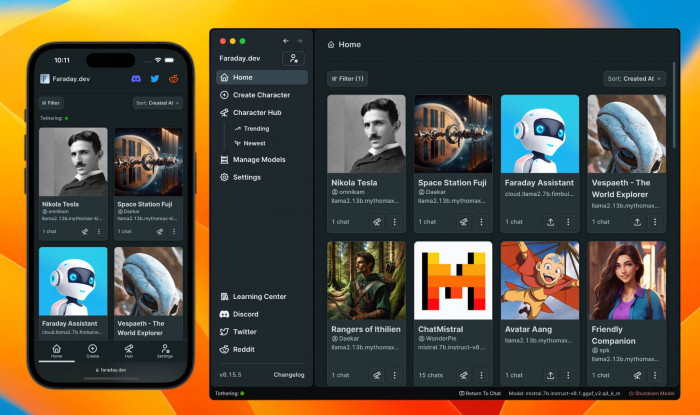
Backyard AI shares the self‑hosted philosophy of SillyTavern but tries to make local models less intimidating. The idea is simple: instead of sending your conversations to someone else’s servers, you run them on your own machine or home server, with a friendlier setup than raw command‑line tooling.
Once everything is configured, the experience feels surprisingly normal: you open your interface, talk to characters, and build long‑term relationships, just like with any cloud platform. The big difference is that nothing leaves your network unless you explicitly choose it to. For Chub AI veterans who started worrying about where their more intimate or personal chats were going, this shift can be very reassuring.
The price you pay is largely in hardware and a bit of complexity. You need a reasonably strong GPU/CPU for larger models, and mobile‑style “log in from any device, anywhere” isn’t the default. If, however, you value privacy more than convenience, Backyard AI represents a level of control that a hosted service like Chub AI simply can’t match.
Backyard AI pricing
| Item | Cost type | What you’re paying for |
| Software | Usually free / open | Tooling itself is often no‑cost |
| Hardware | One‑time purchase | GPU/CPU capable of running the models |
6. Character.ai : Mainstream, Polished, and Heavily Moderated
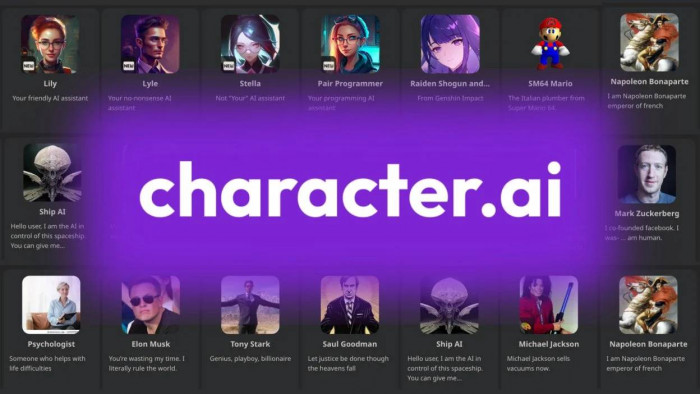
Character.ai is almost the opposite of Chub AI in feel. Where Chub often felt like a hobbyist lab, Character.ai is built like a consumer app: clean, colorful UI, huge lists of bots, and mobile apps that feel as smooth as modern messaging platforms.
You can talk to fan‑made characters, official “assistants,” or celebrities and fictional personalities. Swapping between them is effortless, and the mobile experience is strong enough that many users barely touch the desktop version. For people who want to share chats, play with characters on stream, or recommend a platform to friends, this level of polish matters more than raw customizability.
The big tension is moderation. Character.ai aggressively filters adult and borderline content, which is a deal‑breaker for anyone who used Chub AI for explicit or highly edgy roleplay. For others, though, that very strictness is a selling point: it’s easier to trust in mixed company, family environments, or public content.
Character.ai pricing
| Tier | Approx. price (USD/month) | What changes |
| Free | 0 | Full access, but with queues at busy times |
| Paid (c.ai+) | ~9.99 | Priority access, faster responses |
7. Sakura.fm : Built Around Your Phone, Not Your Desktop

While many Chub AI users started on desktop and moved to mobile later, Sakura.fm begins with the assumption that your phone is the main stage. Its UI, pacing, and notification patterns are all designed for long, comfortable sessions on a small screen.
You can maintain multiple ongoing storylines without feeling lost, because the app treats conversations like long‑form chats rather than isolated “sessions.” Quick reply affordances and thoughtful scrolling behavior keep you in flow; it feels closer to chatting in a social app than tinkering in a tool. For people who mostly roleplay on the couch, in bed, or on commutes, that matters more than tweak‑heavy settings menus.
The limitations are what you’d expect from a mobile‑first RP platform: serious power users may find it too opinionated, and the desktop experience is technically available but clearly not the star of the show. If your priority is thumb‑friendly comfort and habit‑forming use rather than deep model customization, Sakura.fm is a much better fit than a desktop‑centric site like Chub AI.
Sakura.fm pricing
| Plan | Approx. price (USD/month) | Ideal use case |
| Free | 0 | Trying the app, light or occasional RP |
| Premium | ~10–20 | Daily use, multiple long‑running chats |
8. PolyBuzz AI : When You Want Text and Images Together
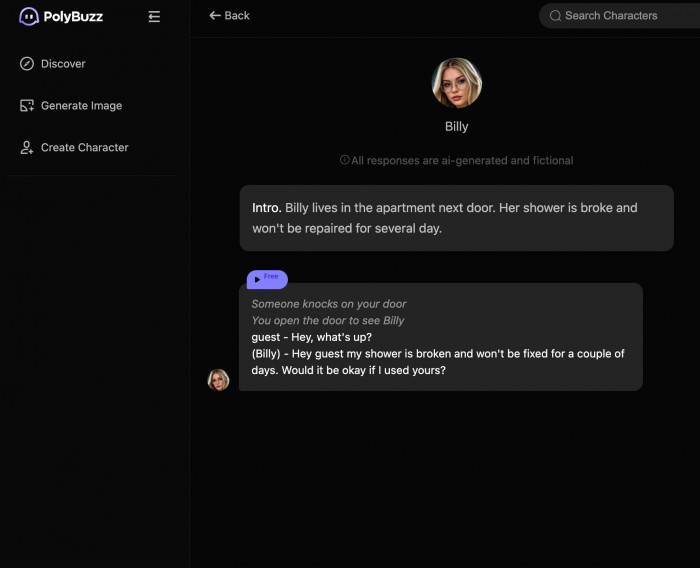
One thing Chub AI never truly tackled is visual storytelling. Platforms like PolyBuzz AI fill that gap by combining character chat with built‑in image generation. Instead of just describing a scene, you can have the system render what you’re talking about as the conversation unfolds.
Polybuzz is especially powerful for users who like to build worlds, design characters, and share their RP. You can refine a character’s look, generate scenes from key story moments, and keep everything in a single, coherent interface instead of constantly switching between a chat site and an image‑gen service.
The downside, naturally, is cost and complexity. Images are more expensive to generate than text, so paid tiers tend to be pricier, and free plans are stricter about limits. This platform is also tuned heavily toward romantic, companion, or fantasy storytelling, which may not appeal if your interests lie elsewhere. But for the slice of Chub AI’s audience that wanted their words to come with pictures, this is a clear upgrade.
PolyBuzz / Lovescape pricing
| Plan | Approx. price (USD/month) | Focus |
| Free | 0 | Limited chats and low‑res or few images |
| Paid tiers | ~10–25 | More messages, more images, better quality |
Quick Comparison
| Tool | Core focus / positioning | Content freedom / control | Pricing ballpark (USD/month) | Where it’s better than Chub AI |
| CrushOn AI | Hosted character‑chat with polished UX | Moderate freedom on paid tiers, platform‑managed | Free tier, then roughly 9–15 for premium | Same “long‑story” energy with less tinkering and more stability |
| SpicyChat | Community‑driven, high‑energy RP hub | Generally flexible, community‑shaped | Free, then roughly 5–10 for plus | More creative, “alive” RP ecosystem with less config overhead |
| JanitorAI | Hybrid hosted + optional API/power features | Higher if you bring your own models | Free, then ~10–20 for hosted; BYO API | Lets you keep your characters while upgrading the brains behind them |
| SillyTavern | Self‑hosted, front‑end for local/remote models | Very high; you define filters & stack | Client free; you pay for hardware/APIs | Removes platform limits and gives you total ownership of the setup |
| Backyard AI | Local/LAN roleplay with privacy focus | Very high; everything runs on your hardware | Software usually free; hardware one‑time | Keeps intimate chats off third‑party servers entirely |
| Character.ai | Mainstream, polished, heavily moderated app | Low freedom; strict safety filters | Free, ~9.99 for priority tier | Far more polished, safe, and “shareable” than Chub AI |
| Sakura.fm | Mobile‑first, long‑session RP experience | Moderately flexible within RP focus | Free, then roughly 10–20 for premium | Feels like a native chat app instead of a clunky desktop site on mobile |
| PolyBuzz | Text + integrated image generation for RP | Moderate–high; tuned for romantic/visual RP | Free with tight limits, ~10–25 paid | Adds built‑in visuals so your worlds are seen, not just described |
Verdict: Which Chub AI Alternative Fits You Best?
The “best” Chub AI alternative isn’t about raw power; it’s about matching the tool to the reason you’re walking away in the first place. If you still love Chub’s core idea but hate the fragility, CrushOn AI gives you almost the same experience in a smoother, more stable package that feels ready for daily use.
When your priority is energy and creativity, rather than configuration, SpicyChat is the place where the RP scene feels most alive, with a constant flow of new characters and scenarios to jump into. If you’ve started tinkering with models and prompts but aren’t ready to run everything yourself, JanitorAI is the gentlest way to ease into APIs and custom backends without abandoning the comfort of a hosted site.
For users who are ready to take full ownership of their stack, SillyTavern and Backyard AI are the natural endgame: you control the models, the data, the rules, and you’re no longer at the mercy of someone else’s platform decisions. If you care more about safety, polish, and something you can confidently recommend or stream, Character.ai is a better match than Chub AI in almost every mainstream context.
Roleplayers who live on their phones will feel immediately at home in Sakura.fm, which treats mobile as the default and long, thumb‑friendly sessions as the norm rather than an afterthought. Finally, if your ideal experience is not just talking but also seeing your worlds, PolyBuzz push roleplay into visual storytelling, letting you build scenes and images alongside the dialogue in the same space.
Comments