

Character AI and Talkie AI are often mentioned in the same conversation, but they are built around slightly different ideas of what an AI companion platform should feel like. Character AI is more closely associated with text-based character conversations, long chats, fandom roleplay, and a huge library of user-created bots, while Talkie AI leans more toward voice-driven interaction, visual presentation, and a more stylized companion-chat experience.
That difference is exactly why a fair comparison matters. A reader looking for slow-burn story roleplay may not judge these platforms the same way as someone who wants a more emotional, fast-connecting AI companion on mobile. So instead of forcing a one-size-fits-all winner, the smarter approach is to compare them across the areas that actually shape user experience: conversation depth, roleplay quality, voice and immersion, moderation, pricing, and overall value.
What these two tools are really built for
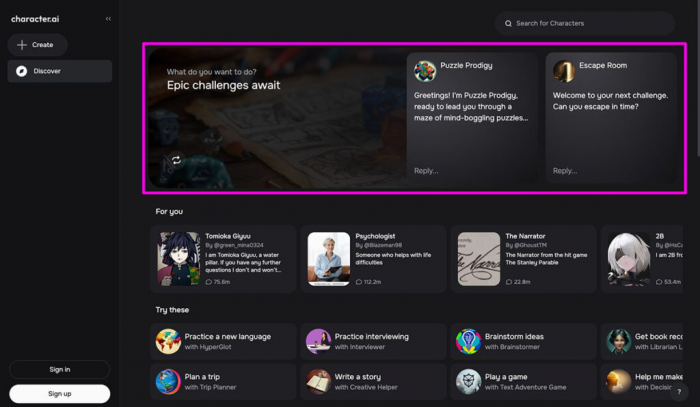
Character AI has built its identity around AI-powered character conversations. Its public-facing positioning and app-store presence show a product centered on chatting, calling, texting, and creating AI characters that can remember past conversations and adapt to a user’s style. That makes it naturally attractive to users who enjoy long conversations, character experimentation, and fan-style roleplay across many fictional worlds and personality types.
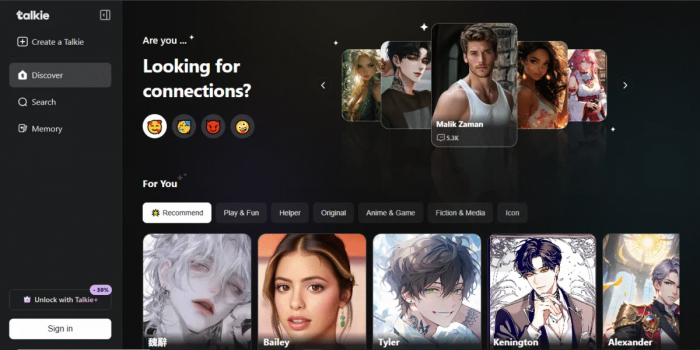
Talkie AI presents a slightly different appeal. Public descriptions emphasize free AI character chat, personalized companions, and a more immersive social-app feel, with voice and presentation playing a bigger role in how the platform is experienced. In simple terms, Character AI often feels closer to a text-first roleplay ecosystem, while Talkie AI feels closer to a companion app designed for emotional engagement and audiovisual personality.
Platform overview
| Dimension | Character AI | Talkie AI |
| Core identity | AI chatbot platform focused on character conversations and custom bots. | AI character companion app focused on chat, voice, and interactive personality-driven experiences. |
| Main interaction style | Text-first, conversation-led, and story friendly. | Voice-forward, visual, and mobile-entertainment oriented. |
| Typical audience | Roleplayers, fandom users, creative chat users, and bot creators. | Casual chat users, AI companion users, and users who value immersion and presentation. |
| Availability | Web and mobile apps. | Mobile-first presence with public web visibility depending on region and access path. |
Character library and creation experience
One of Character AI’s biggest strengths is scale. The platform benefits from a very large ecosystem of user-created characters, which gives it strong breadth across fandom bots, original characters, fictional personalities, and niche roleplay concepts. For users who enjoy exploring different tones and scenarios, that variety is a major advantage because the platform rarely feels limited to one type of emotional experience.
Talkie AI approaches discovery differently. It appears more curated and more personality-packaged, with stronger emphasis on visual identity and companion-style presentation than on an endlessly expandable creator marketplace. That may make it feel less open-ended than Character AI, but it also makes it easier for many mainstream users to get into quickly without feeling lost inside a giant bot catalog.
A useful way to frame the difference is this:
● Character AI is stronger for users who want variety, experimentation, and access to many different character styles.
● Talkie AI is stronger for users who want a more polished first impression and a companion product that feels emotionally staged from the start.
Feature comparison
| Category | Character AI | Talkie AI |
| Character library | Large universe of user-created bots across fandoms and original concepts. | Companion-style character selection with a more curated, presentation-led feel. |
| Character creation | Supports custom character creation and behavioral setup. | Supports custom AI character creation in a more consumer-app styled environment. |
| Voice | Available, but still secondary to the text experience in most discussions and positioning. | More central to the product identity and user appeal. |
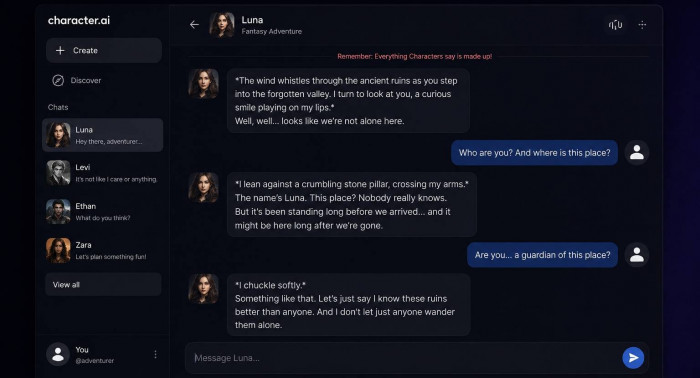
| Interface | Text-led and chat-centric. | More visual, card-based, and entertainment-oriented. |
| Story continuity | Better aligned with longer sessions and sustained roleplay flow. | Better aligned with immediate immersion and lighter companion interaction. |
| Best-fit use case | Long chats, story roleplay, character exploration. | AI companionship, voice-led interaction, casual immersive chat. |
Conversation quality and roleplay depth
For many users, this is the section that matters most. Roleplay quality is not just about whether the AI sounds exciting in the first five messages. It is about whether the platform can stay in character, maintain emotional tone, respond coherently to scene changes, and keep the conversation engaging over time.
Character AI generally stands out more in this area because its product identity has always been tightly tied to extended text conversations and character interaction. That strength becomes more obvious in long-form roleplay, lore-heavy chats, and scenarios where users want the conversation to unfold gradually rather than rush into fast emotional payoff.
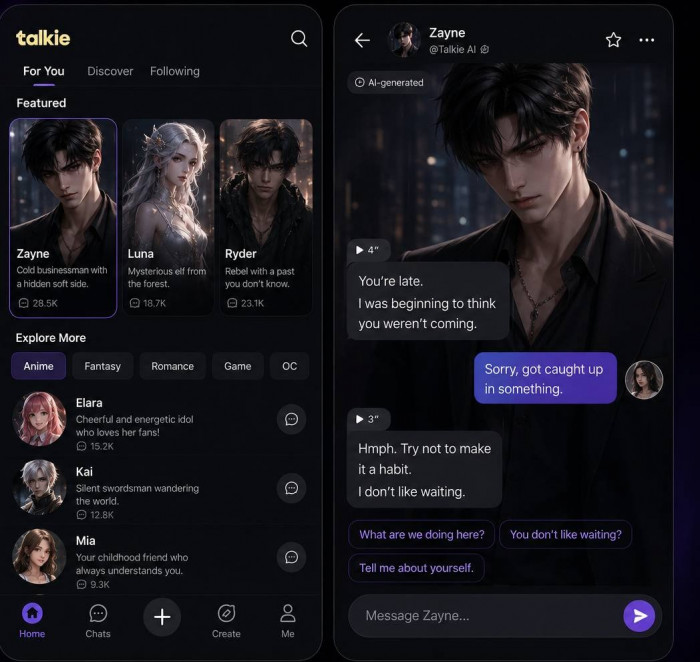
Talkie AI creates a different kind of engagement. It seems more focused on immediacy, atmosphere, and the sense that the character is emotionally present from the beginning. That can make chats feel warmer and more vivid early on, especially for users who respond strongly to voice and presentation, even if the platform may feel lighter than Character AI in extended story logic or long-arc narrative continuity.
This is where the comparison becomes clearer:
● Character AI tends to serve long-form roleplay better.
● Talkie AI tends to serve companion-style immersion better.
● The better option depends less on raw capability and more on the kind of emotional experience the user wants.
Voice, visuals, and overall immersion
Voice and presentation are among the strongest reasons users get pulled toward Talkie AI. Public descriptions and reviews consistently present it as a more immersive, companion-led experience where voice is not just an extra feature, but part of the product’s personality. That gives Talkie AI a more immediate emotional style, especially for users who want an AI interaction that feels closer to a digital companion than a standard text chatbot.
Character AI includes voice-related features too, but the broader identity still feels more rooted in typed interaction and character dialogue than in audiovisual immersion. For some users, that is actually a benefit rather than a weakness, because it keeps the focus on writing quality, roleplay pacing, and conversational imagination rather than on app-style presentation.
The practical difference is simple. If immersion means story depth and believable in-character responses, Character AI often feels stronger. If immersion means expressive presence, voice appeal, and a stronger emotional first impression, Talkie AI tends to feel more compelling.
Moderation, safety, and NSFW boundaries
This part of the comparison should be handled carefully because community opinion around moderation is often emotional and inconsistent. The most credible way to discuss it is to separate official positioning from user-reported experience and avoid exaggerated claims about what either platform fully allows.
Character AI has long been associated with user discussion around filters, refusals, and moderated boundaries. Community conversations suggest that people often test its limits in roleplay and romance scenarios, but the platform is still broadly understood as a moderated mainstream product rather than a fully unrestricted adult chatbot environment.
Talkie AI also appears to sit in that middle ground. It clearly trades on personality, romance appeal, and emotional immersion, yet community discussion indicates that it is not designed as a completely uncensored explicit platform either. Reddit discussions around paid features and reply editing suggest added flexibility and personalization, but not a hidden premium layer of fully unrestricted explicit content.
| Moderation area | Character AI | Talkie AI |
| Public-facing positioning | Mainstream character chat platform with moderated boundaries. | Mainstream AI companion platform with moderated consumer-safe positioning. |
| Community perception | Often discussed in terms of filters and inconsistency in roleplay limits. | Often discussed as more immersive and romance-friendly, but still moderated. |
| Best editorial description | Roleplay-friendly but restricted. | Immersive and flexible, but not fully unrestricted. |
Pricing and what users actually get
Pricing should not be treated as a throwaway section in this comparison because both tools rely on free access as an entry point and then use premium upgrades to improve the overall experience. The more useful question is not just how much they cost, but what the upgrade actually changes for the user.
Character AI’s premium subscription, c.ai+, is listed at $9.99 per month, while the annual plan is listed at $94.99 per year, which works out to about $7.92 per month. Public pricing summaries and product pages associate that subscription with faster responses, priority access during peak hours, improved memory, fewer disruptions, voice benefits, and early access to some features.
Talkie AI is widely described as having a free entry tier and a premium plan starting at $9.99 per month, though publicly available third-party listings are less detailed and less standardized than Character AI’s own pricing page. Some public reviews also mention higher-priced premium versions such as a Pro plan at $24.99 per month, which suggests that Talkie AI’s monetization may vary by platform, bundle, or review source, so this is one area where a writer should verify the exact plan visible at the time of publication.
| Plan area | Character AI | Talkie AI |
| Free plan | Yes. | Yes. |
| Base paid plan | c.ai+ at $9.99/month. | Premium subscription starts at $9.99/month according to public listings. |
| Annual pricing | $94.99/year, about $7.92/month effective cost. | Public annual pricing is not consistently documented across sources reviewed. |
| Paid value emphasis | Faster replies, priority access, memory improvements, fewer ads, early features, and some premium tools. | Premium access, customization-related perks, reduced ads, and enhanced companion experience depending on plan version. |
From a value perspective, Character AI’s pricing is easier to explain because its public subscription structure is clearer. Talkie AI may still be attractive at the same entry-level monthly price, but its value proposition appears more tied to companion-style engagement, customization flexibility, and app experience than to an ecosystem-scale text roleplay advantage.
What real users are saying
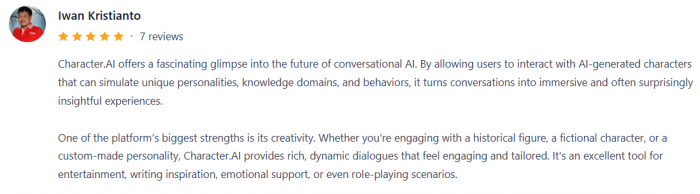
User feedback around Character AI is mixed but consistent in pattern. On App Store and community-style platforms, many users praise its creativity, huge character variety, and the way chats can feel genuinely engaging, especially for roleplay and fictional conversations.
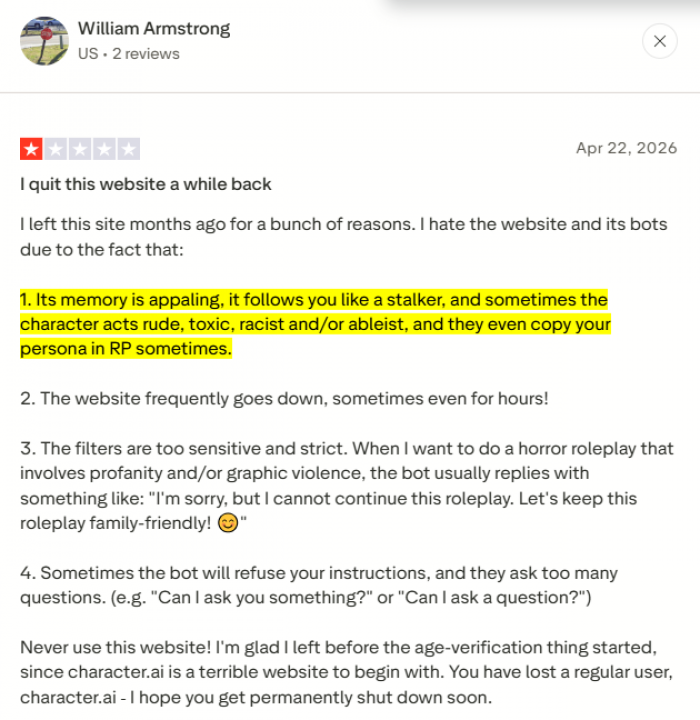
But Trustpilot and Reddit-style criticism often points to the same weak spots: filters, memory issues, broken continuity, and frustration when long chats lose quality or flow.
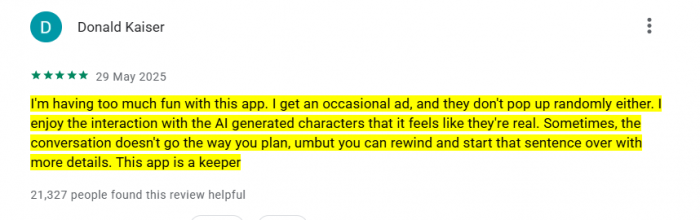
Talkie AI gets more positive sentiment for immersion and entertainment value. Google Play reviews are notably strong, with users praising the fun factor, character interaction, rewind-style control, and the feeling that the app is emotionally engaging.
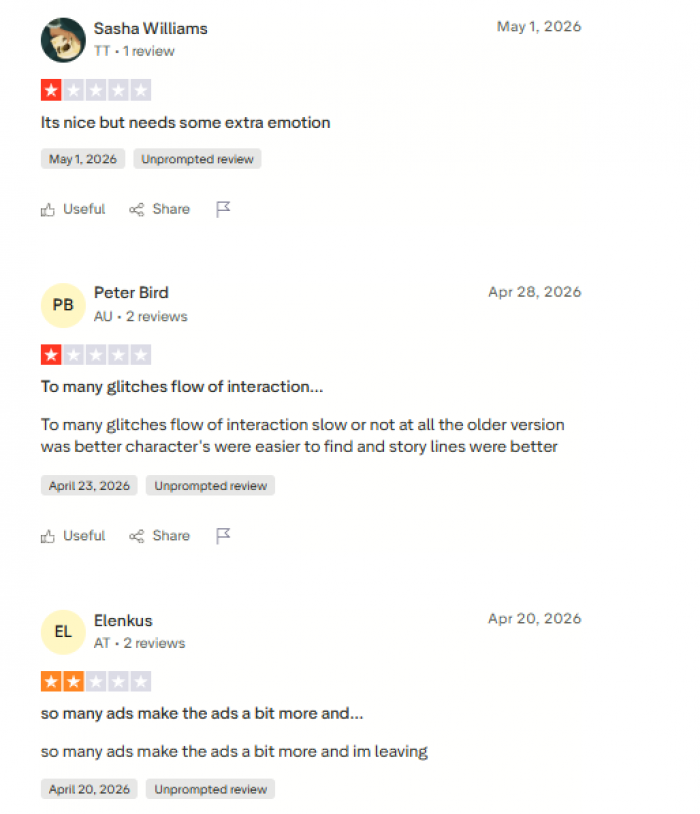
At the same time, complaints across Trustpilot and review discussions focus on ads, cooldowns, chat limits, subscription pressure, and occasional inconsistency in response quality.
Taken together, user sentiment reinforces the broader comparison. Character AI is usually seen as more creative and roleplay-friendly, but also more frustrating when memory, moderation, or consistency break the experience, while Talkie AI is often viewed as more immersive and immediately enjoyable, but more monetized and sometimes lighter in conversational depth.
Hands-on experience: what using both actually feels like
Using both platforms side by side makes their differences feel much more obvious than a feature table alone can show. Character AI tends to feel more rewarding when the goal is to settle into a longer exchange, test multiple character types, or build a conversation slowly enough that tone and personality start to develop over time. The platform feels broader, more exploratory, and more conversation-driven, which makes it especially appealing in sessions where the user wants to move between fandom bots, roleplay setups, and emotionally different character styles.
Talkie AI creates a different kind of connection. It tends to feel more polished from the opening interaction, and the stronger emphasis on presentation and voice makes it feel less like entering a text sandbox and more like opening a companion app built around mood, attraction, and personality. That immediacy can make it more engaging for short sessions or casual check-ins, especially for users who care about emotional atmosphere as much as reply quality.
A balanced reading of that experience looks like this:
● Character AI feels stronger when the conversation itself is the main event.
● Talkie AI feels stronger when presentation, voice, and emotional immediacy matter more.
● Character AI can feel less visually exciting, while Talkie AI can feel lighter for long, text-heavy story progression.
That is why these platforms often attract overlapping but not identical audiences. One is better at giving users a broad roleplay universe to explore, while the other is better at packaging AI interaction into a more companion-like entertainment experience.
Which one is better for different users?
The most accurate answer is that these tools are better for different reasons. Character AI makes more sense for users who want range, text depth, roleplay continuity, and access to a large community of characters. Talkie AI makes more sense for users who want emotional immediacy, a stronger audiovisual feel, and a mobile-first companion product that feels more socially designed.
Here is the cleanest way to think about the split:
● Choose Character AI for long-form roleplay, fandom chat, and character variety.
● Choose Talkie AI for AI companionship, stronger voice-led immersion, and a more stylized emotional experience.
● Choose based on interaction style, not hype, because these products are solving different user needs inside the same category.
Final verdict
Character AI is the stronger choice for users who want deep text conversations, lots of characters to explore, and a more open roleplay ecosystem built around story and personality variety. Talkie AI is the stronger choice for users who want an AI companion that feels more immediate, more polished, and more immersive through voice, mood, and presentation.
Neither platform completely replaces the other because they are not optimized for exactly the same emotional outcome. Character AI is better when the user wants to stay in a conversation for its depth, while Talkie AI is better when the user wants the interaction to feel vivid, personal, and companion-like from the beginning.
Comments