

Cheaterbuster AI sits at the crossroads of AI, dating apps, and suspicion. The name often comes up when people reach a point where guesswork and gut feeling are no longer enough, but direct confrontation still feels too risky. This is not a productivity app that helps plan the week. It is a specialist scanner, pointed directly at one question: is there a Tinder profile that looks like it belongs to this person?
Cheaterbuster AI: What It Claims to Be
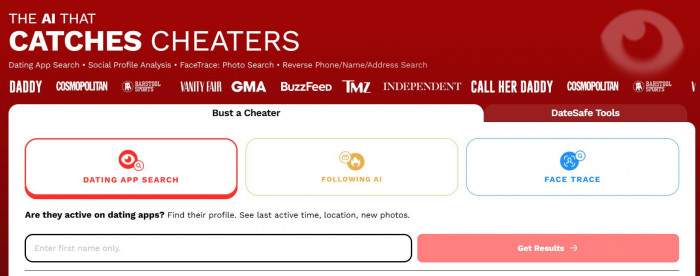
In its own positioning, Cheaterbuster AI is described as an AI‑powered way to uncover hidden dating profiles. Enter a name, age, and location, upload a photo if available, and the system combs Tinder’s public data to find profiles that look like a match.
The core ideas behind the product are straightforward:
● Find Tinder profiles using basic identity details.
● Run checks without logging into Tinder or creating a fake account.
● Let an automated system do the time‑consuming search through profiles.
All of this centres on one underlying promise: no need to swipe for hours or guess blindly. The system turns that manual labour into an automated search.
However, Cheaterbuster AI is not a spy tool wired into Tinder’s private systems. It does not read messages or access hidden logs. It is a focused search engine built on what Tinder exposes publicly. That difference defines everything else about how it behaves.
How Cheaterbuster AI Works (From Search to Report)
From a workflow point of view, Cheaterbuster AI is surprisingly structured.
The process begins with data entry. The searcher provides:
● First name (or the name believed to be on the profile).
● Age or age range.
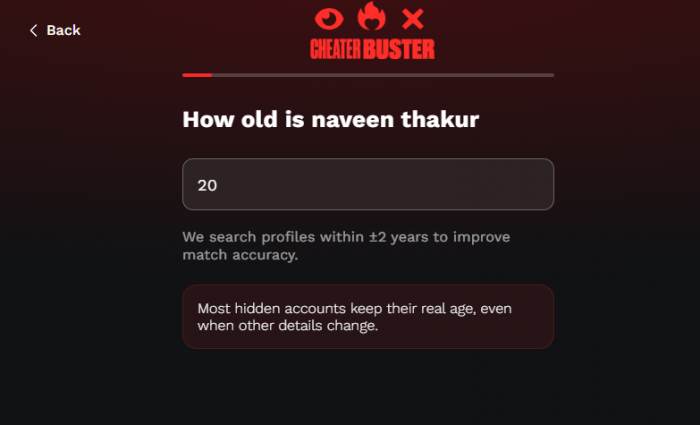
● City, postcode, or general location.
● Optionally, a clear, recent face photo.
These details form the query. At that point, the backend starts scanning Tinder’s public‑facing profiles in the relevant area.
The engine filters profiles by age range and location, then applies name matching. Where a photo is provided, Cheaterbuster AI uses image recognition to compare the uploaded face against profile pictures. Profiles that are close matches on both metadata and imagery are added to a candidate pool.
Once that pool is ready, Cheaterbuster compiles a report. A typical report includes:
● Screenshots of possible matching profiles.
● Display names and ages.
● Profile photos, bios, and sometimes interests.
● Location indicators and distance estimates.
● Signals that suggest recent activity or subscription level.
Results are usually returned within a few minutes. From the user’s side, the experience is essentially: enter details, confirm payment, wait briefly, then read.
No credentials are required for Tinder. No target accounts are accessed directly. Everything is derived from what is already visible in the dating app’s public layer at the time of the scan.
Cheaterbuster AI Features: What It Actually Does
The feature set becomes clearer when focusing on what the tool does repeatedly and reliably, rather than on every marketing claim.
The headline feature is the ability to find Tinder profiles by combining name, age, and location. This is what most users care about first. Under good conditions—precise identifiers and a good photo, the system often succeeds in surfacing the correct profile if it exists and is not brand new or recently deleted.
Facial recognition is the second major capability. When a selfie or clear headshot is uploaded, the system can look beyond text fields. This matters when someone uses nicknames, slightly altered ages, or different spellings on Tinder. Face matching cuts through those variations in many cases and is a major driver of successful matches.
The third recurring feature is activity insight. The system does not have access to real‑time internal logs, but it can infer recency based on profile changes, location shifts, or subscription signals. That produces a rough “how active does this look?” impression rather than a precise timeline.
A quieter but important feature is anonymity. Cheaterbuster AI lets a searcher check Tinder presence without logging into Tinder, without creating a fake account, and without sending any kind of notification to the person being checked. That anonymity is part of the appeal and part of the ethical tension.
Critical absences are just as important to recognise:
● No access to messages or private conversations.
● No direct view of likes, matches, or swipes.
● No insight into fully private or hidden profiles.
● No equal coverage of every dating app across the market.
In other words, the tool is powerful on the specific problem of “is there a visible Tinder profile that looks like this person?” and almost useless for anything outside that scope.
Cheaterbuster AI Pricing: Is It Worth Paying Per Scan?
The cost question appears quickly once the basic concept is understood.
Cheaterbuster AI normally uses a pay‑per‑scan or credit‑based model rather than a subscription‑first one. A single search sits at around $17.99, with no free trial or freemium tier. The official site has also been seen advertising a $19.99 + tax starting price, so the headline figure realistically hovers in the $18–$20 band depending on when and where you look.
Bundles reduce the per‑scan cost if several searches are bought at once, though the up‑front spend grows accordingly. Three‑search bundles have been reported to bring the effective rate down to roughly $11.66 per search. The practical catch is that most people do not get a clean answer on the first attempt: once the likelihood of repeat searches is factored in, the real cost of reaching a definitive answer often lands between $36 and $54 — and still covers only Tinder.
| Plan | Typical price | Effective per‑scan |
| Single search | ~17.99–19.99 + tax | ~18–20 |
| 3‑search bundle | Discounted | ~$11.66 |
| Real‑world “definitive answer” cost | Multiple scans | ~36–54 |
There is usually no free trial. A serious search is, by design, a paid event.
This pricing positions the tool as high‑stakes, not as a casual gadget. The trade‑off looks like this:
● One targeted, well‑set‑up scan in a serious situation may justify the spend.
● Multiple speculative scans with fuzzy data quickly become expensive and usually do not improve outcomes.
Some versions on app stores appear inside subscription shells, which introduces additional risk of recurring charges if cancellation is not handled carefully. Recurring billing, where it appears, is a frequent source of user complaints and needs to be considered part of the real cost.
Cheaterbuster AI Accuracy: What Real Testing Shows
Accuracy is the point where bold claims and independent experience often part ways.
Promotional content frequently references very high accuracy numbers—often in the 97–99% range—when the searcher provides an exact name, age, city, and a clear photo. Real‑world tests tell a more measured story.
Under ideal conditions, precise inputs and a face photo, the system can often identify the correct profile if it exists. Independent testing puts effective accuracy closer to 89% in that regime—strong, but well short of the homepage figures, and enough that roughly one in nine searches with perfect inputs still comes back wrong or empty. This matches cases where people run a search on themselves as a test and see their own profile appear.
As soon as inputs become less precise, accuracy falls:
● Approximate ages and large cities produce many candidates.
● Very common names add noise; there is only so much the system can do without a photo.
● No photo at all turns the search into a simple name/age/location filter, with far greater ambiguity.
The most important line is simple:
Cheaterbuster AI is not a magic detector; it is a pattern recogniser whose usefulness is directly proportional to how much is already known.
Poor input guarantees poor output. Good input makes strong output possible but never guaranteed.
What a “No Match” Result Actually Means
A found profile gets all the attention, but the empty result deserves just as much scrutiny, because it is the one people most often misread.
A “no match” is easy to receive as reassurance, a clean bill of health. It is not that. The scan only sees Tinder, and only the part of Tinder that is publicly visible at the moment of the search. A profile set to be hidden, paused, recently deleted, restricted to a more private mode, or built on a different app entirely produces the same empty result as genuine absence. The tool cannot tell the difference between “nothing there” and “nothing it can see.”
A blank result is consistent with several very different realities:
● The person has no Tinder profile at all.
● A profile exists but is hidden, paused, or outside the searched area.
● Activity is happening on a platform this tool never checks.
Read correctly, an empty report lowers the probability of one specific thing on one specific app. It is not evidence of innocence, and treating it as a final answer can be as misleading as over‑reading a match. Absence of proof is not proof of absence.
Cheaterbuster AI on Trustpilot: Real‑User Patterns
Public review sites give an unfiltered look at how the tool behaves in practice, and the picture here is unusually stark.
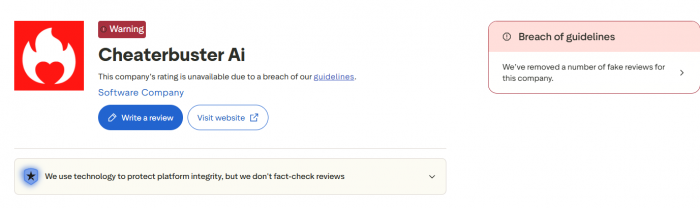
As of October 2026, Trustpilot does not display a star rating for Cheaterbuster at all. The profile carries a warning that the company’s rating is unavailable due to a breach of Trustpilot’s guidelines, with a note that a number of fake reviews were removed. That alone is worth pausing on: a suppressed rating is a stronger signal than any single score, and it reframes every positive review on the page as something to read with caution.
On one side are stories where the tool surfaced a partner’s Tinder profile, complete with recent photos and bios, and the details aligned with what the reviewer later confirmed offline. These users often mention fast results and a simple interface, and describe the service as having delivered the exact proof they suspected might be there.

On the other side are users who report feeling misled by billing, especially recurring charges after what they perceived as a one‑time scan.
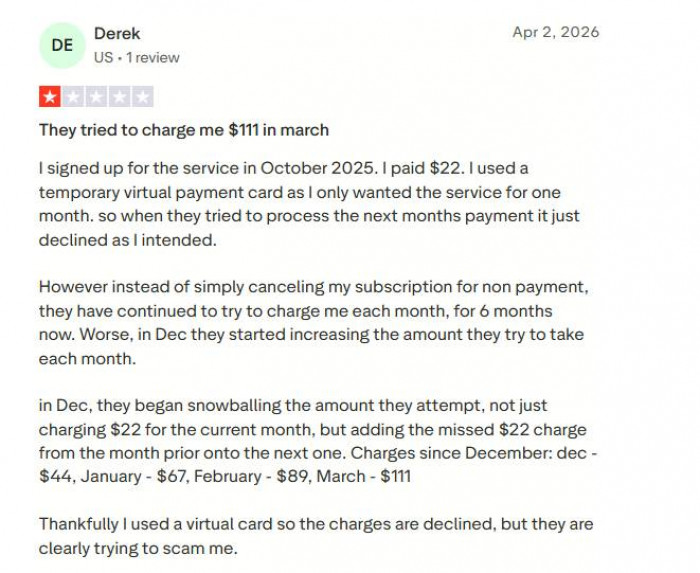
Others describe empty results where no profiles were found even in self‑tests or obviously wrong matches being marked as relevant. Slow or absent responses from customer support amplify these negative experiences.
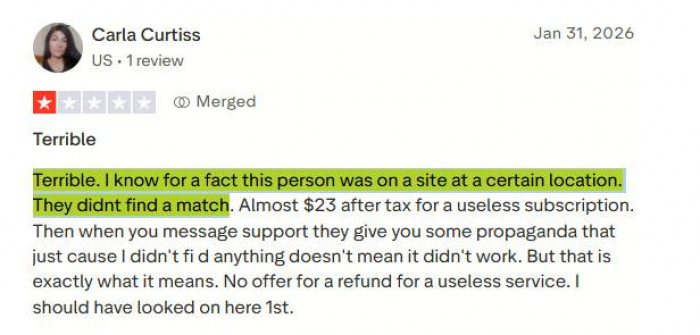
Viewed as a pattern, not as isolated complaints, the conclusion looks like this:
● The tool can deliver the kind of proof some users seek.
● The overall impact, positive or negative hinges heavily on billing clarity, expectation management, and support responsiveness, not just technical capability.
A discussion about whether the product is “legit” or “a scam” that ignores these real user patterns is incomplete. The technology itself is not outright fake; the surrounding business experience is uneven.
Ethical and Emotional Risks of Using Cheaterbuster AI
The practical questions around features, pricing, and accuracy sit on top of a deeper issue: the cost of using a service like this, beyond money.
Running a search is not a neutral act. It means one person is investigating another’s dating‑app behaviour in secret. Even if the data is technically public, the act itself is private. That dynamic carries ethical weight.
There are scenarios where such a step can be justified: long‑term patterns of lying, repeated inconsistencies, clear safety concerns, or histories of serial infidelity. There are other scenarios where the urge to search comes more from anxiety than from evidence. The tool does not distinguish between those cases. It simply accepts input.
Results do not tell the whole story either. A profile can be dormant: created long ago and abandoned, with last‑active signals reflecting that inertia rather than current intent. A missing profile does not guarantee that no other apps or channels are in play. In all cases, the report is information, not a verdict.
Any serious analysis has to underline this: whatever is retrieved still needs to be evaluated in context, communicated carefully, and weighed against personal safety and long‑term consequences.
The Legal Line Most Users Never Check
Ethics and legality are not the same thing, and the second gets far less attention than it should. A tool that feels like a private judgment call can, depending on where the searcher lives and what they do with the results, brush against real law.
The scan itself draws on publicly visible data, which is the part that keeps the service operating. What happens afterward is where the ground shifts. Using a report to monitor someone repeatedly, to intimidate them, or to act on the findings in a way that causes harm can fall under stalking, harassment, or data‑protection rules in many jurisdictions. Where the person being searched shares a home, finances, or children with the searcher, the results can also surface in legal proceedings, and how they were obtained may matter as much as what they show.
The line worth holding onto is simple:
● Public data being searchable does not make every use of it lawful.
● Intent and what follows the search carry more legal weight than the search itself.
● Anything destined for a divorce, custody, or safety matter belongs with a lawyer, not a scan report.
None of this is legal advice, and the specifics vary widely by country and state. But treating a scan as consequence‑free simply because the data was visible is the assumption most likely to cause trouble later.
Cheaterbuster AI vs Everyday Workspaces Like Notion and Evernote
The product often appears in broad lists of “AI tools,” but not all tools serve the same role.
Notion operates as a workspace. It stores notes, tasks, databases, and documents. It functions as a second brain: a place where information is created, updated, and revisited. Evernote plays a similar role, with an emphasis on long‑term personal knowledge capture and search. These are tools people live in day after day.
Cheaterbuster AI is not a workspace. It is a one‑off probe aimed at external data. It does not help plan projects, track tasks, or organise ideas. It does not provide a canvas. It provides a snapshot about someone else.
This distinction becomes clear in a simple comparison:
| Tool | What It Is Built For | How It Is Used Most of the Time |
| Cheaterbuster AI | Checking for Tinder profiles matching a person | One‑off scans in high‑tension situations |
| Notion | Managing notes, tasks, docs, and team knowledge | Daily workspace for projects and planning |
| Evernote | Capturing and searching personal information | Ongoing note‑taking and reference storage |
Grouping them all under a single “AI tools” label obscures the reality. Cheaterbuster resembles a specialised test or investigation service much more than the platforms used to run everyday work and life.
When Cheaterbuster AI Makes Sense and When It Does Not
A clear verdict section has to draw a line between appropriate and inappropriate use, because the same tool can be reasonable in one situation and reckless in another.
Situations where the tool can make sense:
● Specific, recurring red flags around dating‑app use, rather than a single anxious night.
● Detailed knowledge of the person’s real name, age, location, and appearance, the inputs that actually move accuracy from a guess toward a confident match.
● A clear plan for what to do whether the result is “profile found” or “no match found,” decided before paying, not after the report lands.
● An understanding that one well‑prepared scan is usually enough. This is not an everyday tool, and the cost structure punishes treating it like one.
Situations where the tool is poorly suited:
● Vague curiosity without concrete reasons, where the search feeds the spiral instead of settling it.
● Attempts to monitor a partner routinely or secretly over time, which the no‑notification design makes easy and which crosses from checking into surveillance.
● Use with a guessed name, approximate age, unclear location, or no photo, where weak input all but guarantees ambiguous or misleading output.
● Efforts to substitute a report for communication, counselling, or legal help, none of which a scan can replace.
Seen this way, Cheaterbuster AI is best treated like a specialist diagnostic test. It is helpful when used sparingly, with strong input and a genuine reason, and the result is read as one data point rather than a verdict. It becomes harmful when overused, misread, or reached for as a shortcut around a harder but necessary conversation.
The line worth holding onto is simple: the value of a scan is set almost entirely before it runs, by the quality of the reason and the quality of the inputs, not by the report itself.
Before You Run a Scan, Sit With the Question
The moment before paying for a scan is the one worth slowing down. Once a report exists, it cannot be un‑seen, and the decision to look is usually made at the peak of anxiety rather than the peak of clarity.
A few honest questions tend to change how the result lands, whatever it turns out to be. They do not stop anyone from searching; they simply make sure the search is answering a real question rather than feeding a spiral.
Worth asking before the scan, not after:
● What will I actually do if a profile is found and what will I do if one is not?
● Am I acting on a pattern of evidence, or on a bad night's worth of doubt?
● Is this replacing a conversation I already know I need to have?
If both possible outcomes lead to the same place, more information may not be the thing that is missing. The report can supply a data point. It cannot supply the trust, the conversation, or the decision that has to come afterward, and no scan was ever going to.
Cheaterbuster AI: Final Take for 2026
Cheaterbuster AI is not the universal villain some critics describe, nor the flawless cheater detector implied by some promotional content. It is a tightly focused Tinder search engine with an AI‑assisted matching layer, a relatively high per‑scan price, a mixed customer‑support record, and a heavy emotional footprint.
On the technical side, it can do what the name suggests: locate public dating profiles that look like they belong to a specific person and present them in a digestible format. On the commercial and ethical side, it operates on thinner ice: billing is not always as clear as it could be, support is not always as responsive as many users would hope, and the tool is most often deployed in already volatile situations.
The most honest summary is this:
● A sharp, niche tool, not a toy.
● Effective when fed accurate details and used rarely, with intent.
● Risky when treated as a casual app or a substitute for trust.
Handled with care, Cheaterbuster AI can be one piece of a difficult puzzle. Handled without that care, the fallout can easily exceed whatever clarity the tool provides.

Ophelia Clarke
Sep 20, 2026I wasn’t impressed with the accuracy. I used fairly specific details and a clear photo but some of the profiles it brought back still felt like guesses rather than confident matches. The bigger problem is that even finding a profile doesn’t tell me whether it is currently being used or has just been sitting there for months.
Login To Reply ↪