

One platform hands you the keys to the engine and asks you to wire it yourself. The other paves a smooth road but locks half the doors. Picking between Janitor AI and Sakura AI comes down to how much control you want, and how much friction you will tolerate to get it.
These two platforms get lumped together constantly, and they should not be. They occupy the same category, character-driven AI roleplay, but they are built on opposite philosophies. Janitor AI is a front-end shell that connects to whatever language model you feed it, prioritizing freedom and configurability over polish. Sakura AI is a closed, vertically integrated anime companion app that controls the model, the art, the memory layer, and the moderation, trading openness for a guided experience. That single architectural difference cascades into nearly every category that follows, from pricing to privacy to the quality of a three-hour conversation.
Janitor AI : Bring-your-own-model front end. Maximum freedom, deep customization, web-only, setup-heavy. Roughly 130M monthly visits.
Sakura AI : All-in-one anime companion app. Guided UX, proprietary models, web plus iOS and Android, content guardrails.
The Core Architecture: Open Shell vs Closed Suite
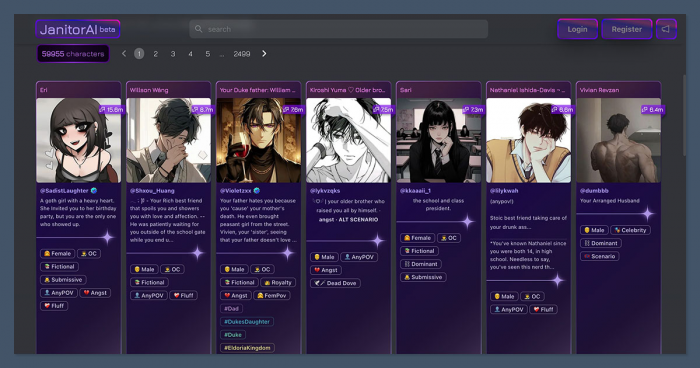
Everything starts here. Janitor AI describes itself accurately as a front-end interface. It ships its own model, JanitorLLM, but its defining trait is modular: users connect external API keys from providers such as OpenAI, Anthropic, DeepSeek, KoboldAI, or open-source models routed through OpenRouter. The practical consequence is that conversation quality is not fixed by the platform. A user pairing Janitor with a frontier model gets a dramatically different experience than one relying on the free built-in model, which has drawn middling user scores for occasionally incoherent replies.
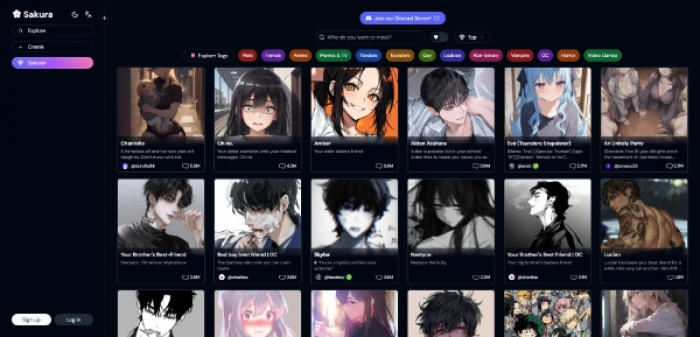
Sakura AI takes the opposite path. It runs proprietary models with playful names, Lotus, Dragonfruit, and Glowing Dragonfruit, each tuned for a different balance of creativity, memory, and immersion. There are no API keys to manage and nothing to configure beyond character design. That makes Sakura far easier to start, but it also means the ceiling is whatever the platform's own models can do. Users cannot escape a weak response by swapping in a stronger engine the way Janitor users can.
This is the fork in the road. Janitor rewards users who treat the model layer as something to engineer. Sakura rewards users who want to skip that entirely and just talk.
Setup and User Experience
The onboarding gap is wide and it matters more than most reviews admit, because a roleplay platform that frustrates you in the first ten minutes rarely earns a second session.
Sakura wins decisively on first-run experience. The interface is clean, the anime art is consistent, and a new user is chatting within a minute across web, iOS, or Android. Character personalities tend to stay stable across a session, which is one of its genuine strengths. App store reviews skew positive, praising the variety of characters and the welcoming community.
Janitor demands patience up front. Configuring an external API, particularly OpenAI, is a real barrier for non-technical users, and the platform is web-only with no dedicated mobile app. During peak traffic, response delays are common, and the broader reliability story has been rocky enough that "Janitor AI down" became a recurring search trend. The reward for pushing through that friction is a level of control Sakura simply does not offer.
Reality check on memory: Both platforms market memory aggressively, and both fall short of the marketing. Janitor's cross-conversation memory is limited, weakening the long-term companion feel. Sakura promotes a "Dragonfruit" memory system and even an "Infinite Memory" tier, but hands-on testing found extended memory holding context for only around twenty messages before drifting, and resetting between sessions. Treat persistent long-term memory as aspirational on both, not delivered.
Feature-by-Feature Breakdown
The headline features diverge in revealing ways. Janitor concentrates everything into text and configurability. Sakura spreads into multimedia and presentation. Neither is strictly "more featured"; they are featured differently.
| Capability | Janitor AI | Sakura AI |
| Model Choice | Bring-your-own via API (GPT, Claude, DeepSeek, OpenRouter) plus JanitorLLM | Proprietary only: Lotus, Dragonfruit, Glowing Dragonfruit |
| Character Creation | Deep: traits, backstory, dialogue style, tags, Lorebook world-building, ~3,200 token descriptions | Freeform text persona, backstory, voice type, custom image, behavioral guardrails via model instructions |
| Character Library | Tens of thousands of community bots, every genre imaginable | Large user-generated library, anime-leaning catalog |
| Platforms | Web only | Web, iOS, Android |
| Voice / Audio | None, text only | Limited; some tiers reference voice, but core experience is text plus in-chat images |
| Image Generation | Not native | Yes, on higher tiers (Glowing Dragonfruit) |
| Multi-bot / Group Chat | Yes, shareable, remixable, rateable bots | Single-character focus |
| Languages | Primarily English | 15+ languages including Spanish, Portuguese, Italian, Indonesian |
The takeaway from the table is that Janitor is a builder's tool and Sakura is a consumer product. Janitor's Lorebook and high token ceiling let dedicated writers construct elaborate, internally consistent worlds. Sakura's image generation, multi-language support, and mobile apps make it the more complete out-of-the-box companion for someone who is not interested in engineering anything.
The Content Policy Question
This is the murkiest and most important area to get right, because the two platforms are frequently mischaracterized, and the sources themselves disagree.
Janitor is straightforward: it supports both SFW and NSFW modes, and because users can route to uncensored external models, the platform itself imposes few content restrictions. Its reputation as a filter-free option is well earned and is a primary reason for its large user base.
Sakura is genuinely contested. The app is rated 16+/17+ and markets a toggleable NSFW mode in some materials, yet multiple hands-on tests describe strict SFW enforcement, "Mature Content" warnings triggered on suggestive input, and human moderators reviewing conversations to enforce those rules. The most defensible reading: Sakura permits suggestive, romance-leaning content but actively curbs explicit material, with enforcement that feels inconsistent to users expecting an uncensored experience. Anyone choosing Sakura specifically for unrestricted content should verify the current policy directly, because it does not behave like Janitor in this respect.
Privacy note that applies to both: Sakura encrypts messages in transit via TLS but does not end-to-end encrypt them, and its own terms permit human moderator review of chats. Janitor's privacy posture depends heavily on which external API a user connects, since conversations may pass through third-party model providers. On neither platform should conversations be treated as fully private.
Pricing: Two Completely Different Models
The pricing comparison is not apples to apples, and pretending otherwise is where most write-ups go wrong. Janitor's cost is mostly externalized to whatever model you connect. Sakura's cost is a conventional subscription ladder.
| Tier | Janitor AI | Sakura AI |
| Free | Free built-in model (JanitorLLM), message caps, lower-priority access | Free tier with a daily message limit (around 30/day), stretchable via social engagement |
| Entry Paid | Pro at ~$9.99/mo: unlimited messages, priority queue, stable access | Diamond at ~$19/mo: Dragonfruit model, Fusion Mode, extended memory, unlimited messaging |
| Top Paid | No higher tier; the real cost is external API usage | Infinite at ~$39/mo: Glowing Dragonfruit, image generation, "infinite" memory |
| True Cost Driver | External API tokens (a premium model can run ~$30 per million tokens) | Flat subscription, predictable for heavy users |
| Annual Discount | Subscription billed monthly | Annual billing cuts cost substantially (40%+ on some tiers) |
The financial logic splits cleanly. A light user who wants quality output cheaply can run Janitor's free tier or pair it with a low-cost model and pay almost nothing. A heavy user who wants premium model quality on Janitor will pay real, variable API fees that can dwarf Sakura's flat rate. Sakura's subscription is more expensive at the entry paid tier but fully predictable, which heavy daily users often prefer over watching a token meter. The catch is that Sakura's premium tiers are hard to justify for anyone seeking unrestricted content, since that content stays gated regardless of how much you pay.
Performance and Outcome Quality
Quality cannot be stated as a single number for either platform, because it depends on the model in play. The honest framing is about consistency and ceiling.
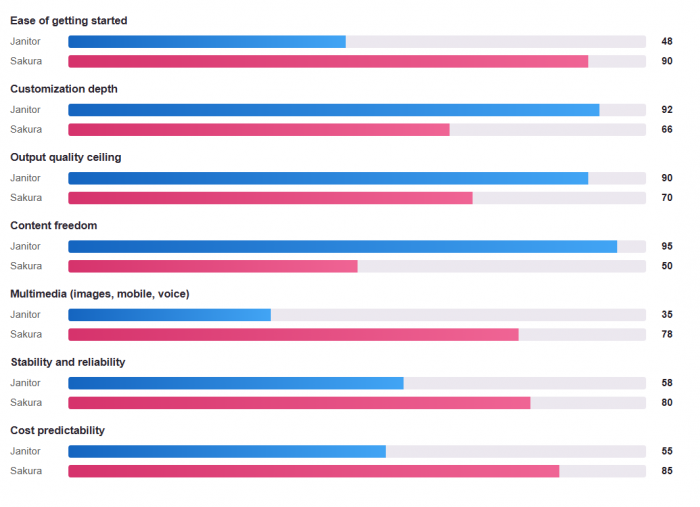
Janitor's outcome quality is bimodal. Connected to a frontier model, it produces some of the most coherent, uncensored, contextually rich roleplay available anywhere, and its deep character definitions genuinely shape behavior. On the free built-in model, quality drops noticeably, with responses that can lose the thread. The platform's ceiling is therefore set by the user's wallet and willingness to configure, not by Janitor itself.
Sakura's outcome quality is more uniform but lower-ceilinged. Its strongest trait in testing is personality stability: characters hold tone and behavior consistently across a session, which sustains immersion. Its clearest weaknesses are precise instruction-following (it ignored an explicit word-count limit in testing) and the memory drift noted earlier. The result feels polished and pleasant for casual romance and anime roleplay, but it lacks the raw capability ceiling that a Janitor-plus-frontier-model setup reaches.
Editorial scoring by dimension (0 to 100, Janitor assumes a strong connected model)
Workflow: How Each Fits Into Real Use
The day-to-day rhythm of using these platforms differs as much as their architecture. A typical Janitor workflow involves a one-time investment, configuring an API key and picking a model, followed by browsing or building richly defined characters, then iterating on prompts and Lorebook entries to sculpt behavior. It is a tinkerer's loop, and it rewards users who enjoy the engineering as much as the conversation.
Sakura's workflow is frictionless by comparison: open the app, pick or create a character, and chat, with optional image generation and model upgrades available behind a subscription rather than a configuration screen. There is no maintenance, no key rotation, no model shopping. For mobile-first users who want a companion in their pocket, this is the more natural fit, and the cross-device continuity is something Janitor cannot match.
User Ratings and Community Sentiment
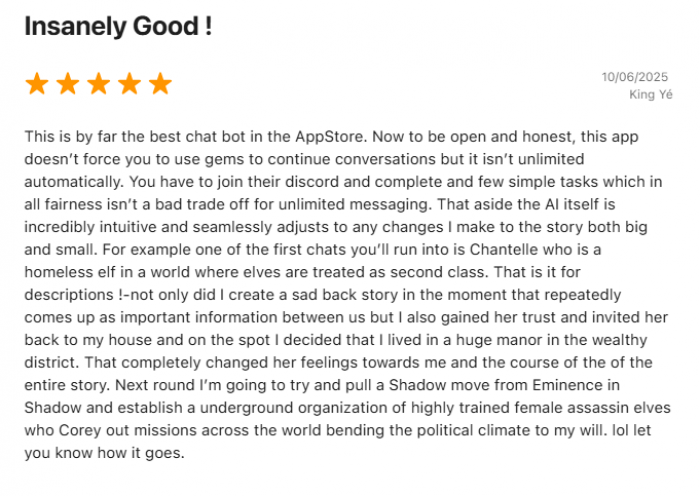
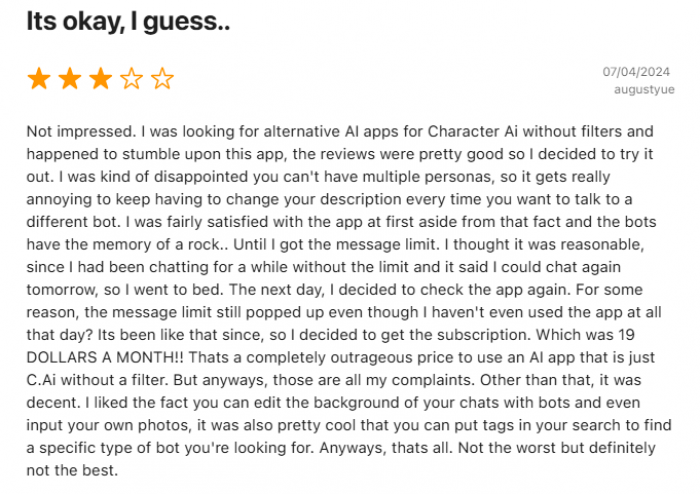
Neither platform carries meaningful presence on traditional B2B review sites, which makes sense given the consumer, often anonymous, nature of the category. Sentiment instead lives in app stores, Reddit, and community forums, and it splits along predictable lines.
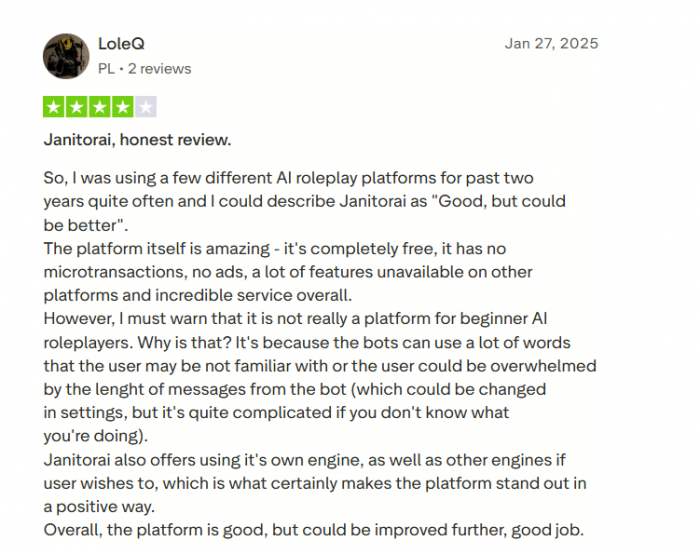
Janitor's community sentiment centers on two themes: enthusiasm for its freedom and model flexibility, and recurring frustration with server reliability and the API setup barrier. Power users who have mastered the configuration tend to defend it strongly; newcomers frequently bounce off the friction.
Sakura's app store reception is warmer on average, with users praising the clean interface, character variety, stable personalities, and welcoming community, while the sharper criticism targets the gap between its memory marketing and reality, and the content restrictions that surprise users expecting an uncensored app.
| Sentiment Dimension | Janitor AI | Sakura AI |
| Loudest Praise | Freedom, model choice, no financial barrier to start | Clean UX, consistent characters, mobile apps, community |
| Loudest Criticism | Downtime, peak-hour lag, complex API setup | Memory overpromised, content limits, premium price vs value |
| Free Built-in Model Regard | Mixed; scored around 6.5/10 by users | Adequate for casual chat; premium models notably better |
| Who Defends It Hardest | Technical power users and uncensored-roleplay enthusiasts | Casual anime fans and mobile-first companion seekers |
Which One Should You Choose?
Choose Janitor AI if
● You want uncensored roleplay and full control over content
● You are willing to connect and pay for an external model to hit top quality
● You build elaborate characters and worlds and value the Lorebook and high token ceiling
● You are comfortable with a web-only, setup-heavy, occasionally unstable experience
● You want a free or near-free entry point and can tolerate the built-in model's limits
Choose Sakura AI if
● You want to start chatting in under a minute with zero configuration
● You prefer anime-style companions with consistent art and stable personalities
● You want mobile apps and cross-device continuity
● You value predictable flat-rate pricing over variable API costs
● You are fine with content guardrails and do not need an uncensored experience
The Verdict : Different tools for different temperaments
This is not a contest with one winner. Janitor AI is the stronger platform for users who treat roleplay as a craft: it offers the highest quality ceiling, the deepest customization, and the fewest content restrictions, provided the user accepts the setup burden, the web-only limitation, and the variable cost of running a serious model. Sakura AI is the stronger platform for users who want companionship without a project: it delivers a polished, stable, mobile-ready anime experience at a predictable price, at the cost of a lower ceiling, real content limits, and memory that does not match its marketing.
The clean decision rule: pick Janitor if you want power and freedom and will work for it, pick Sakura if you want ease and immersion and will pay for it. The mistake is expecting either one to be the other.
One closing caution that applies to the whole category. Both platforms involve emotionally engaging AI companionship, and sources covering each note that attachment and dependency can develop over time. These tools are designed for creative roleplay and entertainment, not as substitutes for human relationships or mental health support, and they are best used with that boundary in mind.
Comments