

Few app bans have generated as much lingering confusion as CapCut's disappearance from India. Ask a casual user why the app is unavailable and you'll usually get a vague answer involving "China" and "privacy." Ask a content creator who built an entire editing workflow around it, and you'll get frustration mixed with genuine curiosity about whether the app is coming back. The truth is that CapCut's ban has very little to do with CapCut itself as a piece of software, and everything to do with a chain of geopolitical events, a specific Indian law written decades before short-form video existed, and a broader global reckoning over who controls the data flowing out of billions of smartphones.
This article walks through the full story in depth: the trigger event, the legal mechanism used to enact the ban, the specific concerns cited by the government, what happened to CapCut's parent company ByteDance in the years since, how India's approach compares with other countries, and what realistic options remain for Indian users and creators today.
What CapCut Actually Is
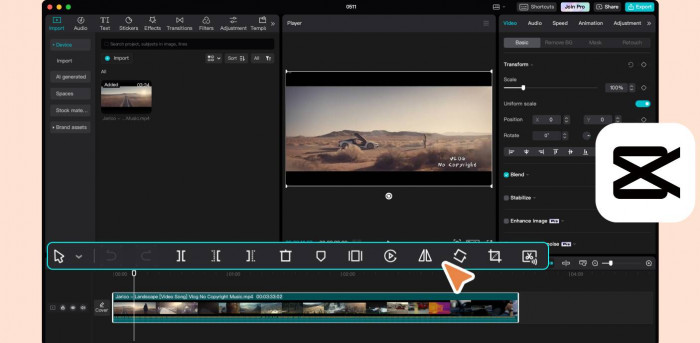
Before diving into the ban itself, it helps to understand why CapCut became such a big deal in the first place. Released internationally in 2020 by ByteDancethe same Beijing-based company behind TikTokCapCut quickly built a reputation as one of the most capable free video editors available on mobile. It offered trimming and merging tools, a large library of trending templates synced to popular audio, automatic captioning with word-level timing, background removal, speed ramping, and keyframe animation, all wrapped in an interface simple enough for a teenager to pick up in minutes.
By mid-2022 it had crossed 200 million active users, and by early 2023 it had become one of the most downloaded apps in the United States. For millions of creators making content for Instagram Reels, YouTube Shorts, and TikTok itself, CapCut wasn't just convenientit became close to indispensable, largely because its output style matched exactly what algorithms on those platforms seemed to reward.
That popularity is precisely why its absence in India has been felt so strongly, and why the ban is worth understanding properly rather than dismissing as a footnote in a larger TikTok story.
The Trigger: The Galwan Valley Clash
CapCut's ban cannot be separated from the military and diplomatic crisis that preceded it. In June 2020, Indian and Chinese soldiers clashed violently along the disputed Line of Actual Control in the Galwan Valley, Ladakh. It was the deadliest confrontation between the two nuclear-armed neighbors in over four decades, and it immediately transformed India-China relations from tense-but-manageable into openly adversarial. Diplomatic channels stiffened, trade relationships came under review, and Indian public sentiment turned sharply against Chinese commercial interests operating in the country, technology included.
Governments rarely respond to a single flashpoint by rewriting an entire regulatory framework overnight, but they often do respond by reaching for existing legal tools they already have on hand. That is exactly what happened here. Within days of the Galwan clash, India's Ministry of Electronics and Information Technology (MeitY) began drafting an order targeting Chinese-origin mobile applications, and it didn't take long to act.
The Ban Itself: What Happened, and When
On June 29, 2020, MeitY formally banned 59 mobile apps tied to Chinese companies. CapCut was among them, alongside far more widely recognized names such as TikTok, UC Browser, Shein, and Helo. This wasn't a narrow, app-specific investigation, it was a sweeping, category-wide action against Chinese digital services operating in the Indian market. Over the following months, the government expanded the list repeatedly, eventually blocking well over 200 apps with Chinese ownership across categories ranging from social media to browsers to gaming and shopping platforms.
The practical effect for CapCut was immediate and total. It vanished from the Google Play Store and Apple App Store for users browsing from India, and CapCut's official website became inaccessible to Indian IP addresses, returning a blocked or geo-restricted message. Existing users who already had the app installed found that it gradually stopped functioning as backend services were cut off and updates became unavailable.
The table below lays out the key milestones in the timeline, from the initial trigger through the present day.
| Date | Event |
| June 15–16, 2020 | Deadly clash between Indian and Chinese troops in the Galwan Valley, Ladakh |
| June 29, 2020 | MeitY bans 59 Chinese apps, including CapCut and TikTok, under Section 69A of the IT Act |
| Late 2020 – 2022 | Government expands the list to include 200+ additional Chinese-linked apps in phases |
| 2022–2024 | No legal reversal; CapCut remains delisted from Indian app stores and its website blocked |
| January 2025 | Separate from India's ban, the U.S. briefly removes CapCut and TikTok from app stores under the PAFACA law |
| Early–mid 2025 | U.S. enforcement paused after an executive order delays the deadline; both apps restored in the U.S. |
| 2026 | CapCut remains permanently banned in India; no official review or reinstatement announced |
The Legal Mechanism: Section 69A of the Information Technology Act
It's worth spending real time on the legal basis for the ban, because it explains both why the government was able to act so quickly and why the ban has proven so durable. The order relied on Section 69A of the Information Technology Act, 2000, a provision that gives the central government the power to direct any government agency or intermediary to block public access to online content or applications, provided the government is satisfied that doing so is necessary in the interest of one or more specific grounds.
Those grounds, as written into the law, include the sovereignty and integrity of India, the defense of India, the security of the state, friendly relations with foreign states, public order, and the prevention of incitement to a cognizable offense related to any of the above. Section 69A also allows the government to act without necessarily disclosing the full evidentiary basis for a given block, since national security determinations are treated as sensitive by nature. This is part of why detailed, app-by-app justifications were never published for each of the 200-plus apps eventually banned; the government issued a general rationale covering the whole category rather than individualized findings for each service.
In its official communication at the time, MeitY described the banned apps as being engaged in activities "prejudicial to sovereignty and integrity of India, defence of India, security of state and public order"language taken close to verbatim from the statute itself. This gave the ban a formal legal footing that has, in practice, proven very difficult to challenge, since courts generally defer heavily to the executive branch on matters framed as national security.
The Substantive Concerns: Data, Surveillance, and Strategic Anxiety
Underneath the legal language sat three overlapping concerns that Indian officials and policy commentators raised repeatedly in the aftermath of the ban.
1. The first was data residency. Officials were uneasy about the possibility that data collected from Indian userseverything from device identifiers to usage patterns to, in some apps' cases, precise locationcould be stored on or routed through servers based in China, placing it outside the reach of Indian privacy law and oversight.
2. The second concern was surveillance risk stemming from China's own legal framework, which under laws like the National Intelligence Law can compel domestic companies to cooperate with state intelligence and security agencies upon request. Indian officials worried that even if a company like ByteDance had no intention of misusing user data, its legal obligations at home could eventually force its hand.
3. The third concern was less about data specifically and more about strategic leverage in a moment of active military confrontation: with troops facing off at the border, allowing widely used apps with plausible ties to Chinese state influence to keep operating felt, to policymakers, like an unnecessary and avoidable vulnerability.
It's worth being precise about where CapCut fits into this picture, because it is a meaningfully different product from TikTok. CapCut is fundamentally a video-editing tool rather than a social network; on its own, it doesn't operate a public feed, doesn't build the kind of behavioral and social-graph profile that a platform like Tikok does, and its core function doesn't require the same scale of continuous data collection. Even so, CapCut shares ByteDance's ownership, and in many of its versions shares backend infrastructure and account systems with TikTok, including login options.
That shared ownership and shared plumbing were enough to place it inside the same regulatory net, even though the privacy case against a pure editing tool is inherently weaker than the case against a social platform built on an engagement-driven recommendation engine.
How ByteDance Responded
ByteDance's response to the Indian ban, and to subsequent international pressure more broadly, has been cautious and largely reactive rather than confrontational. The company did not mount a sustained public legal challenge specifically over CapCut in India, and unlike its approach in some other markets, it has not attempted to relaunch CapCut in India under a restructured entity, a joint venture with an Indian data partner, or a modified data-governance framework designed to satisfy Indian regulators.
This stands in contrast to how some other banned apps' parent companies have occasionally tried to negotiate a path back into the market. As of 2026, there is no public indication that ByteDance is actively pursuing reinstatement for CapCut in India, which suggests the company may view the Indian market as a lower priority relative to the regulatory battles it continues fighting in the United States and Europe.
How India's Approach Compares Globally
India's ban is unusual in both its scale and its permanence, but it isn't the only country wrestling with the ByteDance question. The comparison is useful because it shows just how much national context shapes the outcome, even when the underlying company and app are identical.
| Country/Region | CapCut Status (mid-2026) | Basis for Restriction |
| India | Permanently banned since June 2020 | Section 69A of the IT Act; national security and data privacy concerns following border clashes |
| United States | Available; briefly removed in January 2025, then restored | PAFACA law requiring ByteDance divestiture; enforcement paused via executive action |
| European Union | Available, under regulatory scrutiny | Ongoing data-protection reviews under GDPR and the Digital Services Act; no outright ban |
| Most other countries | Available | Generally no formal restriction in place |
What stands out in this comparison is that India moved first, moved hardest, and has shown no sign of revisiting the decision, whereas the U.S. situation has been defined by legislative deadlines, court challenges, and executive intervention that have kept CapCut's status there in constant flux. India's ban, by contrast, has simply held steady for more than six years, largely because it isn't tied to an expiring law or a divestiture clockit's tied to a bilateral relationship that has not meaningfully thawed.
The Real-World Impact on Indian Creators
It's easy to treat an app ban as an abstract policy story, but the effect on working content creators has been concrete. Many Indian creators who built editing workflows around CapCut's trending templates and automated captioning had to migrate to other tools almost overnight, often with a noticeable dip in output quality or turnaround speed during the transition. Because CapCut's templates were frequently synced to trending audio and effects circulating simultaneously on TikTok and Instagram, losing access also meant losing a certain kind of trend-responsiveness that competing apps didn't replicate as quickly.
With time, most professional creators adapted, either by adopting a combination of two or three alternative tools to cover the gap or by shifting toward desktop-based editing suites that offered more control at the cost of a steeper learning curve.
Attempts to Access CapCut Despite the Ban
Despite the ban being in place for six years, plenty of Indian users still try to reach the app through workarounds, and it's worth being candid about both how these methods work and why they carry real risk rather than presenting them as a simple loophole.
The most common approach is a VPN, which reroutes a device's apparent location to a country where CapCut is still available, allowing access to the app store listing or the official website as though the request originated elsewhere. A second approach involves downloading APK files directly from third-party sites rather than through an official app store, sideloading the app onto an Android device after enabling installation from unknown sources. A third, less common approach involves running the app through an Android emulator on a desktop computer, which sidesteps the mobile app store restriction entirely.
Each of these methods carries genuine downsides that go beyond mere inconvenience. VPN use to access blocked services sits in a legal gray area and doesn't guarantee a stable experience, since connection quality and account verification can vary. Sideloaded APKs from unverified sources are one of the most common vectors for mobile malware, since there's no app-store review process standing between the file and the user's device; a modified or repackaged CapCut APK could just as easily be bundled with spyware as with the genuine app. And because sideloaded installations fall outside the official update channel, users typically miss security patches and eventually find themselves running an outdated, unsupported version of the app with no clear upgrade path.
Legitimate Alternatives Available in India
Given the ban's permanence, a mature ecosystem of alternative editing tools has taken root among Indian creators, each covering a slightly different part of what CapCut used to offer.
| Tool | Best For | Platform | Notable Strength |
| InShot | Quick social media edits | Mobile (iOS/Android) | Long-standing reliability, simple interface |
| VN Video Editor | Free, watermark-free exports | Mobile and desktop | Close in spirit to CapCut's mobile-first design |
| YouCut | Lightweight everyday editing | Android | Runs smoothly on lower-end devices |
| DaVinci Resolve | Professional-grade editing | Desktop (Windows/Mac) | Advanced color grading and timeline control |
| Adobe Premiere Rush | Cross-device consistency | Mobile and desktop | Tight integration with the broader Adobe ecosystem |
None of these fully replicates CapCut's specific combination of AI-driven auto-captioning, a constantly refreshed library of trend-matched templates, and TikTok-native export formatting, which is part of why demand for CapCut itself hasn't disappeared even years after the ban. But taken together, this set of tools covers the vast majority of what everyday creators and small businesses need for short-form video production.
Is There Any Chance the Ban Gets Lifted?
Predicting policy reversals is inherently speculative, but a few factors are worth weighing. Any reinstatement would likely require a meaningful improvement in India-China relations at a diplomatic level, since the ban stemmed from a security crisis rather than a narrow technical dispute solvable through a data-localization agreement alone. It would also likely require ByteDance to propose restructured data governance for the Indian market specifically, similar to localized data-hosting arrangements discussed in other jurisdictions.
As of mid-2026, neither condition shows clear signs of being met, and government messaging around Chinese apps has, if anything, stayed consistent rather than softened. That doesn't rule out a future reversal, but it does suggest CapCut's official return to India isn't likely on any near-term timeline.
Conclusion
CapCut's ban in India is, at its core, a story about geopolitics wearing the costume of a technology policy. It began with a violent border clash that reshaped India-China relations within days, was executed through a decades-old legal provision built for exactly this kind of national security determination, and has persisted for more than six years without any serious political movement toward reversal. The specific privacy and surveillance concerns raised by the government were real and worth taking seriously, even if CapCut's own product, as a video editor rather than a social network, arguably presented a narrower risk profile than some of the other apps swept up alongside it.
What's clear is that CapCut got caught in a category-wide response to a company, ByteDance, rather than a targeted judgment about CapCut's own data practices. For Indian creators, that has meant six years of adaptation, a thriving alternative-tools ecosystem, and a lingering, unresolved question about whether one of the world's most popular editing apps will ever officially return.
Comments