

Remaker AI and Pica AI sell the same promise: drop in a face, get a believable swap back in seconds. On a feature checklist they look like twins. They are not. I spent a week handing both the exact same jobs the same portraits, one deliberately messy group shot, a short video clip, and a LinkedIn-style headshot and the gaps showed up inside the first five minutes. Here is what actually happened, round by round, with the receipts.
How I tested this
To keep it fair, both tools got identical inputs on the same afternoon, each on its paid entry tier, and I logged credits spent and rough timings for every task. I used the first output every time no best-of-three, no re-rolling until something looked good. Where one tool simply cannot do a job the other can, I say so plainly instead of scoring around it. A quick orientation before the rounds:
| Remaker AI | Pica AI | |
| Best described as | An all-in-one AI image & video suite | A focused face-swap & headshot app |
| Maker | ZINGDECK INTL (Singapore), led by Alex Zhang; also branded FaceVary | WEGITAL HK Limited (Hong Kong) |
| Pricing model | One-time credit packs (no subscription required) | Monthly subscription (credit allowance) |
| Free tier | ~30 credits on signup + 5 free daily | 4 credits, full stop |
| Standout strength | Breadth + batch processing | Clean UX + privacy posture |
| Biggest weakness | Uptime and support wobble | Thin toolkit; 3-face ceiling |
| Best platform | Browser (plus an API) | Polished iOS app + web |
Getting in: signup and the free tier
The first real difference has nothing to do with face-swap quality. It is how far each tool lets you walk before it asks for a card. Remaker AI drops you straight into a working account with a stack of credits and tops you up a little each day, so you can genuinely test the thing across several jobs.
Pica AI hands you four credits and then waits. Since a single swap on Pica costs one credit and a multi-face swap costs two, I had effectively two or three attempts before the paywall, not enough to form a real opinion, which is presumably the point.
• Remaker's free runway is generous: roughly 30 credits at signup plus 5 fresh credits every day, exports without a watermark on several tools, and a few utilities (background removal, basic upscaling) that work with no login at all. I tested four separate jobs before spending a cent.
• Pica's free runway is a tease: 4 credits total, no daily refresh. I burned through them on one single swap and one group swap, and the “try before you buy” experience was over almost immediately.
• Login friction differs too: Pica offers Google, Facebook and Apple sign-in but no email or guest option, so there is no truly anonymous trial. Remaker lets you touch some tools before you ever create an account.
Round winner: Remaker, comfortably. If you want to evaluate a face-swap tool properly before paying, four credits is not an evaluation, it is a sample.
The single face swap (the fair fight)
This is the one job both tools are built to do, so it is the cleanest apples-to-apples test. I used the same source face and the same well-lit target portrait on each. Both came back quickly, and honestly both were good, this is the round where they are closest.
Remaker's result had the slightly more convincing blend: the skin tone reconciled well between face and neck, and the hairline transition was clean rather than smudged.
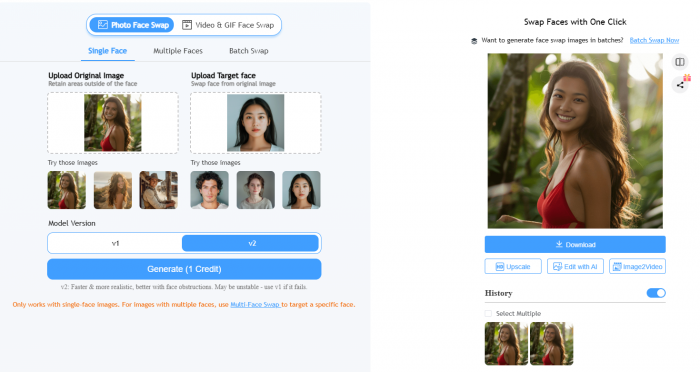
Pica's swap was perfectly usable and arguably a touch sharper on the facial features themselves, but on close inspection the edge where the new face met the original lighting was a little less settled.

On a frontal, evenly lit photo you would be happy with either. The separation only starts to appear when conditions get harder with different head angles or mixed lighting, where both tools wobble, but Remaker held the structure marginally better in my runs.
Worth noting for anyone shipping client work: both let you export the single swap without a watermark on their paid tiers, so neither leaves a brand stamp on your output.
Round winner: a narrow edge to Remaker on blending, but this is the round where picking either tool is defensible.
The group photo (where the limits bite)
Here the two tools stop being comparable and start being different products. I fed both a deliberately awkward four-person group shot and asked each to swap every face.
Pica capped out. It detects and swaps up to three faces in a single image, so the fourth person was simply left untouched and there is no batch mode to process a folder of images in one pass. For a few faces it is fine; for a crowd, or for anyone doing this at volume, it is a wall.

Remaker took all four without complaint and, more importantly, offers batch processing across many images at once (its documentation cites up to 50 in a run). That batch capability is the single biggest practical separator between these two tools for anyone working at scale rather than one selfie at a time.
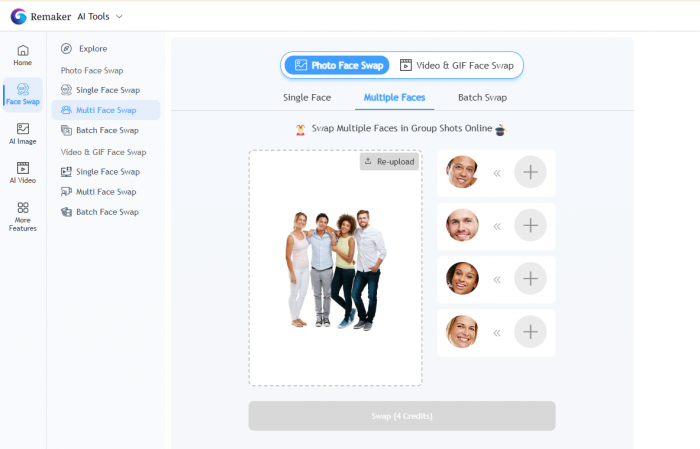
Quality-wise, multi-face is where alignment errors creep in for both a face occasionally lands slightly rotated relative to the head it is sitting on. Remaker was more consistent across the group, but neither is flawless once several faces are in play.
Round winner: Remaker, decisively, on both the face ceiling and the existence of batch.
Video face swap
Video is the most demanding job and the one that drains credits fastest, so I kept the clip short and identical for both. The headline: Remaker supports far longer source videos (its tooling advertises clips up to 30 minutes), while Pica handles video but is noticeably slower and feels built for short, social-length clips rather than anything substantial.
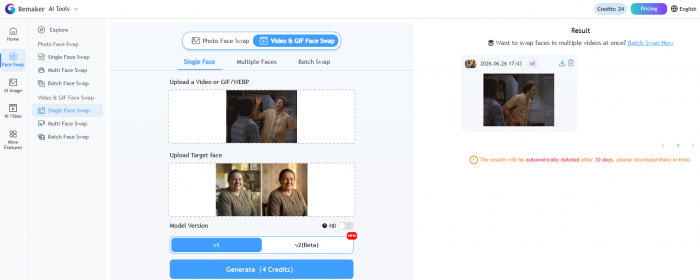
Remaker AI Video Face Swap Result
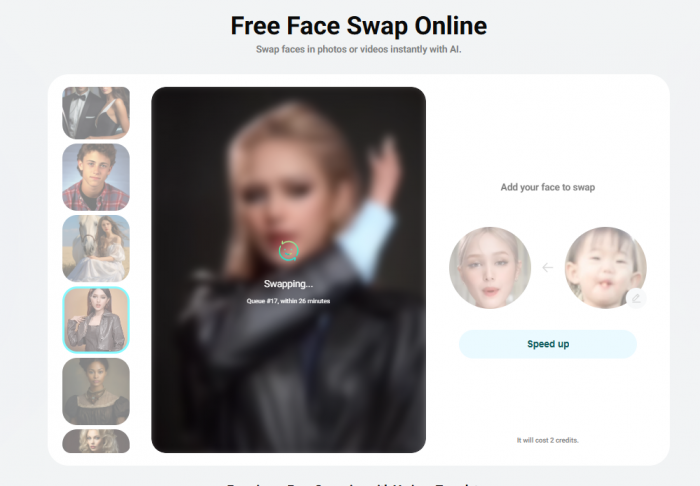
Pica AI Video Face Swap takes time
Two honest caveats so this does not read as a Remaker advert. First, Remaker's free tier limits you to roughly 10 seconds of video, and the longer-clip support sits behind paid credits that disappear quickly. Second, clarity is the shared weak point: across frames, both tools can soften detail and the swap can shimmer slightly on fast motion. Remaker wins on capability and speed; nobody wins on flawless fidelity. If broadcast-grade video is your goal, neither of these is your finishing tool.
Round winner: Remaker on length, speed and headroom with the asterisk that video burns credits on both.
Beyond the swap: suite vs specialist
This round is really the whole article in miniature. Once you step past face-swapping, the two tools are not playing the same game. Remaker keeps going; Pica mostly stops. Here is what each actually puts in your hands beyond the swap:
What Remaker adds on top of face swap:
• Image generation from text, running recognised models (Flux variants, Seedream, and Google's Nano Banana) rather than a single in-house engine useful if you want to create source imagery, not just edit it.
• Background removal and a magic eraser, both genuinely handy for product and profile shots, and both available without login for quick one-offs.
• Image and video upscaling plus image-to-video, though the still-image upscaler was the weakest tool I touched on either platform it rarely made a visible difference, so treat that feature as a bonus, not a reason to buy.
• AI portraits, headshots, and even voice cloning, which push Remaker from “face-swap site” toward “general content workshop.” Breadth is the whole pitch.
What Pica gives you instead:
• A tight, four-tool kit face swap, photo enhancer, old-photo restoration, and headshots with the enhancer now routed through Artguru (Pica retired its own enhancer in late 2025 and hands that job to a stronger engine). It does fewer things, and leans on a partner for the one it kept.
• A noticeably cleaner path to a result: the interface is minimal and the headshot flow in particular is quick and unintimidating, which is exactly what a casual user wants and a power user finds limiting.
The fair question is not “who has more features” Remaker obviously does but “will you use them?” If face swap is genuinely all you need, Remaker's extra dozen tools are clutter you are paying nothing extra for and will mostly ignore. If you want one tab that also generates, erases, upscales and enhances, Pica will feel thin within a week.
Round winner: Remaker on raw capability; Pica on focus, if focus is what you actually want.
Reliability, speed, privacy and support
The unglamorous round that decides whether you renew. This is where Pica claws a lot back. Remaker's breadth comes with rough edges: there are credible, recurring user complaints about site downtime stretching to hours, features failing intermittently, and slow or thin customer support its Trustpilot footprint is small and its average there sits low (around 2.5 out of 5, on few reviews). It works, and works well when it works, but it does not feel rock-solid.
Pica, by contrast, leans on a polished, well-rated iOS app (roughly 4.5 stars across 800-plus reviews as of early 2026) and a calmer, more predictable experience. It also takes a clearer stance on privacy uploaded images are deleted within 24 hours, which it states up front. That matters more than usual for a face-swap tool, because the whole premise is uploading real people's faces. Remaker is vaguer here: its corporate registration details are public, but its data-handling promises are less prominent and its domain ownership is privacy-shielded.
Round winner: Pica, clearly, on stability, app polish, and a privacy posture you can actually point to.
Pricing, decoded
The two tools do not just charge different amounts they charge in fundamentally different ways, and that structure should drive your choice as much as the price itself.
| Remaker AI | Pica AI | |
| Model | One-time credit packs | Recurring monthly subscription |
| Entry price | From about $5.99 for ~200 credits | From about $4.99 / month |
| Top end | Up to ~$299 for ~20,000 credits | Higher tiers add larger credit allowances |
| Best for | Occasional or bursty use buy, use, stop | Steady, ongoing monthly use |
| Watch out for | Video and premium models eat credits fast | You pay every month whether you use it or not |
The practical read: if you face-swap in occasional bursts a campaign here, a batch of product shots there Remaker's pay-as-you-go credits are kinder, because nothing expires on a billing cycle. If you swap or enhance photos most weeks, Pica's subscription is the more predictable line item. Just be honest about your own cadence, because the wrong model quietly wastes money either way.
On pure value for money, Remaker takes it: a one-time spend buys you the entire suite plus batch processing, whereas Pica asks for a recurring fee in exchange for a much narrower toolkit and a three-face ceiling. The one scenario where Pica's value flips positive is a steady, light user who swaps a few photos every week, values the cleaner app, and would never touch Remaker's extra dozen tools anyway for them, a small monthly fee for exactly what they use beats buying credits they keep forgetting they own.
The scorecard
Pulling every round together, here is how the two tools scored across the categories that actually decide the matchup. The pattern is the story: Remaker sweeps the capability and value columns, Pica owns the experience-and-trust columns.
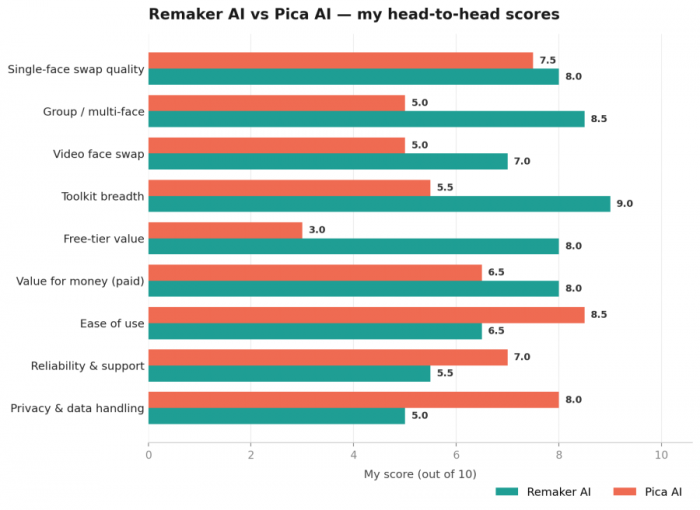
| Category | Remaker | Pica | Winner |
| Single-face swap quality | 8.0 | 7.5 | Remaker |
| Group / multi-face | 8.5 | 5.0 | Remaker |
| Video face swap | 7.0 | 5.0 | Remaker |
| Toolkit breadth | 9.0 | 5.5 | Remaker |
| Free-tier value | 8.0 | 3.0 | Remaker |
| Value for money (paid) | 8.0 | 6.5 | Remaker |
| Ease of use | 6.5 | 8.5 | Pica |
| Reliability & support | 5.5 | 7.0 | Pica |
| Privacy & data handling | 5.0 | 8.0 | Pica |
What genuinely annoyed me about each
Remaker AI:
• The unreliability is the real tax. Twice during testing a tool stalled or the site lagged badly enough that I lost a few minutes and, worse, a little trust. When you are mid-deadline, “usually works” is not the same as “works.”
• Credits vanish on the fun stuff. Image swaps are cheap, but video and the premium generation models drain a pack fast, so the headline “200 credits for $5.99” goes further on paper than in practice once you touch video.
Pica AI:
• The four-credit trial is almost hostile. There is no realistic way to judge the tool before paying, which feels like a decision made by the billing team rather than the product team.
• The three-face ceiling and missing batch show up fast. The moment you move past selfies and single portraits group photos, bulk product shots you hit limits Remaker simply does not have, and there is no workaround inside the app.
The verdict: which one should you actually use?
After putting both through identical work, I am not going to crown a single winner, because they are aimed at different people and pretending otherwise would be useless to you. The honest split:
Choose Remaker AI if you do this at any kind of volume or variety batch swaps, group photos, longer video, plus the occasional need to generate, erase, or upscale an image without opening a second tool. It is the better pick for marketers, ecommerce sellers, and anyone whose work is “many images, many jobs.” You trade away some stability and a clean privacy story to get that reach, and you should go in knowing the uptime can wobble.
Choose Pica AI if you want a calm, trustworthy, mostly-mobile tool that does a small number of things cleanly single and small-group swaps, a quick LinkedIn headshot, the odd old-photo restore and you value a clear privacy promise and a polished app over a sprawling feature list. It is the better pick for casual and privacy-conscious users, and a poor one for anyone who needs scale.
Strip it all back and the choice is the spine of this whole comparison: a versatile workshop that occasionally creaks, versus a tidy specialist that quietly does its few jobs well. Pick the one whose shape matches your work, not the one with the longer feature list.
FAQ
Is Remaker AI or Pica AI free?
Both have a free tier, but they are not close. Remaker gives roughly 30 credits at signup plus 5 free credits a day, so you can test it properly. Pica gives just 4 credits total with no daily refresh enough for two or three swaps before you have to pay.
Which has better video face swap?
Remaker, on capability and speed: it supports much longer source clips and processes faster, while Pica's video is slower and aimed at short social clips. Neither produces flawless, broadcast-grade fidelity, so treat both as good-enough rather than perfect for video.
Is Pica AI safe with my photos?
Pica states that uploaded images are deleted within 24 hours and markets privacy as a core feature, which is reassuring for a tool built on uploading real faces. Remaker is less explicit about data handling, so if privacy is your priority, Pica makes the clearer promise.
Can either tool do batch face swaps?
Remaker can offer batch processing across many images in one run, which is its biggest practical edge. Pica has no batch mode and swaps a maximum of three faces per image, so it is not suited to high-volume work.
Which is better for LinkedIn-style headshots?
Both have a dedicated headshot feature and both are capable here. Pica's headshot flow is cleaner and faster for a one-off, while Remaker is the better choice if you also want to batch-produce headshots or edit them further with its wider toolkit.
Comments