

Akkio is useful because it makes predictive analytics feel lighter and more approachable for business teams, but it is not the only tool solving that problem. Some alternatives are better at no-code machine learning, some are stronger for BI and dashboards, and others are better for teams that want AI-assisted analysis without committing to Akkio’s specific workflow.
The best Akkio alternative therefore depends on what someone is actually trying to replace. If the goal is quick prediction from spreadsheets, one kind of tool wins. If the goal is advanced business intelligence, deeper analytics, or a more collaborative AI-data workflow, a different class of platform makes more sense. That is why the seven tools below are not random competitors. They represent the main paths people take when Akkio AI feels too narrow, too broad, too expensive, or simply not the right fit.
Quick 7 best alternatives Overview
| Tool | Best known for | Starting price |
| Obviously AI | Fast no-code predictive modeling | Typically around $50–$100/month range depending on usage and plan structure. |
| Julius AI | Chat-based data analysis for non-technical users | Free; Plus $20/month; Pro $45/month/member. |
| Hex | Collaborative analytics with AI, notebooks, and apps | Free; Professional $36/editor/month; Team $75/editor/month. |
| Tableau | Enterprise-grade business intelligence and dashboards | Viewer $35/month, Explorer $70/month, Creator $115/month billed annually. |
| Qlik Sense | Associative analytics and AI-powered BI | Business $30/user/month billed annually. |
| Amazon QuickSight | Lower-cost BI inside AWS workflows | Standard Author $9/user/month billed annually; Enterprise Author $18/user/month billed annually. |
| Alteryx | Code-free data prep and analytics workflows | Starter Edition $3,000/user/year. |
1. Obviously AI
Obviously AI is one of the closest Akkio alternatives because it also focuses on no-code predictive analytics for business users. The platform is built around a direct workflow: upload data, choose the target column, and let the system generate a model without code.
It is especially useful for teams working on lead scoring, churn prediction, risk estimation, or other structured business outcomes from spreadsheets and tabular datasets. Compared with Akkio, Obviously AI feels more narrowly focused on prediction itself, while Akkio feels broader because it leans more into analytics, dashboards, and AI-assisted reporting.
Pricing
| Plan area | Obviously AI |
| Starting price | Typically positioned around the $50–$100/month business-software range depending on records, usage, and plan structure. |
| Free plan | No strong signal of a full free production tier in the surfaced sources. |
| Trial access | Trial or limited access is commonly referenced in comparison listings. |
| Compared with Akkio | Similar SMB pricing territory, but the value is more concentrated around prediction workflows than broader analytics and dashboarding. |
Obviously AI beats Akkio when the goal is simple, fast prediction building without extra layers. It feels cleaner for teams that already know what they want to predict and do not necessarily need another reporting environment. Where it falls behind Akkio is in platform breadth. Akkio is generally stronger when a team wants predictions, dashboards, and business-facing analytics in one place.
Obviously AI is best for small teams and non-technical analysts who want to turn structured business data into predictions quickly without adopting a more layered analytics stack.
2. Julius AI
Julius AI takes a different approach from Akkio. Instead of centering the whole experience around no-code model-building, it frames analytics as a chat-based interaction where users ask questions about their data, generate charts, and explore insights through natural language.
That makes Julius AI particularly attractive to users who find traditional analytics tools intimidating. Rather than setting up a full modeling workflow, they can upload data, ask questions, and let the tool interpret, summarize, and visualize the dataset in a more conversational way.
Pricing
| Plan area | Julius AI |
| Free plan | $0/month with 15 messages per month. |
| Plus | $20/month, billed annually at $200/year. |
| Pro | $45/month/member, billed annually at $450/year. |
| Enterprise | Custom pricing. |
Julius AI beats Akkio when the user wants a lighter, more intuitive way to work with data without committing to a full predictive analytics workflow. It is easier to start with and much more approachable for solo professionals, consultants, and business users who want quick answers from data. Where it does not fully replace Akkio is in deeper predictive modeling and business-process-style machine learning workflows, where Akkio remains more purpose-built.
Julius AI is best for professionals who want AI-assisted analysis, charts, summaries, and data exploration with minimal setup and a low entry cost.
3. Hex
Hex sits between notebook-based analytics and business collaboration. It combines SQL, Python, AI assistants, dashboards, and lightweight apps into one workspace, which makes it a much stronger fit for hybrid teams that include analysts, technical users, and business stakeholders.
It is not as no-code and business-simple as Akkio, but that is also part of its strength. Hex gives teams more room to grow into serious analytics workflows without immediately moving into heavy enterprise BI software.
Pricing
| Plan area | Hex |
| Community | Free. |
| Professional | $36 per editor/month. |
| Team | $75 per editor/month. |
| Enterprise | Custom pricing. |
Hex beats Akkio when collaboration, flexibility, and analyst-grade workflows matter more than strict no-code simplicity. It is especially strong for teams that want AI help but also want the option to work in SQL or notebooks. It falls behind Akkio for pure business users who want prediction and dashboards without dealing with more technical interfaces or collaborative analytics structures.
Hex is best for startup data teams, analytics-driven SaaS companies, and mixed teams where technical and non-technical users work together on the same data problems.
4. Tableau
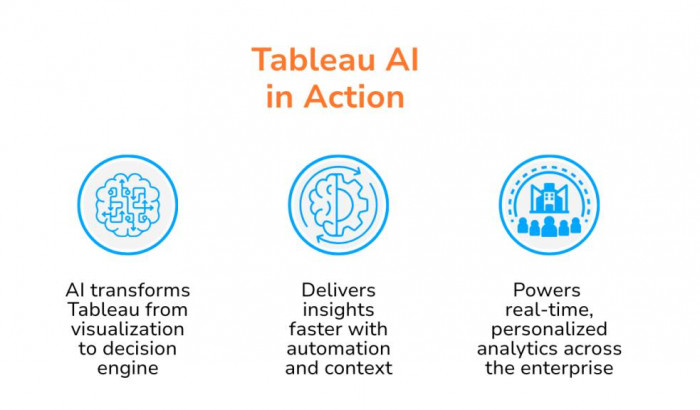
Tableau is one of the most established names in analytics and BI, and G2 lists it as the best overall Akkio alternative. It is not a direct no-code predictive analytics clone, but it is a serious option for organizations that realize they need stronger dashboards, richer visual exploration, and enterprise-grade reporting more than they need Akkio’s lightweight AI workflow.
Tableau’s strength is not just visualization quality. It is the fact that organizations can build an entire reporting and analytics culture around it. That makes it a very different kind of “alternative”: less focused on easy predictive modeling, but much stronger for large-scale dashboarding and decision support.
Pricing
| Plan area | Tableau |
| Viewer | $35 per user/month billed annually. |
| Explorer | $70 per user/month billed annually. |
| Creator | $115 per user/month billed annually. |
| Lower-cost references | Some external comparisons cite lower server/cloud mixes, but Tableau’s official pricing page surfaces the higher current enterprise edition rates. |
Tableau beats Akkio when visual analytics, enterprise reporting, and organization-wide dashboard use are the priority. It does not beat Akkio on simplicity for no-code ML. In fact, for smaller teams that simply want predictions without adopting a full BI environment, Tableau may feel like too much platform and too little immediacy.
Tableau is best for medium-to-large organizations that need robust dashboards, deep reporting, and enterprise BI discipline more than “upload a CSV and get a prediction” simplicity.
5. Qlik Sense
Qlik Sense is another strong BI-focused Akkio alternative, but it stands out for associative analytics and AI-powered exploration rather than only traditional dashboards. That means users can move through data more freely and explore relationships without relying entirely on predefined queries and rigid reporting structures.
It sits in an interesting middle ground: more advanced and enterprise-facing than Akkio, but still more dynamic and exploration-driven than some older BI tools.
Pricing
| Plan area | Qlik Sense |
| Business | $30/user/month billed annually. |
| Enterprise SaaS | Contact vendor for pricing. |
| Other market references | Some third-party reviews cite standard/premium structures from $30 to $50/month, but G2 and Capterra most clearly confirm the $30 business tier and custom enterprise pricing. |
| Trial | Free trial available. |
Qlik Sense beats Akkio when a team wants stronger BI, augmented analytics, and more sophisticated exploration of business data across departments. It does not beat Akkio on ease of entry for no-code prediction use cases. For a small business that just wants a quick forecasting or churn model, Qlik can feel heavier than necessary.
Qlik Sense is best for organizations that want AI-assisted analytics and interactive exploration, but with more enterprise capability than Akkio offers.
6. Amazon QuickSight
Amazon QuickSight is one of the more cost-efficient alternatives on this list, especially for organizations already using AWS. It focuses on BI, dashboards, and scalable reporting, and it becomes more attractive when cost control and cloud integration matter more than no-code predictive modeling.
QuickSight is not the closest conceptual replacement for Akkio, but it can be a smarter choice for teams that care primarily about reporting, embedded dashboards, and cost-managed analytics at scale rather than machine learning simplicity.
Pricing
| Plan area | Amazon QuickSight |
| Standard Author | $9/user/month billed annually or $12/user/month. |
| Enterprise Author | $18/user/month billed annually or $24/user/month. |
| Readers | $0.30 to $5/session/user/month. |
| Free version | External comparisons note a free version path in some usage contexts. |
Amazon QuickSight beats Akkio on affordability for BI, AWS ecosystem fit, and flexible reader-based dashboard distribution. It does not beat Akkio on no-code predictive analytics or business-user ML simplicity. In other words, it is a better dashboard and cloud reporting alternative than a direct prediction-builder replacement.
Amazon QuickSight is best for AWS-centric teams, SaaS companies embedding analytics, and organizations that want cost-aware cloud BI rather than no-code AI modeling.
7. Alteryx
Alteryx is a more serious analytics and workflow automation platform than Akkio, and G2 ranks it among the top alternatives. It is built for users who want code-free data prep, blending, transformation, and analytics workflows, but at a much more advanced operational level than most no-code AI tools.
That makes it powerful, but also much heavier. It is not the kind of platform most small teams adopt casually. It is the kind of platform teams move into when data prep and automation become too important to manage with lighter no-code tools.
Pricing
| Plan area | Alteryx |
| Starter Edition | $3,000 per user/year. |
| Professional Edition | Contact us. |
| Enterprise Edition | Contact us. |
| Other public reference | TopAdvisor lists Designer Cloud Starter at $960/year and Desktop at $5,195/year, reinforcing that cost varies by edition and deployment model. |
Alteryx beats Akkio when the real problem is complex data preparation, workflow automation, and larger-scale business analytics operations. It does not beat Akkio for accessibility or price. For many smaller companies, it will feel too expensive and too operationally heavy compared with Akkio’s fast-start ML focus.
Alteryx is best for enterprise analytics teams, operations-heavy organizations, and businesses that need advanced code-free workflows beyond prediction alone.
How to Choose an Akkio Alternative ?
Akkio alternatives fall into clear categories once you strip away the marketing. Obviously AI is the closest fit for fast no-code prediction work. Julius AI is the easiest and cheapest path for conversational data analysis. Hex is the best collaborative analytics workspace for modern startup and product teams. Tableau and Qlik Sense are stronger when BI depth matters more than predictive simplicity. Amazon QuickSight is a smart value choice for AWS users, and Alteryx is the heavy-duty option for serious analytics operations.
That is why there is no universal “best” replacement. The smartest article framing is not “which tool beats Akkio overall,” but “which tool replaces the specific part of Akkio you actually care about.”
The strongest overall picks
For most SMBs and non-technical business teams, Obviously AI and Julius AI are the most natural places to start. Obviously AI is the closest alternative if the goal is predictive modeling without code, while Julius AI is the easiest step down in complexity and price for users who mostly want AI-assisted data interaction rather than formal ML workflows.
For modern data teams and collaborative analytics environments, Hex stands out because it gives more power than Akkio without immediately forcing teams into heavyweight enterprise BI software. For larger organizations, Tableau and Qlik Sense are the strongest alternatives when reporting, governance, and company-wide analytics matter more than lightweight predictive setup.
The clearest verdict is this: Akkio is still a strong option if a business wants approachable no-code AI and is comfortable paying for a business-focused predictive analytics platform. But if the priority is lower-cost AI analysis, stronger collaboration, deeper BI, or more advanced data workflows, one of these seven alternatives will usually fit better and more honestly than trying to force Akkio into a role it was not designed to own.
Comments