

“Tired of wasting time? We can help.” The sentence contains a problem and promises a solution, yet it could advertise accounting software, meal delivery, a cleaning company, or almost anything else. The formula is not the problem. The opening lacks recognition. The intended buyer cannot see a familiar task, consequence, or failed workaround in it.
A useful problem-solution hook does more than mention pain and introduce an offer. It identifies what the customer already understands, shows what keeps the issue unresolved, and creates a credible path toward change. The product or service should enter only after that path makes sense.
The Hook’s Working Parts
Problem-solution hooks are often treated as two-part statements: name the problem, then present the solution. Effective hooks usually contain more movement.
| Hook component | Its role in the opening |
| Recognition | Describes a situation the intended buyer knows |
| Friction | Identifies what makes the situation difficult |
| Consequence | Shows what the unresolved problem affects |
| Pivot | Suggests that another approach may work |
| Solution signal | Hints at the product, service, or method |
Not every opening needs all five parts in one sentence. A video may establish recognition first, develop the consequence, and reveal the solution after the viewer understands the issue.
Compare these openings:
Generic: “Struggling to manage customer enquiries?”
Specific: “Your team answers the same support questions every morning while sales enquiries wait.”
The second version shows both the repeated task and its cost. It does not need the word “struggling” because the friction is visible. That gives a chatbot, routing system, knowledge base, or support service a legitimate role in the next line.
Problems Have Several Layers
Weak hooks usually stop at the visible inconvenience. Stronger hooks connect that inconvenience to an operational or commercial consequence.
| Problem level | Invoicing example |
| Surface problem | Invoices take too long to prepare |
| Operational consequence | Sending and follow-up happen inconsistently |
| Commercial consequence | Payment timing becomes difficult to predict |
“Create invoices faster” addresses the surface. “The invoice may take ten minutes to create, but a missing follow-up can delay payment for weeks” connects the task to a larger consequence.
The same logic applies to services. A landscaping company may reduce maintenance demands or correct drainage, not merely improve appearance. A recruitment service may prevent a slow hiring process from losing qualified applicants between interview stages. The right level depends on audience awareness. New buyers may respond to a visible symptom. Buyers comparing solutions often need an explanation of the deeper cause.
Products Need Different Hooks
Products and services may solve similar problems, but they earn trust differently. A physical product can often demonstrate its mechanism quickly. A storage system can show how its components fit together. Software can display the difference between a manual and automated workflow. The strong Hook writing can move from friction to mechanism with little explanation.
Services sell judgement, diagnosis, coordination, or execution. Their hooks need to show that the provider understands why the problem continues. “We grow your traffic” says little. “More traffic will not repair a checkout process that loses buyers before payment” demonstrates diagnosis before promotion.
The opening should match the offer:
● A physical product hook should make an inconvenience tangible and show the feature that changes it.
● A software hook should identify a repeated workflow, bottleneck, or preventable error.
● A professional service hook should reveal a process gap or decision that requires expertise.
● A local service hook should connect the issue to safety, disruption, maintenance, or avoidable damage.
● A coaching hook should explain why effort has not produced progress and what structure is missing.
● A subscription hook should expose the cost of repeatedly solving the same need by hand.
One formula cannot carry every category. The final line needs the logic of the actual offer.
Customer Language Comes First
The raw material for hooks is often sitting in sales calls, support messages, reviews, comments, and search queries. These sources reveal how people describe the problem before marketers turn it into polished language. Look for four details: what the person was trying to do, what interrupted the task, what they had already attempted, and what happened because the issue continued.
A customer might say, “I post regularly, but every post feels disconnected from the last one.” The predictable rewrite is “Improve your social media strategy.” That removes the useful part. A stronger hook preserves the situation and sharpens the cause:
“Posting consistently will not build a recognizable brand if every post makes a different point.”
Customer language should not be copied carelessly. The writer’s job is to retain the recognizable truth while removing details that make the statement too narrow or emotional.
The Recognition Test
Before refining style, check whether the problem is identifiable. A useful opening should answer at least two questions: when the problem occurs, what task is underway, what goes wrong, what has been tried, or what the failure affects.
“Is managing your business becoming stressful?” is too broad.
“If every client update requires searching through email, chat, and spreadsheets, the project is already harder to control than it should be” gives the reader a scene.
Specificity comes from observable behavior such as waiting, repeating, rebuilding, correcting, missing, or switching between tools. A simple test is to remove the product name and ask whether the intended buyer would still know the hook is meant for them.
Seven Useful Hook Angles
Problem-solution hooks become less repetitive when the angle changes according to the buyer’s situation. These structures are not lines to copy word for word. They are different ways to reveal tension.
1. Repeated Friction
Use this angle when the customer performs the same slow or manual task repeatedly.
Product example: “Still copying meeting notes into three different tools? This workspace turns the conversation into assigned tasks.”
Service example: “If monthly reporting means rebuilding the same spreadsheet, the problem is not the data. It is the reporting process around it.”
The task may look small once, but its accumulated cost becomes visible when it happens every day or month. Keep the solution proportional by showing the removed step or cleaner handoff.
2. Hidden Cost
This angle connects a visible inconvenience to a less obvious consequence.
Product example: “A slow checkout does more than test patience. It gives ready-to-buy customers time to leave.”
Service example: “That unanswered review is not sitting quietly on your profile. It is shaping the next customer’s decision.”
The consequence must follow logically from the problem. Avoid invented fear or unsupported revenue claims. This angle works best when customers have started treating the visible issue as normal.
3. Failed Workaround
Some buyers have already tried a common fix. Naming it shows a better understanding of their position.
Product example: “Another folder will not organize your product photos if nobody knows which version is approved.”
Service example: “Posting more job ads will not solve a hiring process that loses qualified candidates during follow-up.”
Do not mock the earlier attempt. Explain why it reaches the symptom without correcting the cause. This angle often suits experienced buyers who are actively comparing solutions.
4. Misdiagnosed Problem
A misdiagnosis hook challenges the first explanation and introduces a deeper cause.
Product example: “You may not need a faster internet plan. You may need to remove the dead zones inside the building.”
Service example: “Your landing page may not need more traffic. It may need a clearer reason to buy.”
The new diagnosis must be plausible and connected to the offer. Use conditional language when the cause has not been confirmed. The strength comes from insight, not false certainty.
5. Risk Reduction
Use this angle when the decision is expensive, difficult to reverse, or easy to get wrong.
Product example: “Stop approving packaging from a screen preview. Test the size, finish, and print quality before committing to a full run.”
Service example: “Before replacing the entire roof, identify whether the leak comes from flashing, drainage, or damaged material.”
Samples, assessments, trials, and inspections fit naturally here. Make the reduced uncertainty concrete rather than relying on phrases such as “buy with confidence.”
6. Desired Shift
This hook contrasts the current operating state with a more useful one.
Product example: “Move from searching through chat history to seeing every client decision in one project timeline.”
Service example: “Turn a website that explains your company into one that helps buyers choose the right service.”
A desired shift works because the audience can see what changes. Use verbs that describe a real transition, such as reduce, consolidate, identify, replace, or convert.
7. Timely Trigger
This angle connects the problem to a moment when delay increases its cost.
Product example: “Before the next sales event, make sure inventory alerts arrive before products disappear from the shelf.”
Service example: “Hiring after the busy season begins means training new staff during the weeks you need them most.”
Timely hooks suit launches, seasonal demand, renewals, maintenance windows, and deadlines. The urgency should come from the decision or calendar, not a manufactured countdown.
Examples Across Categories
The same method works across industries: describe an identifiable situation, reveal the limit of the current approach, and create an opening for the offer.
| Category | Problem-solution hook |
| SaaS | “If every approval is buried in email, another dashboard will not help unless decisions move with the work.” |
| E-commerce | “Your skincare routine should not require five products to manage one recurring dry patch.” |
| Marketing service | “More leads will not improve revenue if qualified enquiries wait three days for a response.” |
| Home service | “A small ceiling stain may be the last visible stage of a leak that started months earlier.” |
| Online course | “Watching more tutorials will not build the skill if none gives you work to complete and review.” |
| Fitness coaching | “The workout plan is not useful if it falls apart whenever the week becomes busy.” |
| Financial service | “Tracking expenses after month-end shows where the money went, not when the budget began drifting.” |
| Subscription service | “Stop rebuilding the office supply order every month from old receipts and memory.” |
The solution is not always named. The hook only needs to open the problem clearly enough for the next sentence, visual, or demonstration to introduce the mechanism.
When the product enters before the issue is understood, the opening feels like an advertisement. When the pain is repeated for too long, it feels manipulative. The offer should appear once recognition has been established.
Weak Hooks, Rebuilt
The editorial decisions become clearer when the same hook is improved in stages.
1. Project Management Software
Weak: “Struggling with project management?”
Better: “Projects become difficult to manage when updates live in five separate places.”
Stronger: “If the status meeting is the only place anyone knows the project status, the team does not have a reliable project system.”
The weak line names a category. The stronger version shows an observable failure: knowledge exists only inside a meeting. That makes a shared system relevant without naming the product too early.
2. Cleaning Service
Weak: “Do not have time to clean?”
Better: “Weekends disappear quickly when every unfinished household task is waiting for Saturday.”
Stronger: “If cleaning keeps taking the only free hours in the week, the problem is no longer the mess. It is the time the mess keeps claiming.”
The final version reframes the service around time recovery without exaggerating the condition of the home or shaming the customer.
3. Email Marketing Service
Weak: “Want better email results?”
Better: “Sending more campaigns will not help if subscribers stop opening after the welcome email.”
Stronger: “A growing email list has limited value when the sequence gives subscribers no reason to return after joining.”
The revision moves from a vague desire to a specific stage in the subscriber journey. It creates room for strategy, segmentation, messaging, or automation rather than promising an unexplained improvement.
Bridge Into the Offer
A strong hook can still fail when the product appears without a causal bridge. The bridge should explain why the problem continues and identify the mechanism needed to change it.
Consider a lead-management service:
Hook: “More leads will not repair a follow-up process that leaves enquiries unanswered for two days.”
Bridge: “Each enquiry needs an owner immediately, along with a visible record of whether contact has been made.”
Offer: “Our service maps the handoff, configures lead routing, and gives managers a clear response-time view.”
The offer feels earned because it addresses the system exposed by the opening. For physical products, the bridge may be a visual demonstration. For services, it often needs a sentence about diagnosis, process, or expertise.
Match the Next Step
Not everyone who recognizes a problem is ready to buy. The call to action should continue the decision created by the hook.
A person newly aware of the issue may need an explanation, checklist, or example. A buyer comparing approaches may want a demonstration, process breakdown, or case study. Someone who has already evaluated the offer may be ready for a trial, quote, consultation, or purchase.
Many good hooks become poor ads because the opening describes an early-stage problem and then demands an immediate commitment. The stronger sequence is recognition, explanation, evidence, and action. The amount of evidence depends on the price, risk, familiarity, and reversibility of the offer.
Four Hook Writer Tools
Hook generators are useful for exploring different opening angles, but their output depends heavily on the information provided. A strong prompt should mention the audience, the specific problem, its consequence, the platform, and the offer. Broad inputs usually produce generic hooks about saving time, improving results, or reducing stress.
1. Smartpostly Hook Writer
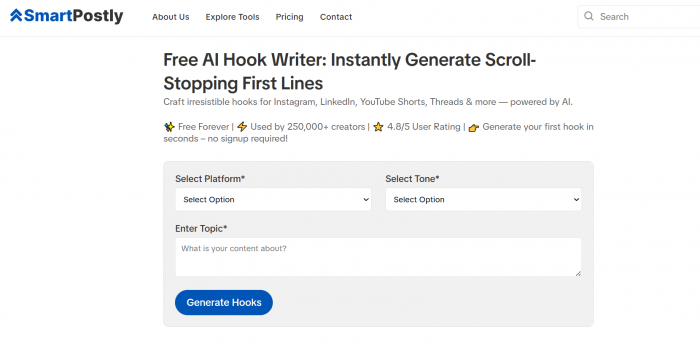
Smartpostly Hook Writer creates opening lines for platforms such as Instagram, LinkedIn, X, Threads, and YouTube Shorts. Users can enter a topic, select a platform, and choose a tone such as educational, bold, casual, emotional, or humorous.
Its platform and tone controls make it useful when one topic needs different openings for different social channels. For example, instead of entering “project management tool,” a stronger prompt would describe “a tool for agencies that lose client approvals across email and chat.” This gives the generator a recognizable problem to work with.
Generated hooks should still be checked for vague wording, exaggerated claims, and phrases that do not match the rest of the post.
Best for: Creators, social media managers, and small businesses that need several social-first hook variations quickly.
2. Buffer Hook Generator
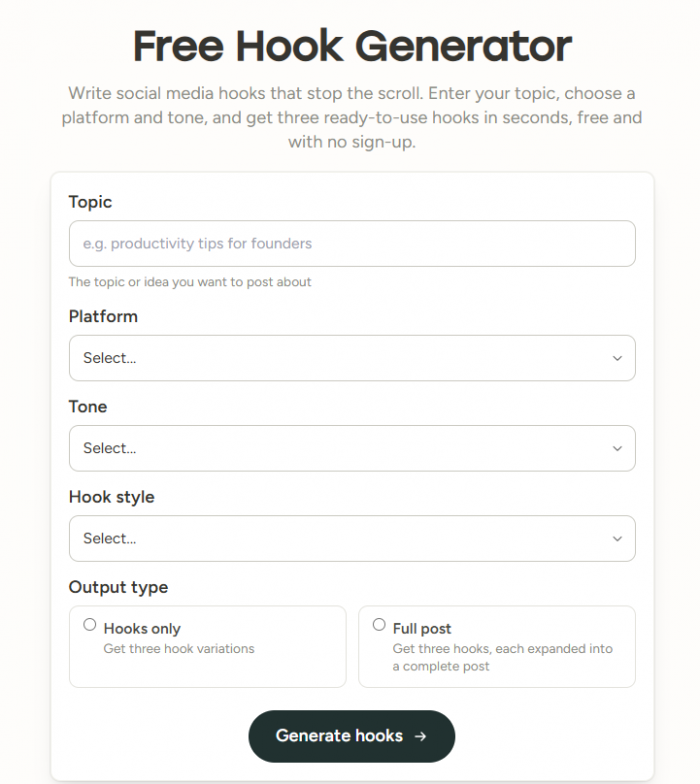
Buffer’s Hook Generator creates multiple opening options based on the topic, platform, tone, and preferred hook style. It supports major social platforms, including Instagram, TikTok, LinkedIn, X, and YouTube.
The hook-style setting is useful for comparing approaches such as a common mistake, hidden cost, strong opinion, or surprising observation. Buffer can also expand a selected opening into a longer social post, making it suitable for writers who want to move from hook ideation into drafting.
The tool works best when the prompt includes a clear customer situation. Platform selection can change the presentation, but it cannot fix a weak or overly broad problem statement.
Best for: Marketers adapting the same content idea across several platforms.
3. Ahrefs Hook Generator
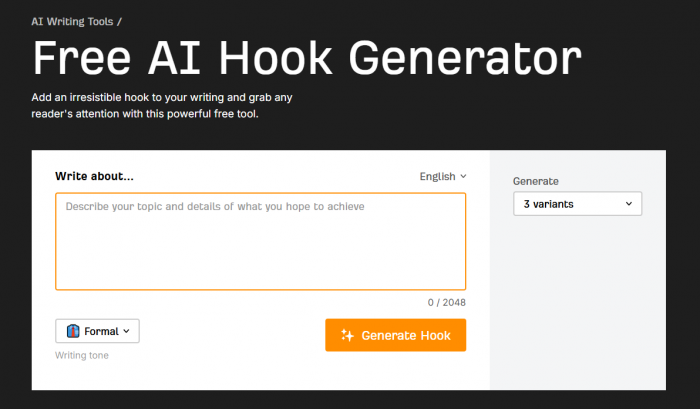
Ahrefs Hook Generator is designed for a wider range of writing formats, including articles, advertisements, landing pages, social posts, and presentations. Users enter a subject, choose a tone, and receive several possible openings.
Its broader focus makes it helpful when a single problem-solution idea needs to be used across both short and long-form content. A writer can test which part of the customer problem creates the strongest opening before adapting it to the final format.
Because it is not focused only on social media, some results may need to be shortened or rewritten for fast-moving feeds.
Best for: Content writers who need hooks for social posts, articles, landing pages, and campaign copy.
4. Postel Hook Generator
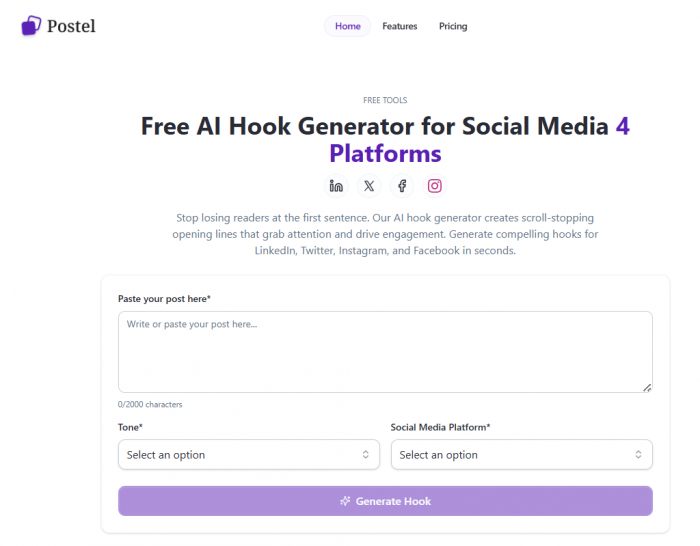
Postel allows users to paste an existing social post and generate alternative openings for LinkedIn, X, Instagram, or Facebook. This draft-led approach makes it most useful after the main body has already been written.
Because the tool works from a completed copy, its suggestions are more likely to reflect the post’s actual argument. However, the original draft should still contain one clear problem and one central solution. A post with several competing ideas may produce unfocused hooks.
Best for: Professionals and thought-leadership writers who have finished a post but need a stronger first line.
A Better Generator Workflow
Start with evidence, not a topic label. Paste a customer statement, describe the failed workaround, and identify what the problem affects. Request different angles such as hidden cost, repeated friction, risk reduction, or misdiagnosis.
After generation:
● Reject any line that could advertise dozens of unrelated offers.
● Add a concrete action, delay, error, consequence, or decision.
● Preserve the customer’s recognizable situation when shortening the wording.
● Check that the solution addresses the cause introduced in the opening.
● Read the line aloud and remove language more dramatic than the body.
● Create two or three distinct versions instead of changing one adjective.
A generator should widen the option set. Judgement determines which option deserves publication.
Test Attention Quality
Hook testing is useful only when the rest of the content stays reasonably stable. If the visual, body, offer, and posting conditions all change, the result cannot show which opening influenced performance.
For video, examine whether the intended audience remains after the opening seconds. For text posts, look at continued reading, useful comments, profile visits, and qualified clicks. For advertisements, compare enquiry and conversion quality rather than click-through rate alone.
The most dramatic hook may attract the largest audience while producing weaker intent. A narrow line about delayed invoice follow-up may reach fewer people than “You are losing money every day,” but the smaller audience may be far more relevant.
The best hook does not stop the most people. It brings the right people into the right explanation.
Closing Perspective
Problem-solution hooks work when the issue is described accurately enough for the intended buyer to recognize the situation before the offer appears. Strong openings expose repeated friction, a hidden cost, a failed workaround, a mistaken diagnosis, a risky decision, a desired shift, or a timely reason to act.
Products often benefit from visible mechanisms and demonstrations. Services need sharper diagnosis because the buyer is evaluating judgement as much as delivery. In both cases, the hook must connect naturally to the method, evidence, and next step that follow.
Hook-writing tools can produce useful variations, with Smartpostly Hook Writer providing a strong social-first starting point. The writer still has to supply customer language, context, and restraint. A hook earns attention by naming the problem accurately. The offer earns consideration by proving that it understands what needs to change.
Comments