
THE SHORT VERSION ● Evergreen social content isn't a topic you pick it's a way of building a post so its value doesn't expire and the algorithm can keep resurfacing it. ● Trending posts rent you reach; evergreen posts build reach you keep. The strongest creators run both on purpose, not by accident. ● The real work isn't posting more it's mining ideas from search, structuring for the long tail, atomising one idea across platforms, and measuring over 90 days instead of 24 hours. |
Most creators are quietly stuck on a treadmill. A post goes up, spikes for a day, and slides into the archive so the next morning starts back at zero. You're not building anything; you're feeding a machine that forgets you by lunchtime.
Evergreen content is how you step off. Done right, a single post keeps pulling views, saves, and followers for weeks or months while you sleep, travel, or work on something else. This is the playbook for making that happen, not the recycled “post consistently” advice, but the actual mechanics.
What “Evergreen” Actually Means on Social

On a blog, evergreen has a clean definition: content that ranks in Google for years. Social is different, and most advice never adjusts for that difference. Feeds move in hours, not months, and the vast majority of posts are functionally dead within two days of publishing.
So evergreen on social means two things working together. First, the value of the post doesn't expire; someone finding it in six months still gets something useful. Second, the platform can resurface it through search and recommendations long after the initial push fades. A post can be timeless in message but still die if it's built in a way the algorithm can't re-serve.
Evergreen isn't a topic. It's a property. The same idea can be disposable or evergreen depending entirely on how you build it.
“How I edit my Reels” filmed over a trending sound that'll feel dated in three months is disposable. The same tutorial, with the steps spoken aloud and the key terms in the caption, is evergreen because it answers a question people will keep searching, in a format the platform can keep recommending.
Why Evergreen Is the Highest-Leverage Bet You Can Make
Every post you make falls into one of two economies. Disposable content spikes hard and vanishes a hit of dopamine and reach that's gone by the weekend. Compounding content earns slowly at first, then keeps accruing views and saves with no additional work from you.
The difference matters more the longer you create. Chase-only creators are always starting over, because their entire library expired the week it went up. Creators with an evergreen base are standing on months of posts that still quietly deliver. One good evergreen tutorial can out-earn fifty trend-chasing Reels over a year not because it was better on day one, but because it never stopped..
Trending content buys you reach you rent. Evergreen content builds reach you own.
The Barbell: Trending vs Evergreen, and the Right Ratio
This isn't a fight, and treating it like one is where a lot of creators go wrong. Trends and evergreen do different jobs, and you want both deliberately weighted, not left to whatever you feel like posting on a given day.
Trends bring new eyes to the profile; they're your reach engine. Evergreen content is what those new eyes find when they land and start scrolling it's your conversion and retention engine. A rough working split that holds up for most creators:
| Content type | Share | Job it does | Payoff window |
| Evergreen | ~70% | Gets discovered, saved and shared over time; converts new visitors into followers | Weeks to months |
| Trending | ~30% | Rides existing attention to reach fresh audiences fast | Hours to days |
The mistake at each extreme is easy to see once you name it. All-trends creators never get discovered outside the moment they posted in. All-evergreen creators build a genuinely useful library that nobody ever stumbles onto. The barbell is the point: heavy on the asset you keep, with enough trend-riding to keep the door open.
The Anatomy of a Post That Refuses to Die
Evergreen posts share a structural DNA. It's less about the subject and more about how the piece is put together. Before you publish anything you want to last, run it against these traits:
● It solves a recurring problem. The question it answers is one people will keep asking next month and next year, not one tied to a single news cycle or update.
● It carries save or reference value. Someone bookmarks it to come back to a checklist, a method, a set of examples rather than just double-tapping and scrolling on.
● It has no expiry stamps. No “the new update,” no “this week,” no dates or references that quietly age the post the moment the moment passes.
● It's legible to search. The topic is stated in words spoken, on-screen, and in the caption so the platform can actually understand what it's about and who to show it to.
● It stands on its own. A stranger who's never seen your other posts still gets the full value without needing context you didn't include.
Miss one of these and the post can still do well on day one. Miss two or three and it will never be resurfaced, no matter how strong the idea underneath it is.
The Evergreen Content Categories Worth Mining
Most “evergreen” advice stops at tutorials and calls it a day. Tutorials are great, but they're one category out of many and the emotional and identity-driven ones age just as well while facing far less competition.
| Category | Why it lasts | Example post |
| How-to / tutorial | Answers a question people keep searching | “How to colour-grade phone footage in three steps” |
| Framework / system | Gives a repeatable method people return to | “My 3-bucket system for never running out of ideas” |
| Myth-busting | Corrects a belief that stays wrong for years | “You don't need 10k followers to make money” |
| Mistakes to avoid | Fear of loss keeps it relevant and shareable | “5 editing habits quietly killing your watch time” |
| Definitions / glossary | Beginners keep entering the topic and searching | “What ‘reach’ actually means (and why it's not views)” |
| Transformation | Before-and-after is endlessly compelling | “How I rebuilt my feed from messy to cohesive” |
| Story-driven lesson | A specific story delivers a universal takeaway | “The post that got me 400 unfollows taught me this” |
| Answer-a-question | Maps directly to what people type into search | “Do hashtags still matter in 2026? Honestly, kind of” |
If you only ever make tutorials, you're competing with everyone else who read the same advice. The story-driven and identity-based categories are where you can be genuinely hard to copy, because the story is yours.
Finding Ideas: Social Search Is the New SEO

This is the section that changes how you work, so slow down here. A growing share of people, especially younger users, now search directly inside Instagram, TikTok, and YouTube the way they used to search Google. “Best budget mic,” “how to hide the following list,” “cheap date ideas.” That behaviour is the single biggest reason evergreen social content works at all.
Which means the best ideas aren't invented at your desk. They're retrieved from what your audience already types into the search bar. A few places to pull from, in rough order of quality:
● Your own comments and DMs. Every repeated question is a post request in disguise. If three people asked it, three thousand are wondering it silently.
● In-app search autocomplete. Start typing a topic into the platform's own search and read the suggestions that's a live feed of real demand, ranked by how often people look for it.
● Related-topic rails. The “people also searched” suggestions under videos and results map the neighbourhood of questions around your topic.
● Competitor comment sections. The top comment is often a question the creator never answered. That gap is your next post.
Do this for a week and you'll never stare at a blank content calendar again. You're not guessing what might land; you're answering demand that already exists. Once those signals start piling up, the next challenge is making sure we never run out of content ideas by turning search terms, audience questions, saved references, and half-formed thoughts into a steady pipeline of posts.
Hooks and Captions Built for Longevity
An evergreen hook makes a durable promise. “Watch before you post today” expires tonight. “The three-second rule that fixes weak openings” works the same in any month of any year. When you write the hook, ask whether it would still make sense to someone finding the post half a year from now if not, rewrite it.
Captions do double duty on evergreen posts. They carry the human voice, and they carry the keywords that make the post searchable. Front-load the payoff in the first line, then work the natural search terms into the body “colour grading,” “beginner,” “iPhone” the words a real person would actually type. You're writing for a human and quietly feeding the algorithm at the same time.
If writing durable hooks and search-legible captions is where you slow down, that's exactly what tools like Hook Writer and Caption Generator are built for draft several angles fast, then pick the one that reads timeless rather than time-stamped.
One Idea, Every Platform: The Atomisation Method
Here's where evergreen content stops being expensive. One strong “pillar” idea shouldn't become one post, it should become five or six, each reshaped for the platform it lives on. Not copy-pasted (platforms punish that and audiences feel it), but genuinely re-cut for the format.
Take a single idea say, “how I plan a month of content in two hours” and atomise it:
One hour of thinking becomes a week of content, and because each piece is evergreen, all five keep working in parallel. This is how solo creators produce like teams not by working more, but by squeezing every idea for everything it's worth.
Designing for Timelessness: Avoiding the “Dated” Trap
You can nail the idea and still kill the post with production choices that age badly. This is the part most articles skip, and it's where a lot of otherwise-evergreen content quietly rots.
The biggest offender is trending audio. A viral sound gives you a reach bump today and makes the post feel embarrassing in three months and if that sound gets muted or pulled for licensing, your view count can collapse overnight. For anything you want to last, use original audio or a subtle track you have clean rights to. The same logic applies to of-the-moment slang burned into on-screen text, heavy trend filters, and anything that screams the exact week you filmed it.
The fastest way to kill an evergreen post is a viral sound that'll feel dated by the time it's meant to be paying off.
On the flip side, invest in the things that stay legible: a clear first frame that tells people what they're about to get, readable on-screen text, and good lighting. Those never go out of style, and they're what makes a stranger stop when the post resurfaces months from now.
The Resurfacing Playbook: Getting Re-Served by the Algorithm
Publishing is the start of an evergreen post's life, not the end. The whole point is that the platform keeps showing it to new people and there are specific things you can do to make that more likely.
● Say the keywords out loud. Platforms transcribe your audio and read it for topic signals. If your video is about lighting, the word “lighting” should be spoken, not just implied.
● Write for search, not just style. Put the real topic in the caption and on-screen text. Treat hashtags as topic labels; a few relevant ones beat thirty random ones.
● Pin your best evergreen posts. Every new visitor should land on your strongest, most representative work first.
● Link new content back to old. When a fresh post touches a topic you've already covered well, point people to that older piece you're sending it fresh signals and traffic.
None of this is a one-time action. The creators who win with evergreen treat resurfacing as an ongoing habit, not something they do once and forget.
Maintain and Refresh: The Content Audit
A content library is a garden, not a filing cabinet. Every quarter, spend an afternoon going through what you've posted and sort it into three piles. It's fast, and it compounds.
THE QUARTERLY AUDIT, IN THREE BUCKETS ● Keep still performing, still accurate, still on-brand. Leave it alone and consider re-pinning or re-sharing it. ● Refresh good bones, weak execution. Rewrite the hook, update the caption, or re-cut the first three seconds and re-post it as new. ● Retire genuinely dated, off-brand, or wrong now. Archive it so it stops representing you to new visitors. |
The refresh pile is the sleeper. A post that flopped because of a weak opening can be a completely different result with a new hook, same idea, second chance, and often better than anything you'd make from scratch that week.
Measuring What Actually Matters
Here's where a lot of creators sabotage themselves: they judge evergreen content by day-one likes, decide it “flopped,” and delete their best long-term assets before those assets ever get going. Evergreen posts are supposed to start slow.
The metrics that tell the truth about longevity are different from the vanity ones. Watch these instead:
| Look at this | Because it signals | Not this |
| Saves | The post has reference value the core of evergreen | Day-one likes |
| Shares / sends | People find it useful enough to pass on | Follower-count vanity |
| Watch-through rate | The content delivers on its hook | Comment count alone |
| Search impressions | The platform is serving it to people who search the topic | First-hour reach |
| Views over 30–90 days | The post is compounding, not just spiking | The 24-hour snapshot |
If you judge evergreen content by its first 24 hours, you'll delete exactly the posts that were about to become your best-performing assets.
Build Your Evergreen Engine: The Loop
Everything above only works if it's a system rather than a scramble. The pieces connect into a repeatable cycle call it the Evergreen Loop that you run on a schedule instead of relying on inspiration.
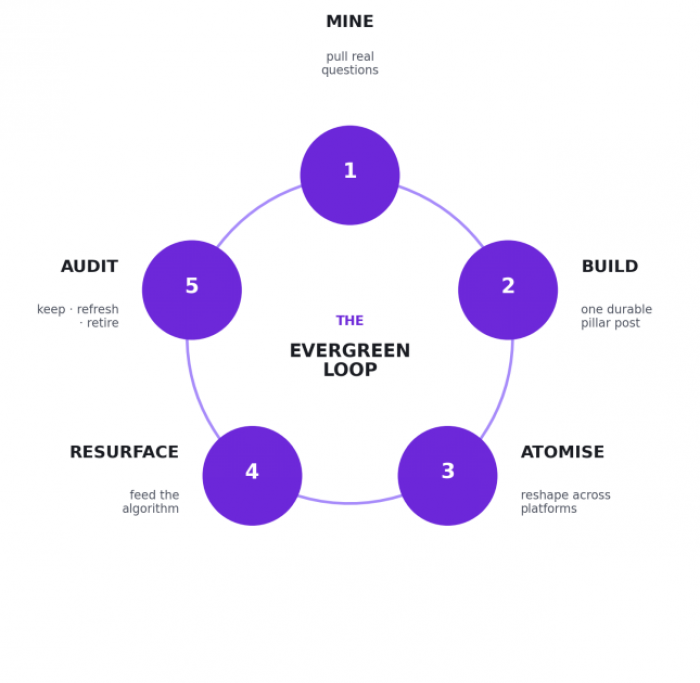
1. Mine pull real questions from search, comments and DMs, and bank them as a running idea list.
2. Build turn each idea into one pillar post structured for longevity, using the anatomy checklist.
3. Atomise reshape that pillar into five or six platform-native pieces.
4. Resurface feed the algorithm search signals, pin the best, and link new posts to old.
5. Audit every quarter, keep, refresh or retire and feed the winners back into the loop.
Naming it matters more than it sounds. Once it's a loop you run rather than a mood you wait for, evergreen content stops being a nice idea and becomes the way you actually work.
Evergreen Myths and Mistakes to Avoid
A few beliefs keep good creators from ever trying this. Worth clearing them out directly:
● “Evergreen means boring.” No it means durable. A gripping story about a lesson you learned is evergreen and anything but dull. Timeless and lifeless are not the same word.
● “Post it once and forget it.” The opposite of the truth. Evergreen posts need resurfacing, refreshing and re-pinning. The set-and-forget version just gets forgotten.
● “Trends and evergreen don't mix.” They're a portfolio, not a rivalry. You want the reach of trends and the staying power of evergreen, held in deliberate balance.
● “You need to go viral first.” Evergreen doesn't need a viral moment; it needs to keep answering a real question well. Steady beats spiky over a year, every time.
The Verdict: Stop Renting Reach, Start Owning It
The creators who last aren't the ones who post the most or chase every trend hardest. They're the ones who quietly build a library, a stack of posts that keeps working while they focus on something else. That's the real shift here: from feeding a feed that forgets you, to building an asset that remembers.
You don't need to overhaul everything this week. Pick one pillar idea, build it against the anatomy checklist, atomise it across your platforms, and measure it over 90 days instead of 24 hours. Do that a handful of times and you'll feel the treadmill slow down because for the first time, your old work is carrying some of the load.
Comments