

BacktoFrontShow pricing starts at $1,200 per month for Basic, increases to $3,600 for Pro, and moves to custom pricing for Enterprise. At these rates, the important question is whether the platform offers enough value to justify the investment.
BacktoFrontShow focuses on podcast audience analytics, engagement tracking, and listening behavior. However, understanding its pricing requires looking beyond monthly subscription fees to examine features, plan differences, and long-term costs.
What Is BacktoFrontShow?
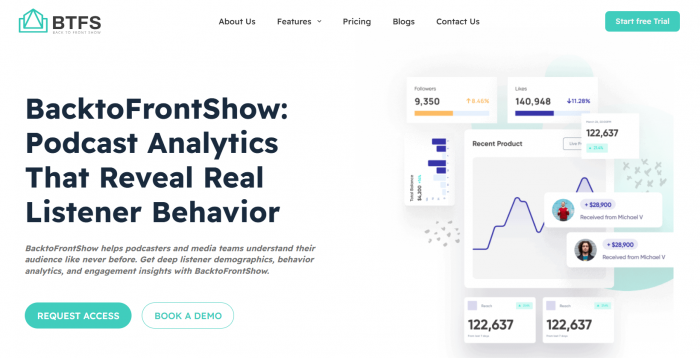
BacktoFrontShow is a podcast analytics platform designed to help creators, production teams, and media businesses understand how audiences interact with their content. Rather than focusing on podcast recording or hosting, it provides insights into listener demographics, engagement, and episode performance.
Its capabilities include geographical insights, audience behavior analysis, and performance reporting. Higher-tier subscriptions introduce sentiment analysis, detailed listening metrics, and external integrations.
For example, a podcast network can use audience information to identify popular episodes, understand listening patterns, and evaluate content performance across shows.
What interests me more is whether these insights help businesses make better decisions. Collecting detailed analytics is useful, but the real value comes from understanding what the numbers mean and how they influence future content.
BacktoFrontShow Pricing Overview
According to the official BacktoFrontShow pricing page, checked on November 12, 2026, the platform lists three subscription plans: Basic, Pro, and Enterprise. Basic costs $1,200 per month, Pro costs $3,600 per month, and Enterprise requires a custom quotation.
| Plan | Published Monthly Price | Calculated 12-Month Cost | Main Features |
|---|---|---|---|
| Basic | $1,200 | $14,400 | Audience demographics, engagement monitoring, support |
| Pro | $3,600 | $43,200 | Listening behavior, device analytics, sentiment analysis, API integration |
| Enterprise | Custom quote | Not publicly available | Custom reporting, white-labeling, dedicated support |
Important: The 12-month totals are calculated by multiplying the published monthly price by 12. They are not official annual subscription prices or confirmed annual contract offers.
Pro costs $2,400 more per month than Basic, making it three times as expensive. The difference comes from the additional analytics, integrations, and reporting capabilities advertised in the higher tier.
The official pricing page does not clearly specify annual discounts, minimum contract duration, setup fees, or cancellation charges. These details should be verified with the provider before making a purchasing decision.
What Each Plan Includes
Basic Plan: $1,200/Month
Basic provides foundational audience analytics for podcast teams that want more information about their listeners and content performance.
Its key capabilities include:
● Audience demographics: Examine listener information, including age-related data and geographical locations, to understand audience composition.
● Engagement monitoring: Track interaction metrics such as likes, shares, and comments to assess audience responses.
● Customer support: Access 24/7 assistance for account-related questions and technical issues.
● Data security: Benefit from security measures designed to protect analytics information and account data.
The official homepage also advertises episode performance tracking, listening trends, and customizable reporting under Basic. However, the dedicated pricing page describes a narrower feature set focused on demographics, engagement monitoring, customer support, and data security.
This difference matters because the public pages do not establish exactly how much listening behavior data or reporting customization Basic subscribers receive. Buyers should request a complete feature breakdown before assuming these capabilities are included without restrictions.
Pro Plan: $3,600/Month
Pro expands the platform's capabilities with deeper audience behavior analysis and external integration options.
Its additional features include:
● Listening behavior tracking: Examine episode popularity and average listening time to identify audience preferences.
● Device analytics: Understand device usage and listening platform preferences.
● AI sentiment analysis: Categorize available audience feedback as positive, negative, or neutral.
● Feedback aggregation: Consolidate supported audience responses for easier evaluation.
● Real-time updates: Access frequently updated analytics for ongoing performance monitoring.
● API integration: Connect compatible external systems to broader reporting workflows.
I find listening behavior tracking and integrations particularly relevant because they can help production teams improve reporting and identify content patterns.
However, sentiment analysis depends on available feedback and classification accuracy. Similarly, real-time reporting does not guarantee complete listener-level data from every podcast platform.
For $3,600 monthly, Pro makes the most sense when businesses actively use advanced analytics to manage content strategies, reporting responsibilities, and commercial partnerships.
Enterprise Plan: Custom Pricing
Enterprise targets larger organizations requiring customized analytics and operational support. Alongside Pro capabilities, it includes advanced geographical reporting, custom reports, premium templates, white-labeling, and priority feature requests.
Dedicated account management, training sessions, analytics webinars, and customized onboarding are also part of the Enterprise offering.
The official Enterprise listing includes custom reports, geographical analytics, premium templates, priority feature requests, white-labeling, a dedicated account manager, advanced training, monthly analytics webinars, and customized onboarding.
These features make Enterprise the most extensive advertised option, particularly for organizations requiring specialized reporting and account-level support. However, the exact service limits, implementation arrangements, and contractual commitments are not publicly explained.
Enterprise pricing is available only through direct contact with BacktoFrontShow. Organizations should request an itemized quotation showing included services, any additional charges, and the conditions attached to customization or support.
Basic vs Pro vs Enterprise
The main difference between these subscriptions is how extensively businesses can analyze and manage audience information.
| Feature | Basic | Pro | Enterprise |
| Demographic analytics | Yes | Yes | Yes |
| Engagement monitoring | Yes | Yes | Yes |
| Listening behavior analysis | Basic insights | Advanced | Advanced |
| Device analytics | Not included in plan features | Yes | Yes |
| AI sentiment analysis | Not included | Yes | Yes |
| API integrations | Not included | Yes | Yes |
| Advanced geographical reports | Not included | Not included in plan features | Yes |
| Dedicated account manager | Not included | Not included | Yes |
| White-labeling | Not included | Not included | Yes |
| Custom onboarding | Not included | Not included | Yes |
Basic focuses on audience visibility, Pro introduces detailed behavioral analysis, and Enterprise emphasizes customization and dedicated services.
A single branded podcast may find advanced integrations unnecessary, while a network managing several sponsored shows could benefit from centralized reporting and customized analytics.
Choosing the right tier depends less on the number of features and more on how frequently those capabilities will be used.
Monthly vs Annual Costs
Monthly subscription fees become more significant when calculated over longer periods.
| Duration | Basic | Pro |
| 1 month | $1,200 | $3,600 |
| 3 months | $3,600 | $10,800 |
| 6 months | $7,200 | $21,600 |
| 12 months | $14,400 | $43,200 |
Over twelve months, Pro costs $28,800 more than Basic. That difference could support podcast production, marketing, audience research, or additional staff resources.
Personally, I find the annual comparison more revealing because it shows the actual scale of the commitment. A subscription that appears manageable monthly can become a substantial operational expense over a year.
Organizations already receiving analytics through their hosting providers should determine whether BacktoFrontShow offers enough additional value to justify this expenditure.
Free Trial and Access
BacktoFrontShow provides a free-trial option, allowing prospective customers to explore the platform before making a subscription decision. Access involves submitting the necessary information and selecting the appropriate plan.
Trial duration, feature availability, and billing conditions should be confirmed during the registration process.
I would use the trial primarily to examine reporting accuracy, supported integrations, and practical functionality rather than simply exploring the interface.
Testing how the platform handles actual podcast data can provide a clearer understanding of whether the analytics are useful for everyday reporting and content decisions.
BacktoFrontShow does not have a permanent free tier within its main subscription structure. Businesses looking for ongoing access should evaluate one of the paid plans.
Costs Beyond Subscription
Monthly pricing is only part of the potential financial commitment. Depending on an organization's requirements, technical implementation and contractual arrangements can also affect overall expenditure.
Before purchasing, several details deserve clarification:
● Implementation charges: Confirm whether onboarding, historical data imports, or custom dashboard configurations involve additional fees.
● Integration limits: Check supported platforms, API allowances, and restrictions on data exports.
● Account allowances: Establish how many podcasts, users, and client accounts are included.
● Cancellation conditions: Review minimum commitments, renewal terms, and possible termination charges.
● Data management: Understand how information is collected, stored, exported, and deleted after cancellation.
These considerations are particularly important for businesses managing several podcast properties or requiring integrations with existing reporting systems. For Enterprise buyers especially, written contractual terms help ensure that implementation requirements and ongoing service expectations are clearly understood.
Who Should Consider BacktoFrontShow?
BacktoFrontShow's value depends on a podcast operation's commercial objectives, audience size, and reporting requirements.
1. Independent podcasters: Smaller creators may struggle to justify the entry-level expense. Basic statistics from existing hosting providers could be sufficient for monitoring downloads and audience growth.
2. Growing production teams: Teams producing multiple shows can benefit from detailed behavioral analysis and consolidated reporting, particularly when audience insights influence content planning.
3. Podcast agencies: Agencies managing sponsorships and branded content may require more advanced audience reporting to communicate performance to clients.
4. Enterprise media businesses: Larger companies can benefit from customized dashboards, integrations, dedicated support, and standardized reporting across departments.
For me, podcast size alone is not the deciding factor. A commercially focused show with strict reporting requirements may need better analytics than a larger podcast primarily interested in audience growth.
Is BacktoFrontShow Worth the Price?
BacktoFrontShow occupies a premium pricing category, with its two fixed-price subscriptions costing $1,200 and $3,600 monthly.
Consider a production business subscribing to Pro. At the regular monthly rate, its annual expenditure reaches $43,200, excluding any separately negotiated costs. To justify that amount, the company would need measurable benefits such as reduced reporting workload, better sponsorship analysis, or improved content decisions.
One concern I have with expensive analytics subscriptions is that more information does not necessarily produce better outcomes. Detailed dashboards offer limited value if teams lack the resources or processes to act on the findings.
Data quality is equally important. Demographic predictions and behavioral insights are most valuable when their sources, methodologies, and limitations are understood.
A subscription becomes easier to justify when it solves a defined business problem. If it merely duplicates existing analytics, paying thousands of dollars monthly becomes considerably harder to defend.
What to Verify Before Paying
Before subscribing, prospective customers should evaluate BacktoFrontShow against their actual reporting requirements rather than selecting a plan based entirely on feature availability.
A product demonstration should cover supported integrations, available reports, data collection methods, and relevant usage limitations.
I would pay particular attention to how listening behavior and demographics are calculated. Podcast distribution platforms provide different levels of information, and some insights may depend on estimates or specific integrations.
Sample reports can help determine whether the platform provides genuinely useful information beyond existing analytics tools.
Businesses should also ensure that their chosen plan supports the number of podcasts, team members, reporting requirements, and integrations they need. Privacy documentation, support commitments, cancellation policies, and payment terms should be reviewed before agreeing to a subscription.
Final Verdict
BacktoFrontShow pricing begins at $1,200 monthly for Basic, increases to $3,600 for Pro, and requires a custom quotation for Enterprise. Its features cover audience demographics, listening behavior, sentiment analysis, and advanced reporting.
From my perspective, the platform is more relevant to established podcast businesses than beginners. Its premium pricing creates an expectation of dependable analytics, useful reporting, and capabilities beyond standard podcast statistics.
I would evaluate BacktoFrontShow through a product demonstration and a clear comparison with existing tools before committing. For organizations with specific audience intelligence requirements, it is worth considering, but the investment should be justified by practical business value rather than the number of available features.
Comments