
Hashtag generators used to compete on one simple promise: give creators the biggest possible list. That is a poor measure of usefulness now. Instagram limits posts and Reels to five hashtags, while TikTok treats hashtags as one piece of content information alongside signals such as sounds, searches, watch behavior, and user interactions.
A useful generator therefore needs to do more than produce #viral, #trending, and twenty variations of the topic. The better tools help narrow a subject, uncover related language, separate broad tags from niche ones, or provide enough context to decide which suggestions are actually worth using.
What Makes a Good Hashtag Generator?
The value of a hashtag tool is increasingly about selection quality, not the number of results on screen. Instagram's five-tag cap makes that obvious: a list of fifty mediocre suggestions is less useful than five tags that clearly describe the subject, niche, audience, or campaign. Instagram head Adam Mosseri has also said that a few specific tags are preferable to long lists of generic ones and that hashtags can help with search without guaranteeing additional reach.
TikTok requires slightly different thinking. TikTok's own documentation lists hashtags as part of the content information considered in recommendations and search, but it also says user interactions, including watch behavior, can carry greater weight in recommendation feeds. In search, how closely the content matches the query is particularly important.
That means the strongest free hashtag generators should offer some combination of the following:
● Relevant suggestions rather than simple keyword variations. A tool should understand that “15-minute vegetarian breakfast” belongs to several useful contexts, not merely attach #breakfast to every result.
● Platform-specific generation. Instagram and TikTok should not automatically receive identical hashtag sets because discovery works differently across the two platforms.
● Enough input context to avoid generic output. Tools accepting descriptions, multiple keywords, images, or links have more information to work from than a generator built around one broad word.
● Some way to judge the suggestions. Search volume, frequency, related hashtags, popularity data, trend information, or competitive context can be more valuable than another ten generated tags.
● Usable free access. A free generator should allow meaningful research without turning every useful function into a paid-only feature after the first click.
With those criteria in mind, these six tools stand out for different reasons.
Quick Comparison
| Tool | Strongest Area | TikTok | Research Data | Free Access | |
| SmartPostly | Platform-specific generation | Yes | Yes | Basic | Yes |
| Hootsuite | Description-based ideas | Yes | Yes | Basic | Yes |
| Inflact | Detailed Instagram research | Yes | Limited focus | Strong | Yes, with limits |
| SISTRIX | Data-backed Instagram discovery | Yes | No dedicated mode | Strong | 25 searches/day |
| Ahrefs | Flexible AI generation | Yes | Yes | Limited | Yes |
| Display Purposes | Related-tag exploration | Yes | Usable for TikTok | Stronger contextual data | Yes |
The differences matter. Some of these are idea generators, while others are closer to research tools. The best choice depends on whether the problem is “I cannot think of relevant hashtags” or “I already have several hashtags and need help deciding which ones deserve a place.”
1. SmartPostly: Best for Platform-Specific Suggestions
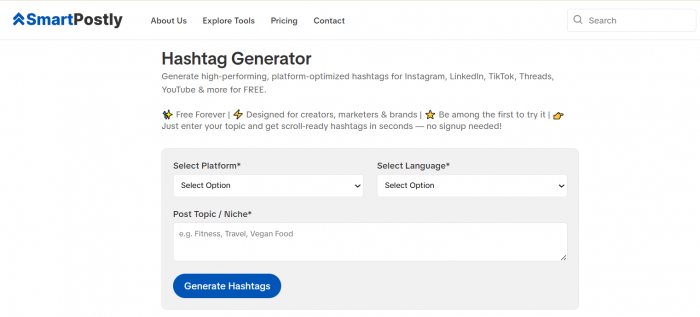
SmartPostly Hashtag Generator takes a straightforward approach: choose the platform, select a language, enter the post topic or niche, and generate a set of hashtags. Its current generator supports Instagram, TikTok, LinkedIn, YouTube, and other platforms, which makes it useful for creators adapting the same subject across more than one social network.
The tool is particularly suited to quick content workflows. Instead of expecting creators to understand search volume or build complicated filters first, it concentrates on translating a clear topic into a mix of broader and niche-oriented hashtag ideas.
Key Features
● Platform selection helps avoid treating one hashtag list as universally suitable for Instagram, TikTok, LinkedIn, and YouTube.
● Language selection is useful for creators publishing for audiences outside English-speaking markets.
● Topic or niche input keeps the workflow simple when the creator already knows exactly what a post covers.
● Related SmartPostly tools include caption, hook, Reel script, bio, content-calendar, and username generators, which can be useful when hashtags are one part of a wider social-content workflow.
Where It Helps Most
SmartPostly works well when the problem is turning a clearly defined topic into usable hashtag possibilities quickly. A post about “beginner strength training for women at home” gives the generator much more useful material than entering “fitness,” because it can work around the subject, audience, and activity rather than falling back on the broadest fitness tags.
Its platform selector is also important. A creator repurposing one short video for Instagram and TikTok can generate separate starting points rather than automatically copying the same tags into both captions.
What to Watch For
SmartPostly is primarily a generation tool rather than a full hashtag intelligence platform. Its free generator does not provide the same depth of historical volume, competition, demographic, or regional analysis available from research-heavy tools.
The suggestions should therefore be treated as a shortlisting stage. Highly generic results should be removed, while unfamiliar tags should be checked on the target platform before being attached to a post. That extra check also helps avoid common hashtag mistakes, such as choosing a tag for its size rather than how closely it matches the actual post.
Free Access
The standard Hashtag Generator is presented as free to use without sign-up. SmartPostly also promotes a Pro version for users wanting features such as trend-based sets, niche analysis, or engagement-oriented information.
| Relevance | Research Depth | Ease of Use | Free Value |
| 4.5/5 | 4 /5 | 4.8/5 | 4.8/5 |
Best suited to: Creators who want quick Instagram and TikTok hashtag ideas without learning a complicated research dashboard.
2. Hootsuite: Best for Detailed Post Descriptions
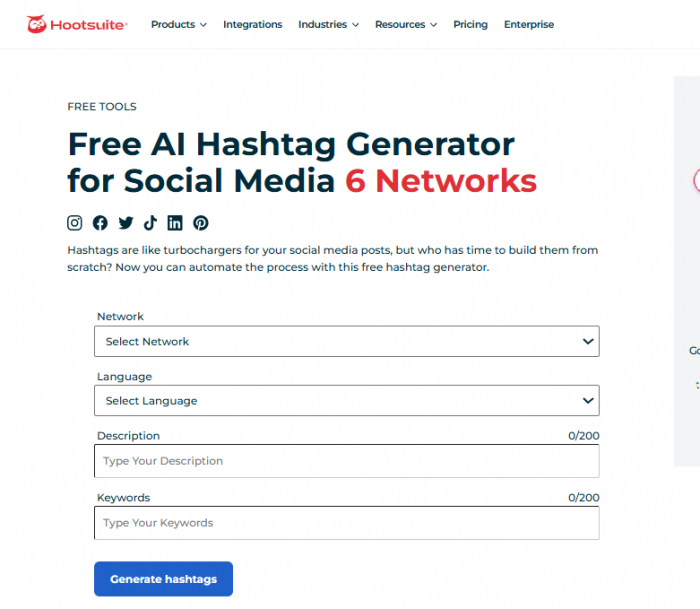
Hootsuite's free Hashtag Generator is useful because it asks for more than a single keyword. Users can choose a social network and language, then provide both a description and keywords, giving the generator additional context about what the post is actually communicating. Hootsuite currently lists support for six networks, including Instagram and TikTok.
That additional description field can make a meaningful difference. “Coffee” is vague; “a Reel showing how to make cold brew at home without specialist equipment” gives a generator several concepts around which to build a better shortlist.
Key Features
● Network selection covers Instagram, TikTok, Facebook, LinkedIn, Pinterest, and X.
● Description and keyword fields allow creators to explain both the content and the terms they consider important.
● Language selection makes the generator more practical for multilingual content.
● Hootsuite's dedicated Instagram generator can also accept a photo, giving visual posts another way to produce suggestions.
Where It Helps Most
Hootsuite is particularly useful for posts with several overlapping subjects. A small bakery, for instance, may be publishing a behind-the-scenes Reel about gluten-free sourdough sold locally in Toronto. A simple “bread” keyword misses most of the useful context, while a description can capture the product, format, dietary angle, and location.
This makes Hootsuite better suited to expanding a specific post into adjacent hashtag concepts than generators that simply convert one keyword into closely related terms.
What to Watch For
The free generator does not turn those suggestions into detailed competitive research. It can help answer “What other tags relate to this post?”, but it is less useful for questions such as “How quickly is this TikTok hashtag growing?” or “Which country is driving the trend?”
Creators should also resist the temptation to copy every result simply because it was generated from a detailed description. Relevance remains more important than filling every possible hashtag slot.
Free Access
Hootsuite offers the generator as a standalone free tool. A paid Hootsuite subscription is not required simply to use the public hashtag-generation page.
| Relevance | Research Depth | Ease of Use | Free Value |
| 4.3/5 | 3.0/5 | 4.8/5 | 4.7/5 |
Best suited to: Creators who prefer describing the entire post rather than generating hashtags from one isolated keyword.
3. Inflact: Best for Deeper Instagram Research
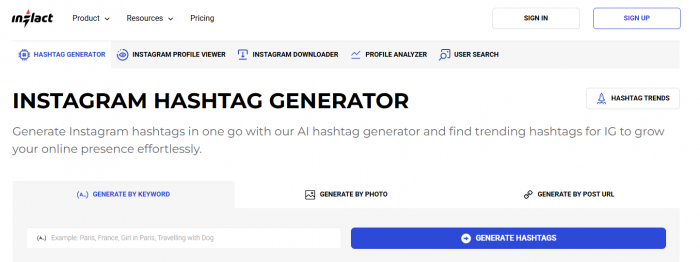
Inflact is noticeably different from the simpler AI generators in this list. Instead of focusing only on producing a convenient set of words, its Instagram Hashtag Generator adds several layers of research around those suggestions.
Users can generate hashtags through keywords, an image, or an Instagram post link. Inflact also separates hashtags by usage frequency and provides related tags and analytics, making it more useful when the goal is to evaluate options rather than generate them as quickly as possible.
Key Features
● Multiple keyword input allows up to five key phrases to narrow the subject.
● Image-based generation can identify potential tags from the visual itself.
● Instagram-link input provides another route for researching tags around existing content.
● Frequency categories separate suggestions into frequent, average, and rarer hashtags.
● Hashtag analytics provide additional metrics and related-tag information for deeper research.
Where It Helps Most
Inflact is better suited to situations where broad popularity can become misleading. A niche ceramic artist does not necessarily benefit from choosing the five largest art hashtags available. Seeing broader and more specific alternatives makes it easier to build a set that actually describes handmade pottery, glazing, studio work, location, or a particular ceramic style.
Its multi-keyword system is also useful because combinations can change intent. “Model, Spain” can produce suggestions around two subjects, while a combined phrase can surface hashtags containing both concepts.
What to Watch For
Inflact is heavily Instagram-oriented, so it is not the most natural choice for someone whose main priority is TikTok. Some of its own promotional language also makes strong claims about engagement and reach, which should not be confused with guarantees about how Instagram will distribute an individual post.
Its access model is also more complicated than the completely open generators. Inflact currently promotes free hashtag functionality, while its pricing and support materials also place some hashtag capabilities within account limits and paid packages.
Free Access
A free tier is available, but advanced and higher-volume functionality sits inside Inflact's paid research and Pro ecosystem. It is therefore better described as free with limitations than completely unrestricted.
| Relevance | Research Depth | Ease of Use | Free Value |
| 4.6/5 | 4.5/5 | 4.1/5 | 4.0/5 |
Best suited to: Instagram creators who care more about researching a small set of tags than generating a large list as quickly as possible.
4. SISTRIX: Best for Data-Backed Instagram Discovery
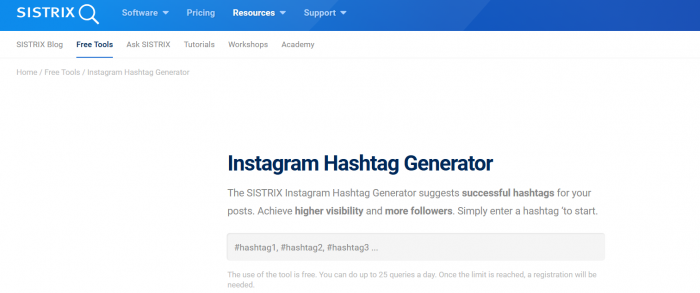
SISTRIX takes a database-led approach rather than behaving like a typical generative-AI tool. Users enter an existing hashtag and the generator returns related suggestions drawn from a dataset that SISTRIX says contains more than 15 billion hashtag combinations and over 7.7 million individual hashtags.
This approach is useful because it begins with relationships between hashtags, not merely linguistic similarity. Two terms can look related in English while rarely appearing in the same real-world content context, and a large co-occurrence dataset can reveal associations that simple text generation might miss.
Key Features
● Related hashtag discovery begins from an existing seed hashtag.
● Large hashtag-combination dataset provides the basis for recommendations.
● Regular data updates aim to keep the underlying relationships current.
● Up to 25 free queries per day can be performed before registration becomes necessary.
Where It Helps Most
SISTRIX is particularly useful when a creator already has one strong tag but needs four supporting ones. Under Instagram's five-hashtag limit, that is a more realistic problem than generating thirty tags for every post.
Consider a specialist food creator starting with #SourdoughBaking. The useful task is not finding the broadest food hashtags on Instagram; it is finding closely connected terms that place the post within bread-making, fermentation, home baking, or a specific baking community.
What to Watch For
SISTRIX is built specifically around Instagram hashtag discovery, so TikTok creators will need another source for platform-specific validation. It also begins from a hashtag rather than a full natural-language description, making the user responsible for choosing a sensible seed term first.
Its data-heavy approach can also make highly popular relationships look attractive even when they are too broad for a particular post. Large numbers are context, not proof that a tag belongs in the final set.
Free Access
The tool allows up to 25 queries per day for free. Registration is required after the daily allowance has been reached.
| Relevance | Research Depth | Ease of Use | Free Value |
| 4.4/5 | 4.3/5 | 4.4/5 | 4.6/5 |
Best suited to: Instagram users who already know their main hashtag and want data-backed related options rather than AI-written guesses.
5. Ahrefs: Best for Flexible AI Generation
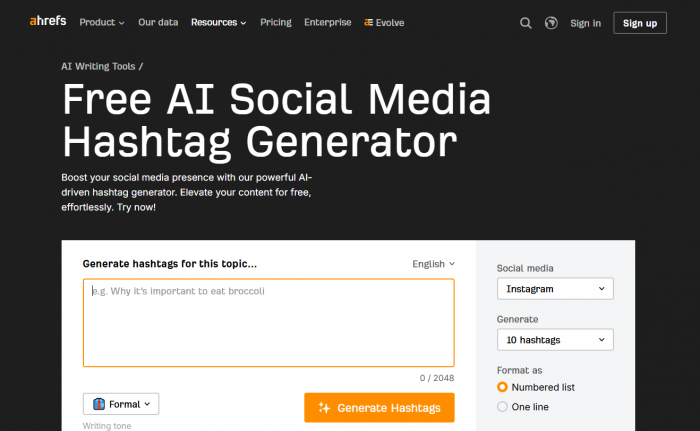
Ahrefs' free Social Media Hashtag Generator sits inside its collection of AI writing tools. It accepts a relatively long topic description, allows users to select a writing tone and social network, choose how many hashtags should be produced, and format the result as either a list or a single line.
Ahrefs also provides dedicated Instagram and TikTok hashtag generators, making it more relevant to this comparison than tools designed only around one platform.
Key Features
● Long-form topic input supports considerably more context than a single-keyword box.
● Platform selection allows the generation request to reflect the intended social network.
● Adjustable output quantity helps avoid generating more tags than are actually needed.
● Output formatting can place hashtags in a numbered list or one-line format for easier copying.
● Separate Instagram and TikTok generators are available within Ahrefs' AI writing-tool collection.
Where It Helps Most
Ahrefs is useful when the creator wants more control over how the result is generated, not necessarily more research after generation. A detailed description can include the subject, intended viewer, location, content format, and angle, making it possible to create more focused candidate tags.
The ability to limit the output is particularly appropriate for Instagram now. There is little reason to ask for thirty suggestions simply because older hashtag workflows were built around much larger lists.
What to Watch For
Ahrefs' free generator is AI-led rather than built around live social trend analytics. It can generate semantically convincing tags, but a tag that sounds logical is not automatically popular, active, or useful on the platform at the moment it is generated.
This distinction is especially important on TikTok, where trends can move quickly. Candidate tags should still be checked against TikTok's own search or Creative Center before being treated as current trend signals.
Free Access
The standalone AI hashtag tool is available free through Ahrefs' writing-tools collection. Ahrefs promotes additional social-media management products separately, but they are not required for basic hashtag generation.
| Relevance | Research Depth | Ease of Use | Free Value |
| 4.2/5 | 3 /5 | 4.6/5 | 4.7/5 |
Best suited to: Creators who want more control over the prompt, number of suggestions, and formatting without needing a full hashtag analytics dashboard.
6. Display Purposes: Best for Exploring Related Hashtags
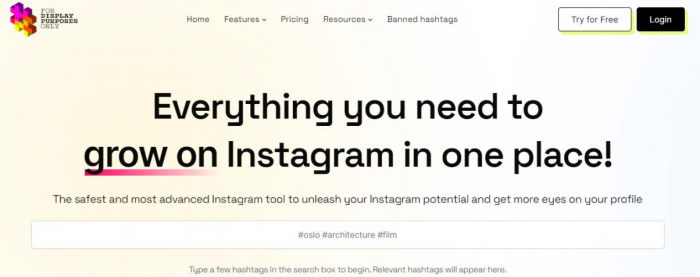
Display Purposes is useful when hashtag research needs to move beyond simple generation. Its public hashtag pages show related tags alongside information such as estimated usage, countries, cities, language distribution, demographic information, and similar hashtags for many queries. The service says its results can be used across Instagram, TikTok, YouTube, Facebook, and X.
That makes it closer to an exploration tool than a one-click AI writer. Instead of starting and ending with a generated list, creators can follow related terms and see how different hashtag communities connect.
Key Features
● Related hashtag suggestions help move from a broad term toward more specific communities.
● Usage figures provide context about how widely certain tags have appeared.
● Country and city information can help with geographically sensitive topics.
● Language and demographic data add another layer when audience fit matters.
● Cross-platform positioning makes the suggestions usable as research starting points beyond Instagram.
Where It Helps Most
Display Purposes is valuable when the obvious hashtag is too broad. A travel creator researching #travel, for example, gains little from learning that other enormous lifestyle hashtags exist. Moving through destination, activity, photography style, regional, or niche travel tags can reveal terms that describe the actual content much more precisely.
The extra context is also helpful when two tags appear equally relevant linguistically but attract noticeably different geographic or audience patterns.
What to Watch For
Historical usage does not equal current momentum. A hashtag can have millions of accumulated posts and still be less useful today than a smaller term connected to an active topic or community.
Creators should also avoid assuming that cross-platform compatibility means identical performance. A tag with a large Instagram history should still be checked on TikTok before it is treated as a TikTok trend.
Free Access
Display Purposes makes its hashtag-discovery pages publicly accessible, allowing creators to research related tags and associated data without purchasing a conventional subscription before starting.
| Relevance | Research Depth | Ease of Use | Free Value |
| 4.3/5 | 4.4/5 | 4.1/5 | 4.8/5 |
Best suited to: Creators who want to move beyond generated lists and understand the context surrounding related hashtags.
Instagram and TikTok Need Different Strategies
A common mistake is generating one hashtag set and pasting it underneath the same video on both platforms. The subject may be identical, but the role hashtags play within each platform is not identical. That is why Instagram and TikTok hashtags work differently even when the underlying piece of content stays exactly the same.
Instagram's current five-hashtag cap makes every slot more valuable. The practical goal is to label the content accurately through a handful of specific terms rather than covering every broad category remotely connected to the post. Instagram has explicitly pushed creators toward fewer, more relevant hashtags instead of long generic lists.
TikTok provides more reason to think about live topic behavior. Its recommendation documentation lists hashtags among content-information signals, while its search system considers hashtags and how closely content matches a user's query. TikTok also says interaction signals such as watching, liking, sharing, commenting, or skipping can carry substantial weight in recommendations.
The implication is simple: a hashtag cannot compensate for weak content on either platform. On TikTok, even a perfectly chosen tag does not override poor watch behavior. On Instagram, adding the maximum five hashtags does not automatically produce more distribution.
Generated Tags Still Need Validation
A generator answers one question: “What hashtags could fit this content?” It usually does not fully answer the more important question: “Which of these tags makes sense right now?”
TikTok's Creative Center is particularly valuable at this stage. Its Trends area lets users search or filter hashtags by industry and time frame, then inspect trendlines, related videos, audience insights, regional popularity, and related hashtags. TikTok describes Creative Center as a free public resource.
A practical TikTok process therefore looks different from blindly copying generator output. Generate possible terms first, remove anything broad or irrelevant, check promising tags against TikTok's live environment, and then choose only the ones that genuinely describe the video.
Instagram validation can be simpler because only five hashtags are available. Search the candidate term directly, look at what kind of content appears around it, and ask whether the post genuinely belongs beside those results. If the answer is no, a large post count does not make the hashtag a good choice.
Avoid the “Biggest Hashtag Wins” Trap
Hashtag numbers are easy to misunderstand. A tag attached to hundreds of millions of posts looks powerful, but its size tells you very little about whether it accurately describes one specific piece of content.
Consider a small café publishing a Reel showing how it makes Vietnamese egg coffee. Tags such as #food, #coffee, and #viral are enormous, but they provide weak information about what is distinctive about the video. More descriptive concepts around Vietnamese coffee, egg coffee, specialty coffee, the café's city, or its local food community may provide clearer context even if their total usage is dramatically lower.
The same principle applies on TikTok. A smaller hashtag tied closely to the subject can be more informative than a giant trend pasted onto content that barely relates to it. A generator becomes useful when it helps uncover this vocabulary rather than simply ranking tags by size.
Generator vs Research Tool
The six tools above fall into two broad groups.
SmartPostly, Hootsuite, and Ahrefs are strongest when the starting problem is a blank box. Give them the subject, description, or keywords and they quickly create candidate hashtags.
Inflact, SISTRIX, and Display Purposes become more useful when the creator already has an idea of what the content is about and wants additional information around related hashtags, frequency, usage patterns, or semantic connections.
Neither approach replaces the other. Generation is faster for ideation; research is stronger for narrowing the final choice. For creators publishing frequently, using a generator first and a research source only for the most promising tags is usually more efficient than performing deep research on every suggestion.
Which Tool Should You Choose?
There is no single free hashtag generator that is strongest in every category. The right choice depends on where the difficulty sits in the workflow.
| Need | Strong Choice |
| Fast Instagram and TikTok ideas | SmartPostly |
| Detailed post-description input | Hootsuite |
| Deeper Instagram hashtag research | Inflact |
| Related hashtags backed by a large dataset | SISTRIX |
| Flexible AI-generated lists | Ahrefs |
| Hashtag context and related-data exploration | Display Purposes |
For someone who only needs a few sensible tags for each post, SmartPostly or Hootsuite keeps the process simple. Creators who want more research before selecting their Instagram tags will get more value from Inflact or SISTRIX, while Display Purposes is useful for exploring relationships and audience context around tags.
Ahrefs sits somewhere between these groups. It is quick and flexible, particularly when a detailed description is available, but it still needs external validation when current trend data matters.
Final Perspective
The best free hashtag generators in 2026 are no longer the ones that produce the longest copy-and-paste block. Instagram's five-hashtag limit has made precision more valuable, while TikTok's recommendation and search systems place hashtags alongside many other signals rather than treating them as a shortcut to distribution.
SmartPostly is a strong starting point for simple platform-specific generation, while Hootsuite is particularly useful when a detailed description provides important context. Ahrefs offers flexible AI generation, and Inflact, SISTRIX, and Display Purposes move closer to research by helping creators understand relationships, frequency, and surrounding hashtag data.
The useful habit is to stop treating a generator's output as the final answer. Generate candidates, remove the generic tags, check whether the remaining terms genuinely match the post, and validate current TikTok trends where necessary. Hashtag tools save the most time when they reduce the search space from dozens of possibilities to a few defensible choices, not when they give creators another wall of tags to paste underneath every post.
Comments