

A question posted by a productivity newsletter received 1,400 votes: What usually breaks your weekly plan first?
The options were urgent requests, underestimated tasks, too many meetings, and loss of motivation. Meetings received the most votes, but that was not the most useful part of the result. The comments showed that many readers did not consider meetings the real problem. The disruption came from the preparation, context switching, and unfinished work left around them.
One simple poll had uncovered a more interesting issue than the original question contained. That is where the real power of polling sits. A poll does more than collect answers. It gives people an easy way into a conversation, shows how individual experiences compare, and provides the creator with a starting point for deeper content.
One Question, Two Outcomes
Polls are commonly treated as lightweight engagement posts. They appear between videos, carousels, articles, and promotions to create a temporary rise in activity. That view misses half of their value.
Every well-designed poll strategy can produce two outcomes at the same time. The visible outcome is participation: people stop, read the options, choose an answer, and sometimes explain their reasoning. The less visible outcome is direction. The creator learns which problem deserves investigation, which belief divides the audience, or which option needs to be tested next.
The productivity newsletter could have posted an open question asking, “What disrupts your weekly plan?” It might have received thoughtful answers, but only from people willing to formulate and publish a response.
The poll reduced that burden. Readers did not need to explain their entire week. They only had to recognise the option closest to their experience. Once they had chosen, commenting became easier because the first decision had already been made.
That sequence matters. A poll does not demand the deepest possible interaction at the beginning. It creates a manageable first action and allows deeper participation to follow.
The Three Lives of a Poll
A useful poll has three separate lives. Most weak polls are designed only for the first.
| Poll stage | What the audience does | What the creator should do |
| Before the vote | Interprets the question and compares the options | Make the decision clear, relevant, and fair |
| After voting | Examines the result and compares positions | Add context and invite explanation |
| After the poll closes | Looks for meaning or consequence | Turn the result into content, testing, or action |
The first life is about the choice. The second is about comparison. The third is about consequence. A poll that collects votes but never develops the result stops after its least valuable stage. The number may look impressive, yet the audience receives no explanation and the creator learns little beyond which button was tapped most often.
The strongest polling strategies are designed backwards. Before writing the question, the creator decides what kind of conversation or action the result should make possible.
Before the Tap
The visible poll may contain ten words, but the audience must process several things before voting. People need to understand the situation, recognise the difference between the options, and decide whether their answer says something they are comfortable expressing. If any part is unclear, they may ignore the poll even when the subject interests them.
This is why successful polls are rarely built from a clever question alone. They are built from a clearly defined decision.
Start With the Decision
“Which is better, videos or carousels?” sounds simple, but it contains several unanswered questions. Better for reach, education, sales, production speed, or audience retention? The respondents may be voting on completely different interpretations.
A more useful version would be:
Which format helps you explain a complex idea more clearly?
● A short video
● A visual carousel
● A long caption
● A linked article
The revised question does not attempt to identify the universally best format. It asks about one specific job.
Before writing a poll, the creator should complete this sentence:
I want to understand how my audience decides between ______ and ______ when ______.
That final condition is important. It gives the choice a boundary.
Build Real Alternatives
The answer options determine the quality of the feedback. If the options are weak, the final percentages may look precise while representing a badly framed decision.
Consider this poll:
What is the best way to grow an online audience?
● Publish valuable content
● Post without a strategy
● Copy competitors
● Wait for people to discover you
Only one option has been written as a serious answer. The poll is not measuring audience opinion. It is directing people toward the creator’s preferred message.
A stronger version might compare educational content, community participation, collaborations, and paid distribution. Each option represents a genuine approach with strengths and limitations.
Balanced options are especially important when the poll will support a later claim. A creator should not announce that “82 percent of our audience believes educational content is best” when the other available answers were clearly unreasonable.
Respect the Missing Answer
Poll writers often force every participant into one of the supplied categories. This keeps the graphic tidy but can make the result less useful.
Returning to the productivity poll, some readers may lose control of their week because of illness, caregiving, travel, technical failures, or unclear priorities. None of those experiences fits neatly into meetings, urgent requests, underestimated tasks, or motivation.
A “something else” option could capture that gap. The creator might then ask those voters to explain in the comments.
Not every casual poll needs an escape option. A playful preference question about two cover designs can remain simple. The missing-answer problem matters when the creator intends to interpret the result as genuine feedback.
After the Vote
The act of voting changes how a person views the result. Before choosing, the percentages are information. After choosing, they are comparison.
The voter now has a position inside the distribution. A close result creates uncertainty. A dominant result can provide validation or surprise. An unpopular choice may encourage someone to explain why the minority position deserves more attention.
This makes the result a second piece of content rather than an administrative screen shown after submission.
A Tie Creates Debate
Suppose 51 percent of an audience selects written tutorials and 49 percent selects video tutorials. Announcing the winner would miss the real finding. The near-even split suggests that format preferences may depend on the task, complexity, available time, or learning style.
The follow-up question becomes more useful than the original poll:
What makes you choose written instructions over video, or video over written instructions?
The poll has performed its job by revealing where the disagreement sits. The comments can now provide the conditions behind each position.
A Landslide Needs Investigation
A clear winner may appear easier to interpret, but it can raise a different set of questions.
If 86 percent of participants say meetings are the main cause of weekly disruption, the creator should not immediately conclude that the audience wants fewer meetings. The real problem could involve meeting length, poor agendas, inconvenient timing, unnecessary attendance, or the work created afterward. The poll identifies the door. Further questioning reveals what is behind it.
The Minority May Hold the Insight
Creators tend to focus on the winning option because it provides the simplest headline. The smaller groups can be more informative.
People choosing an unpopular answer may have different experience levels, workflows, budgets, or constraints. Their comments can expose an audience segment the creator has been overlooking. A good results post therefore asks two questions: why did the leading option win, and what conditions led people to choose differently?
The Poll as a Miniature Interface
A poll is not only written content. It is a small interface through which people make a decision. Every part of that interface influences the response: the wording, the order of options, the amount of context, whether results are shown immediately, and whether voting feels anonymous or public.
Survey researchers have repeatedly found that wording, question order, and the available answer choices can affect how people respond. Pew Research Center recommends clear, specific wording, non-overlapping categories, and answer sets that include reasonable responses. It also notes that closed answer lists can shape what participants select compared with open-ended questions.
Social media polls are much less formal than research surveys, but the same design risks still apply.
The First Option Advantage
On a fast-moving platform, some people may choose the first reasonable option rather than inspect every answer closely. This becomes more likely when the alternatives are long, similar, or difficult to compare.
The practical response is not always to randomise options, since many native social platforms do not offer that control. Instead, poll writers can rotate answer order across repeated tests or avoid consistently placing the expected winner first.
Words Carry Judgement
Compare these two options:
● Use AI to improve efficiency
● Replace human creativity with AI
The language has already framed one answer as practical and the other as destructive. Neutral alternatives would describe comparable actions, such as using AI for idea generation, first drafts, editing, or not using it in the workflow.
The aim is not to remove every trace of perspective. Conversation polls can be opinionated. The audience should still be choosing between positions rather than between a sensible answer and a caricature.
Results Can Influence Later Votes
When participants can see the distribution before voting, some may be drawn toward the majority while others deliberately support the underdog.
That influence may be acceptable in entertainment polls, live events, and community conversations. It becomes more problematic when the creator wants an independent preference signal.
The decision to reveal results should therefore match the purpose. Instant results make the interaction more satisfying. Hidden results can reduce the chance that early votes shape later ones.
Four Rooms Where Polls Work
Polls become more useful when they are attached to a real workflow rather than posted as a general engagement tactic.
The Editorial Room
A content team can use polls to choose between subjects, identify confusing concepts, or decide which example deserves a longer explanation.
The audience should not be asked to design the entire editorial calendar. A better approach is to offer several topics the team is already equipped to cover, then use the result as one input alongside search behaviour, comments, support questions, and business priorities.
An editorial poll works best when the winning topic is visibly developed. Publishing the requested article shows that participation had a consequence.
The Product Room
Product polls can compare names, interfaces, colours, feature priorities, or onboarding problems. They offer a quick preference signal before more expensive testing begins.
The risk is treating stated preference as proof of future behaviour. A person may say they want advanced customisation and still prefer the simpler product in practice.
Product polls are most valuable near the beginning of an investigation. They help identify what deserves prototyping, interviews, or usability testing. They should not carry the full weight of a product decision.
The Community Room
Communities need recurring reasons to recognise one another. Polls make shared experiences visible.
A professional community might ask which skill members are trying to develop this quarter. A creator community could compare editing bottlenecks. A customer group might vote on the next workshop topic.
The result gives members a picture of the room. People see that a problem they considered personal is widely shared, or that the community contains several distinct perspectives.
The Live Room
In meetings, webinars, classes, and events, polls interrupt one-way delivery. They allow the presenter to check understanding, collect predictions, choose a discussion direction, or surface disagreement without requiring every participant to speak.
Timing matters more than volume. A poll placed before an explanation creates anticipation. One placed afterward tests whether the argument changed the room. A final poll can reveal what people plan to do next.
Too many polls can fragment the session. The strongest live questions change how the presenter continues, rather than acting as decorative breaks between slides.
What the Percentage Cannot Prove
A social poll reports the choices of people who encountered the post and decided to participate. It does not automatically represent every follower, customer, or member of the broader market.
The most active followers may be overrepresented. Platform distribution determines who receives the question. The subject may attract people with particularly strong opinions, while indifferent users continue scrolling.
Professional polling organisations use sampling methods and weighting because non-representative samples can produce skewed results. AAPOR specifically warns that representativeness depends on who is included and who responds.
Creators do not need to turn every community poll into formal research. They do need to describe the evidence honestly.
Instead of writing, “Our audience prefers video,” a more accurate interpretation would be, “Among the 740 people who voted, video received the largest share.” That wording does not weaken the result. It prevents a directional signal from being presented as universal proof.
Four Poll Generator Tools
The best poll tool depends on where the audience will encounter the question. Some tools help generate the idea, while others host the vote or bring it into a live session.
1. SmartPostly Poll Question Generator : Best for generating social poll ideas
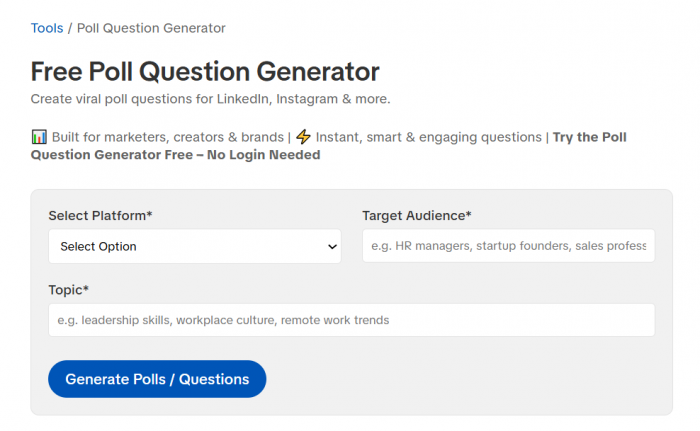
SmartPostly Poll Question Generator is the strongest starting point for creators who know the subject but have not found the right question. Its Poll Question Generator is part of a wider collection of social media content tools and is designed to create poll questions intended to increase social interaction.
The tool is particularly useful during the blank-page stage. A broad topic such as remote work, personal branding, content planning, or customer service can be turned into several possible poll directions.
Its output should be treated as a draft. The creator still needs to check that the answers are balanced, distinct, and suited to the audience. The greatest value is speed: SmartPostly provides workable starting points that can then be refined into a sharper question.
2. Typeform Poll Maker : Best for standalone and branded polls
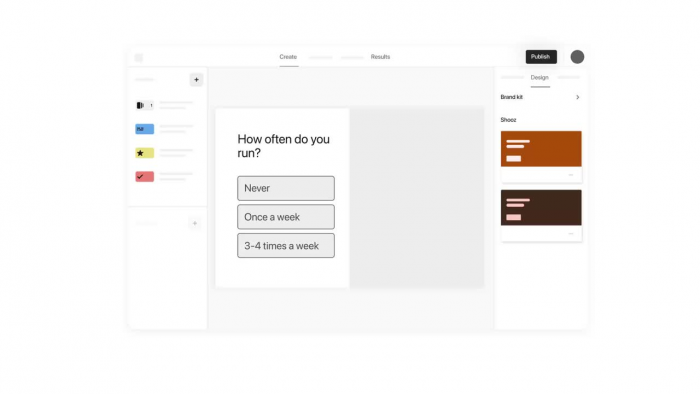
Typeform is a practical choice when the poll needs to live outside a native social platform. Its poll maker is designed for single-question or very short feedback and supports link sharing, embedding, design customisation, instant results, and integrations with other tools.
It fits product preference tests, event follow-ups, newsletter polls, and branded audience questions. The clean, guided presentation can make the poll feel more deliberate than a quick platform post.
Typeform is less suitable when the creator only needs a simple idea for an Instagram Story or X poll. Its value appears when presentation, response collection, and a shareable destination matter.
3. Opinion Stage : Best for website and visual polling
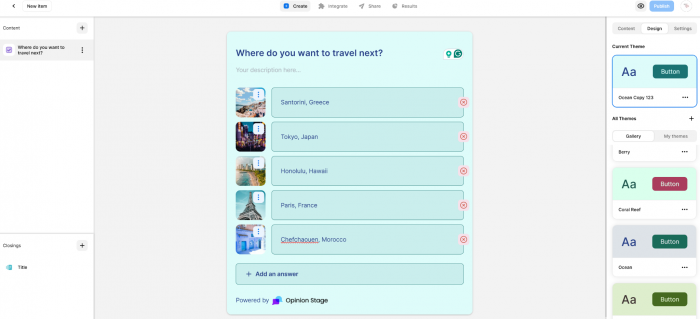
Opinion Stage is built for interactive polls that can be embedded in articles, landing pages, and websites. It supports multiple-choice, image, head-to-head, rating, ranking, and live formats, alongside real-time results and design customisation.
The visual options make it useful for comparing product designs, article covers, packaging, photographs, or other choices that are difficult to describe in text.
Publishers can place the poll directly inside a related article, allowing the reader to vote at the point where the disagreement or decision is being discussed.
4. Slido : Best for meetings and live events
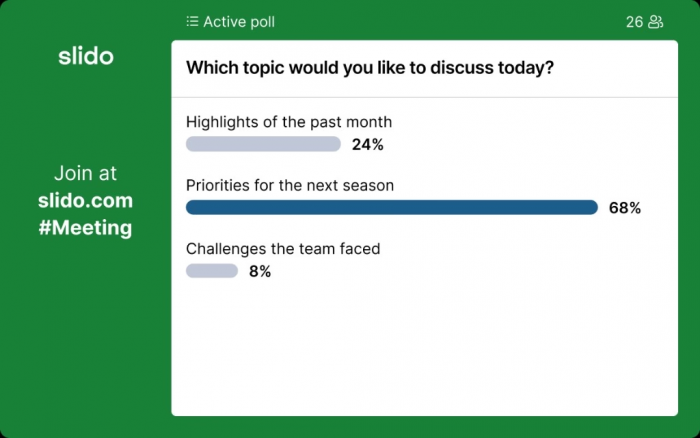
Slido focuses on live audience participation. Its polling options include multiple choice, word clouds, quizzes, ratings, open text, rankings, and surveys, making it useful for presentations, workshops, classes, and webinars.
A presenter can begin by asking participants to predict an outcome, reveal the result during the explanation, and return to the same question at the end. This turns the poll into part of the structure of the session.
Slido is not primarily a social content ideation tool. It is strongest when the response needs to appear immediately and influence a live conversation.
One Poll, Six Pieces of Content
The productivity newsletter does not need to abandon its poll after announcing that meetings won.
The result can become a sequence:
1. A results post can show the distribution and explain why the leading answer was unexpected.
2. A comment analysis can group recurring explanations, such as context switching, preparation, and follow-up work.
3. A practical guide can examine how to reduce the hidden work surrounding meetings.
4. A second poll can ask which part of a meeting creates the most disruption.
5. An expert interview can explore why calendar time understates the real cost of interruption.
6. A final follow-up can share which changes readers tested and what improved.
This is not content recycling in the sense of repeating one percentage across six posts. Each stage moves closer to the underlying problem. The first poll identifies a pattern. The comments introduce possible causes. The next pieces test, explain, and apply them.
The No-Poll Test
Not every subject should be reduced to fixed choices. A poll is the wrong format when the creator does not yet understand the likely answers, when the issue requires personal context, or when simplifying the options could misrepresent a sensitive experience.
Before posting, ask whether the audience can answer honestly within the available categories. If the useful response begins with “it depends,” an open question, interview, or survey may be more suitable.
Polls are powerful because they reduce effort. That same reduction can remove nuance. The writer’s job is to know when simplification creates a useful entry point and when it distorts the subject.
The Value Begins After Voting
The most successful poll is not necessarily the one with the largest response count. It is the one that produces a useful next move.
A strong question helps people recognise their experience. Balanced options make the choice credible. The visible result allows participants to compare perspectives. The creator then interprets what happened and turns the response into better content, a deeper question, or a more informed test. The vote is the smallest part of the process. Its value comes from what the audience and creator can do once the result is visible.
Comments