

AI can produce a technically beautiful couple portrait and still miss the part that matters: the couple does not look like a couple. The faces may be polished, the sunset perfect, and the clothing immaculate, yet the interaction feels staged because the prompt describes appearance without describing a believable moment.
Good couple photo prompts work more like directions given to a photographer. They define what the two people are doing, how close they are, where the camera is positioned, what kind of light reaches them, and what should remain imperfect enough to feel real. The 20 prompts below are built around those details, with enough variety to create everything from quiet everyday photographs to cinematic relationship portraits.
What Makes a Couple Photo Feel Real?
The word romantic does surprisingly little by itself. Image models respond much better when romance is translated into something visible: one person adjusting the other's scarf, two people laughing while walking, a forehead touch, a hand resting naturally on a shoulder, or a couple talking across a café table.
The strongest prompts usually control five areas at once.
| Prompt element | What it changes in the image |
| Interaction | Gives the couple believable body language instead of making them stand stiffly beside each other. |
| Environment | Establishes context, whether the photograph takes place at home, in a city, near the ocean, or inside a studio. |
| Lighting | Determines much of the mood, from soft window light to warm evening light or cool rain-soaked streets. |
| Camera direction | Controls framing, depth, distance, and whether the result resembles a portrait, candid shot, or editorial photograph. |
| Emotional tone | Helps distinguish a playful date from a peaceful embrace, formal portrait, nostalgic memory, or cinematic scene. |
Notice that none of these relies on piling up words such as beautiful, perfect, magical, or stunning. Those terms express an intention, but they give the model little visual information. A better prompt describes what the camera would actually see.
A Better Prompt Formula
A useful structure for couple photography is: Couple + interaction + setting + clothing + lighting + camera/framing + mood + realism instructions
Consider the difference.
Basic prompt:
A romantic couple walking on a beach at sunset.
That will probably generate the right general subject, but nearly everything else is left for the model to invent.
A more controlled version might read:
Create a realistic photograph of an adult couple walking barefoot beside the shoreline while holding hands and talking naturally. Their summer clothing moves slightly in the sea breeze. Use warm late-evening sunlight from behind, a full-body candid composition, subtle reflections in the wet sand, realistic skin texture, natural facial expressions, and a lightly cinematic 50mm photography look.
The second prompt is not better because it is longer. It is better because almost every phrase changes something visible.
Romantic Everyday Moments
Everyday scenes are especially useful when you want couple photos that look like memories rather than advertisements. Ordinary activities also give the model a reason to position hands, faces, and bodies naturally.
1. Slow Sunday Morning
Best for: Lifestyle portraits, anniversaries, personal photo collections.
Prompt: Create a realistic lifestyle photograph of an adult couple spending a quiet Sunday morning together in a bright apartment. They sit close on a slightly unmade bed with coffee mugs, talking and smiling naturally rather than looking directly at the camera. Use soft morning window light, simple neutral sleepwear, realistic bedding folds, slightly messy hair, natural skin texture, and a candid 50mm photography style. Keep the room lived-in rather than perfectly staged, with subtle background details and shallow depth of field.
Make it yours: Replace the bedroom with a balcony, sofa, breakfast table, or cabin while keeping the relaxed interaction.
2. Coffee Shop Date
Best for: Casual romantic photos with a believable social-media photography look.
Prompt: Generate a candid photograph of an adult couple sitting across from each other at a small neighborhood café table. One person is speaking while the other smiles naturally, with two coffee cups, a phone, and small everyday objects on the table. Shoot through soft window light with gentle reflections in the glass, warm interior tones, slightly blurred customers in the background, natural hand placement, realistic facial expressions, and an observational 35mm street-photography feel.
Make it yours: Change the café to a bookstore coffee corner, roadside tea shop, bakery, or outdoor terrace.
3. Cooking Together
Best for: Playful relationship images that rely on movement instead of traditional poses.
Prompt: Create a photorealistic indoor image of an adult couple preparing dinner together in a modern but believable home kitchen. One person chops vegetables while the other reaches across to steal a taste from the cutting board, making both of them laugh. Include ingredients, utensils, small signs of active cooking, realistic hand positions, natural clothing, warm overhead and counter lighting, and a candid waist-up composition. The scene should feel spontaneous, slightly imperfect, and photographed during a real evening at home.
Make it yours: Swap dinner preparation for baking, making pizza, preparing breakfast, or decorating a cake.
4. Walking Through the City
Best for: Urban lifestyle photography and casual travel portraits.
Prompt: Create a natural full-body photograph of an adult couple walking through a busy city neighborhood in the early evening. They hold hands loosely while continuing a conversation rather than posing for the camera. Surround them with storefronts, pedestrians, parked bicycles, street signs, and soft traffic lights in the distance. Use a 35mm environmental photography look, realistic walking posture, slight motion in clothing and hair, balanced natural colors, and a candid composition that makes the photographer feel like an observer.
Make it yours: Use a specific season or neighborhood style instead of simply asking for a generic city.
Cinematic Love Stories
Cinematic prompts work best when there is a small story behind the image. Dramatic lighting alone does not create narrative. Give the scene a reason for the couple to be there and something for them to be doing.
5. Rainy Night Walk
Best for: Moody, film-inspired couple photography.
Prompt: Create a cinematic nighttime photograph of an adult couple walking beneath one umbrella after rain in a lively city street. They stand close to fit beneath the umbrella, with one person looking toward the other while they walk. Wet pavement reflects shop lights and passing vehicles without becoming overly neon or futuristic. Include realistic raindrops, damp clothing edges, slightly wet hair, accurate reflections, soft background bokeh, and a natural 50mm low-light photography look with restrained film-style contrast.
Make it yours: Try an old-town street, railway entrance, quiet residential lane, or nighttime market.
6. Golden-Hour Field
Best for: Engagement-inspired portraits without an overly formal wedding look.
Prompt: Generate a natural editorial photograph of an adult couple walking through a wide field shortly before sunset. One person looks back toward their partner while holding their hand, with clothing and hair moving gently in the wind. Keep the sun low behind them, producing warm edge light without blowing out the entire sky. Use a slightly compressed 85mm composition, realistic grass texture, natural skin tones, subtle lens softness, and an understated emotional expression instead of dramatic posing.
Make it yours: Replace the field with vineyards, hills, tall grass, farmland, or a quiet coastal path.
7. Rooftop Dinner
Best for: Elegant date-night imagery.
Prompt: Create a realistic evening photograph of an adult couple having dinner on a rooftop overlooking a city. They sit across from each other and lean slightly forward during conversation, with a few candles and simple tableware providing warm foreground light. Keep the skyline softly blurred behind them, add believable reflections in glasses and cutlery, gentle movement from an evening breeze, realistic facial shadows, and a polished editorial photography style. The setting should feel intimate and sophisticated without resembling a staged luxury advertisement.
Make it yours: Change the dinner to drinks, dessert, an anniversary celebration, or a quiet rooftop picnic.
8. Train Station Goodbye
Best for: Emotional storytelling rather than conventionally romantic posing.
Prompt: Create a cinematic photograph of an adult couple saying goodbye beside a train platform. One person holds a small travel bag while the other stands close, their hands still connected as they look at each other. Include subtle signs of departure such as the train, platform markings, passengers farther away, and soft station lighting. Use realistic body language, restrained emotion, natural clothing folds, slight background motion blur, and a 50mm documentary-film composition. Avoid exaggerated sadness or theatrical expressions.
Make it yours: The same emotional structure works at an airport entrance, bus station, ferry terminal, or taxi pickup.
Soft and Intimate Portraits
Close portraits expose AI mistakes quickly. When most of the frame is occupied by two faces, unnatural skin, strange eye direction, merged features, and awkward head positions become difficult to hide. These prompts therefore keep the physical interaction relatively simple.
9. Forehead Touch Portrait
Best for: Profile pictures, anniversary portraits, and close emotional compositions.
Prompt: Create an ultra-realistic close-up portrait of an adult couple gently resting their foreheads together with relaxed expressions and subtle smiles. Keep both faces clearly recognizable and naturally proportioned, with realistic pores, individual hair strands, and believable eye and eyelid detail. Use warm soft side lighting, an uncluttered creamy background, shallow depth of field, an 85mm portrait-lens look, and restrained color grading. The connection should come from proximity and expression rather than exaggerated romantic styling.
Make it yours: Try side profiles, partially open eyes, monochrome treatment, or cooler daylight.
10. Window-Light Embrace
Best for: Calm indoor portraits with soft lighting.
Prompt: Create a realistic portrait of an adult couple standing beside a large window covered by thin curtains. One partner gently embraces the other from behind while both look toward the daylight outside. Use diffused natural window light, realistic shadows along the face and clothing, slightly textured curtains, natural posture, accurate arms and hands, subdued interior colors, and an 85mm portrait composition. Keep skin texture visible and avoid excessive beauty retouching or artificial glow.
Make it yours: Morning, overcast afternoon, and sunset window light can make essentially the same composition feel completely different.
11. Shoulder Rest
Best for: Quiet portraits where the relationship should feel comfortable rather than dramatic.
Prompt: Create a candid waist-up photograph of an adult couple sitting together on a sofa. One person rests their head naturally on the other's shoulder while they both look slightly away from the camera, appearing relaxed after a long day. Use warm but realistic indoor lighting, casual clothing, subtle fabric creases, natural hand placement, an ordinary living-room background, shallow depth of field, and a documentary lifestyle-photography look. Avoid perfectly symmetrical positioning and overly polished interiors.
Make it yours: A park bench, train seat, balcony, or car passenger seat can create the same sense of closeness.
12. Black-and-White Close-Up
Best for: Timeless portraits where expression matters more than scenery.
Prompt: Generate a realistic black-and-white close portrait of an adult couple facing each other at a slight angle. One person smiles subtly while the other looks directly at them, leaving enough space between their faces to preserve clear profiles and facial structure. Use soft directional light, rich but natural monochrome contrast, visible skin detail, fine film grain, shallow depth of field, and a classic 85mm portrait appearance. Keep jewelry, hair, and clothing simple so the expressions remain the visual focus.
Make it yours: Experiment with stronger side light for drama or softer front light for a gentler result.
Finding More Prompt Inspiration
Once you understand the structure, comparing other prompt styles can be useful because small instructions often produce surprisingly large visual differences. Collections of romantic couple photo prompts show several approaches to identity preservation, lens choice, body language, lighting, cinematic environments, and multi-image storytelling.
The useful part is not copying every modifier into your own prompt. Look at which details solve a specific problem. If your faces keep changing, study identity instructions. If poses feel stiff, focus on interaction. If every result looks like generic AI artwork, pay more attention to camera position, natural textures, and believable lighting.
Travel and Outdoor Couples
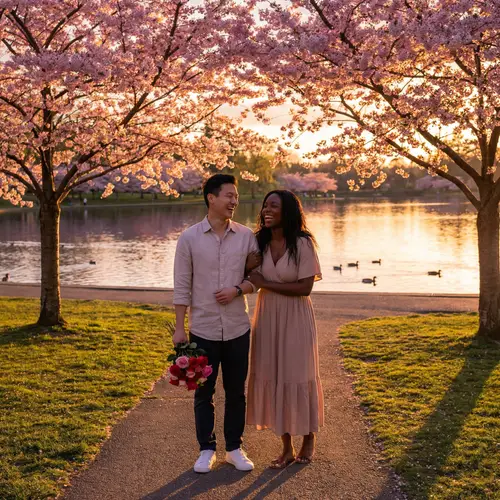
Outdoor prompts have a different challenge: the location can easily overpower the couple. Describe enough environmental detail to establish a place, but continue treating the people as the subject.
13. Barefoot Beach Walk
Best for: Travel memories and relaxed destination photography.
Prompt: Create an editorial-style photograph of an adult couple walking barefoot through shallow water near the shoreline on an overcast coastal afternoon. They hold hands naturally and occasionally glance toward each other as their clothing moves in the sea breeze. Include small waves, damp sand reflections, distant cliffs or coastline, realistic footprints, subtle atmospheric haze, and soft cloud-filtered light. Use full-body framing with a natural 85mm photography look and subdued colors rather than an intensely saturated tropical scene.
Make it yours: Cloudy beaches often produce more believable portraits than constantly requesting dramatic orange sunsets.
14. Snowy Winter Date
Best for: Seasonal portraits with strong clothing and environmental texture.
Prompt: Create a realistic winter photograph of an adult couple walking along a snow-covered path wearing coordinated but non-matching coats, scarves, and gloves. One person brushes fresh snow from the other's shoulder while both laugh naturally. Include visible footprints, snow collecting lightly on clothing, soft breath in the cold air, distant trees, and diffused overcast light. Keep skin tones warm but believable against the cooler environment, with realistic fabric texture and a crisp 50mm outdoor-photography style.
Make it yours: Add a mountain village, frozen lake, city park, or small winter market without changing the core interaction.
15. Road-Trip Stop
Best for: Less conventional travel couple images.
Prompt: Generate a candid travel photograph of an adult couple taking a break beside their parked car on a scenic mountain road. One person sits casually on the open trunk edge while the other stands nearby holding two takeaway drinks, and they are mid-conversation rather than facing the camera. Include travel bags, slightly windswept clothing, distant hills, realistic road markings, natural late-afternoon light, and a 35mm environmental composition. Keep the vehicle and landscape secondary to the people.
Make it yours: Change the vehicle, season, landscape, or activity while preserving the unscripted road-trip feel.
16. Evening on an Old Street
Best for: Romantic travel photography with strong atmosphere.
Prompt: Create a realistic evening photograph of an adult couple exploring a narrow historic street lined with small cafés, old stone buildings, balconies, and warm window lights. They walk close together while one points toward something farther down the street. Use mixed natural twilight and warm practical lighting, realistic paving textures, a few distant pedestrians, subtle motion, and a candid 35mm composition. Avoid turning every light into oversized bokeh; enough background detail should remain visible to establish the location.
Make it yours: Specify the architectural character you want rather than asking for a vague “European street.”
Creative Couple Concepts
Not every AI couple image needs to imitate a normal photoshoot. AI becomes more interesting when it is used for concepts that would be difficult, expensive, or time-consuming to photograph traditionally.
17. Couple in an Art Gallery
Best for: Editorial images and visually unusual anniversary concepts.
Prompt: Create a photorealistic scene of an adult couple standing hand-in-hand inside a quiet contemporary art gallery, viewed mostly from behind as they look at a large framed painted portrait of themselves. One person rests their head lightly on the other's shoulder. Use polished floors with restrained reflections, clean gallery walls, warm focused light on the artwork, accurate height differences and hand placement, and a medium-wide cinematic composition. The painting should resemble the same couple while remaining visibly painterly rather than looking like another photograph.
Make it yours: Replace the portrait with an abstract artwork inspired by the couple, a sculpture, or a wall of framed memories.
18. Film-Strip Love Story
Best for: Social-media layouts and relationship storytelling.
Prompt: Create a realistic vertical film-strip composition featuring the same adult couple across four connected candid photographs. Show different moments from one afternoon: walking together, laughing over coffee, sharing a quiet close-up, and watching the sunset from behind. Keep facial identity, clothing, hairstyle, lighting progression, and color treatment consistent across every frame. Use subtle analog grain, natural expressions, believable framing differences, and the appearance of genuine photographs captured sequentially rather than four unrelated AI images.
Make it yours: Build the sequence around one date, one trip, one season, or different stages of a celebration.
19. 1990s Flash Portrait
Best for: Retro social posts and less polished couple imagery.
Prompt: Create a realistic late-1990s-inspired photograph of an adult couple at a casual house gathering, photographed with a compact point-and-shoot camera and direct on-camera flash. Dress them in believable period casual clothing without turning the styling into costume. They stand close together while laughing toward someone outside the frame. Include slightly imperfect framing, harder flash shadows, mild film grain, modest color shifts, ordinary background clutter, and the authentic feeling of a personal snapshot rather than a modern editorial photograph with a vintage filter.
Make it yours: Different decades need more than color grading. Clothing, interiors, cameras, hair, and composition all help establish the period.
20. Years Together Memory Collage
Best for: Anniversaries, relationship timelines, and personalized keepsake concepts.
Prompt: Create a cohesive vertical memory collage showing the same adult couple across several believable relationship moments. Include one larger central portrait and smaller surrounding photographs showing laughter during a walk, a quiet indoor moment, a travel scene, and a simple close embrace. Keep facial identity consistent across every frame while varying camera angle and expression. Use natural colors, realistic skin, subtle photographic grain, believable shadows, restrained layering, and small differences in lighting so each photograph feels distinct while the collection still belongs to one visual story.
Make it yours: The scenes can represent actual places or milestones that matter to the couple instead of generic romantic situations.
Why Reference Photos Still Go Wrong
Uploading reference photographs does not automatically guarantee a recognizable result. Couple generations are more difficult than single-person portraits because the model has to maintain two identities while also changing pose, clothing, lighting, angle, and environment.
Identity problems become more noticeable when the reference images differ sharply. A brightly lit front-facing selfie of one person and a dark side-profile photograph of the other provide very different amounts of facial information. The model may preserve the clearer face while simplifying or altering the second one.
There are several practical ways to improve the odds:
● Use references where both faces are clearly visible. Heavy filters, sunglasses, extreme angles, and low-resolution crops give the model less useful information about facial structure.
● Ask for identity preservation before aesthetic changes. If recognizable faces matter more than dramatic styling, state that facial structure, complexion, proportions, and distinctive features should remain consistent.
● Avoid complicated poses at first. Interlocked arms, overlapping faces, crossed hands, lifting poses, and unusual body angles give the model more anatomical relationships to solve simultaneously.
● Do not over-retouch the prompt. Requests for flawless skin, perfect facial symmetry, extreme beauty, or glamorous transformation may encourage the model to replace recognizable details with a more generic idealized face.
● Keep the first generation relatively simple. Once you know the model can preserve both people in a straightforward portrait, introduce more ambitious locations, outfits, and compositions.
Reference preservation still depends heavily on the model being used. Prompt wording can communicate priorities, but it cannot force a system to reproduce an identity perfectly.
How to Avoid the Obvious AI Look
Many artificial-looking couple photos fail for reasons that have little to do with resolution. An image can be extremely sharp and still look synthetic.
1. Describe actions instead of emotions
“Deeply in love” is an abstract instruction. “She laughs while he fixes the scarf around her neck” gives the model posture, eye direction, hand placement, and an expression to render.
The more emotion can be translated into observable behavior, the less the image has to rely on exaggerated smiles and stereotypical poses.
2. Leave some imperfection
Real candid photography is rarely perfectly symmetrical. Shoulders sit at different heights, clothing folds unpredictably, hair moves across the face, and people do not always stare directly into a lens.
You do not need to deliberately request bad photography, but phrases such as natural posture, candid framing, and slightly imperfect composition can help move the result away from the polished AI-poster aesthetic.
3. Stop stacking lighting styles
Prompts often ask for golden hour, soft cinematic lighting, studio illumination, rim light, dramatic shadows, and glowing bokeh simultaneously. Those instructions compete with one another.
Choose a primary light source first. A window, cloudy sky, candle, sunset, flash, or streetlamp gives the scene physical logic.
4. Be careful with “quality” words
Writing 8K, masterpiece, award-winning, ultra-HD, hyper-detailed five times does not fix awkward anatomy or empty expressions.
Useful details describe photography. Lens perspective, camera distance, depth of field, skin texture, light direction, movement, and composition usually affect realism more directly.
5. Simplify the hands
Two people create far more opportunities for hands to overlap. Asking for every finger to perform a complex gesture while the couple hugs, carries objects, and touches faces can increase visible errors.
When hands matter, give each one a clear purpose. Holding hands while walking is easier to interpret than an elaborate intertwined embrace.
Prompt Customization Cheat Sheet
You do not need to rewrite a prompt from zero whenever you want a different result. Keep the interaction that works and swap the variables around it.
| If you want to change | Try adding or replacing |
| Mood | playful conversation, quiet affection, nostalgic warmth, restrained elegance, spontaneous laughter |
| Photography style | candid lifestyle, documentary, fashion editorial, analog film, environmental portrait |
| Lighting | diffused window light, overcast daylight, direct flash, golden-hour backlight, warm practical lights |
| Framing | tight close-up, waist-up portrait, full-body shot, medium-wide scene, environmental portrait |
| Lens character | 35mm for more environment, 50mm for a natural perspective, 85mm for tighter portrait compression |
| Movement | walking, dancing, turning, laughing, running, fixing clothing, reaching for an object |
| Texture | natural skin, visible fabric weave, windblown hair, subtle film grain, realistic reflections |
The important word here is replace. Constantly adding modifiers eventually creates a prompt in which nothing has priority.
Common Couple Prompt Mistakes
A few recurring habits make otherwise promising prompts much harder for an image model to interpret.
1. Describing Two People but No Relationship
A detailed description of a man's clothing followed by an equally detailed description of a woman's clothing may create two well-rendered subjects, but nothing tells the model how they relate spatially or emotionally.
Give them an interaction. It does not need to be dramatic. Sharing eye contact, walking in step, leaning slightly together, or reacting to the same event is often enough.
2. Making the Background Do Too Much
Sunset, fireworks, roses, rain, candles, a skyline, flying petals, mountains, lanterns, and ocean waves might all sound romantic individually. Combined, they turn the background into a competition.
A convincing photograph normally has a visual hierarchy. Decide whether the image is primarily about the couple, the location, or the spectacle.
3. Ignoring Camera Distance
“Romantic couple photo” leaves the framing almost entirely open. The model may crop legs, place faces too far away, or choose an awkward distance.
Terms such as close portrait, waist-up photograph, full-body environmental shot, or medium-wide composition remove a surprising amount of uncertainty.
4. Treating Romance as One Expression
Romantic photographs do not have to feature kissing or intense eye contact. Some of the most convincing relationship images are built around humor, familiarity, calmness, or an ordinary shared activity.
If every prompt asks for the same embrace with a different background, the results may look like one photoshoot repeatedly reskinned.
Creating a Consistent Couple Photo Series
Generating one good image is different from creating ten images that appear to feature the same people during the same trip or photoshoot.
Consistency improves when you decide which details are fixed and which are allowed to change.
For a single series, keep the identity references, approximate age, hairstyle, major facial characteristics, color treatment, and general photographic style stable. If the images are supposed to occur on the same day, wardrobe should remain consistent as well.
Then change only a few variables at once. Move from a café to the street outside while keeping the clothing and lighting similar. Change the pose while preserving the lens style. Move from a medium portrait to a wider shot without simultaneously changing location, hairstyle, season, wardrobe, and time of day.
This approach also makes troubleshooting easier. If a face suddenly changes after one edit, you have a much better idea which instruction caused the drift.
For a story told across multiple images, continuity details matter more than decorative quality words. A jacket that changes color in every frame or hair that repeatedly changes length can make an otherwise attractive sequence feel artificial.
Verdict: Make the Moment Specific
The strongest couple photo prompt is not necessarily the most elaborate one. It is the one that makes clear decisions.
Tell the model what the couple is doing, where they are, how the camera sees them, what lights the scene, and which characteristics should stay realistic. Once those pieces are in place, words such as romantic become supporting direction rather than carrying the entire prompt.
It also helps to think less like someone describing an ideal image and more like a photographer directing a real shoot. “Beautiful couple at sunset” describes a subject. “Couple walking back from the water while laughing, photographed from several meters away as the last warm light catches the edges of their hair” describes a moment. That difference is where AI couple photos usually begin to feel less generated and more photographed.
Shubham
Aug 26, 2026Nice prompts, thank you so much!
Login To Reply ↪