

There is a specific Reel that never gets posted. You film it, watch it back, and then picture the people who follow you and what they expect, and the draft just sits in your camera roll. Trial Reels exist to kill that hesitation.
The feature pushes a Reel to people who do not follow you, hides it from the ones who do, and gives you three days of real data before you decide whether your own audience ever sees it. The important thing to understand up front is what that actually makes it: not a “preview” button, but a free version of the cold-audience testing that advertisers pay for. Whether it is useful or useless comes down almost entirely to how you set each one up, so this guide skips the brochure and gets into how to run them well in 2026.
What the Trial Reel Actually Does
Strip away the marketing language and a Trial Reel is a controlled distribution experiment. Instagram takes your Reel and shows it only to accounts outside your follower base, which means it gets judged on relevance and watch time rather than on any loyalty you have already earned.
That distinction is the whole value. A normal post always carries a loyalty tax, where part of your reach and engagement comes from people who would have watched anything you put up. A trial strips that out and tells you how the content does on its own merits.
This is why trials behave so much like paid promotion under the hood. You are getting discovery-focused distribution to a cold audience, for free, and the Reel lives or dies on whether strangers keep watching. If that sounds unforgiving, it is, and that is exactly what makes the data worth reading.
Eligibility and Where the Toggle Hides
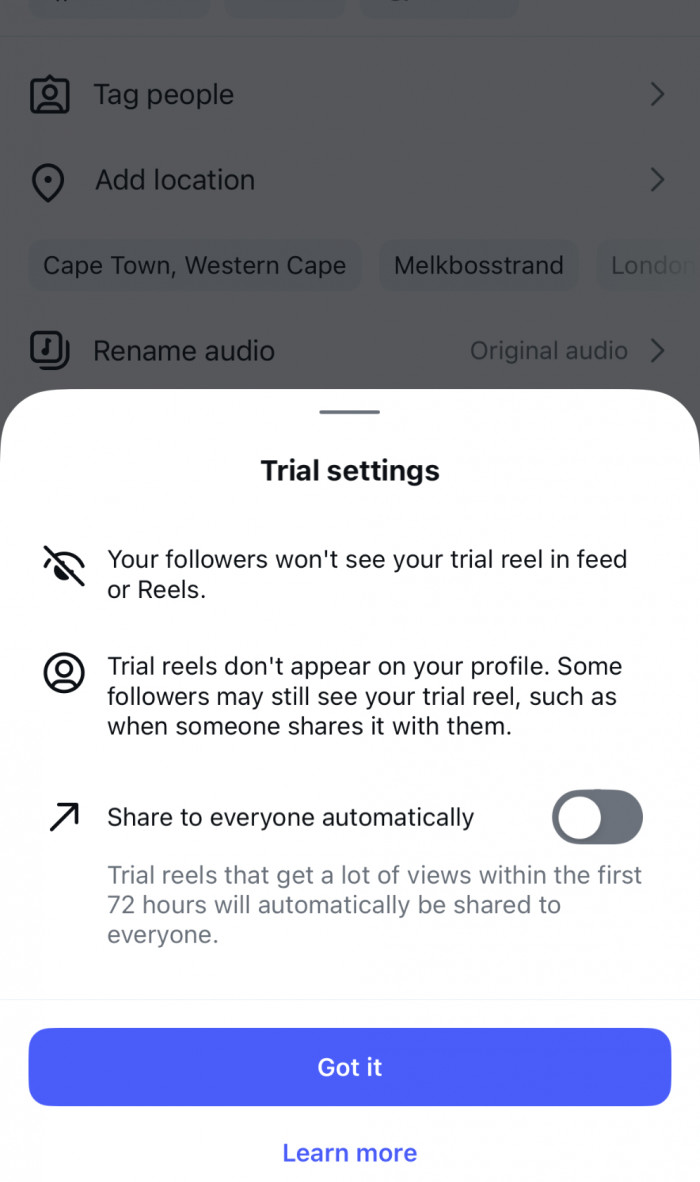
The feature is open to accounts above 1,000 followers, and there is nothing to request or activate. The option appears on its own on the final sharing screen when you go to post a Reel, sitting below the caption field rather than anywhere in your settings.
If you cannot find it, the reason is almost always one of these:
● Your account is set to private. Trials depend on reaching non-followers, so a private account gives the feature nothing to do, and the toggle simply will not show.
● You are sitting under the follower threshold, even by a little.
● The app is out of date, or access reached your account recently and needs a refresh. Update it and give it a day before deciding the feature is broken.
What the 72-Hour Window Really Measures
The window lasts 72 hours, and through all of it your followers are shut out. That is the easy part to understand. The part worth slowing down on is what those three days actually test, because it is narrower than it looks.
During the window the Reel is live to cold viewers only. Your followers cannot see it unless they go out of their way to visit your profile, and even then it hides behind a separate “Trials” tab instead of your grid. So the data you collect is purely a measure of how the content performs with no existing relationship in play.
That is powerful, but it has a blind spot: it tells you nothing about how your current followers would react. A Reel can win cold and still underwhelm your warm audience, and occasionally the reverse. Keep that in mind before you treat a trial result as the final word on a piece of content.
The practical read is this : The window answers one question well, which is “can this travel to strangers,” and for growth that is the single most important question there is. Just do not stretch the result into questions it never tested.
Trial Reels vs Regular Reels
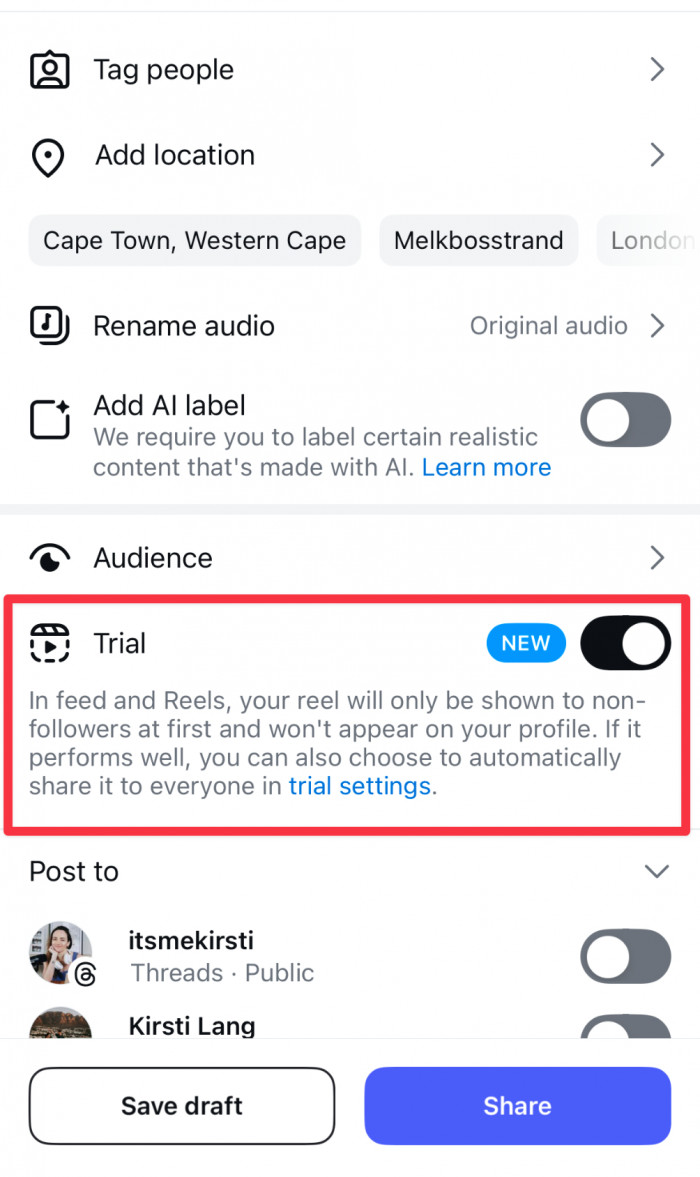
In the editor they are the same. Everything that separates them is downstream of posting.
| Aspect | Trial Reel | Regular Reel |
| First audience | Non-followers only | Followers first, then discovery |
| What it measures | Pure cold-audience appeal | Blended loyalty plus discovery |
| Grid visibility | Hidden until you share it | Visible immediately |
| Window | Fixed 72 hours | Ongoing |
| Reversible | Yes | No |
The line that matters is the last one. A regular Reel is a decision you cannot take back, and a trial is a decision you can. That reversibility is the entire reason to build a habit around it.
Reading the Data Without Fooling Yourself
When the window closes, Instagram hands you the numbers, and this is where the feature usually gets wasted, because the easiest move is to glance at the view count and move on. Views are the least useful thing on the screen.
Here is how to weight what you see, strongest signal first:
● Retention and average watch time carry the most weight. A cold audience that keeps watching is confirming your hook worked and the pacing held. Understanding the structure of a high-retention Reel can help identify where viewers lose interest. If retention is strong and views are low, you may have a distribution problem rather than a content problem.
● Saves and shares show the Reel had value past the scroll. A stranger saving your video decided they wanted it again later, which is a far heavier vote than a tap of the like button.
● Comments tell you what the Reel provoked, so read them for tone and not just count. A pile of confused comments means the message did not land even if the view number looked healthy.
● Likes are the softest signal and the one to trust least. They are cheap to give and tell you almost nothing about whether an idea deserves a wider push.
The habit to build is reading these together. One number on its own lies constantly. A Reel with big views and weak retention means the hook pulled people in and the body lost them, which is a completely different fix than a Reel nobody clicked at all.
The Two Ways a Winner Goes Live
When a trial ends, a Reel that did well can reach your followers through one of two routes, and which one you pick says a lot about how comfortable you are with the feature.
With manual sharing, you read the data and decide, tapping “Share to all” to send it wide or leaving it archived. With auto-graduation, you let Instagram judge the trial against your recent content and promote it automatically if it clears a threshold. Manual is the right default while you are still learning the feature, because it forces you to actually study the numbers and build a feel for what “good” looks like on your specific account.
Auto-graduation earns its place once you are running trials in volume and trust your read on them. The quiet danger of auto mode is that a Reel can clear the bar on shallow engagement while being off-brand for your page, so if you use it, keep checking what it promotes.
One thing worth knowing: sharing a winner to everyone is a fresh distribution event to a different audience, your followers, who never saw the trial. A Reel that crushed it cold can land softer once it hits people who already know you, so do not assume a graduated Reel repeats its trial numbers exactly.
What Is Worth Testing
Running a trial on content you already know performs is a wasted test. The feature only pays off on genuine uncertainty, so point it at the ideas you would otherwise be too nervous to post.
The best candidates tend to be:
● A topic outside your usual lane that you suspect would confuse your followers. Let strangers tell you whether it has legs before you attach your name to it publicly.
● A sharper or more divisive hook than you would normally risk on your main feed. Testing different Reel hook ideas with a cold audience helps reveal which openings attract attention without putting your usual content at risk.
● Old winners, repackaged. Take a Reel that did well three to six months ago, rebuild the first few seconds or refresh the information, and run it as a trial. You already know the core idea works, so you are purely testing whether the new wrapper reaches new people.
● A format you have never tried, like a talking-head cut of something you usually do as text on screen, so you can see which delivery a stranger actually sits through.
Designing a Trial So It Teaches You Something
This is the part that separates people who grow from the feature and people who abandon it. The common failure looks identical every time: you post a trial that is basically a clone of your normal content, it lands at 80 views, you feel a little deflated, and you never open the feature again. That is not the feature failing you. That is an experiment that was never built to produce an answer.
A trial only teaches you something if you change one thing at a time. If you are testing a new hook, keep the rest of the Reel identical to one you already posted, so any difference in retention points cleanly at the hook and nothing else. If you are testing length, hold the topic and style steady and move only the runtime. The variables worth isolating one by one are the first three seconds, the amount of on-screen text, the cover frame, the opening line of the caption, and the call to action.
Change five things at once and a good result is useless, because you cannot name what caused it and therefore cannot repeat it. Treat each trial as a single question with a single answer and your results stop being a scattered pile of view counts and start becoming a real picture of what your audience responds to.
Running Trials at Volume
A single trial is an anecdote. The feature only gets powerful when you run enough of them to see a pattern, because more tests mean more data, more reach, and more chances to stumble onto something that works.
Instagram now lets you schedule trials, which makes it realistic to batch a week of them around one question without crowding anyone’s feed, since nobody following you sees them anyway. A rhythm that works is to pick one variable, something like “do shorter hooks hold cold viewers better,” run four or five trials that isolate it, and then read all of the results together at the end. Patterns live in the set, never in the single post, and reacting to each Reel as it lands is how you talk yourself out of a format that was actually working.
The Mistakes That Quietly Waste It
Even people who use trials often leave most of the value on the table. The ones that come up again and again:
● Testing content that mirrors your usual posts, which teaches you nothing new because there was no new question in it to begin with.
● Judging off one metric, usually views, and missing that the retention underneath was either strong or weak.
● Quitting after one flop, when a single underperforming trial is just noise and the real signal only shows up across several.
● Graduating the losers anyway, which throws away the entire point of testing something before you commit to it.
Turning Results Into a System
The real return never comes from one post. It comes from treating trials as a feedback loop you run continuously instead of a thing you poke at occasionally. Keep a plain running note of what you tested and what the cold audience rewarded, and after a few weeks that note becomes a rough map of what travels beyond your current followers, which is exactly the content most likely to grow your account.
The people who win with this feature are not the ones who get lucky with a single viral trial. They are the ones who run enough honest tests that they stop guessing and start knowing.
The verdict
Trial Reels are one of the few genuinely low-risk growth tools on Instagram right now, but only if you treat each one like a lab run and not a scratch card. Post the ideas you are unsure about, change one variable at a time, weight watch time over likes, let the weak ones die in the archive, and read your results as a set. Do that for a month and the feature stops being a novelty and starts telling you, fairly bluntly, what your next audience actually wants to see.
Comments