

A reel isn't a clip you post, it's a timeline you engineer. Trending audio, posting times, and hashtag stacks are levers on the margins. The thing that actually decides whether a reel travels is whether people keep watching it and that comes down to how the reel is built, frame by frame.
This article walks through that build the same way a viewer experiences it: from the first frame to the final loop, then out to the principles that hold it all together. By the end you'll be able to look at any reel yours or someone else's and see the structure underneath it.
Retention Is the Only Metric That Compounds
Every other metric is downstream of retention. Likes, shares, follows, reach none of them move until people have watched. When a reel holds attention, the platform reads that as a signal worth amplifying and pushes it to more feeds, where it holds attention again, and the loop feeds itself.
That's why retention is the one thing worth engineering first. A reel with a mediocre topic and airtight structure will routinely outperform a brilliant idea that's paced badly. Structure is the multiplier that everything else runs through.
What "Retention" Actually Measures
"Retention" gets used as a vibe, but it's made of specific, trackable numbers. If you don't know which one you're trying to move, you're guessing. The ones that matter:
● Average watch time : how many seconds the typical viewer stays. This is the blunt headline number, useful for spotting whether a reel worked at all.
● Completion rate : the percentage who watch to the end. On short reels this is the metric platforms lean on hardest, because finishing a video is a strong vote of interest.
● Re-watches : how often the same viewer loops back. Under 15 seconds, a single re-watch can double a reel's counted watch time, which is why looping is a structural weapon (more on that later).
● The retention graph : the shape of where people drop off. This is the diagnostic tool that turns "it flopped" into "it flopped at the 6-second mark, so my setup is the problem."
A high-retention reel isn't a lucky one. It's one where each of these numbers was accounted for before the reel was ever posted. The rest of this piece is about how to account for them.
The Retention Curve: Reading the Shape of a Reel
Open the analytics on any reel and you'll find a line that starts at 100% and falls. That line is the most honest feedback you'll ever get, because it shows you the exact moment viewers decided you weren't worth the next second.
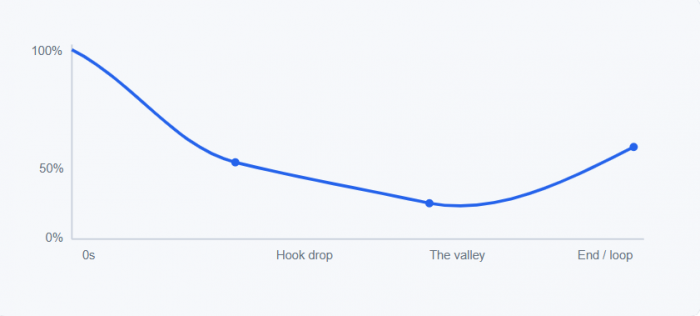
Viewer Retention Across Key Stages of a Short-Form Video ( generated by chartgpt.co)
Three features of that curve tell you almost everything:
1. The cliff at the start. A steep drop in the first three seconds means your hook failed before the content began. No amount of great payoff can save a reel that loses half its audience here.
2. The valley in the middle. A slow, steady slide through the body means your pacing is leaking attention. This is the most common and most fixable failure.
3. The tick back up at the end. If the line rises in the final second, people are looping the single best sign that your structure is working, because viewers are choosing to watch again.
Read this graph after every reel and you stop guessing. You start knowing exactly which section to rebuild.
The Hook (0–3 Seconds): Winning Before Anyone Decides
The opening three seconds aren't part of the reel; they're the audition for it. A viewer isn't deciding whether they like your content yet; they're deciding whether to give it a chance at all. That decision is closer to a reflex than a judgment.
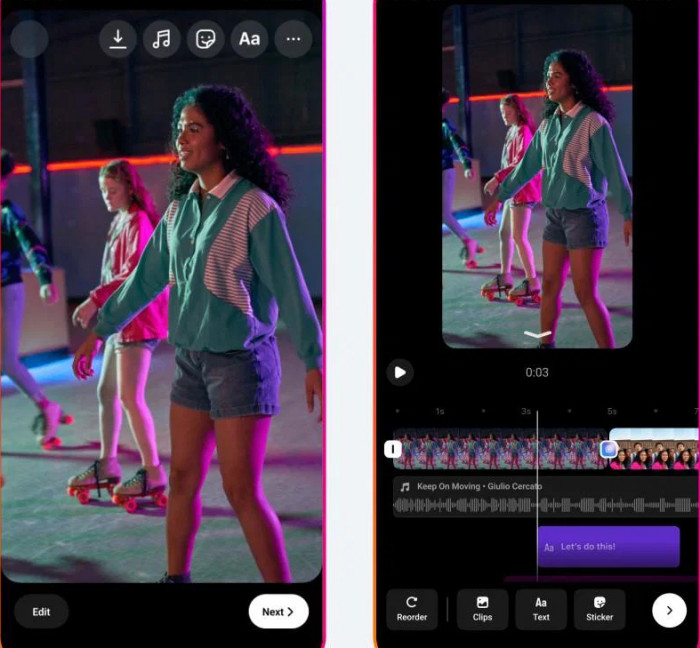
A hook that survives that reflex usually does one of a few jobs. The strongest Reel hooks create enough curiosity or tension to stop the scroll without giving away the payoff too early. In practice, they tend to work in a few recognizable ways:
● Opens a loop. It poses a question or teases an outcome the viewer now needs resolved "I wasted three years doing this wrong." The brain hates an open loop and stays to close it.
● Interrupts the pattern. An unexpected motion, sound, or visual that doesn't match the feed's rhythm. The scroll is monotonous; anything that breaks the monotony earns a pause.
● Makes a bold or specific claim. Specificity reads as credibility. "This saved me $4,000" stops more thumbs than "This saved me money."
The fastest way to kill a hook is to warm up. Any second spent on "Hey guys, so today I wanted to talk about…" is a second the viewer spends leaving. Start on the most interesting frame you have, not the polite one.
The Setup (3–8 Seconds): Earning the Next Five Seconds
If the hook buys a glance, the setup has to convert it into commitment. This is the stretch most creators forget exists: they nail the hook, then immediately sag into the content without giving the viewer a reason to stay for it.
The job here is to make a promise. Good Reel scripts use this stretch to connect the opening hook with the payoff without dumping the entire answer too early. The hook raised a question; the setup confirms you're actually going to answer it and gives the viewer a reason to stay long enough to hear that answer.
Keep this section lean. Its only purpose is to bridge the hook to the payoff without leaking the attention you just earned. The moment the setup starts feeling like content itself, it's too long.
The Build (8–20 Seconds): Where Most Reels Quietly Die.

This is the valley on your retention curve, the long middle where the initial curiosity has faded and the payoff hasn't arrived. It's where reels don't crash so much as slowly bleed viewers, one boring frame at a time.
The discipline that saves this stretch is ruthless: no dead frames. Every second has to either advance the idea or add energy. In practice that means:
● Cut the pauses you'd tolerate in conversation. The breath before a sentence, the "um," the beat where nothing happens, all of it goes. Silence that feels natural on camera feels like an eternity in a reel.
● Deliver information in a rising order. Save your strongest point for near the end of the build so curiosity keeps climbing rather than plateauing.
● Change something every few seconds. A new angle, a zoom, a text pop, a location shift. Visual change resets attention even when the underlying content is steady.
Most weak reels aren't weak because the idea was bad. They're weak because the build was allowed to breathe, and attention slipped out through the gaps.
The Payoff (Final Seconds): Closing the Loop
The payoff is where you keep the promise the hook made. If the open loop was "here's the mistake everyone makes," the payoff is the fix delivered cleanly, without hedging or trailing off.
The mistake here is anticlimax: building tension for fifteen seconds and then muttering the answer, or padding the end with "anyway, that's it, follow for more." The resolution should land as the strongest moment in the reel, because it's the last thing the viewer carries and the thing that decides whether they share it.
A clean payoff also sets up the re-watch. End on a beat that connects back to the opening, and the viewer's instinct is to loop rather than leave.
The Loop: Designing for the Re-Watch
Here's the structural trick most creators never deliberately use: a reel that ends where it began plays forever. When the last frame flows seamlessly into the first, the viewer often doesn't register that it restarted and every extra loop multiplies your watch time without a single new viewer.
You can build for this in two ways:
1. The seamless visual loop. The final shot matches the opening shot closely enough that the restart is invisible, same framing, same motion. The reel feels like it never ended.
2. The narrative callback. The payoff references the hook so directly that hearing the hook again feels like part two, not a repeat. The viewer stays to "confirm" the connection.
On a 10-second reel, three loops turns 10 seconds of content into 30 seconds of watch time. That's not a hack, it's structure doing exactly what it's supposed to do.
Pacing and Rhythm: The Invisible Skeleton
Content is what you say. Pacing is what keeps people there to hear it. You can have a strong hook and a real payoff and still lose everyone if the rhythm sags in between because attention responds to tempo almost independently of substance.
The clearest way to see it is to compare two edits of the exact same footage:
| Loose pacing (bleeds retention) | Tight pacing (holds retention) |
| One long take, few cuts, natural pauses left in | Cut on every completed thought; pauses removed |
| Visuals stay static for 5–8 seconds at a time | Something shifts every 2–4 seconds |
| Audio and visuals drift out of sync | Cuts land on the beat of the music or speech |
| Feels slow even when the content is good | Feels urgent even when the content is simple |
Syncing your cuts to the audio is the highest-leverage habit here. When a visual change lands on a beat, the reel feels intentional and propulsive, and the viewer's attention rides the rhythm forward without deciding to.
Captions, Text and Visual Anchors
A large share of your audience watches with the sound off, at least at first. For them, the on-screen text isn't an accessory, it's the entire reel. If your structure lives only in the audio, those viewers are gone before they ever turn the volume up.
Text does structural work beyond accessibility:
1. It carries the hook for silent viewers. A bold caption in the first frame delivers your open loop even with the sound muted, buying you the same three seconds you'd get from a spoken hook.
2. It anchors attention between cuts. A word or phrase appearing on screen gives the eye something to lock onto, smoothing the transitions and reducing the urge to swipe.
3. It reinforces the payoff. Putting the key takeaway on screen at the end makes it stick and screenshot-able, which quietly drives shares and saves.
Keep it short and high-contrast, and place it where the platform's interface won't cover it. Text that's cut off by the caption bar or the profile icons is text nobody reads.
Structure by Reel Type: One Skeleton Doesn't Fit All
The hook–setup–build–payoff–loop spine holds across every reel, but different formats lean on different parts of it. Knowing where to put your effort saves you from over-editing the wrong section.
| Reel type | Where the structure lives |
| Tutorial / how-to | The setup carries the load you must promise a clear, achievable outcome fast, or viewers assume it's too complex and leave. |
| Storytime | The open loop in the hook is everything. Tease the ending's stakes up front, then withhold the resolution to hold people through the build. |
| Listicle / tips | Pacing dominates. Each item is a mini-payoff, so the rhythm between them keeps the whole thing moving. |
| Transformation / before-after | The payoff and the loop. Show a glimpse of the "after" in the hook, deliver it fully at the end, and loop back to the "before." |
| Talking head | Cut discipline in the build. With no visual variety from the subject, your edits and on-screen text are the only thing preventing drift. |
The framework doesn't change the emphasis. Match your effort to the part of the skeleton your format leans on hardest.
Structural Mistakes That Flatten Retention.
These aren't random tips each one maps to a dip you can see in your analytics:
● The slow warm-up. Any greeting or throat-clearing before the hook. It shows the early cliff. Fix: delete the first three seconds and see if the reel is stronger than it usually is.
● Two ideas in one reel. The viewer's attention splits and neither idea lands. Shows as a mid-reel drop where the second idea starts. Fix: one reel, one idea.
● A build with no escalation. The middle just lists things at the same intensity. Shows as the long, flat valley. Fix: reorder so interest rises toward the payoff.
● A dead ending. Trailing off with "that's it for today." Kills the loop and the share. Shows as a flat line with no tick-up. Fix: end on your strongest beat, not your politest one.
● Text that gets covered. Key words hidden behind the interface. Silent viewers miss the point entirely. Fix: keep text in the safe center zone.
Structure Is the Strategy
You can't control the algorithm, the trends, or whether a given day's audience is in the mood for your topic. You can control the structure and structure is the part that actually moves retention, which is the part that moves everything else. The creators who grow consistently aren't the ones with the best luck. They're the ones who treat a reel like a designed object, with a job for every second.
So stop posting clips and start building timelines. Hook them in three seconds, keep the promise, cut the dead air, and close the loop so they watch it twice. Then open your retention graph, find the exact second you lost them, and rebuild that one section. Do that on repeat and you're no longer guessing what works you're engineering it.
Comments