

Three words. That is roughly the runway you get before a thumb decides your video is not worth the next three seconds. Not three sentences, not a graceful intro with your name and a logo sting three words, sometimes fewer. The whole economy of short-form runs on that hinge, and it is the reason "just use a template" is both the most common advice online and the least useful. A template does not survive contact with the first second. The thinking behind it does.
So this is not another list of blanks to fill. We are going to open a few scripts up on the table, look at what each organ does, and only then talk about templates as reusable shapes you can bend, not scripts you paste and pray over. If you write for Instagram Reels, TikTok, or YouTube Shorts, the grammar underneath is shared. What changes is the accent, and we will get specific about that too.
A template is scaffolding, not autopilot
Here is the uncomfortable part: nobody selling you "50 viral templates" wants to say out loud: a template used lazily makes you sound like everyone else who bought the same template. The feed is a sameness detector. When forty creators open with the identical "You won’t believe what happened next," the phrase stops being a hook and becomes wallpaper and wallpaper gets scrolled.
The value of a template is not the words. It is the structure of attention hiding inside it: where the tension sits, when the payoff lands, what keeps someone from swiping. Learn that structure and you can generate a hundred original scripts. That's also the only sane way to use AI reel script generators , let them draft the skeleton fast, then bring the mechanism and the voice yourself. Copy the words and you have generated the fifty-first identical one. Everything below is built to teach the first thing.
Every good script has the same four organs
Vary the genre all you like a cooking clip and a finance rant and a get-ready-with-me share the same skeleton. What separates them from the flops is not talent, it is that each of these four beats is doing its job in the right order. A script is literally a timeline, and the retention graph in your analytics is that timeline scored.
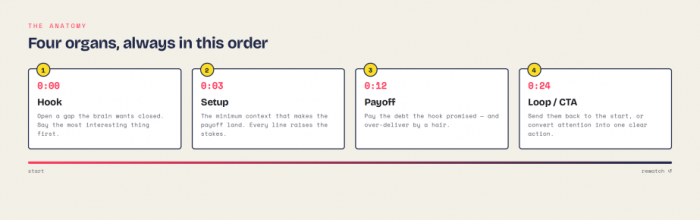
0:00 : The Hook: buy the first three seconds
The hook has one job and it is not to be clever. It is to make the cost of leaving feel higher than the cost of staying. It does that by opening a gap, a question, a stake, an unresolved image that the brain wants closed. "I lost $40,000 in one afternoon" opens a gap. "Hey guys, welcome back to my channel" opens nothing. Say the most interesting thing you have first, not last.
0:03 : The Setup: earn the tension you promised
Now you owe the viewer context, but only the minimum required to make the payoff hit. This is where discipline matters: every sentence here either raises the stakes or it is cut. The setup is not backstory, it is a slope each line should make the viewer lean slightly further forward.
0:12 : The Payoff: pay the debt, then a little more
You promised something on the hook. Deliver it clearly, and ideally over-deliver by a hair so the video feels worth the time. A payoff that undershoots the hook is how you train an audience to distrust your thumbnails and your first lines the fastest way to kill a channel that was working.
0:24 : The Loop or CTA: decide what the last second does
The end is not a goodbye, it is a lever. A loop ends on a line that sends the viewer back to the start, quietly doubling your watch time. And the bigger version of the same trick works across videos, not just within one: a format people return for week after week. That's the logic behind building a reel series that keeps viewers coming back. A CTA converts attention into an action: a follow, a save, a comment prompt that is a real question, not a hostage negotiation. Pick one on purpose. Doing both, badly, is worse than doing neither.
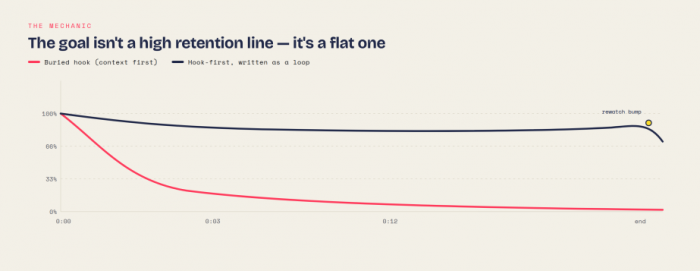
One mechanic worth internalising: the goal is not a high retention line, it is a flat one. Platforms reward videos people finish and rewatch. A script engineered as a loop where the last line reframes the first is the cheapest rewatch trick there is, and it is written in, not edited in.
Same grammar, three different accents
This is where most articles get lazy and treat the three as interchangeable. They are not. The skeleton above is universal, but each platform has a native speaking style, and a script that kills on TikTok can land flat on Shorts for reasons that have nothing to do with the writing and everything to do with where people’s heads are when they arrive.
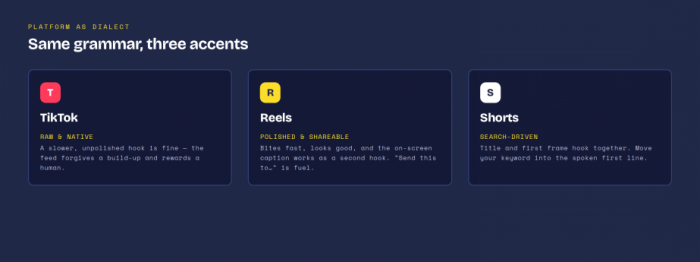
| Dimension | TikTok | Instagram Reels | YouTube Shorts |
| Hook tolerance | Slow, raw, conversational a build-up hook is fine | Needs polish fast; the visual hook carries weight | Title + first frame do the hooking together |
| Production feel | Native and unpolished wins; ads-that-look-like-ads die | Higher gloss expected; aesthetics are the message | Middle ground clarity beats gloss |
| Discovery driver | Pure feed behaviour + trending audio | Feed + shares to DMs; "send this to…" is fuel | Search + suggested; half video-platform |
| Text on screen | Essential; many watch muted, captions are the script | Essential; the caption’s SEO also matters | Helpful, but spoken clarity matters more |
| Sweet-spot length | Rewards both very short and surprisingly long | Tighter; punchy 7–15s over-performs | Comfortable a touch longer; watch-time economy |
| Ending move | Loop, or a comment-bait question | Save-prompt or share-prompt | Explicit "subscribe / full video" works |
The practical takeaway is not to write three scripts from scratch. It is to write one, then re-tune three dials: how fast the hook has to bite, how much gloss the visuals need, and what the last line asks for. On Shorts you often move your best keyword into the spoken first line because search is reading it. On Reels you write the on-screen caption as if it were a second hook. On TikTok you can afford to breathe for a beat longer before the tension lands.
Six shapes worth stealing (and why they hold)
Now the templates but named, and dissected, so you keep the mechanism when you throw away my words. Each gives you the psychology, the bare skeleton, and one filled example. Treat the examples as demonstrations, not scripts to lift verbatim. The hook in each is highlighted so you can see exactly where the attention is bought.
The False Start
You begin as if the camera caught you mid-thought, in the "wrong" place: no intro, no setup, just a fragment that makes no sense yet. The brain flags the anomaly and stays to resolve it. It works because it violates the rhythm of every other video in the feed, and novelty is the one thing the scroll cannot ignore.
SKELETON [abrupt mid-action line] → "okay, wait context:" → the real setup → payoff → loop back to the fragment |
● REC · TELEPROMPTER 0:00 " and that’s the moment I deleted four months of work on purpose." 0:03 "Okay. Context. I’d built this entire app and it was… technically fine. 0:09 But ‘technically fine’ is why nobody was using it. So here’s what I did instead " [loop closes on the deletion line] |
The Heretic
You open by attacking something your audience holds sacred. This triggers two reactions at once: the people who agree feel seen, and the people who disagree stay to argue and arguing means watching to the end and commenting. The trick is that the belief has to be genuinely common, and your reasoning has to actually earn the heresy.
SKELETON [kill the sacred cow] → "I know how that sounds" → the stakes → your real reasoning → the reframe |
● REC · TELEPROMPTER 0:00 "Posting every single day is quietly killing your account." 0:04 "I know, that’s the opposite of what everyone tells you. Hear me out. 0:08 Ten mediocre posts teach the algorithm your ceiling. One that lands teaches it your reach " |
The Receipt
You lead with undeniable evidence before you make any claim about the number, the result, the artifact so skepticism never gets a foothold. Most creators state a claim and then try to prove it, which means the viewer spends the whole video deciding whether to believe them. Flip it: show the proof, and the rest of the video is just them wanting to know how.
SKELETON [show the undeniable result] → "here’s the exact process" → steps, fast → save-prompt |
● REC · TELEPROMPTER 0:00 "This 14-second clip made me $8,000. No ad spend. One take." 0:04 "Here’s the whole thing, line by line, so you can rebuild it. 0:07 First, the hook did one specific job " [end: "save this before it scrolls away"] |
The Trapdoor List
A list format promises an easy skim, which lowers the viewer’s guard. Then you plant a trapdoor: one item is teased as the one that actually matters, and you hold it to the end. The listicle shape gives people permission to start; the open loop gives them a reason not to leave. It abuses a real quirk: we struggle to abandon a sequence we’ve started counting.
SKELETON "[N] things about [X]" → tease that the last one changed everything → items 1..N-1 quickly → land the last |
● REC · TELEPROMPTER 0:00 "Three editing tricks. The third doubled my watch time and takes four seconds." 0:04 "One: cut on the motion, not the pause. Two: caption the hook, not the whole script. 0:11 Three and this is the one you end on the sentence you started with…" |
The POV Reenactment
You cast the viewer as the main character of a hyper-specific scenario. The specificity is the whole engine: a narrow, true detail creates a jolt of recognition, and recognition is what makes someone send it to exactly one friend it describes. Vague POVs get nothing because they recognise no one.
SKELETON "POV: [narrow, specific situation]" → escalate the tension of that exact moment → punchline or turn |
● REC · TELEPROMPTER 0:00 "POV: you’re the only one on the call who actually read the document." [silent beat, camera holds on the reaction] 0:05 "…and now someone’s asking a question that’s answered on page one." |
The Reverse Tutorial
Standard tutorials bury the payoff at the end, so the hook is a promise of a reward you can’t see yet. Flip the order: show the finished result first, let it look impossibly good, then reveal it was simpler than it looked. The pull is the "how on earth did they do that" gap and the relief of the answer being achievable is what earns the save.
SKELETON [show the finished thing] → "you’d think this took hours" → the actually-simple method → "save this for later" |
● REC · TELEPROMPTER 0:00 "This looks like a $500 studio render. It’s three free apps and nine minutes." 0:04 "No skills, I promise. Start with a photo you already have " [end on the finished render again + "save this"] |
Notice what every one of these has in common: the mechanism does the work, not the phrasing. Swap my example lines for your own topic and the shape still holds. That is the entire point you are meant to outgrow the words.
What quietly kills a script
Good advice lands harder against its opposite. These are the recurring causes of death you’ll find when you open up a video that under-performed despite a decent idea. Most are self-inflicted in the first five seconds.
The throat-clear. "Hey guys, so today I wanted to talk about…" You have spent your entire hook window saying nothing. By the time you reach the interesting part, the audience you needed is gone.
The buried hook. Your best line is sitting in position four. Move it to position one. The context you think it needs almost always makes more sense after the tension, not before it.
The undershot payoff. The hook promised a jaw-drop and the ending delivered a shrug. Do this a few times and your own audience learns to distrust your first lines the most expensive lesson you can teach them.
The begging CTA. "Please like, comment, share, follow, and save." Five asks is zero asks. Pick the one action that matches the video and make it a real, answerable question.
The over-script. Every word planned, none of them alive. Short-form rewards a human who sounds like a human. Write the beats, not the syllables, and leave room to actually talk.
The mute failure. No text on screen. A large share of your audience watches with the sound off, which means your captions are the script and you didn’t write them.
The "wait for it" with nothing to wait for. Tension you open must be tension you close. An unpaid promise is the fastest route to a comment section that turns on you.
These seven are the ones I see most, but the full autopsy list runs longer, we've broken it down in common reel script mistakes that lower watch time.
Keep the skeleton, burn the scriptTemplates are not the enemy and they are not a shortcut. They are training wheels for the one skill that actually compounds: engineering attention on purpose. The creators who last are not the ones with the best template they are the ones who stopped needing it, because they internalised the four organs and can now build a fresh script for any idea in the time it takes to think of one. So take the molds above, use them until the shapes are muscle memory, then do the thing that keeps you out of the sea of sameness: change one variable no one else is changing. A different hook mechanism, a payoff that over-delivers by ten percent, a loop where everyone else puts a goodbye. Go pull up your last video that flopped and rewrite only its first three seconds using the anatomy above. If the rest of the script was fine, that one change is usually the whole difference. |
Comments