

A social media post may earn attention, but the profile often decides whether that attention becomes a follow. Visitors arrive with little context. They scan the name, profile image, recent posts and bio, then quickly judge whether the account is relevant.
A strong bio does not summarize an entire person or business. It gives the right visitor enough information to understand the account, trust its direction and expect something useful from following it.
A Bio Is Positioning
Many bios fail because they are written as personal descriptions rather than audience-facing positioning statements.
“Writer, marketer, traveller and coffee lover” may be accurate, but it does not explain what the account offers. A stranger still has to guess whether the content covers writing advice, marketing commentary, travel diaries or lifestyle updates. The problem is not a lack of personality. It is a lack of priority.
A bio has limited space, so every detail competes for attention. The goal is not to include everything true about you. It is to select the details that help visitors understand why the account matters to them.
An effective bio should:
● Identify who is behind the account without turning the profile into a résumé.
● Explain the subject, problem or interest that gives the account a clear centre.
● Give visitors a reason to expect continued value from future posts.
● Direct attention toward the next useful action, such as following, subscribing, booking or browsing.
This makes the bio a positioning tool. Positioning is not only about what you do. It is about the place you want to occupy in the audience’s mind.
A photographer may position an account around weddings, street photography, beginner education or visual storytelling. All four can be truthful, but each attracts a different audience. The bio becomes useful when it makes that choice visible.
Specificity also works as a filter. A broad bio may appear more inclusive, but it rarely gives any one group a strong reason to stay. A narrower promise can reduce casual follows while improving audience fit. That trade-off is usually healthy. Followers who clearly understand the account are more likely to engage with future posts, share them with relevant people and recognize related offers later.
The Profile Visit Decision
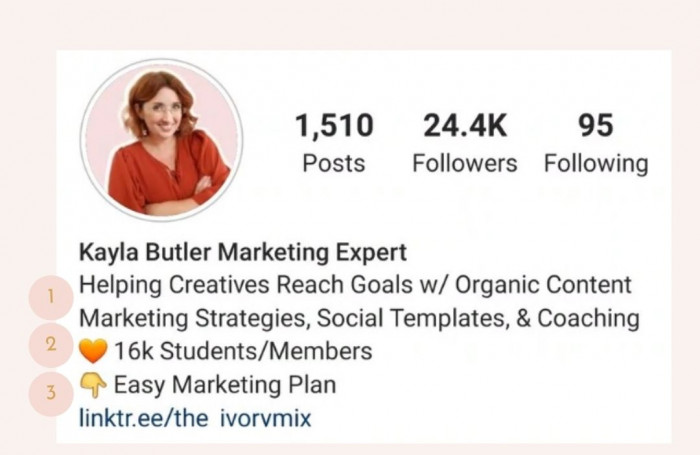
Visitors rarely study a profile line by line. They scan for signs that confirm or challenge the impression created by the post that brought them there.
Someone may discover a creator through a useful video about freelance pricing. On the profile, they want to know whether that video was a one-off success or part of a consistent body of work. The bio helps answer that question, but it does not work alone. Recent posts, pinned content, highlights, visual presentation and account name all influence the decision.
The central principle is expectation alignment. The bio should make a promise that the visible content can support. If it says “daily research-backed nutrition advice” but the latest posts are mostly personal updates and promotions, the promise feels unreliable. Polished wording cannot overcome a profile that sends conflicting signals.
| Visitor concern | Evidence they look for |
| Is this account relevant to me? | A clear topic, audience or recurring theme |
| Is the account credible? | Useful posts, experience, results or qualifications |
| What will I receive by following? | A recognizable content promise |
| Is the account active? | Recent posts, updated links and current offers |
| What should I do next? | A clear follow prompt, link or contact route |
The bio should help visitors predict the next few posts. A witty line can add personality, but creativity only works when it strengthens recognition rather than hiding the subject.
The Five-Layer Structure
A useful bio can be built in layers. Not every account needs all five in equal measure, but this structure helps decide what belongs and what should be removed.
1. Recognizable Identity
The first layer establishes who is speaking. This may be a profession, role, company category or area of experience.
A consultant might use “B2B pricing strategist.” A creator may use “Home-cooking educator.” A local brand could use “Small-batch bakery in Pune.” The wording should help visitors place the account quickly.
Include the identity details that support the content promise, not every title, hobby or award. The account name or profile category may already communicate part of this information, so avoid repeating it.
2. Audience Relevance
The second layer shows who the content is for or which situation it addresses. Compare “marketing ideas and business growth” with “campaign analysis for small ecommerce teams.” The second version narrows the audience, subject and context.
Audience relevance can be expressed through a group, stage, challenge or goal:
● “Strength training for adults returning after a long break” identifies both the audience and their situation.
● “Budget travel plans for working professionals” connects the content to a lifestyle constraint.
● “Interview advice for first-time managers” identifies a specific career stage.
● “Plain-English tax guidance for freelancers” combines audience, topic and communication style.
3. Recurring Content Promise
The third layer explains what followers can expect repeatedly. This converts identity into a reason to follow. Weak promises are usually broad: “sharing knowledge and inspiration,” “helping you become your best self,” or “tips, motivation and lifestyle.” They sound positive but do not create a clear expectation.
A stronger promise describes the subjects, formats or outcomes that appear consistently:
“Weekly breakdowns of pricing, proposals and client retention.”
“Short recipes built around affordable pantry ingredients.”
“Practical LinkedIn writing lessons for technical founders.”
The promise must also be sustainable. Do not claim daily tips if the account posts twice a month. The wording should reflect the account people can actually follow.
4. Credibility That Supports
The fourth layer gives visitors a reason to trust the promise.
Credibility may come from experience, qualifications, client work, measurable results, research, lived expertise or a consistent record of useful content. The signal must be relevant.
“Former product lead at [Company]” supports a product leadership account. “Registered dietitian” strengthens a nutrition profile. “Built and sold two subscription brands” adds weight to advice about ecommerce operations.
Numbers also need context. “Helped 1,000 freelancers improve their pricing systems” is more believable than “helped 1,000 people.” New creators can use method as proof, such as testing one landing-page experiment every week.
5. The Next Action
The final layer tells visitors what to do after they understand the account. The action may be to follow, join a newsletter, download a guide, watch a video, book a call or explore a product. The best choice depends on the account’s main objective.
Not every profile needs a sales-focused call to action. A creator may use “Follow for weekly teardown posts,” while a business should be more specific than “Contact us,” such as “Book a 20-minute fit call.”
A practical framework is: Identity + audience + recurring value + evidence + next step
Treat it as a diagnostic tool, not a sentence template. Some bios will combine two functions in one line, while others will omit a layer because the profile already communicates it elsewhere.
Platform Changes the Emphasis
The central identity should remain recognizable across platforms, but the same bio should not be copied everywhere. Each platform creates a different visitor mindset.
| Platform | Visitor mindset | Bio priority |
| Visual discovery, personality and interests | Clear niche, distinctive tone and useful link | |
| TikTok | Fast discovery after a single video | Immediate topic recognition |
| Professional credibility and relevance | Role, expertise, audience and business value | |
| X | Ideas, commentary and discussion | Point of view and subject focus |
| YouTube | Deeper educational or entertainment content | Channel promise and publishing direction |
Instagram bios work alongside the grid, pinned posts and Story Highlights. A TikTok bio needs to establish the account’s subject quickly because many visitors arrive after watching a single video. It should confirm what type of content they can expect and give them a clear reason to follow. An X bio can carry more personality, but the account’s main topic should still be obvious. Voice, humour or a strong point of view can make it memorable, provided they do not replace basic clarity about what the account covers.
The tone can change across platforms, but the central position should remain stable. A creator should not appear to be five unrelated people across five profiles unless those interests are deliberately connected.
Write Before You Compress
People often struggle with bios because they try to write the final short version immediately. The character limit becomes the starting point, so the idea is compressed before it is clear.
Begin with a long, unrestricted draft. Answer these questions:
● Which subjects appear most consistently in my content?
● Who receives the greatest value from those subjects?
● What specific result, understanding or experience does the content provide?
● What evidence supports my right to make this promise?
● Which action matters most after someone visits the profile?
Do not try to sound polished yet. The purpose is to uncover the account’s actual position.
1. Find the Core Promise
Complete this sentence: “People should follow this account because they want __________.”
The answer should describe ongoing value. “To learn how to price freelance services with more confidence” is useful. “To become successful” is not. “To see honest reviews of budget filmmaking gear” is clear. “To stay inspired” gives little direction.
2. Remove Empty Language
Delete words that sound appealing but carry little information. Terms such as passionate, authentic, innovative, inspiring and empowering are often used instead of evidence.
“Passionate about helping brands grow” does not explain the method, audience or type of growth. “Email retention experiments for independent ecommerce brands” says much more without making a grand claim.
3. Narrow Broad Categories
Most bios improve when broad labels become a more precise content territory.
“Fitness coach” can become “Strength training for women over 50.”
“Travel creator” can become “Three-day city itineraries from Delhi.”
“Business content” can become “Pricing and operations lessons for solo consultants.”
Narrowing gives visitors a reliable entry point without preventing the account from discussing other interests.
4. Assign Each Line a Job
Read the draft line by line and identify the function of each phrase. One line may establish identity. Another may define the audience. A third may explain the content promise. The final line may direct action. If two lines perform the same job, combine them or remove one.
5. Read It as a Stranger
Ask whether someone with no prior knowledge could predict what the next five posts will cover. If the answer is no, the bio may still be too abstract. Ask another person to read it without explaining the account first. Their interpretation is often more useful than your intention.
Stronger Bio Revisions
Examples are most useful when they show why the change works.
Personal Creator
Weak: “Content creator | Dreamer | Living my best life.”
Improved: “Simple filming and editing lessons for new video creators. Weekly breakdowns using affordable gear.”
The improved version identifies the audience, subject, teaching style and publishing pattern.
Consultant
Weak: “Helping ambitious brands achieve sustainable growth.”
Improved: “Customer retention strategy for subscription businesses. Former growth lead at [Company].”
Local Business
Weak: “Quality food and excellent service since 2018.”
Improved: “Small-batch desserts made in Jaipur. Weekly menu and celebration orders below.”
Educational Account
Weak: “Making science simple, fun and accessible.”
Improved: “Everyday physics explained through household objects, small experiments and visual lessons.”
Professional Creator
Weak: “Product leader sharing thoughts on technology, leadership and life.”
Improved: “Product leadership lessons for first-time managers. Team rituals, roadmap decisions and difficult conversations.”
Where Bios Usually Fail
Bio problems usually come from unclear positioning rather than poor grammar. The first failure is creator-centred writing. Interests, titles and achievements may add warmth, but they should support the account’s purpose.
The second is exaggerated language. Claims such as “changing lives” or “helping everyone succeed” are difficult to verify, while smaller promises feel more credible.
The third is equal emphasis on every interest. A bio listing marketing, fitness, travel, books, finance and food may reflect a complete person, but it does not give the account a clear centre. Choose the subject that earns the follow and allow the remaining interests to appear in the content.
The fourth is premature selling. A profile that asks visitors to buy or book before establishing relevance can feel transactional. Clarify value before presenting the next step.
The fifth is inconsistency between the bio and the feed. If the bio changes direction, recent and pinned posts should support the new promise.
The sixth is imitation. Borrow structural ideas from strong profiles, not someone else’s positioning.
Test the Bio Properly
A bio is a hypothesis about what will help the right visitor understand and follow the account. It should be tested against behaviour, not judged only by personal preference.
Useful signals include profile visits, follow conversion, link clicks, enquiries, newsletter sign-ups and the quality of new followers. The right metric depends on the account’s objective.
Follower count alone can be misleading. A more specific bio may produce fewer follows but attract people who engage more deeply and remain interested longer. Audience fit often matters more than raw volume. Change one major element at a time. If the bio, profile image, pinned posts and content direction all change together, the result becomes difficult to interpret.
Do not treat one week of results as proof. Follow conversion can rise or fall because of a viral post, a promotion, a platform recommendation or a change in the type of people visiting the profile. Review performance across a meaningful sample of profile visits, then compare the quality of the audience as well as the quantity. A bio that attracts fewer but more relevant followers may be doing a better job. Direct messages also provide useful feedback. Repeated questions about your services or audience may show that the profile is unclear.
Review the bio every few months:
● Check whether it reflects the subjects you actually publish.
● Confirm that the audience description matches the people engaging with the account.
● Remove outdated proof, links, offers or publishing claims.
● Make sure the call to action supports the current objective.
● Compare the bio promise with recent and pinned posts.
The goal is not endless optimization. It is continued alignment between what the account promises and what it delivers.
Final Thought
A social media bio attracts followers by making relevance easy to recognize. It does not need to capture your complete personality, list every achievement or rely on clever wording. It needs to help the right visitor understand who the account serves, what it publishes and why the next post may be worth seeing.
The strongest bios combine a clear identity, a specific audience, a repeatable content promise and believable evidence. They also match the visible profile around them. When the wording and content support the same expectation, the follow decision feels natural rather than forced.
Write the long explanation first, reduce it to its most useful parts and test it against real visitor behaviour. A good bio is not the most impressive description of you. It is the clearest reason for the right person to stay.
Comments