

The creators who sound like they're just talking to you with no notes, no plan, half their sentences trailing off into a better thought are almost always the ones working from the tightest scripts. That's the part nobody warns you about when you start.
Sounding unscripted isn't what happens when you throw the script away. It's what happens when you write a smarter one. This is a guide to writing that smarter one: a script the camera can't detect.
Why Most Scripts Sound Scripted
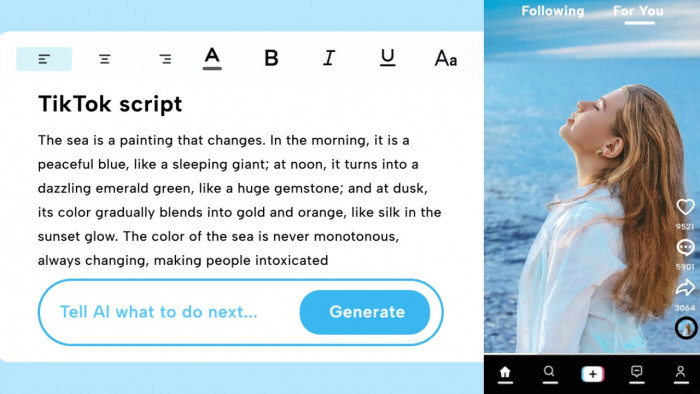
Here's the thing most people get wrong: a video sounds scripted long before anyone hits record. The stiffness gets baked in at the writing stage, the moment you sit down and type the way you were taught to write full sentences, clean grammar, one idea flowing politely into the next.
That's essay writing. Nobody talks in essays. So when you read those sentences out loud, your mouth does something it never does in an actual conversation, and the viewer's ear catches it in about half a second, even if they couldn't tell you what's off.
The tells are pretty consistent once you know to look for them:
• Complete, grammatically perfect sentences. Real speech is full of fragments, half-thoughts, and sentences that change direction halfway through. Flawless grammar on camera reads as “read from a page.”
• The presenter's voice. That slightly-too-bright, evenly-paced radio energy that switches on the second someone knows they're “on.” It's the audio version of a posed smile.
• Eyes doing the teleprompter dance. Little flicks off to the side as the next line loads. Even a well-hidden teleprompter changes where a person looks and how their eyes move between beats.
• Emphasis in the wrong places. Stressing words a normal person wouldn't stress usually because the writer heard the sentence one way in their head and the speaker delivers it another.
Fix the writing and most of these clear up on their own, without a single acting lesson.
Write for the Ear, Not the Eye
Written language and spoken language are basically two different dialects. Writing is built for a reader who can go back and re-read, so it can afford long clauses, nested ideas, and punctuation that carries meaning. Speech gets exactly one pass, in real time, with no rewind so it works completely differently.
Spoken language front-loads. It says the point first and explains afterward. It uses shorter words, more contractions, and a lot of connective glue “so,” “and,” “okay but here's the thing” that looks sloppy on a page and sounds completely normal out loud.
Written for the eye “There are several reasons your videos might not be performing well, the most significant of which is your hook.” Written for the ear “Your videos are flopping? It's almost always the hook. Every single time.” |
Same information, two completely different textures. One sounds like a blog post being read aloud; the other sounds like a person. The rule underneath all of it: you can't hear a semicolon. If a sentence only holds together because of punctuation the ear can't detect, it needs a rewrite.
Rethinking the Hook: Start Mid-Thought
Hooks are where scripts sound most announced, because this is exactly where people reach for their “broadcaster” instincts. “Hey guys, welcome back to today's video. I'm gonna show you five tips for…” The moment a viewer hears that shape, they know they're being handed a piece of content, and the thumb starts twitching upward.
The fix is to write hooks that sound like you're already mid-conversation like the viewer wandered in in the middle of something good, rather than the start of a segment. You're not opening. You're continuing. That opening also has to lead somewhere. A strong first line quietly determines what the rest of the script needs to deliver, which is why understanding a good Reel hook matters as much as making the opening sound natural.
Announced “In this video, I'll explain why you're always tired in the afternoon.” Mid-thought “Okay so the reason you crash at 3pm every single day it's not what you think it is.” |
The mid-thought version borrows the authority of a conversation that's apparently already underway. There's an unspoken “as I was saying” hanging off the front of it, and that little implication makes the viewer feel like they're catching something real instead of being launched into a pitch.
Structure Without a Cage: Beat Scripts vs. Word-for-Word
There are two ways to script, and picking the wrong one for the video is a big reason people freeze up on camera. You can write out every single word a word-for-word script or you can write the beats: the ordered list of points you need to hit, then improvise the actual sentences around them in the moment.
Word-for-word buys you control and precision. It's also the quickest route to sounding like you're reading, because you are. Beat scripts give up a little precision in exchange for delivery that sounds alive, since your brain is building the words on the spot the way it does in normal speech.
Which script style fits which video
| Word-for-word | Beat script | |
| Control over phrasing | High | Low |
| Sounds spontaneous | Rarely | Usually |
| Risk of stumbling | Low | Moderate |
| Memorization load | Heavy | Light |
| Best for | Very short clips, exact claims, a joke with a precise punchline | Stories, opinions, explainers anything past ~20 seconds |
The practical answer is usually a hybrid. Beat-script the body so it can breathe, but write your hook and your final line word-for-word. Those two moments carry the most weight, and they're worth getting exactly right.
The One-Person Rule
TikTok feels intimate for a physical reason: people watch it alone, phone about a foot from their face, usually with headphones in. So the biggest register mistake is writing for a crowd. “What's up everybody,” “you guys are gonna love this” that's stadium language, and it clashes with a medium that's actually one-to-one.
Write to a single person instead. Not “you guys.” Just “you.” It looks like a tiny change, but it quietly reshapes your word choice, your tone, and the kinds of things you're willing to say. You stop performing to a room and start talking to someone.
That shift is the whole engine behind why short-form feels weirdly personal: the parasocial pull where a stranger feels like they actually know you. You don't manufacture that with volume or energy. You manufacture it with your pronouns and the quiet assumption that exactly one person is on the other end.
Engineering the Imperfections
This is the counterintuitive one. A little mess makes a script sound real but only when the mess is doing a job. You can write imperfections in: a false start, a mid-sentence correction, a “wait, no, let me put that better.” Real speech is full of them, and a completely frictionless delivery can come off strangely smooth, almost synthetic.
The word that matters here is load-bearing. A random stammer adds nothing. A self-correction that lands on a sharper phrase adds a lot, because the viewer watches you arrive at the better version in real time and watching someone think is far more convincing than watching them recite.
Frictionless “This is the best budgeting method for beginners.” Load-bearing correction “This is the best budgeting method for okay, not the best, but the one I'd actually recommend if you've never done this before.” |
The second one sounds like someone hedging honestly, and honesty reads as real. Just don't get carried away. One or two engineered imperfections in a video is seasoning; a dozen is a stutter.
Rhythm, Cadence and the Music of Speech
Natural speech has a beat to it. It speeds up when you're excited, slows down when something actually matters, and changes its sentence length constantly. Scripts that sound robotic usually do the opposite one pace, one sentence shape, medium-length and evenly stressed, rolling on at the same tempo until the video ends.
You fix it on the page by varying sentence length on purpose. Follow a long, winding sentence with a short one. Like that. The short sentence hits harder because the one before it ran long, and that contrast is most of what we actually hear as “good delivery.”
Treat punctuation as your tempo map. A comma is a breath you can hear, a period is a full stop the viewer feels, a dash is a swerve. Put the pauses where you'd genuinely want to breathe, then read it back and check that the rhythm on the page matches the rhythm in your mouth.
Speaking the Platform's Native Language
Every platform has a vernacular, and TikTok turns over fast. Using it well signals that you're a native a real person who's actually here instead of a brand that studied the audience in a slide deck. Using it badly signals the opposite, loudly, and instantly.
The trap is that slang has a half-life. Phrasing that felt current three months ago can read as dated or try-hard today, and reaching for last season's slang is genuinely worse than using none at all. When you're not sure a term is still alive, cut it. Plain language never expires.
Here's a filter that works: only use slang you'd drop into a text to a friend without thinking about it. If you have to consciously insert a phrase because it's “what people say now,” the audience will feel the insertion. The words have to already be yours before they reach the script.
The Read-Aloud Test
This is the single most valuable edit you can make, and almost nobody actually does it. Before you record, read the entire script out loud at full performance energy and pace, not mumbling it under your breath at your desk. Your mouth will find every problem your eyes skated straight past.
Wherever you stumble, the writing is wrong. A phrase your tongue trips over isn't a delivery problem you can drill away with practice; it's a sentence that was never built for a mouth in the first place. Rewrite the stumble instead of rehearsing it into submission.
Better still, record the read-through and play it back. Listening uses a different part of your brain than speaking, so you'll catch the spots that sound announced, the emphasis that landed weird, the sentence that overstayed its welcome. Fix those on the page, then record for real.
Memorize the Idea, Not the Words
There's a real difference between knowing what you want to say and knowing the exact words you wrote down and it shows up on camera. When you memorize sentences, you're basically running a teleprompter in your head. The instant you lose a word, you freeze, because you're retrieving text instead of expressing a thought. And that freeze is visible.
Memorize the beats instead: the order of the ideas, not the phrasing. If you know point one leads into point two leads into the payoff, you can generate the sentences fresh on every take and fresh sentences always sound more alive than recited ones.
This is also why beat scripts quietly win for longer videos. You're not lugging around twelve memorized lines; you're holding five ideas, and your brain fills the gaps the same way it does in ordinary conversation. Which, conveniently, is the exact sound you were chasing the whole time.
A script that sounds scripted and a script that vanishes completely can hold the exact same words. The difference is entirely in how they were built.
Where the Script Ends and Editing Begins
A script isn't the finished video, and forgetting that is how people end up over-engineering the writing. A surprising amount of what viewers read as “natural” is actually manufactured in the edit. The jump cut hides the breath between takes. The retake captures the one clean delivery. Pacing you could never hit in a single run gets assembled afterward, piece by piece.
So the script doesn't have to be perfect in one flawless take. You can write it knowing you'll shoot the hook four times and keep the best one, or that a clumsy transition will simply get cut. That knowledge takes a lot of pressure off the page.
It also means the script should leave room for the edit to treat it as one layer of the video, not the entire thing. Some of your best “unscripted” moments will be ad-libs you decide to keep and dead weight you decide to cut, and none of them ever lived on the page at all. Once the words are working, the next layer is deciding what the viewer actually sees around them. A simple Reel storyboard can map those visual beats without forcing the spoken delivery into an overly rigid performance.
The CTA Without Breaking the Spell
The call to action is where most natural-sounding videos suddenly fall apart. You've spent forty seconds sounding like a human being, and then “Don't forget to like, comment, and follow for more content just like this!” the register snaps, the energy jumps a gear, and the whole spell breaks in a single sentence.
The fix is to keep the CTA in the exact same voice as everything before it. Say it the way you'd actually say it, tie it directly to what the video was about, and make it specific instead of generic.
Spell-breaking “Follow for more amazing tips and don't forget to smash that like button!” In character “I've got like three more of these that are honestly weirder follow so you actually catch them.” |
The second one doesn't sound like a CTA. It sounds like the same person still talking, which is the entire point. You're not switching into “ask mode.” You're just… mentioning something.
Traps That Sneak the Scripted-ness Back In
Even with all of the above working, a handful of habits will quietly drag the stiffness back into your delivery. These are the usual suspects:
• Writing for the algorithm instead of the ear. Cramming in keywords and search phrases because you read them helps discovery makes sentences clunky and obviously optimized and viewers can smell an SEO'd sentence from a mile off.
• Forcing energy you don't actually have. Manufactured enthusiasm reads as fake faster than almost anything else on camera. Calm and genuine beats loud and performed nearly every time.
• Trying to fit too much into one video. When you jam six points into thirty seconds, you have to talk fast and hit each beat precisely and fast-and-precise is the exact texture of “scripted.” Cut ruthlessly; one good idea, fully landed, beats six rushed ones.
• Over-rehearsing past the sweet spot. There's a window where you know your beats but the delivery is still fresh. Past a certain number of takes, you stop sounding like you're talking and start sounding like you're reciting a speech you've given too many times.
The Verdict: Authenticity Is a Discipline, Not an Accident
The uncomfortable truth is that “just be yourself on camera” is terrible advice, because being yourself on camera is a skill you build, not a mood you relax into. The creators who make it look effortless are quietly running a full set of deliberate choices: writing for the ear, scripting beats instead of sentences, engineering the right imperfections, keeping one single person in mind from the first word to the last.
None of it is about being less prepared. It's about preparing differently. The stiff script and the invisible one can carry identical information; everything that separates them lives in the craft of how they were written.
So write the script. Write a tight one. Just write it for a mouth, and an ear, and a single person watching alone on their phone and it'll sound like you never wrote a word of it.
Comments