

TikTok Recharge is easy to use but surprisingly difficult to price. You pay real money for Coins, spend those Coins on virtual Gifts, and see the Gift appear almost instantly during a LIVE or eligible video. What is less obvious is how much each Coin really costs, why the same spending budget can buy different amounts of Coins depending on where you recharge, and how the amount a viewer spends relates to what a creator eventually earns.
That is where TikTok Recharge becomes more than a simple top-up feature. It is a virtual payment system built directly into one of TikTok’s most emotional forms of interaction.
TikTok Recharge in Practice
TikTok Recharge is the process of adding TikTok Coins to your account. Coins function as prepaid virtual currency and are primarily used to send Gifts to creators.
The transaction moves through several stages: Real money → TikTok Coins → Virtual Gift → Creator reward system
Keeping those stages separate is important. A Coin is not cash sitting inside a normal wallet, and sending 1,000 Coins does not mean the creator simply receives whatever you originally paid for those 1,000 Coins.
For the viewer, Coins are the spending unit. For the creator, TikTok uses a separate reward system that includes Diamonds. That makes TikTok gifting closer to a closed virtual economy than a conventional person-to-person tip.
The Basics at a Glance
| Area | What It Means |
| What you purchase | TikTok Coins |
| Main use | Sending virtual Gifts |
| Where Coins can be bought | TikTok app and TikTok web Recharge where available |
| Age requirement | Generally 18+, with regional differences |
| Coin value | Varies by package, region and purchase route |
| Creator side | Gifts feed into TikTok’s separate creator reward system |
| Main issue to watch | The real cash cost becomes less obvious after money is converted into Coins |
The system itself is simple. Understanding the value moving through it is where most of the confusion begins.
How Much Do TikTok Coins Cost?
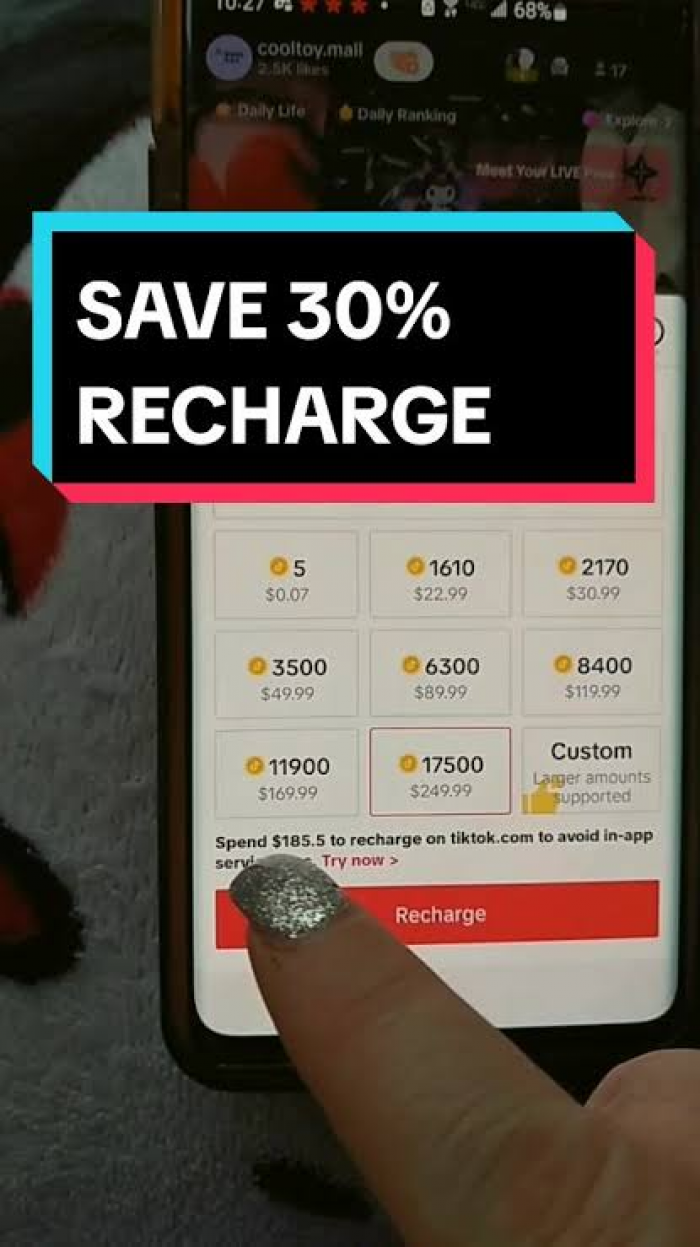
There is no single permanent worldwide price for TikTok Coins. The amount visible to one user may differ from another because TikTok pricing can vary by country, package size and purchase method. That is why a fixed table claiming that “100 TikTok Coins always costs X” can become inaccurate surprisingly quickly.
A useful reference range puts in-app Coins at roughly $0.014 to $0.015 per Coin, while web purchases can sometimes come closer to $0.010 to $0.011 per Coin.
Using those approximate rates, 1,000 Coins could cost somewhere around:
● $14–$15 when purchased at the higher in-app reference rate.
● $10–$11 when purchased around the lower web reference rate.
Those are not guaranteed prices. They are useful benchmarks for understanding why the purchase route deserves attention.
A much better habit is to calculate your own rate whenever you recharge: Total checkout price ÷ number of Coins received = cost per Coin
For easier comparison, multiply that figure by 1,000. If 1,000 Coins cost you $10.50, your effective rate is $10.50 per 1,000 Coins. If another route asks $14.50 for approximately the same number, the difference is immediately obvious.
For someone making a $3 purchase once a year, this barely matters. For a viewer who regularly buys tens of thousands of Coins, it can become a substantial difference.
App Recharge vs Web Recharge
TikTok Recharge can feel identical regardless of where you buy because the resulting Coins end up in the same TikTok balance. The economics can be different.
Inside the app, Recharge is deliberately easy to reach. A user can open their balance, select a Coin package and complete the transaction through the payment system available on the device.
TikTok also provides a browser-based Coin purchase route in supported locations. The practical advice is simple - compare both official options before making a meaningful purchase.
Suppose your account shows something close to these rates:
| Route | Approx. Coin Rate | Approx. Cost for 1,000 Coins |
| In-app Recharge | $0.014–$0.015 | $14–$15 |
| TikTok web Recharge | $0.010–$0.011 | $10–$11 |
Even a four-dollar difference per 1,000 Coins becomes significant at higher volumes. At 10,000 Coins, the difference between $0.0105 and $0.0145 per Coin is approximately $40. At 30,000 Coins, it becomes roughly $120. That is why people who gift frequently should stop thinking only in terms of Coin bundles and start looking at cost per 1,000 Coins.
The important caveat is that these differences are not guaranteed in every country or on every account. The correct comparison is always the final price TikTok shows you at checkout.
Why LIVE Recharge Feels Different
The location of the Recharge button matters almost as much as the price. Imagine buying Coins from the Balance page before opening a LIVE. You are making a deliberate purchase. You can compare packages, decide how much to spend and leave if the numbers do not make sense.
Now compare that with running out of Coins during a LIVE. Perhaps a creator is in the final seconds of a battle. Other viewers are sending Gifts. You select a Gift, TikTok tells you that the balance is too low, and Recharge is immediately available.
The second transaction happens in a completely different mental state.
You are no longer deciding whether you want to buy Coins. You have already decided that you want to send the Gift. The Recharge simply removes the obstacle. That is one reason TikTok’s payment system is so effective. It reduces the distance between emotion, participation and payment.
The viewer does not need to leave the LIVE, open another store, make a purchase, return to TikTok and find the Gift again. The entire spending loop remains inside the experience. From a product-design perspective, it is excellent. From a budgeting perspective, it means frequent viewers should decide their spending limits before the LIVE becomes exciting.
The Real Cost of Popular Gifts
Coin numbers are difficult to interpret without converting them back into normal currency. A Gift priced at 1,000 Coins sounds very different from one priced at $10 or $15, even when the two represent roughly the same spending.
Using a reference Coin rate of approximately $0.0105 per Coin, several commonly discussed Gift values would work out roughly like this:
| Gift | Coin Amount | Approx. Cost at $0.0105/Coin |
| Rose | 1 | ~$0.01 |
| Finger Heart | 5 | ~$0.05 |
| Galaxy | 1,000 | ~$10.50 |
| Lion | 29,999 | ~$315 |
| Universe | 44,999 | ~$472 |
If the same Coins were purchased at approximately $0.0145 each, the effective cost would be very different.
● A 1,000-Coin Gift would be around $14.50.
● A 29,999-Coin Gift would represent roughly $435.
● A 44,999-Coin Gift would come close to $652.
These examples make one point clear: the Recharge route barely matters for a one-Coin Gift, but it can matter enormously for high-value gifting. Gift inventories and Coin values can change, so these numbers should be treated as useful reference calculations rather than permanent TikTok prices.
The Coin Layer Changes Price Perception
Virtual currencies work because they separate the payment from the individual purchase. When you spend $30 at a normal checkout, the financial decision happens at the exact moment the money leaves your account.
TikTok separates those events. First, you spend $30 on Coins. Later, you spend 300 Coins here, 500 Coins there, perhaps another 1,000 during a particularly active LIVE. None of those later actions requires you to watch another $5 or $10 leave your bank account. That changes how spending feels.
Suppose you start a LIVE with 3,000 Coins. After sending several Gifts, your balance falls to 400. It is easy to think: “I only have 400 Coins left.”
The more financially useful thought is: “I have already spent 2,600 Coins from money I deposited earlier.”
That distinction becomes even more important across multiple Recharge transactions. Five small $10 top-ups may feel less serious than one $50 transaction, even though the monthly cost is identical. For regular gifting, the most useful metric is therefore not the remaining Coin balance. It is total money recharged during the month.
Bigger Coin Packs Are Not Always Better
Coin packages create another pricing illusion. A larger bundle may offer a lower cost per Coin. That sounds like an obvious saving, but it is only a saving if you actually intended to spend that amount.
Imagine two options: 500 Coins at 1.1 cents each versus 5,000 Coins at 1 cent each
The larger package has better unit economics. But someone who originally wanted 500 Coins has committed roughly ten times as much money to TikTok to obtain that cheaper rate. That is not necessarily good value. There are two different calculations users should make.
1. Coin efficiency asks how cheaply you can acquire each Coin.
2. Budget efficiency asks how little money you need to deposit to achieve what you actually want to do.
Heavy gifters can benefit from lower unit pricing because they know those Coins will probably be used. Occasional gifters may be better off buying a smaller package even when its cost per Coin is slightly higher.
The best Coin package is therefore not automatically the largest one. It is the package that fits your intended spending while giving you a reasonable unit price.
What Does the Creator Receive?
This is where TikTok Recharge becomes considerably less transparent. A viewer buys Coins and spends them on Gifts. The creator does not simply receive those Coins and convert them back into money at the viewer’s purchase rate.
TikTok uses a separate creator-side system involving Diamonds and other reward mechanisms.
You will often see estimates claiming that creators effectively receive around half of a Gift’s Coin-side value. Those figures can be useful for understanding scale, but they should not be confused with a fixed official conversion guarantee.
Using a commonly referenced working estimate, a 1,000-Coin Gift may correspond to roughly $5 of creator-side value, while a 29,999-Coin Gift might be estimated around $150 and a 44,999-Coin Gift around $225. Those are estimates, not a published universal TikTok payout table. That distinction matters because the viewer may have paid different amounts to obtain the same 1,000 Coins.
Someone purchasing at around one cent per Coin may have spent roughly $10–$11 for them. Someone obtaining the same number at a higher in-app rate may have paid $14–$15. The Gift still uses 1,000 Coins. The creator-side reward mechanism does not suddenly increase merely because one viewer happened to pay more for those Coins. This is another reason the purchase rate matters to the viewer even before the Gift is sent.
A $100 Recharge Explains It Better
Consider a simplified example. At an in-app reference rate of roughly $0.0143 per Coin, a $100 budget would buy approximately 7,000 Coins. At a web-style reference rate of approximately $0.0105 per Coin, the same $100 could buy roughly 9,500 Coins. That is approximately 2,500 additional Coins from the same cash budget.
If both users send all of those Coins as Gifts, the second viewer has substantially more gifting capacity without spending another dollar.
This does not mean TikTok officially promises a specific creator payout from either purchase. It does show why Recharge pricing matters beyond simply saving a few dollars at checkout. For a heavy gifter, the number of Coins purchased per dollar determines how far the gifting budget reaches.
TikTok Gifts Buy More Than an Animation
Looking only at Coin economics misses why people spend money on Gifts in the first place. Nobody really wants a database entry called “1,000 Coins.” The Coin is only an access layer. What the viewer is buying is participation.
During LIVE streams, Gifts can produce visible animations, affect battles, place supporters on rankings and create opportunities for recognition from the creator. A username being acknowledged in front of thousands of viewers can make a digital purchase feel far more meaningful than its technical function suggests.
That explains why LIVE gifting can generate much stronger spending behavior than simply purchasing a sticker in a conventional app.
The Gift is simultaneously:
● a digital object;
● a public signal of support;
● a way to participate in the LIVE;
● and, in some contexts, a competitive contribution.
This does not mean viewers are being irrational for spending. Paying entertainers for enjoyment is hardly new. TikTok has simply compressed the payment, recognition and entertainment into a few seconds.
The financial challenge is that the emotional value is immediate while the real cash cost has already been translated into Coins.
TikTok's Gift Limit Helps, but It Is Not a Wall
TikTok provides a Gift limit notification feature that allows users to set a daily threshold and receive an alert after reaching it. This is useful because it introduces a spending decision before the next emotional gifting moment.
However, it should be understood correctly. A notification is a reminder, not necessarily an irreversible financial block. Users can manage the setting after reaching the selected threshold.
For regular gifters, a stronger system is to combine two limits. Set a monthly cash budget outside TikTok. This controls how much real money you are willing to convert into Coins. Then use the daily Gift notification inside TikTok as an early warning when gifting becomes unusually active.
Those two controls solve different problems. One manages overall affordability. The other interrupts rapid spending while the user is already inside a LIVE.
Cheap Coin Sellers Change the Risk
Searching for TikTok Recharge often produces offers promising cheaper Coins, regional prices, instant manual top-ups or even free Coin generators.
The problem is not simply that some of these services may be fraudulent. It is that the buyer often cannot verify how the seller is producing the cheaper balance.
Some unofficial sellers may rely on regional price differences. Others may ask users to provide login information so the account can supposedly be recharged manually. At the worst end of the market are phishing sites and fraudulent payment schemes. The discount therefore needs to be compared against more than the official Coin price.
You also have to price in: account access, payment risk, possible reversal of transactions and the difficulty of recovering an account after handing credentials to an unknown service.
No legitimate need to save a few dollars on virtual currency makes sharing a TikTok password sensible.
“Free Coin generators” deserve even less attention. Coins exist inside TikTok’s own system; an unrelated webpage cannot simply create a legitimate TikTok balance by running a progress bar or asking you to complete a survey. The safer optimization is much simpler: compare TikTok's own official purchase routes before looking anywhere else.
Regional Pricing Complicates Comparisons
Coin-price comparisons on the web often fail because they remove the country from the calculation.
TikTok is a global platform operating across currencies, payment systems and markets with very different purchasing power. The options displayed to one user are not necessarily the same options available to another.
That means an article claiming “1,000 TikTok Coins cost $10.50” should really be understood as:
“1,000 Coins cost approximately this amount under a particular pricing condition.”
It should not be treated like an international exchange rate. The same applies to Gift availability and Recharge options. If someone online can access a feature or Coin package that does not appear on your account, the difference may simply come from account eligibility or regional availability.
For current pricing, the final authority is always the Recharge screen shown to your own account immediately before payment.
A Better Way to Recharge
For occasional users, TikTok Recharge does not need to become a financial research project. A small, intentional Gift can simply be part of the cost of enjoying a creator.
Regular gifters should approach it differently.
First, decide how much real money you want to spend before selecting a Coin package. The budget should determine the package, not the other way around.
Next, compare the official app and web prices available to you. At low volumes, the saving may be insignificant. At tens of thousands of Coins, even a small difference in unit price can become substantial.
Then calculate your effective price per 1,000 Coins. Once you know that number, expensive Gifts become much easier to evaluate in normal currency.
Finally, track your monthly Recharge total rather than only watching the remaining balance.
A simple spending framework looks like this:
| What to Track | Why It Matters |
| Total cash recharged | Shows actual monthly spending |
| Cost per 1,000 Coins | Makes packages comparable |
| Cash equivalent of large Gifts | Restores price intuition |
| Web vs app checkout price | Identifies meaningful pricing differences |
| Daily Gift activity | Helps catch unusually heavy LIVE spending |
This tells you much more than the Coin balance alone.
Who Should Use TikTok Recharge?
For occasional viewers, Recharge is straightforward. Buy a modest amount, use official TikTok channels and avoid holding a large Coin balance simply because a bigger package has a slightly lower unit cost.
For regular LIVE viewers, price and spending frequency deserve much more attention. This group has the most to gain from comparing official Recharge routes, calculating the cost per 1,000 Coins and setting a daily Gift reminder.
For heavy gifters, Coins should be treated like prepaid entertainment credit. If you are sending Gifts worth thousands or tens of thousands of Coins, the difference between paying approximately one cent and one-and-a-half cents per Coin becomes real money very quickly.
At that point, Recharge deserves the same attention you would give any recurring entertainment expense.
Verdict
TikTok Recharge is a highly effective payment system because it rarely feels like one. TikTok converts a normal cash purchase into Coins, keeps those Coins ready inside the account and lets viewers spend them at the exact moment a LIVE becomes exciting. That makes gifting fast and entertaining, but it also makes the underlying price easier to overlook. The biggest mistake is treating all Coins as though they cost the same.
At approximate reference rates, 1,000 Coins might cost around $10–$11 through one official purchasing route and $14–$15 through another. At small quantities, that difference looks trivial. At 30,000 or 45,000 Coins, it can change the cash cost by well over $100.
The second mistake is assuming the amount a viewer spends moves directly to the creator. TikTok’s gifting economy contains several stages: money becomes Coins, Coins become Gifts, and creator rewards are handled through a separate system that includes Diamonds. Estimates can help explain the scale, but they should not be mistaken for a guaranteed public payout formula.
For occasional gifting, TikTok Recharge is convenient and easy to understand once you know what Coins represent. For regular or high-value gifting, the smart approach is more deliberate: compare official Recharge prices, calculate your cost per 1,000 Coins, convert large Gifts back into cash before sending them, and track the amount of real money you put into TikTok each month. Coins make gifting feel simple. Knowing what those Coins actually cost is what keeps it simple financially.
Comments