

Content teams tend to treat this as a choice between two systems: weekly or monthly. It isn't a choice. Weekly and monthly cadences answer different questions, and using one to answer both is where most content calendars quietly fall apart.
Two Cadences, Two Different Jobs
"Weekly or monthly" assumes cadence is a single decision. In practice, every content operation is running two separate systems at once, whether it names them or not.
The strategic layer : the themes, campaigns, and bigger bets that give content a reason to exist beyond filling a slot on a calendar. This layer naturally moves in month-sized units, because an idea worth building on usually takes longer than seven days to prove out.
The execution layer : the actual writing, filming, designing, and publishing done against a deadline. This layer naturally moves in week-sized units, because that's the smallest cycle a team can realistically staff, review, and ship inside.
Most "weekly vs monthly" debates are really an argument about which layer gets to set the pace for the other. Teams that plan monthly and only monthly usually mean well at the strategy level but end up executing in the dark for four weeks at a stretch. Teams that plan weekly and only weekly tend to have a tight production rhythm with no strategic layer underneath it, so each week’s output answers to nothing bigger than itself.
The team asking whether to plan weekly or monthly has usually skipped a more useful question: which layer of the operation is currently unplanned?
Where the Two Cadences Actually Diverge
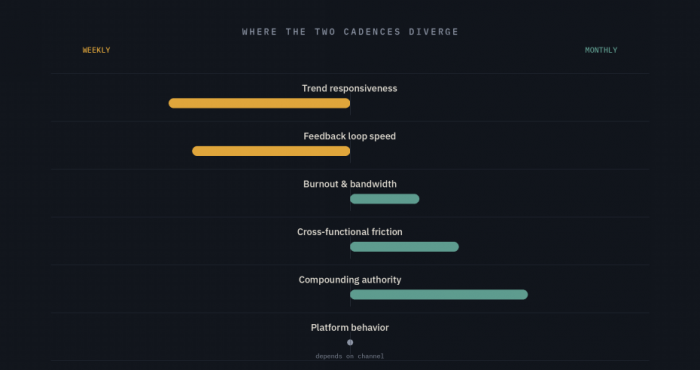
Pros-and-cons lists rarely explain why a cadence succeeds or fails in a specific operation. The differences that matter sit inside six forces, and each one plays out differently depending on team size, industry, and content type.
| D i m e n s i o n | W e e k l y | M o n t h l y |
| Trend responsiveness | Reacts to a news cycle, product update, or trending conversation within days. | Reacts a cycle late; the trigger event has often faded by publish time. |
| Burnout & bandwidth | Constant small decisions consume attention even when total output stays flat. | Fewer, larger planning sessions reduce decision fatigue, but each carries higher stakes. |
| Compounding authority | Easy to scatter across many topics, harder to build depth on any single one. | Enables sustained coverage of one theme across formats, building topical authority. |
| Feedback loop speed | Performance data returns fast enough to adjust the following week's plan. | Data often arrives after the next batch is already locked in production. |
| Cross-functional friction | A 3–5 day approval bottleneck can consume most of the available cycle. | Longer lead time absorbs the same bottleneck without derailing the calendar. |
| Platform behavior | Suits channels that reward recency and consistency social, short-form video. | Suits channels that reward depth SEO content, newsletters, long-form pieces. |
Compounding authority
The clearest case for monthly planning shows up here. A monthly theme can be built out across a blog post, a video, two social threads, and an email several assets that all point at the same underlying idea from different angles. That kind of coverage is difficult to plan a week at a time, because a weekly planner is usually deciding what goes out next Tuesday, not what argument the team is building over six weeks. Search engines and audiences both notice depth; a single well-covered topic tends to outperform six loosely related ones, even when the total word count is identical.
Feedback loop speed
This is where weekly planning earns its keep. A piece published on a Tuesday can show its early performance numbers by the following Monday enough time to know whether a headline, format, or topic is landing before the next batch goes into production. Monthly planning locks four or five weeks of content before the first real performance signal comes back, which means a weak assumption made in week one often survives untested until the entire batch is already published.
Cross-functional friction
Teams that route content through legal review, brand approval, or a design queue tend to underestimate how much of a weekly cycle those steps consume. If approval alone takes three business days, a five-day production week is running on borrowed time before a single sentence is written. Monthly planning doesn't remove that friction, it just gives the same bottleneck more room to happen without collapsing the schedule.
Which Cadence Fits Which Operation
Neither cadence is universally better; each one matches a specific set of operating conditions. The more honestly a team can answer the questions below, the less this becomes a matter of preference.
Weekly tends to win when
● The industry or audience conversation moves fast enough that a month-old take reads as stale finance, technology news, entertainment, and anything adjacent to current events.
● The team is small enough, often one to three people, that a full month of locked content removes the flexibility they rely on to cover gaps or capitalize on a sudden opportunity.
● Distribution runs primarily through platforms that reward frequency and recency over polish, such as short-form video or social feeds with fast-decaying reach.
● The content type is inherently reactive: customer support updates, product release notes, community management where the input driving the content doesn't exist a month in advance.
Monthly tends to win when
● Content requires research, sourcing, or subject-matter review that takes longer than a week to complete properly, such as data-driven reports or expert-interview pieces.
● The channel rewards depth over frequency long-form SEO content, email newsletters, or any format where fewer stronger pieces beat a larger number of average ones.
● Cross-functional approval adds several unavoidable days of lead time to every piece, more than a weekly cycle can reasonably absorb.
● The team is large enough that coordination itself becomes the bottleneck, and a longer planning horizon reduces how often everyone has to re-sync.
The Model Most Experienced Teams Actually Run
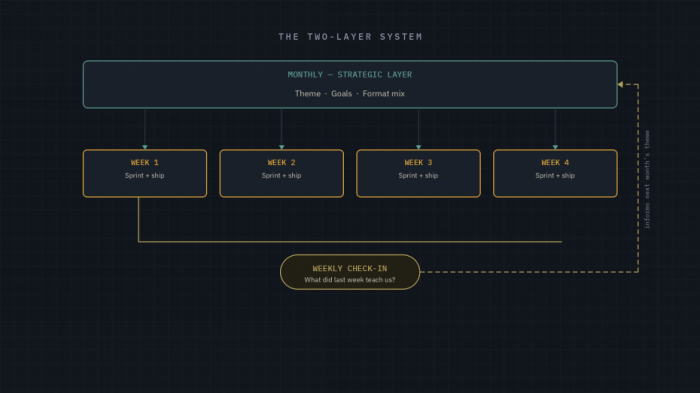
In practice, teams that have been doing this long enough rarely run a pure version of either cadence. What they run instead is a two-layer system: a monthly layer that sets direction, and a weekly layer that executes against it.
The monthly layer answers three questions before a single piece gets written: what theme or campaign this month is organized around, what two or three specific goals it serves as a launch, a seasonal moment, a gap in existing content and what mix of formats will cover it. This layer typically gets locked in a single planning session near the end of the previous month, with enough detail to brief a team but not so much that it dictates every headline in advance.
The weekly layer then breaks that theme into a production sprint: which specific pieces ship this week, in what order, against what deadlines. Crucially, this layer includes a short weekly check-in, often fifteen to twenty minutes, where the team looks at how last week's content actually performed and adjusts the coming week's plan in response. That check-in is the piece a pure monthly system doesn't have, and the piece a pure weekly system usually can't sustain, because there's no strategic layer above it to check the numbers against.
| L a y e r | S e t d u r i n g | Q u e s t i o n i t a n s w e r s |
| Strategic | End-of-month planning session | What is this month building toward, and why? |
| Execution | Weekly sprint planning | What ships this week, and in what order? |
| Review | Weekly check-in | What did last week's content actually teach us? |
The check-in is the hinge the whole system turns on. Remove it, and a hybrid calendar quietly degrades back into a monthly one that just happens to be split into weeks.
A Better Way to Answer the Question
Rather than choosing a cadence in the abstract, it helps to answer a short set of questions about the specific operation in front of the team.
| 01 | How fast does the industry's public conversation actually move? If the honest answer is “in days,” a monthly-only system will consistently publish content that answers questions nobody is asking anymore. |
| 02 | What breaks first when the team is understaffed or overloaded quality, or timeliness? If timeliness breaks first, the execution layer needs a shorter cycle regardless of what the strategic layer looks like. |
| 03 | How long does a single piece take, from first draft to published, including approval? If that number is close to or longer than seven days, weekly planning is structurally impossible, not just difficult. |
| 04 | Does performance data return fast enough to inform the next planning cycle? If reporting lags by more than two weeks, a weekly review step won't have anything real to react to. |
| 05 | Is there an idea that needs more than one piece of content to make its point? If so, something longer than a week needs to hold that argument together across pieces. |
| 06 | What actually happens when a real opportunity or crisis interrupts the plan? A cadence with no room for interruption is a cadence that will eventually produce a public misstep. |
How Each Cadence Actually Fails
Neither cadence fails the way it gets blamed for. Both fail quietly, in ways that look like good management right up until they don't, the same way most common content planning mistakes hide inside calendars that look perfectly organised.
The Monthly Trap The most common failure of monthly planning isn't laziness it's the calendar getting finished too early and too well. A month's content gets planned, approved, and scheduled two weeks before the month even starts, which feels like good management. Then something changes: a competitor announcement, a shift in the news cycle, a product delay. The content keeps publishing anyway, because unwinding a month of approved work costs more effort and political capital than letting it run. The result is content that is technically on-brand and on-schedule, and almost completely disconnected from what is actually happening when it goes live. |
The Weekly Trap The weekly failure mode looks different but comes from the same root cause: nothing above the week to answer to. Each week's content gets planned in reaction to the previous week's numbers, which sounds responsive but actually means the team is always reacting and never building. Months in, there is no body of work that adds up to anything, no topic the audience associates with the brand, no argument that has been made and reinforced over time. Every piece is individually reasonable and collectively directionless. |
Verdict : The Actual Answer
Neither cadence is a management style worth defending on principle. Weekly planning is a production tool; monthly planning is a direction-setting tool. An operation that only has one of them is missing the other's job, not just its schedule.
The operations that get the most out of content planning stopped treating this as a binary choice a long time ago. They run monthly cycles to decide what is worth building and why, weekly cycles to actually build it, and a short recurring review to keep the two connected.
| Cadence should follow content function, not the other way around and the operations that figure that out stop asking whether to plan weekly or monthly, because by then they are doing both, on purpose, at the same time. |
Comments