

A brand publishes four times a week. Clean design, decent writing, always on schedule. Eighteen months in, ask a follower what the account is actually about and you'll get a shrug. The feed reads like a stranger's camera roll competent, forgettable, aimed at nothing in particular.
The problem isn't effort, budget, or talent. It's that the account has topics but no pillars, and those two things are not the same. This guide covers what a pillar really is, why it works, the different types, how to build your own, how to turn one into an actual stream of content, how to weight and measure them, and the ways they quietly fall apart. By the end you should be able to look at any content program including your own and see whether it's standing on pillars or just staying busy.
What a content pillar really is
The textbook answer: a content pillar is a core theme that a brand or creator consistently builds content around. Pick three to five, make everything you publish trace back to one of them, and you have a strategy instead of a pile of posts.
That's true, but it's the shallow version, and it's why so many pillar strategies quietly fail. People hear "core theme," write down a list of topics they could talk about, and call it done. A topic is just something you can cover. A pillar is something you commit to covering, again and again, in a way your audience learns to expect from you specifically.
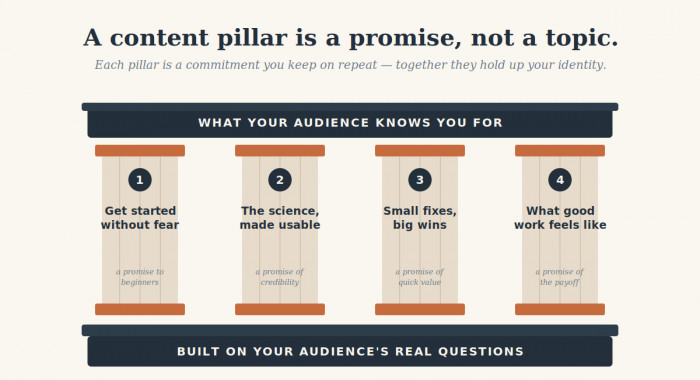
Here's the reframe worth holding onto for the rest of this piece: a content pillar is a promise, not a topic. It's a standing agreement with your reader about the kind of value they'll get when they show up. "Fitness" is a topic. "We help desk-bound professionals train without wrecking their backs" is a promise. The first tells you what you might talk about. The second tells you what you'll deliver, to whom, and why they should keep coming back.
There's also a genuine source of confusion worth clearing up. The phrase gets used for two related but distinct ideas:
● The strategic sense, common in social media and content marketing, where a pillar is one of your recurring content themes the categories your whole output organizes around.
● The SEO sense, where a "pillar page" is a long, comprehensive page on a broad subject that links out to narrower "cluster" articles, signaling topical depth to search engines.
Both are real, and they actually meet in the execution stage. But the strategic version is the one that shapes your identity, so it's where most of this guide lives. The SEO version is a publishing structure; the strategic version is a decision about what you're for.
Pillars vs. the words they get confused with
Much of the confusion around pillars comes from a cloud of near-synonyms that get used interchangeably. They're not the same, and knowing the differences sharpens your thinking.
| Term | What it is | How it differs from a pillar |
| Content bucket | A loose bin you sort posts into after the fact | Descriptive, not committal a bucket organizes; a pillar promises |
| Theme | A mood or recurring subject | Vaguer and softer; a pillar has an audience and a payoff attached |
| Niche | The overall space you operate in | Bigger than a pillar; your niche contains your pillars |
| Topic cluster | An SEO grouping of related pages | A structural concept; pillars are strategic and audience-facing |
| Campaign | A time-boxed push toward a goal | Temporary by design; pillars are permanent by design |
| Series / format | A repeatable content shape (e.g. "Friday Q&A") | A vehicle, not a theme a format can carry a pillar but isn't one |
The last row trips people up the most, so it's worth dwelling on. "A weekly behind-the-scenes video" is a format. It answers how you'll deliver, not what you're promising or to whom. Plenty of creators mistake their formats for their strategy, which is why they can describe their posting schedule in detail but can't tell you what any of it is building toward. A pillar sits underneath the format and gives it a reason to exist.
Why pillars work the actual mechanism
Pillars aren't valuable because they organize your calendar. They're valuable because of what they do to two brains at once: your audience's and yours.
Human attention runs on pattern recognition : People don't evaluate your content one post at a time; they build a rough mental model of "what this account is" and then filter accordingly. When your output clusters around a few consistent themes, that model forms fast and sticks. When it doesn't, the brain files you under "miscellaneous" the folder nobody opens twice. Consistency isn't an aesthetic preference; it's the thing that lets a stranger decide, in about three posts, whether you're worth following.
Pillars compound; scattered content doesn't : Every piece inside a pillar reinforces every other piece. Ten posts on the same promise don't add up to ten they stack into a reputation, because each one deepens the impression the last one made. Ten posts on ten unrelated things stay ten isolated posts. This is the difference between building equity and just staying busy.
Pillars reduce decision fatigue on your side of the screen : A blank content calendar is paralyzing precisely because the options are infinite. Pillars turn an impossible question ("what should I post?") into a manageable one ("what's a fresh angle on pillar two?"). Constraints don't limit creativity here they're what make consistent output survivable over years rather than weeks.
All three mechanisms come down to the same thing: repetition with structure. A pillar forces you to return to the same promise until it becomes yours.
The types of pillars
Not everyone builds pillars the same way, and the right method depends on your business and your audience. There are a few distinct models, and strong strategies usually blend two or three rather than picking one purely.
| Model | Organizes pillars around | Best suited to | Watch out for |
| Audience-based | Different segments of who you serve | Brands with distinct customer types | Segments so narrow you fragment your feed |
| Expertise-based | The domains you're credible in | Consultants, educators, experts | Talking about what interests you, not them |
| Intent / funnel-based | Where the reader is in their journey | Businesses with a clear path to purchase | Getting too sales-heavy, too fast |
| Emotional / relationship-based | The feeling or role you play for people | Personal brands, lifestyle, community | Vagueness "inspiration" isn't a pillar |
| Format-based | The type of content itself | Almost no one, as a sole basis | Mistaking a vehicle for a theme |
A few notes that don't fit in a table. Audience-based pillars work when you genuinely serve different people say, a design tool that speaks separately to freelancers, agencies, and in-house teams. Each pillar becomes a promise to one of them. Expertise-based pillars are the default for anyone selling knowledge; the risk is drifting into what you find interesting rather than what your audience is stuck on. Intent-based pillars map to the buyer's journey and are powerful because they force you to serve people who aren't ready to buy yet which is most of your audience, most of the time.
Format-based pillars deserve a warning. Organizing your entire strategy around content types ("we do reels, carousels, and lives") is the weakest foundation, because format is a delivery choice, not a promise. Formats belong inside pillars, not in place of them.
Most real strategies mix models. A fitness coach might have one audience-based pillar (aimed squarely at total beginners), two expertise-based pillars (training and nutrition), and one relationship-based pillar (the mindset that keeps people going). The mix is fine desirable, even as long as each pillar passes the tests in the next section.
The anatomy of a pillar that holds
Choosing pillars is easy; knowing whether the ones you chose are any good is the hard part. Here's a diagnostic four tests a real pillar has to pass. If a candidate fails two or more, it isn't a pillar yet.
Test 1: Does it sit where audience need meets your credibility? A pillar has to live in the overlap between what your audience actually cares about and what you can speak to with authority. Miss on the first and nobody's interested. Miss on the second and you'll run out of things to say or get caught bluffing. The overlap is narrower than people expect, which is exactly why it's defensible.
Test 2: Is it broad enough to sustain fifty pieces but narrow enough to be recognizable? This is the Goldilocks test, and most weak pillars fail it on the "too broad" side. If your pillar is basically the name of your industry, it's a category with no edges. A good pillar is a subject you could mine for a year without repeating yourself, yet specific enough that someone could describe it back to you in a sentence.
Test 3: Can you actually keep the promise, repeatedly? A pillar is a commitment, so it has to be one you can honor on a bad week, not just your best one. If a theme depends on rare access, expensive production, or a mood you can't summon on demand, it's a nice occasional post, not a pillar you can build on.
Test 4: Does it connect to the others instead of standing alone? Strong pillars are neighbors, not silos. They should share a worldview or an audience so that moving between them feels natural. If your pillars have nothing to do with each other, you don't have a strategy you have three accounts crammed into one.
A quick way to feel the difference between a topic and a pillar that passes these tests:
| A topic (weak) | A pillar (strong) |
| "Productivity" | "Helping overwhelmed freelancers protect their focus" |
| Names a subject area | Names a promise to a specific person |
| Anyone could claim it | Belongs to you and your point of view |
| Generates random posts | Generates posts that build on each other |
| You could run dry or drift | You always know the next angle |
The left column isn't wrong, exactly. It's just unfinished. The work of building a pillar is dragging every idea from the left column into the right.
How to actually find your pillars
The diagnostic tells you whether a pillar is good. This tells you how to arrive at one. The order matters enormously, because the most common mistake is starting from yourself instead of your audience.
Start with the audience, not the brainstorm : Resist the urge to list topics you'd enjoy making. Instead, write down who you're trying to reach and, more importantly, what they're stuck on. The raw material of good pillars is other people's problems, questions, and frustrations not your product features or your interests.
Gather the real questions : Collect the actual language your audience uses: the questions you get asked repeatedly, the search terms that bring people to you, the comments and DMs, the objections that come up in sales conversations, communities where your people already gather. You're looking for recurring phrasings, not polished topics. Aim for dozens of questions before you organize anything.
Cluster the questions into themes : Lay everything out and group what belongs together. Patterns emerge on their own: a knot of questions about getting started, another about a specific recurring obstacle, another about the aspiration underneath it all. Each cluster is a candidate pillar. This step keeps pillars grounded in demand rather than invention.
Name the promise inside each cluster : For every cluster, write the sentence that says who it helps and what it delivers. "Getting started" becomes "we make the first month feel manageable for total beginners." This is where a bin of topics turns into an actual commitment.
Pressure-test and cut to three to five : Run each candidate through the four tests. Kill the ones that are too broad, the ones you can't sustain, the ones that are really about you. Then be ruthless about the number. If you're left with eight, you haven't finished merge, cut, or fold weaker ones into stronger ones until you land in the three-to-five range that an audience can actually remember you for.
Done properly, this produces pillars you can defend, because each one traces back to a real question a real person asked. That traceability is what separates a strategy from a guess.
From pillar to post turning a promise into a pipeline
A pillar that never becomes content is just a nice sentence in a strategy deck. The bridge from promise to publishing is a cascade, and understanding it solves the "what do I actually post?" problem for good.
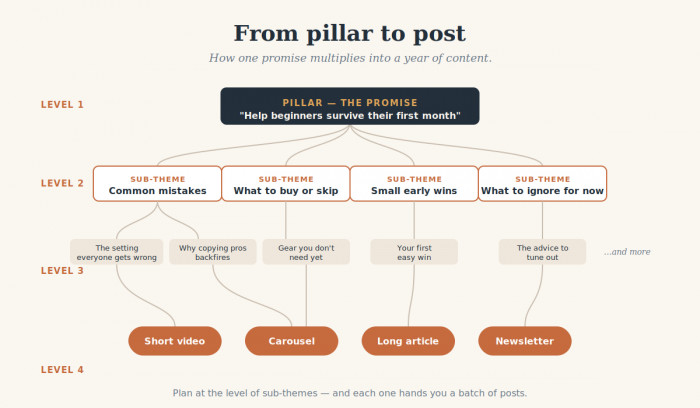
The cascade runs in four levels. A pillar (the promise) breaks into a handful of sub-themes (the recurring subjects within it), which break into specific angles (the individual ideas), which get delivered through formats (video, carousel, article, email). One pillar can feed content for a year because each level multiplies the one above it.
Take a single pillar "help beginners survive their first month" and watch it expand:
● Sub-themes might be: the mistakes beginners make, tools worth buying versus skipping, small early wins, and what to ignore for now.
● Angles within just "mistakes beginners make" could be: the one setting everyone gets wrong, why copying advanced people backfires, the trap of buying gear too early, and the habit that quietly stalls progress.
● Formats then deliver each angle: a quick video for the punchy ones, a carousel for the list-style ones, a long article for the comprehensive one, a newsletter for the personal take.
This is also where the strategic pillar and the SEO "pillar page" meet. In search, a pillar page is a broad, comprehensive hub, and cluster articles cover the sub-themes and link back to it. That hub-and-spoke shape is the same cascade drawn as a website: the pillar page holds the promise, the cluster pages handle the sub-themes and angles, and the internal links tie them into one authoritative structure. Done seriously, your strategic pillars and your SEO pillar pages describe the same territory one for humans building a mental model of you, one for search engines building a map of your expertise.
The practical payoff: you never plan content at the level of individual posts. You plan at the level of sub-themes and let each one generate a batch of angles. That's how people sustain output for years without burning out or drifting.
Getting the mix right weight, rhythm, and the funnel
Having pillars isn't enough; how you balance them is a strategy of its own.
Not every pillar carries equal weight. Some pillars build trust and attract new people; others convert. A sane split for most brands is that the large majority of content should give teach, entertain, help and only a small slice should ask for anything. If your feed is mostly conversion pillars, you've built a sales channel that no one chose to follow. The give-heavy pillars are what earn you the right to occasionally sell.
Map your pillars to the funnel. Different pillars serve different stages of a reader's journey. Laying them out this way exposes gaps fast:
| Funnel stage | What the reader needs | Pillar's job |
| Awareness | To discover you and find you useful | Broad, generous, shareable content that draws strangers in |
| Consideration | To trust that you know your stuff | Depth, proof, and genuinely useful expertise |
| Decision | A reason to choose you specifically | Results, comparisons, and the occasional direct ask |
If all your pillars sit at the awareness stage, you'll grow an audience that never converts. If they all sit at the decision stage, you'll never grow an audience to convert in the first place.
Establish a rhythm. Weighting only works if it shows up in your calendar. Decide roughly how often each pillar appears maybe your trust-building pillar runs twice a week while your conversion pillar surfaces once a fortnight. It needn't be rigid, but it should be deliberate, so the monthly mix reflects your intentions rather than your moods.
Pillars across platforms
The same pillars express very differently depending on where they live. Your promise stays constant; its shape adapts to the channel. A brand that copies identical content across platforms usually thrives on none of them.
| Platform | How a pillar tends to show up |
| Instagram / TikTok | Fast, visual, hook-driven angles one idea per post, high frequency |
| Professional framing, opinion, and lessons learned; story plus takeaway | |
| YouTube | Deep, searchable treatments of a sub-theme; the long-form home of a pillar |
| Blog / SEO | Comprehensive pillar pages and cluster articles built for search intent |
| Newsletter | The personal, relationship-building expression where trust compounds fastest |
The underlying pillar say, "help beginners survive their first month" is the same everywhere. On TikTok it's a 30-second "don't make this mistake." On YouTube it's a 15-minute starter walkthrough. In the newsletter it's a candid note about your own rough beginning. Same promise, five different bodies. Thinking in pillars rather than posts is what makes cross-platform coherence possible without running five unrelated strategies.
Where pillars go wrong
You learn more from the failure modes than from the success stories. Here are the ways pillar strategies fall apart, in rough order of how often they happen.
They're too broad to mean anything. A skincare brand with pillars of "skin," "beauty," and "wellness" has technically done the exercise and gained nothing. Those aren't pillars; they're the entire industry restated three times. The fix is almost always to get more specific about who and why, not what.
They're chosen for the brand instead of the audience. A company picks pillars around what it wants to sell features, product lines, internal priorities. The audience, meanwhile, cares about their own problems, which rarely map to your org chart. Pillars built from the inside out feel like a brochure. Pillars built from the audience's questions produce content people actually seek out.
There are simply too many. Enthusiasm leads people to pick eight or nine pillars so nothing gets left out. The result is that nothing gets reinforced either, because attention spreads too thin to compound. Three to five is roughly the number of things an audience can remember you for.
They're treated as rigid silos. Locking each pillar in its own lane drains the life out of the work. The most interesting content usually lives at the intersection of two pillars where your "how-to" theme meets your "behind-the-scenes" theme. Pillars should be load-bearing, but they shouldn't be walls.
They're borrowed from a competitor. Copying the pillars of a brand you admire feels efficient and produces a hollow imitation. Their pillars came out of their audience and their strengths; pasted onto you, they promise things you may not be built to deliver. Inspiration is fine. Transplanting is not.
They're really just formats in disguise. "Reels, carousels, and lives" is a production plan, not a strategy. If your pillars name content types instead of promises, you've skipped the actual thinking.
They exist on a slide and nowhere else. The quietest failure of all. The pillars get defined in a deck, everyone nods, and the actual posting goes on exactly as before. A pillar that doesn't change what you publish on a random Tuesday isn't a pillar. It's a decoration.
If you're auditing an existing strategy, run through these. Most struggling content programs are failing at least two, and the broadness problem is nearly always one of them.
One brand, built out properly
One case worked all the way through teaches more than five shallow examples, so let's build a single brand and carry it through every stage.
Take a small company that sells ergonomic office furniture to remote workers. The lazy version of their pillars: furniture, office setup, health, productivity. Four topics, technically on-brand, and completely generic. Every competitor could publish the identical list. Against the diagnostic they fail Test 1 (no clear audience) and Test 2 (far too broad).
Now the considered version. Start from the person: a remote worker who suspects their setup is slowly wrecking their body and their focus, has no idea what to fix first, and distrusts being sold to. From that person, the pillars fall out:
● "Diagnose your own setup" content that helps readers spot what's silently hurting them: the monitor that's too low, the chair that tilts them forward, the lighting that fries their eyes by 3 p.m. This is the trust-builder, and it barely mentions the product.
● "The science, made usable" the actual research on posture, movement, and cognition, translated out of academic language into things a normal person can act on today. The credibility pillar.
● "Small fixes, big difference" cheap, immediate changes that cost nothing, which paradoxically makes the eventual paid recommendations more believable because the brand clearly isn't only trying to sell.
● "What good work feels like" the aspirational thread: the calmer body, sharper afternoons, and sustainable pace the whole thing is really about.
Here's the same brand, side by side, so the upgrade is visible:
| Weak pillars | Strong pillars |
| Furniture | Diagnose your own setup |
| Office setup | The science, made usable |
| Health | Small fixes, big difference |
| Productivity | What good work feels like |
| Sells to nobody in particular | Speaks to one specific, anxious buyer |
Now watch the cascade and the mix in action. Take "Diagnose your own setup": sub-themes like desk, chair, screen, and lighting; angles within "screen" like ideal monitor height, the two-monitor mistake, and the blue-light question worth ignoring; formats from a quick diagnostic video to a comprehensive "audit your desk in ten minutes" pillar page with cluster articles feeding it. On the mix side, the first three pillars are give-heavy trust and awareness content, while the actual product recommendations live as occasional decision-stage angles inside "small fixes" earning the sale rather than demanding it.
The whole set passes every test and holds together under one worldview: your body and your focus are worth protecting, and we'll show you how before we ever ask you to buy. That last clause is the strategy. The furniture is almost incidental.
How to tell if your pillars are working
You can't improve what you don't watch, and the useful signals are a mix of the measurable and the human.
The describe-back test. The simplest and most brutal check: can a relative stranger, after browsing your content for a few minutes, tell you what you're about in one sentence? If yes, your pillars are doing their job. If the answer is vague or wrong, your themes aren't landing no matter what the numbers say.
Consistency within pillars. A healthy pillar has a floor even its average posts do okay, because the audience trusts that theme from you. Wildly swingy results within a pillar often mean it isn't really resonating; the occasional hit is luck, not fit.
Different pillars, different jobs measured separately. Don't judge every pillar by the same metric. Awareness pillars are measured on reach and new followers; trust pillars on saves, shares, and time spent; conversion pillars on clicks and sales. Judging a trust-building pillar by its direct revenue will make you kill the very content that earns you the audience.
The chronically dead pillar. If a pillar consistently underperforms across every relevant metric despite good execution over a real stretch of time, believe it. That's usually a sign it was your interest rather than your audience's and a candidate for replacement.
Pillars are not permanent
Pillars are commitments, but they aren't tattoos. The best content programs revisit them deliberately, and knowing when to change is part of using them well.
Pillars should shift when the audience matures past them the beginners you started with become intermediates who need harder material. They should shift when a pillar consistently underperforms despite good execution, which usually means it was your interest, not theirs. And they should shift when the world moves: a new platform, a new format, a new problem your audience suddenly has.
The mistake runs in both directions. Change your pillars every few months and you never let the pattern compound back to the camera-roll problem, just with extra steps. Refuse to ever touch them and you slowly calcify into irrelevance while insisting you have a strategy. The skill is holding pillars firmly enough to build equity and loosely enough to evolve. Treat them like a hypothesis you're committed to testing, not a verdict you've already reached.
The verdict
Strip away everything else and a content pillar is a simple thing wearing a complicated name. It's a promise you make to a specific person and keep on repeat until it becomes the thing you're known for.
That framing resolves most of the confusion around the concept. It's why topics aren't pillars; a topic promises nothing. It's why formats aren't pillars; a format is a vehicle with no destination. It's why too-broad pillars fail: a promise to everyone is a promise to no one. It's why silos are a mistake: the promises should belong to the same relationship. And it's why the whole apparatus of types, cascades, weighting, and measurement exists: to help you decide what you're for, then keep that promise reliably enough that it compounds.
Go back to the brand from the opening four posts a week and nobody could say what it was about. It didn't need more content. It needed to answer one question and stand behind the answer: what do we reliably give people, and who are those people? Everything here is machinery in service of that single question. Get it right, and the posting takes care of itself. Get it wrong, and no amount of posting will save you.
Comments