

Finding a username usually gets difficult after the first few obvious ideas are taken. Adding random numbers solves the availability problem, but it can leave a handle harder to remember, while overly creative spelling can make an otherwise good name difficult to search.
Free username generators are useful because they widen the pool of ideas quickly. The better ones go beyond random word combinations by considering the platform, niche, naming style, account type, or keywords behind the profile.
Quick Comparison of the Best Free Username Generators
The seven tools below approach username generation differently. Some are designed around creator branding, while others are better for broad brainstorming, detailed customization, or less identifiable usernames.
| Tool | Best For | Main Controls | Availability Help | Signup |
| Birdeye | Business and social profiles | Platform, description, account type, category | Manual verification | No |
| SpinXO | Large-scale creative brainstorming | Style, theme, keywords and interests | Username-checking tools | Basic generation is free |
| SmartPostly | Creator and niche-based handles | Platform, style and keywords | Pro availability feature | No |
| Publer | Fast social username ideas | Platform, tone and category | Manual verification | No |
| SocialCal | Cross-platform social handles | Niche, keyword and style | Separate checker | No |
| Postoria | Detailed username customization | Brief, language, style, numbers and separators | Manual verification | No |
| NordPass | Random and privacy-focused usernames | Keyword, length and advanced controls | Selected platform links | No account required |
A tool that produces hundreds of names is not automatically more useful than one that produces a smaller but more relevant set. The important difference is how much control users have over the direction of those suggestions.
How We Compared the Tools
Username generators are difficult to judge by output quantity alone. A list containing 100 combinations is not especially useful if most of them need heavy editing before they resemble something a person would actually use.
The tools in this list are considered around a few practical areas:
● Input control should influence the result in a meaningful way. Platform, niche, naming style, keywords, and account type should change the direction of the suggestions rather than acting like decorative settings.
● Names should remain usable outside the generator. A clever-looking combination loses value if people cannot pronounce it, remember it, or type it after hearing it once.
● Different generations should explore different naming directions. Useful variety means more than changing one suffix or adding a different number to the same base word.
● Social context matters for creator-facing tools. A gaming username, professional business handle, aesthetic Instagram account, and anonymous forum identity solve different naming problems.
● The free workflow should have little friction. A tool advertised as free and instant should allow users to reach useful suggestions without unnecessary account creation.
● Availability should be clearly separated from generation. A generator can suggest a good handle without knowing whether someone already owns it on a particular platform.
With those distinctions in place, the individual tools become much easier to compare.
1. Birdeye AI Username Generator
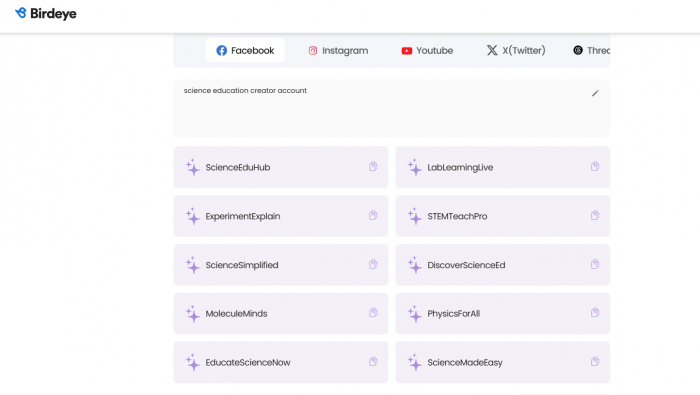
Best for: Businesses, professionals, and creators who want social usernames built around account context rather than a single keyword.
Birdeye starts by asking where the username will be used. Users can choose Facebook, Instagram, YouTube, X, or Threads, provide a short description, select whether the account is personal or business, and choose an industry category. The tool is currently free and Birdeye states that no signup is required.
That structure gives Birdeye more context than a basic word-mixing generator. A personal photography account and a photography studio can start with the same general subject but receive different directions because the account type and description give the generator additional information.
| Area | What Birdeye Offers |
| Main inputs | Platform, description, account type and category |
| Platforms | Facebook, Instagram, YouTube, X and Threads |
| Naming approach | Contextual and brand-oriented |
| Free use | No signup required |
| Availability | Must be confirmed separately |
What Works Well
● The personal-versus-business setting is genuinely useful. It gives users a simple way to steer the generator toward either an individual identity or a more commercial naming style.
● Industry categories reduce vague output. A restaurant, real-estate agent, technology company, and wellness creator can give the system more specific context without writing a complicated prompt.
● The description field leaves room for nuance. Users can mention a location, specialty, audience, or important keyword instead of relying entirely on preset categories.
● Platform selection happens before generation. Birdeye says its tool considers the naming rules and limits of the selected network.
What Makes It Different
Birdeye feels closer to filling out a small naming brief than spinning a random-name wheel. The combination of account type, industry, description, and platform is particularly useful when the username needs to represent an actual business or professional identity.
That structure also reduces the temptation to stuff every important word into the handle. Users can describe the account in detail while letting the generator decide which parts belong in the username.
Keep in Mind
Birdeye does not perform a live availability check through the main social username generator. Its own guidance recommends copying a preferred result and checking it directly on the relevant platform before committing.
2. SpinXO
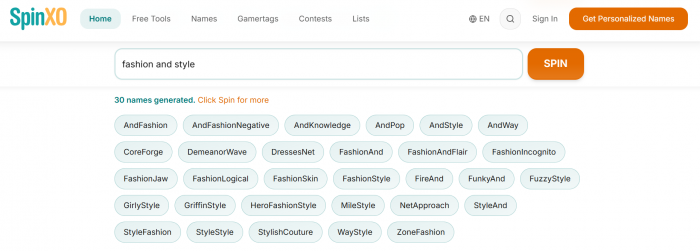
Best for: Users who want a large number of creative possibilities, especially for gaming, casual social profiles, fandoms, or personality-driven accounts.
SpinXO takes a broader brainstorming approach. The current generator includes naming styles such as cool, cute, funny, aesthetic, and mysterious, along with categories including gaming, fashion, music, anime, and fantasy. A standard generation displays 30 names at a time, with additional spins available for more options.
The appeal is not that all 30 suggestions will be usable. It is that a large batch exposes naming patterns quickly. One result may reveal an interesting suffix, another may suggest a stronger keyword pairing, and a third may point toward an entirely different naming direction.
| Area | What SpinXO Offers |
| Main controls | Keywords, style and theme/category |
| Output style | Broad and experimental |
| Batch size | 30 names shown per spin |
| Strongest use | Gaming, social and personality-led names |
| Extra utility | Separate username availability tools |
What Works Well
● The style categories make experimentation quick. Switching from aesthetic to gaming or mysterious can change the overall naming vocabulary without rewriting a prompt.
● The larger batches work well during early brainstorming. Users can scan many combinations and identify patterns they like rather than evaluating each suggestion as a final answer.
● Its ecosystem goes beyond a single generator. SpinXO also provides tools for username availability, similar names, gamertags, aesthetic usernames, and other naming categories.
● The tool is comfortable producing less conventional names. That can be an advantage for gaming and entertainment accounts where a distinctive invented word may work better than a descriptive handle.
What Makes It Different
SpinXO is strongest when the user does not yet know what the final username should sound like. It creates enough variation to help discover a direction rather than asking for a tightly defined naming brief first.
For example, someone starting with the word “Nova” may discover that they prefer short invented names rather than combinations such as NovaGaming or NovaOfficial. That kind of discovery is where a high-volume generator becomes valuable.
Keep in Mind
Quantity creates more filtering work. Some suggestions can feel like mechanically joined words or names that are better used as inspiration than copied directly.
A good workflow with SpinXO is to save the pieces that stand out, then build a smaller shortlist from those patterns instead of trying to choose directly from the first batch.
3. SmartPostly Username Generator
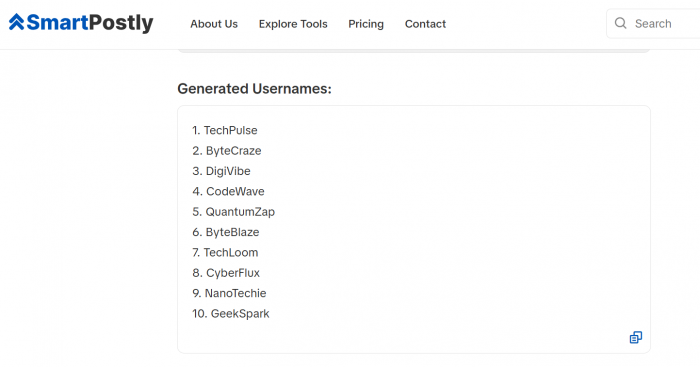
Best for: Creators, niche pages, and small brands that want usernames influenced by the platform, naming style, and subject of the account.
SmartPostly username generator uses a guided three-part setup. Users select the intended platform, choose a style, and enter keywords related to the account before generating suggestions. The tool currently lists platforms including Instagram, YouTube, TikTok, X, and Threads, and the free version states that no login is required.
The keyword field matters because it lets the user supply the core identity without forcing that exact phrase into every result. A travel creator could enter ideas around hiking and city trips, while a gaming channel might start with a game genre, tone, or recurring theme.
| Area | What SmartPostly Offers |
| Main inputs | Platform, style and keywords |
| Platform focus | Instagram, TikTok, YouTube, X, Threads and more |
| Naming approach | Creator and niche-focused |
| Free access | No login required |
| Availability | Instant checking promoted with Pro |
What Works Well
● Platform choice is built into the first step. This is useful for creators who know where the account will primarily live and want suggestions framed around that environment.
● Keywords prevent the results from becoming completely random. A name, niche term, content category, or brand concept can anchor the generated ideas without dictating the entire username.
● Style selection adds another layer of control. Two users can begin with similar keywords but take the naming direction toward different tones rather than receiving nearly identical lists.
● The tool works without an account in its basic form. That suits quick brainstorming sessions where the user wants to test several directions before saving anything.
What Makes It Different
The combination of platform + style + keywords is SmartPostly's most useful feature. Each input deals with a different naming question: where the name will appear, how it should feel, and what subject it should connect to.
That makes the generator particularly practical when the account already has a purpose but the creator has not found a concise handle. It sits between a completely random generator and a longer AI naming prompt, which keeps the process quick without stripping away all control.
Keep in Mind
The free generator and username availability checking should not be confused. SmartPostly currently promotes instant availability checking through its Pro version, so users working with the free generator should still confirm promising names directly on the relevant platform.
It is also worth generating several naming directions before selecting one. The first technically suitable result may not be the one that remains memorable after seeing another 20 possibilities.
4. Publer AI Username Generator
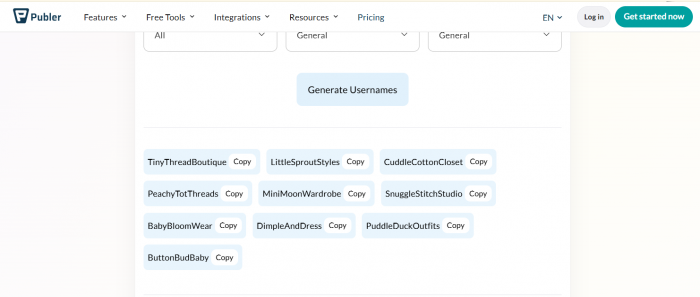
Best for: Users who want quick social-media username ideas without filling in a detailed naming brief.
Publer deliberately keeps the interface simple. Users choose the social platform, select a tone of voice and category, and generate suggestions from there. Publer currently describes the tool as free, without ads, and requiring no registration.
That lower level of setup is useful when the problem is not a lack of branding strategy but simple naming block. Someone who already knows they want a casual fitness handle or professional marketing username can establish that general direction without configuring many individual rules.
| Area | What Publer Offers |
| Main controls | Social platform, tone and category |
| Setup level | Lightweight |
| Best use | Fast social username brainstorming |
| Output direction | Contextual rather than heavily customized |
| Signup | No registration required |
What Works Well
● The generator gets to the results quickly. There are enough controls to provide context without turning the process into a questionnaire.
● Tone is separated from category. This matters because two accounts in the same niche may want completely different personalities.
● The interface suits experimentation. It is easy to change a setting and compare a different direction without rebuilding a long prompt.
● No-registration access lowers the commitment. Users can treat it as a quick idea tool rather than another service they have to join first.
What Makes It Different
Publer's strength is restraint. Some generators become more complicated as additional settings are added, while Publer gives users only a few decisions that meaningfully affect the output.
This can be better for someone at the very beginning of the naming process. Instead of deciding on separators, character length, required phrases, and other details immediately, users can first establish what general style of name feels right.
Keep in Mind
That simplicity also creates the main limitation. Users with strict requirements, such as a word that must appear, a fixed length, no numbers, or a particular separator format, may want a generator with more structural controls.
Publer is better for discovering a direction than engineering a username to a precise specification.
5. SocialCal Username Generator
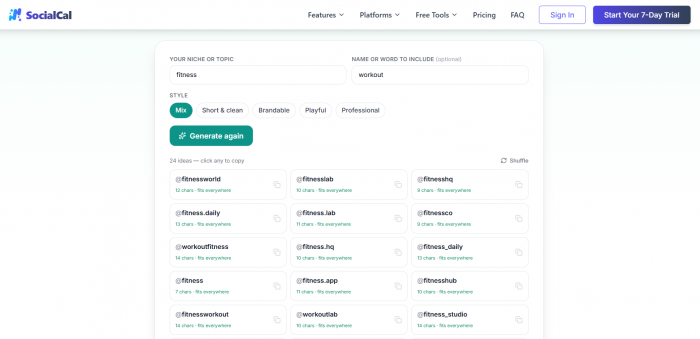
Best for: Creators and brands that want a clean handle with a good chance of working across several social platforms.
SocialCal's generator begins with a niche or topic, an optional name or word that should appear, and a naming style. Current styles include Mix, Short & Clean, Brandable, Playful, and Professional, and the company describes the tool as free, unlimited, and available without signup.
The optional required-word field is particularly useful. A creator can preserve a first name or existing brand term while allowing the generator to explore what should appear around it.
| Area | What SocialCal Offers |
| Main inputs | Niche, optional required word and style |
| Style choices | Short, brandable, playful, professional and mixed |
| Main focus | Social-media-ready handles |
| Availability help | Separate multi-platform checker |
| Free access | Unlimited and no signup |
What Works Well
● The required-word field preserves an important identity element. Users do not have to abandon an existing name simply because the obvious handle is taken.
● Its naming styles solve recognizable problems. “Short & clean” and “brandable” are more actionable than vague creative labels when the goal is a usable social handle.
● The generator emphasizes platform-valid formatting. SocialCal says its suggestions avoid spaces and unsupported characters for major social platforms.
● A separate username checker supports the next stage. Once a promising handle appears, users can move from ideation toward cross-platform availability checking.
What Makes It Different
SocialCal is built around the idea that a handle may need to survive across several networks. That changes the naming target from “good Instagram username” to “name that remains clean and recognizable in several places.”
This is valuable for creators who expect audiences to move between TikTok, Instagram, YouTube, and X. Consistency makes it easier for someone who discovers the creator on one platform to find the same identity elsewhere.
Keep in Mind
Cross-platform consistency should not become an absolute rule. If the clean version is available on the platforms that matter most but unavailable on a minor one, making every handle uglier with extra characters may be a worse trade.
Use the checker to inform the decision, not to force perfect uniformity at any cost.
6. Postoria Username Generator
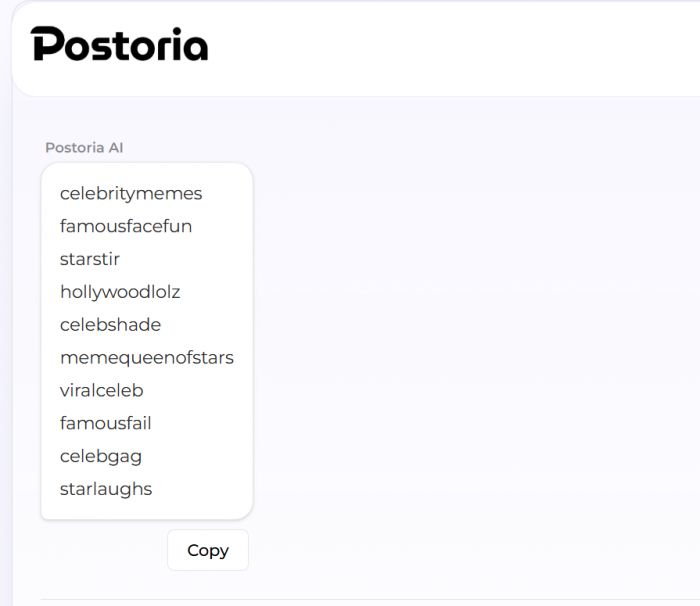
Best for: Users who already know roughly what they want and need tighter control over how the username is constructed.
Postoria provides a detailed prompt field alongside controls for language, number of suggestions, naming style, numbers, and separators. Its Instagram-specific username generator currently states that it is free, requires no signup, and does not check username availability.
The interesting feature is what happens after the first generation. Users can continue with follow-up instructions such as asking for shorter results, removing numbers, making the names more professional, changing the keyword, or exploring another style without starting over.
| Area | What Postoria Offers |
| Main input | Detailed naming brief |
| Structural controls | Language, quantity, style, numbers and separators |
| Refinement | Follow-up instructions supported |
| Availability | Explicitly not checked |
| Signup | No signup required |
What Works Well
● Numbers and separators can be controlled before generation. This avoids wasting part of the result set on formats the user already knows they dislike.
● The prompt field supports a much richer brief. Users can include a name, niche, brand, target style, and other context rather than reducing the idea to one keyword.
● Language selection opens more naming directions. This can matter for regional brands, multilingual creators, or names intended for a non-English-speaking audience.
● Follow-up refinement makes the process iterative. A nearly good batch can be corrected rather than discarded completely.
What Makes It Different
Postoria is closer to editing a naming concept than spinning for inspiration. It gives users enough structural control to say not only what the username should represent, but also what the final form should look like.
That makes it especially useful after the broad brainstorming stage. Someone may discover a promising direction in another generator, then use Postoria-style controls to explore cleaner, shorter, or more professional variations of that idea.
Keep in Mind
Postoria is unusually clear about what it does not do: it does not confirm availability. Its page tells users to verify each suggestion directly on the target platform.
That distinction is useful because a polished-looking AI suggestion can still already belong to someone else.
7. NordPass Username Generator
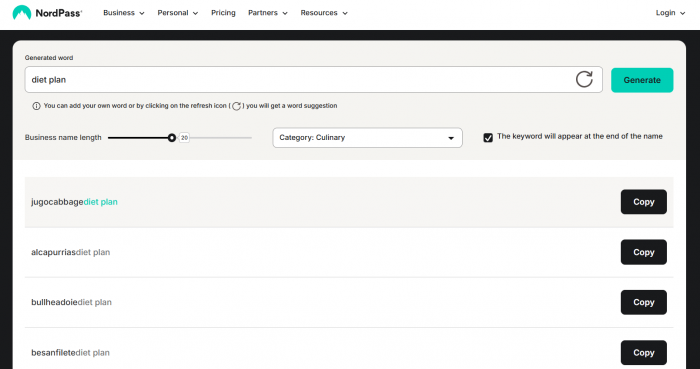
Best for: Users who prioritize randomness, anonymity, or reduced connection between an online handle and their real identity.
NordPass comes from a security rather than social-branding angle. Users can generate random usernames, enter a keyword, adjust username length, or use advanced options including random characters. The page also offers a clear “No, just generate usernames” option, so the generator can be used without signing up for NordPass itself.
That difference in purpose matters. A public creator usually wants the same recognizable identity across several platforms, while someone creating accounts for private communities, gaming, testing, or general online use may prefer a username that reveals less.
| Area | What NordPass Offers |
| Main controls | Keyword, username length and advanced options |
| Main focus | Unique and less identifiable usernames |
| Output style | Random or keyword-based |
| Availability help | Links for selected platforms |
| Account requirement | Generator works without joining NordPass |
What Works Well
● Length can be controlled directly. This prevents random generation from producing usernames that are technically unique but awkward to type.
● Users can choose between meaningful and highly random output. A keyword can preserve some identity, while the random-character option pushes further toward anonymity.
● The generator is tied to a useful privacy principle. NordPass notes that repeated usernames can make separate online accounts easier to connect.
● Selected availability links are provided after generation. NordPass currently mentions checks for services including YouTube, Reddit, Pinterest, and Vimeo.
What Makes It Different
NordPass asks a different question from most of the other tools: should this username identify the person clearly at all?
For a content creator, the answer is often yes. For an account that is not supposed to become part of a public personal brand, deliberately reducing links to a real name, birthday, location, or reused handle can make more sense.
Keep in Mind
Randomness and branding pull in opposite directions. A highly random username may be better for separation between accounts but worse for word-of-mouth discovery, recognition, and creator branding.
NordPass therefore makes the most sense when privacy or account separation matters more than communicating a niche.
Which Username Generator Fits Your Goal?
The generators are easier to choose between when the decision starts with the type of account rather than the tool name.
| If You Need | Good Starting Point |
| A business-oriented social handle | Birdeye |
| Lots of creative naming directions | SpinXO |
| A niche-specific creator handle | SmartPostly |
| Fast ideas with minimal setup | Publer |
| A clean cross-platform identity | SocialCal |
| Fine control over username structure | Postoria |
| A less identifiable random username | NordPass |
A creator can also use more than one tool during the same naming process. One generator may be better at opening up ideas, while another is better for refining the final structure.
Generated Does Not Mean Available
A generated username and an available username are two different things. An AI system can produce a combination that appears highly original without proving that nobody already uses it on Instagram, TikTok, YouTube, X, Reddit, Twitch, or another service. Even generators with checking tools may cover only selected platforms.
Postoria explicitly states that its suggestions must be verified on the destination platform, while Birdeye also recommends checking generated handles directly. SmartPostly currently promotes instant availability checking through its Pro option.
A safer workflow is:
● Generate a shortlist rather than choosing the first appealing option. Five strong candidates create room to move if the preferred name is already taken.
● Check the primary platform before changing the username to force availability elsewhere. The network most important to the account should carry more weight.
● Search similar names as well as the exact handle. A one-character difference from an established creator can still create confusion.
● Check other important platforms before investing in the identity. This should happen before logos, domains, graphics, or promotional materials are built around the name.
● Avoid automatically adding random digits to every unavailable name. A new naming direction can often produce a cleaner identity than name4728.
This short verification stage can save a much larger rebranding problem later.
How to Improve a Generated Username
Username generators are often better at discovering possibilities than producing the final identity without editing. Suppose a travel generator returns TravelWithMia2026. The meaning is clear, but the year will age quickly, and the phrase is longer than it needs to be.
Looking through different username ideas can also help reveal naming patterns worth borrowing, such as shorter structures, cleaner word combinations, or ways to express a niche without spelling out the entire topic.
Possible refinements include MiaRoams, MiaOnRoute, or RoamWithMia. Each preserves the central idea while being easier to say and less dependent on temporary details.
A generated name can usually be improved by checking a few things:
● Remove words that the profile can explain elsewhere. The username does not need to contain the entire niche, location, service, and personality when the display name and bio can carry some of that information.
● Replace disposable numbers with meaningful language where possible. Numbers can solve availability but often contribute little to recognition.
● Say the handle aloud before keeping it. If another person would not know how to spell it after hearing it, search and word-of-mouth discovery become harder.
● Look at the words after spaces disappear. Two perfectly normal words can create an unintended reading once combined into a handle.
● Consider whether the username can survive a broader content direction. A creator may start with one narrow topic and expand later.
The best generated username is often one that needs a small amount of human editing rather than none at all.
What Makes a Username Worth Keeping?
Uniqueness is only one part of the decision. A username also has to work when someone sees it briefly, hears it spoken, tries to tag the account, or searches for it from memory. That matters even more for personal branding, where the same handle can gradually become tied to a creator’s reputation, work, and recognition across different platforms.
A stronger handle usually passes these practical tests:
● It can be pronounced after one look. Users should not have to guess where one word ends and another begins.
● It can be typed after hearing it. Unusual spelling may look distinctive but can work against discoverability.
● It avoids unnecessary punctuation and digits. Extra characters are sometimes necessary, but they should solve a real problem rather than decorate the name.
● It has enough flexibility for the account to develop. A handle tied to one specific challenge, year, product, or trend can become restrictive quickly.
● It is distinct from established identities. Technical availability does not automatically mean the name is sensible to use if a very similar creator or company already dominates the search results.
These checks are simple, but they often matter more than generating another hundred alternatives.
Should You Use the Same Username Everywhere?
For a public-facing creator or business, a consistent username usually makes discovery simpler. Someone who encounters the account on TikTok can search the same phrase on Instagram or YouTube instead of learning another handle.
Perfect consistency is not always possible, and forcing it can make the name worse. If the strongest clean handle is available on every important network except one secondary platform, a small variation there may be better than adding underscores or numbers to every profile.
Privacy-oriented accounts reverse the logic. NordPass specifically warns that reusing the same username across unrelated services can make those accounts easier to connect to the same person.
The choice depends on the purpose of the identity. Public brands benefit from recognizability, while unrelated private accounts may benefit from separation.
Conclusion
A useful username generator should reduce naming friction without pretending the final decision can be automated completely.
Birdeye provides detailed business and account context, SpinXO works well for broad creative exploration, SmartPostly combines platform, style, and keyword controls for creator-focused naming, Publer keeps the process quick, SocialCal emphasizes cross-platform handles, Postoria offers finer structural control, and NordPass brings a privacy-focused approach.
The strongest workflow is usually a combination of generation and editing. Use the tools to build a shortlist, remove weak or unnecessary elements, test how the names sound and look, and then confirm availability before committing. Generating a name takes seconds. Choosing one that still works months or years later deserves a little more thought.
Comments