

Privacy costs nothing until it costs everything. Handing over your phone number to sign up for a service is not a small transaction anymore. It can expose you to marketing lists, platform tracking, spam, and data leaks you may never know about.
That is why virtual phone number services exist. Grizzly SMS is a virtual-number platform designed to help users receive SMS verification codes for hundreds of online services without exposing their real phone numbers. It sits in the grey zone between privacy tool and growth-hacking infrastructure. The real question is whether it delivers enough trust, convenience, and consistency to justify that promise.
What Grizzly SMS Actually Is
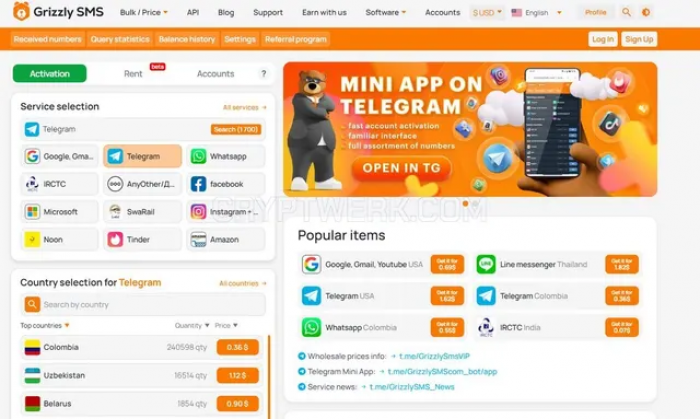
Grizzly SMS is a virtual number marketplace. Users deposit funds, browse a catalog of temporary phone numbers from over 100 countries, purchase a number for a specific platform, receive the OTP or verification SMS in their account dashboard, and move on. The number is not theirs to keep; it is rented for a single verification window, typically a few minutes.
The pitch is clean: no SIM card, no contract, no personal exposure. Numbers are priced from $0.04 on the low end, scaling upward depending on the country and target platform. The platform covers over 2,300 services in its catalog, from Google and WhatsApp to niche payment processors and regional social networks.
The core mechanism is simple but simplicity in the interface masks significant complexity in the supply chain. Where these numbers actually come from, and how reliably they work, is what separates a useful tool from an expensive lottery ticket.
How Grizzly SMS Works
From the user’s point of view, Grizzly looks simple. Under the hood, it orchestrates telecom connections, number pools, and an API layer.
User flow: step by step
| Step | User action | What happens behind the scenes |
| 1 | Register an account and log in via email. | Grizzly creates a user profile, associates balance and settings. |
| 2 | Top up balance using card, e‑wallet, or crypto. | Payment is processed; balance is credited in the internal currency. |
| 3 | Select a country and target service (e.g., WhatsApp, Telegram). | Grizzly filters its pool of numbers that match the requested country and are available for that service. |
| 4 | Request a number for that service. | A virtual number is allocated; its price is locked; an activation ID is created. |
| 5 | Enter the number on the service you’re registering for. | The external service sends an SMS to that number via standard telecom routes. |
| 6 | Wait for the SMS to appear in the Grizzly dashboard. | Grizzly receives the SMS on its backend and displays the verification code in your panel. |
| 7 | Use the code to complete verification. | Once activation is marked complete or expired, the number returns to the system lifecycle. |
For API users, the flow is similar, but everything is triggered by HTTP requests: resolve countries and services, request a number, poll for SMS, and mark activation complete or cancelled.
Grizzly has also introduced parameters like maxPrice in its API, letting automation scripts pre‑define the maximum price they are willing to pay for a number in a given request. That matters during high‑demand periods when cheap numbers are exhausted, but more expensive ones remain available.
Pricing: How Much Does Grizzly SMS Cost?
Grizzly’s public pages and blog give a ballpark sense of pricing, and it’s clearly positioned as a low‑cost provider.
Key pricing signals:
● Virtual numbers “start at 0.1 USD per SMS” for many services according to official blog content.
● Another page frames minimum prices as as low as 2 rubles (a few cents) for one‑time SMS reception, depending on country and service.
● Comparative listings and tools show per‑activation prices from around 0.04 USD in some markets, with higher prices for premium geos or heavily abused services like WhatsApp.
● API users can set maxPrice to cap what they’re willing to pay for numbers in specific requests.
Pricing comparison : cost per number across major platforms (USD)
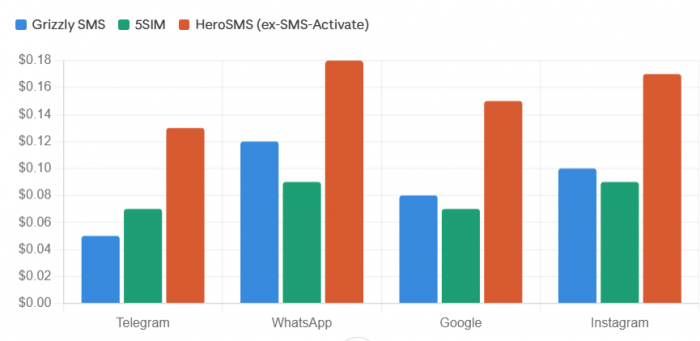
Note: Prices vary by country and availability.
Who Uses This and Why
The user base is more varied than the service's surface-level simplicity suggests. Three distinct groups drive the majority of use cases:
Privacy-conscious individuals who simply do not want their real number attached to platforms they do not trust. A developer testing an app, a traveler needing to register a local service, or someone creating a second account for legitimate personal reasons all fall here.
Social media managers and marketers who routinely manage dozens of client accounts across Instagram, TikTok, and Telegram. For them, virtual numbers are an operational necessity rather than a privacy tool; physical SIM management at scale is impractical.
Developers and QA engineers who need to test registration flows, onboarding sequences, or SMS delivery across multiple simulated user accounts without burning through real subscriber lines.
“Virtual numbers are no longer just a tool for personal privacy. They have become essential in multiple fields: developers, marketers, freelancers, and expats all reach for them for structurally different reasons.”
The fourth group, those attempting to abuse platform policies through mass fake account creation also exists, and no honest review should pretend otherwise. The ethical and legal weight of this depends entirely on how the numbers are used. Grizzly SMS is a tool; it is no more inherently responsible for misuse than a VPN provider is responsible for what traffic runs through it. But the platform's own marketing explicitly referencing "multiple accounts on social networks" and "mass registrations" blurs the line in ways that enterprise-grade providers would never allow.
Performance: The Honest Picture
This is where the marketing and the reality diverge most visibly. Independent testing by VerifySMS in early 2026 recorded a 78% success rate for Grizzly SMS, overall solid for Telegram and Discord, notably weaker on WhatsApp and Instagram. That number needs context: in the virtual number industry, 78% is considered mid-tier. Established competitors like 5SIM routinely clock in higher, particularly on high-demand platforms where number quality degrades fastest.
Estimated success rate by platform (independent testing, 2025–2026)
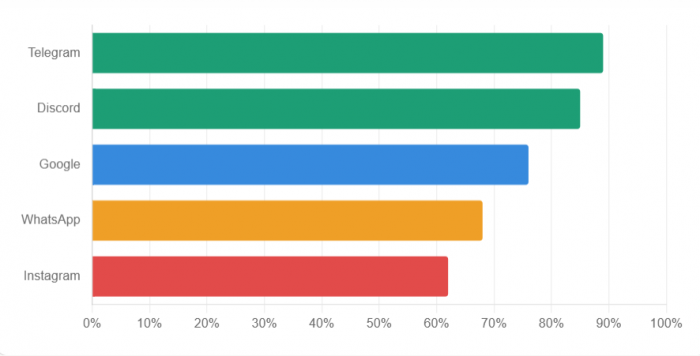
A pattern emerges across user reviews: Grizzly SMS performs reliably when the platform is less aggressively defending against virtual numbers, and struggles when the target service has sophisticated fraud detection. This is not unique to Grizzly SMS; it is structural to the entire industry but it does undermine the blanket reliability claims the service makes in its own promotional material.
How It Stacks Up Against Competitors
| Service | Countries | Min. price | API | GDPR / certs | Est. success rate |
| Grizzly SMS | 100+ | $0.04 | Yes | None disclosed | ~78% |
| 5SIM | 190+ | $0.02 | Yes | SSL + enterprise | ~85% |
| HeroSMS (ex-SMS-Activate) | 180+ | $0.07 | Yes | GDPR history | ~82% |
| SMS-Man | 195+ | $0.03 | Yes | Plaintext pwd risk | ~75% |
Grizzly SMS occupies a mid-tier position: cheaper than HeroSMS for many regions, more expensive than 5SIM for raw cost, and comparable to both in feature set. Its key differentiator claiming not to resell numbers is unverifiable from the outside but plausible given its pricing strategy. The absence of any disclosed compliance certifications (no GDPR statement, no SSL-era transparency report) is a genuine gap for anyone using this in a professional or regulated context.
The competitive landscape is also in flux. SMS-Activate, which defined the category for nearly a decade, shut down in December 2025 after running into payment processor problems. HeroSMS acquired its infrastructure, reshuffling the market and leaving a notable supplier vacuum that services like Grizzly SMS are positioned to fill if they can maintain number quality at scale.
The API Layer
For developers, the existence of an API is table stakes. Grizzly SMS offers one, compatible in structure with the now-defunct SMS-Activate API which means existing automation scripts built for that platform can be migrated with relatively modest effort. The API allows automated number acquisition, code retrieval, and task status management (cancel, complete). Authentication is via API key, which is adequate for non-sensitive automation tasks.
What the API does not offer is the kind of enterprise-grade reliability documentation that a team shipping a production application would need. There are no published SLA figures, no uptime dashboards, and no webhook support for push-based code delivery. If you are building a lightweight test harness or a personal automation script, this is fine. If you are integrating virtual number verification into a production onboarding flow, this is a dealbreaker and you should be looking at Twilio or a carrier-grade provider regardless of cost.
Feature scorecard : Grizzly SMS vs category average
| Aspect | Score (out of 100) |
| Ease of use | 88 |
| Price competitiveness | 80 |
| Delivery reliability | 65 |
| Country coverage | 70 |
| API robustness | 55 |
| Privacy transparency | 50 |
The Privacy Question
Grizzly SMS markets privacy as a core value proposition. "Complete anonymity" is a phrase that appears prominently on their homepage. The reality is more nuanced. The platform does not store your messages beyond the verification window, a reasonable and minimal standard. But account registration requires an email address, top-ups are processed through payment channels that carry their own identity trails, and there is no published privacy policy detailed enough to audit.
Calling this "complete anonymity" is a stretch. It is more accurate to say Grizzly SMS reduces your exposure surface your real phone number is not handed to the service you are verifying with. That is genuinely useful. It is not the same as being invisible.
For users in sensitive contexts journalists, activists, researchers operating in hostile environments with no commercial virtual number service, Grizzly SMS included, provides sufficient operational security. That use case requires a different threat model entirely.
The Ethical Landscape
Virtual number services exist in a legal grey zone that is worth naming directly. Using a temporary number to protect your privacy while signing up for a newsletter is unambiguously fine. Using it to create hundreds of fake accounts to manipulate social media engagement metrics does not violate platform terms of service and, in some jurisdictions, consumer protection law.
Grizzly SMS's own documentation acknowledges the legitimate use cases while gesturing at the others in marketing copy that stresses "mass registrations" without ever disclosing guardrails against abuse. This is standard practice in the industry, but it puts the moral and legal burden entirely on the user. That is a fair arrangement only if the user actually understands it which occasional buyers often do not.
Where Grizzly SMS works well
● Single-use privacy protection for users who don’t want to expose their primary phone number.
● Developer and QA testing flows that require quick, disposable numbers across multiple services or regions.
● Budget‑constrained scenarios where low per-activation cost matters more than enterprise-grade guarantees.
● Verification for platforms like Telegram or Discord, where success rates are generally more consistent.
● Low‑friction onboarding when you need to get a number, receive a code, and move on in a few minutes.
Where Grizzly SMS falls short
● WhatsApp and Instagram activations, where reliability and delivery rates can be inconsistent.
● Compliance‑sensitive environments that expect clear certifications, audits, and governance documentation.
● Use cases that require formal SLAs, uptime guarantees, or dedicated support commitments.
● Advanced integration scenarios that depend on highly mature, feature-rich APIs.
● Users who expect fully transparent, unambiguous privacy practices and data-handling disclosures.
Verdict
Grizzly SMS is a competent mid-market service that does what it claims often enough to be useful. It is not the most reliable option in the category, not the cheapest, and not the most transparent but it is accessible, reasonably priced, and adequate for the majority of everyday verification tasks.
The trap is treating it as something it is not. It is not an enterprise tool, not a compliance-ready infrastructure component, and not a genuine anonymity solution. For a developer spinning up test accounts or an individual who does not want their personal number exposed to a new platform, it earns its place. For anyone needing guarantees of delivery, of uptime, of data handling the gap between Grizzly SMS's marketing and its documented capabilities is wide enough to matter.
Comments