

A free social media tool is useful only if it removes work rather than moving that work somewhere else. That became the most important difference while comparing SmartPostly and Simplified across captions, hashtags, usernames, short-video scripts, and content planning.
I approached both around the same kind of creator workflow instead of checking features one by one. SmartPostly usually got me to an individual piece of content faster. Simplified took more setup in some cases, but it became more useful once that content needed to move into a wider planning or publishing workflow. That difference matters more than the size of either feature list.
SmartPostly and Simplified Solve Different Problems
SmartPostly feels like a collection of focused social-media utilities. Its toolkit includes separate generators for captions, hashtags, usernames, hooks, Reel scripts, calendars, story ideas, polls, bios, and other smaller tasks.
During the comparison, this meant I rarely had to decide where to begin. When I wanted a Reel script, I opened the Reel Script Generator. When I wanted to handle ideas, I moved directly to the username tool.
Simplified felt broader from the start. Social writing sits beside calendars, design, scheduling, publishing, analytics, and other marketing features.
That changed how I used it. I spent a little more time moving through the wider workspace, but once I wanted to take a piece of content beyond the writing stage, the extra tools started making more sense.
The practical difference was clear: SmartPostly helped me finish individual social-content tasks quickly. Simplified became more useful when I wanted to keep several stages of the workflow connected.
How I Tested Both Tools
I did not want to compare one tool with an easy prompt and then give the other something completely different. So I used the same type of creator scenario across the main tests: a small fitness creator producing Instagram and TikTok content.
For example, I worked around requests such as:
● Write an Instagram caption promoting a 15-minute home workout for beginners.
● Suggest hashtags for that same post.
● Generate usernames for a beginner-friendly fitness account.
● Write a 30-second Reel about three workout mistakes beginners make.
● Build a seven-day content plan covering Reels, Stories, and regular posts.
I then looked at six things: how much input each tool needed, whether the first output was useful, how well it understood the platform, how much rewriting remained, how easily I could continue to the next task, and how much of that workflow was available without paying. This made the differences much easier to notice than simply counting features.
What Does Free Actually Get You?
SmartPostly's free structure is relatively easy to understand. Its current Starter plan includes 50 requests per month, with one content generation counting as one request.
During light testing, that felt sufficient because one generation could already provide a usable direction. The limit became more noticeable when I started asking for alternatives. Three caption attempts, two hook variations, several username generations, and a few Reel scripts can consume requests faster than expected.
That taught me something important about the free plan: it works better if the first prompt is specific.
Simplified's free experience felt less like a fixed batch of generations and more like limited access to a larger system. Since the platform covers writing, calendars, publishing, design, and other functions, the practical value depends heavily on which parts someone actually needs.
For occasional social copy, SmartPostly's free structure felt easier to track. With Simplified, I found myself thinking less about individual generations and more about which parts of the broader workflow I wanted to use.
SmartPostly vs Simplified at a Glance
| Area | SmartPostly | Simplified |
| Core approach | Focused social-content generators | Broader social marketing workspace |
| Captions | Dedicated caption generator | AI writing inside a larger workflow |
| Hashtags | Dedicated hashtag tool | Platform-focused hashtag tools |
| Usernames | Dedicated username generator | General and platform-specific tools |
| Short-form scripts | Dedicated Reel Script Generator | AI writing connected with wider creative tools |
| Content planning | AI Calendar Generator | Calendar, planning, scheduling, and publishing |
| Hooks and ideas | Several focused generators | Generated through broader AI workflows |
| Scheduling | Not the main focus | Built into the social product |
| Analytics | Not a core function | Part of the wider social workflow |
| Testing impression | Faster for individual tasks | Stronger once the workflow becomes larger |
| Free approach | Clear generation allowance | Free access spread across a broader system |
The table makes the platforms look close. Using them around the same tasks made the separation much more obvious.
Caption Generation: Focused Tool vs Connected Workflow
For the caption test, I used a simple scenario: promote a beginner-friendly 15-minute home workout on Instagram without making the caption sound overly promotional.
With SmartPostly, the structured setup helped. I could provide the topic, platform, tone, and supporting context without writing a long prompt.
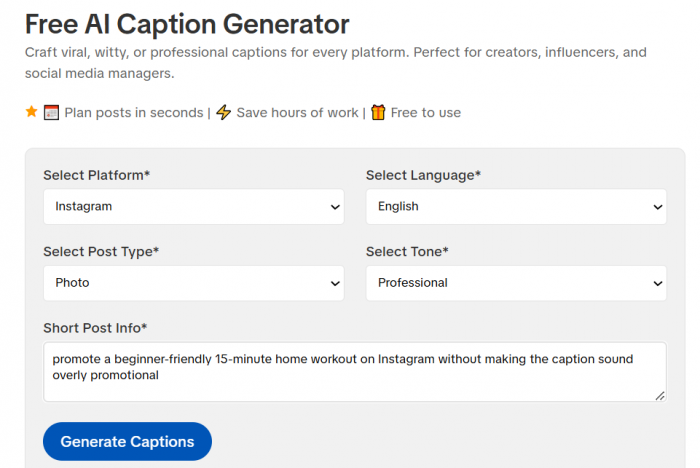
The result was closer to the format I expected on the first attempt. It gave me a social-style caption rather than a mini blog paragraph. I still wanted to remove a few predictable motivational phrases, but the structure itself needed little work.
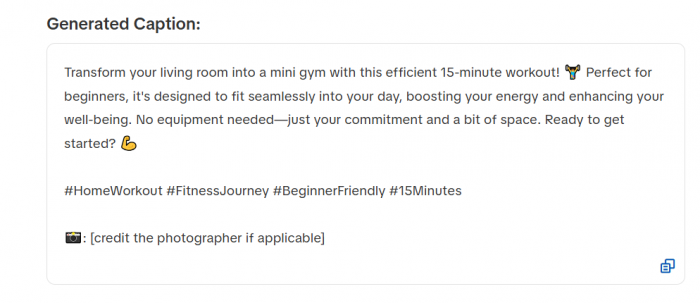
My main edit was making the opening more specific. Generic lines around "starting your fitness journey" were less useful than opening directly with the problem the workout solved.
With Simplified, I could reach a similar type of caption, but the experience felt more connected to the wider content system. The writing itself was not the biggest distinction. The useful part was being able to think about what would happen to the post next. So my result here was not simply that one wrote good captions and the other did not.
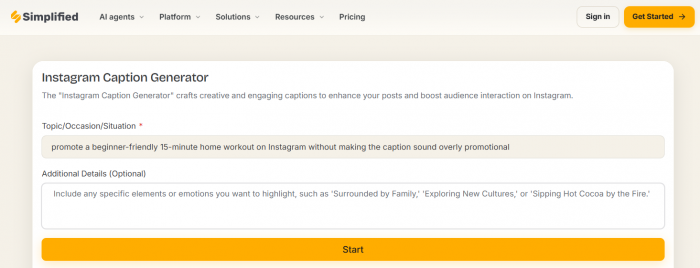
SmartPostly got me to an editable caption with less surrounding workflow. Simplified became more useful when that caption was one part of a larger post-production process.
What I Changed Before I Would Publish It
Neither output went straight to a real account untouched.
I made three types of edits:
● I replaced broad motivational language with details tied to the actual workout.
● I shortened CTAs that sounded too formulaic.
● I removed phrases that could easily have appeared on hundreds of other fitness accounts.
This was a useful reminder that AI caption quality is not just about grammar. The real question is how much personality needs to be added afterward.
Hashtag Generation: Relevance Matters More Than Quantity
I used the same beginner home-workout post for the hashtag test. My goal was not to see which tool could generate the longest list. I wanted to know whether I could take a useful group of tags without spending several minutes deleting irrelevant ones.
SmartPostly returned a mix that stayed reasonably close to the fitness topic. The more specific prompt helped. When I kept the request centered on beginner home workouts rather than simply "fitness," the tags became much more usable.
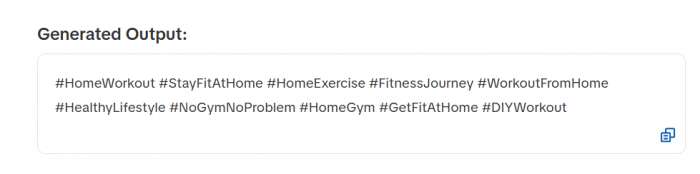
What I noticed, though, was that some broader suggestions were still predictable. Tags connected to general fitness or motivation might technically match the post but add little precision.
Simplified produced a similar mixture of broad and more specific tags through its platform-focused tools. The platform context was useful, especially when thinking separately about Instagram and TikTok.
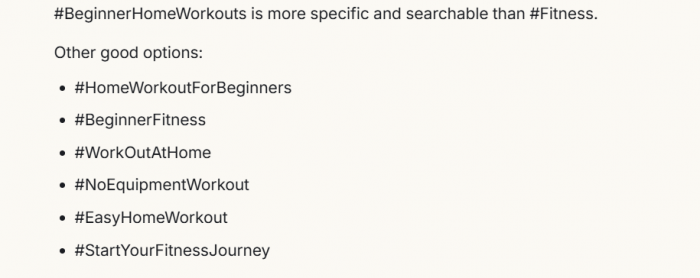
After both tests, I would not have pasted either full result into a post.
My practical result was closer to this: Generate 15–20 possibilities, keep the handful that clearly match the content, and remove anything that looks broad enough to work on almost any post in the niche.
The generator saved research time, but the final selection still needed judgment.
Username Generation Is Harder Than It Looks
For the username test, I asked for ideas around a beginner-friendly fitness page with an approachable rather than hardcore gym identity.
SmartPostly username generator quickly produced enough directions to start narrowing the brand idea. The useful result was not one perfect handle. It was seeing several naming patterns next to each other: some descriptive, some more brand-like, and some built around the creator concept. That made brainstorming faster.
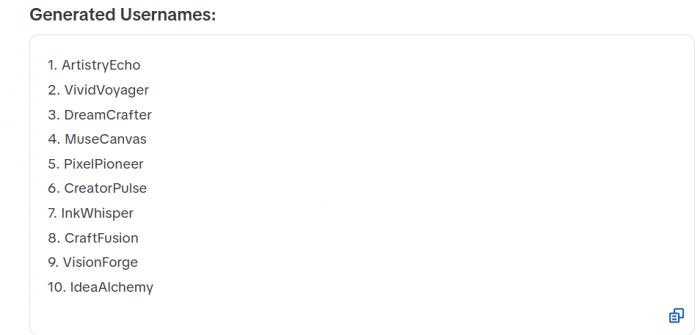
Simplified also produced varied username directions once the niche and style were defined. I found that adding a clear tone mattered a lot. Asking only for "fitness usernames" produced much more predictable ideas than specifying that the account should feel friendly, simple, and beginner-oriented.
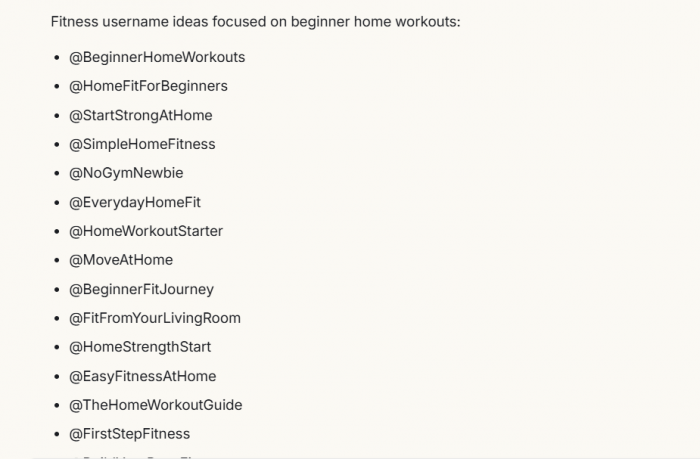
In both cases, the weaker suggestions had familiar problems: unnecessary compound words, slightly forced spellings, or names that sounded more like slogans than handles.
The result I would actually keep from the test was a shortlist rather than a final username. I would still check every shortlisted handle directly on the target platform because generation does not guarantee availability.
Reel Scripts Show SmartPostly's Specialization
For the short-video test, I asked for a 30-second Reel explaining three mistakes beginners make when starting home workouts.
This was one of the sections where SmartPostly's focused tool made the most immediate sense.
Because the generator was already designed around short-form video, I could specify the topic, style, and duration without spending much of the prompt explaining what a Reel script should look like.
The first result had the right basic structure: opening hook, quick points, and an ending. My biggest edit was trimming the middle. Some lines were still more polished on screen than they would sound when spoken naturally.
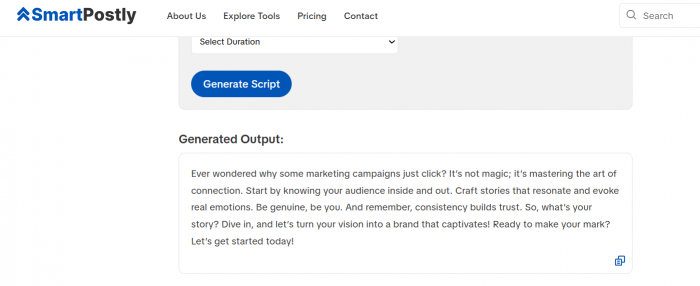
Reading the script aloud changed my opinion of a few sentences. I shortened them and removed one transition that sounded too written.
That left me with something much closer to a recordable script. With Simplified, I could also develop short-form copy, but I felt the benefit more when thinking about what came after the script. If the same workspace is being used for additional creative work and publishing, the broader setup has an advantage.
For this particular test, however, SmartPostly's dedicated Reel workflow felt more direct.
The result was not that it wrote a perfect script. It was that I spent more time editing the wording than fixing the structure, which is a much better starting point.
Content Calendars Reveal the Biggest Difference
For the calendar test, I asked for seven days of content for the same fitness creator.
I wanted variety across Reels, Stories, educational posts, and engagement-driven ideas rather than seven versions of "share a fitness tip."
SmartPostly Calendar Generator gave me a useful starting calendar quickly. I could see several post directions at once and identify which days needed stronger ideas.
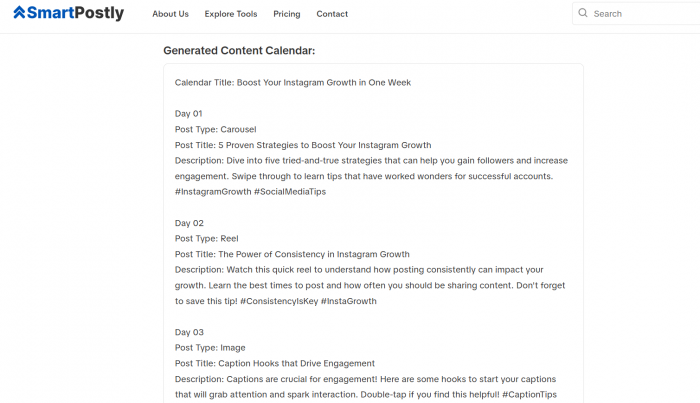
The weak point was repetition at the concept level. A few suggestions belonged to different formats but were essentially solving the same content problem.
For example, a "common beginner mistakes" Reel and a "mistakes to avoid" carousel would not add enough variety if placed too close together.
I would therefore use its calendar as a first planning layer, then manually check for repeated themes before production.
Simplified changed the experience because the calendar is closer to an operational tool. Instead of stopping at "here are seven ideas," the workflow can continue into organization, scheduling, and publishing.
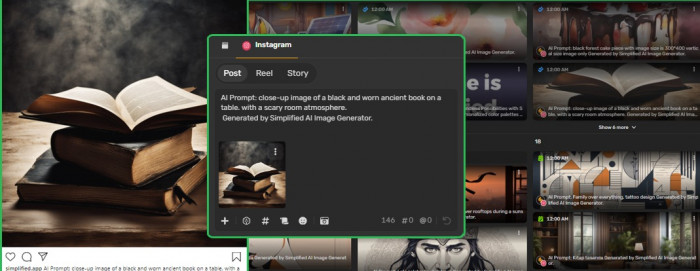
That produced the clearest distinction in the entire comparison.
SmartPostly helped me answer what I could post. Simplified was more relevant when I started asking when the post would go live and how the week's content would be managed.
The Smaller SmartPostly Tools Were More Useful Than Expected
I initially saw tools such as the Hook Writer, Story Idea Generator, Poll Question Generator, and individual bio generators as extras.
Once I started moving between tasks, they made more sense.
For example, after creating the Reel script, I tried treating the opening separately and generating alternative hook directions. That was more useful than asking the script tool to rewrite the entire video every time the first line felt weak.
The same happened with Stories. Instead of trying to make every feed post do more work, a separate Story Idea Generator gave me smaller ideas that could sit around the main content.
The result was a more modular workflow:
Calendar idea → Hook → Script → Caption → Hashtags
I did not need every tool for every post, but being able to isolate the weak part of a piece of content made revisions easier. The downside became visible too. A creator producing at very high volume may not want to jump between several dedicated generators all day.
Simplified Becomes Stronger as the Workflow Gets Bigger
Simplified made more sense to me once I stopped judging it as a collection of individual generators. When I only wanted a caption or username, some of its broader environment felt unnecessary.
Once I thought about a week's campaign, that changed. Writing, visual creation, calendar planning, scheduling, publishing, and analytics belong to the same larger job. Keeping more of those stages connected can save time that would otherwise be spent copying material between different platforms.
That is where Simplified's breadth became its strongest point in the comparison. For a solo creator making three posts per week, I might not use much of that extra system. For a social manager handling several accounts or campaigns, those additional layers become much easier to justify.
Creating Content Is Only Half the Job
After working through the main tests, the two workflows looked noticeably different.
My SmartPostly-style workflow
Idea → Hook → Reel script → Caption → Hashtags → Edit → Copy into publishing tool
I liked this approach when I already knew what I needed. Every step was focused, and I could skip anything irrelevant.
My Simplified-style workflow
Idea → AI copy → Creative work → Calendar → Schedule → Publish → Review
This felt heavier at the beginning but made more sense as the workflow extended beyond text.
The practical result was simple. When I tested one isolated task, SmartPostly usually felt quicker. When I imagined managing several posts through production and publishing, Simplified's extra layers stopped feeling like clutter and started looking useful.
Which One Created More Editing Work?
Neither tool removed editing completely, and I would be suspicious of any social-writing tool that claimed it should.
The type of editing was different.
With SmartPostly, I usually found myself adjusting personality and specificity. The dedicated tools already gave the output a sensible structure, so I did not have to reshape it heavily.
For example, the Reel test needed shorter spoken sentences, but it did not need to be rebuilt as a Reel.
With broader AI writing, the quality depended more on how clearly I defined what I wanted. Strong context produced much better results than a short generic prompt.
Across both, I made the same final checks:
● Could this line appear on almost any competing account?
● Does the script sound natural when read aloud?
● Is the CTA doing anything useful?
● Has the tool invented detail that I never supplied?
● Is there an obvious AI-style phrase I would never normally use?
My main conclusion was that the best output was not the one that looked most polished immediately. It was the one that needed fewer meaningful changes before publishing.
Speed and Interface Depend on the Job
SmartPostly was easier when I arrived with a specific task. Need a username? Open the username tool. Need a hook? Open the Hook Writer, Need a Reel script? Go directly to the script generator. That reduced the number of decisions before generation.
Simplified required more orientation because the platform covers more ground. But judging the extra interface without considering the extra functions would be unfair.
The broader system started paying for itself once I needed planning or publishing features. My experience can be summed up like this:
SmartPostly reduced setup time at the beginning of individual tasks. Simplified reduced switching later in a larger workflow.
Where SmartPostly Made More Sense in My Tests
SmartPostly worked particularly well when the blank page was the main problem.
I found it most useful when:
● I knew exactly what content asset I needed but wanted a faster first draft.
● I wanted several hooks without rewriting an entire script.
● I needed a week of content directions before deciding what to produce.
● I wanted username or bio ideas without opening a larger marketing workspace.
● I already had another method for posting or scheduling content.
Its focused design kept the writing stage relatively clean.
The limitation was equally clear: once I had the finished content, I still needed somewhere else to manage much of what happened next.
Where Simplified Made More Sense in My Tests
Simplified became more useful when the content needed somewhere to go after generation.
I saw more value in it when:
● Several posts needed to be organized together.
● Content was moving from writing into scheduling.
● Creative assets and copy belonged to the same campaign.
● More than one social account had to be managed.
● Brand consistency mattered across many pieces.
● Publishing and performance tracking were part of the job.
For a single caption, that extra depth can feel unnecessary. For a working social-media calendar, it starts looking much more practical.
What Neither Tool Solved for Me
Testing the generators also highlighted where AI stopped being useful. Neither tool could decide whether the fitness audience actually cared about the topic I chose. That requires audience data. Neither could guarantee that a hashtag would improve reach. Both of the tools could not tell me whether a generated username was available without checking the platform.
And neither could decide whether a Reel hook would hold attention better than another one without actual performance data.
I would still keep four areas outside the generator:
● Audience research should come from comments, analytics, search behavior, and real questions.
● Trends should be checked directly on the relevant platform before building content around them.
● Brand voice needs examples and manual editing rather than relying only on a tone dropdown.
● Content decisions should change based on published performance, not simply on how polished an AI output looks.
The tools made production faster. They did not replace the thinking behind it.
Five Creator Workflows That Show the Difference
| Creator Situation | What I Found With SmartPostly | What I Found With Simplified |
| I need an Instagram caption quickly | Fast path from prompt to editable caption | More useful if the caption will continue into a larger workflow |
| I have no idea what to post this week | Quickly generated enough ideas to start planning | Better once the ideas needed to become scheduled posts |
| launching a new account | Useful for jumping between username, bio, and ideas | More useful if branding and wider content production are happening together |
| Publish short videos often | Dedicated hooks and Reel scripts reduced setup | Broader workflow becomes useful after the script stage |
| I manage several social accounts | Stronger for generating individual content pieces | Better suited to organization, scheduling, and publishing |
This made the decision much clearer than counting how many AI tools each platform offers.
Who Should Use SmartPostly and Who Should Use Simplified?
After working through the same types of tasks, I would separate users by workflow rather than experience level.
SmartPostly makes more sense for creators, freelancers, niche-page owners, and small teams whose recurring problem is getting from an idea to usable social copy quickly.
It is especially practical if scheduling, analytics, or design are already handled somewhere else.
Simplified starts making more sense when creation is only one part of the job. Someone managing several channels, visual assets, schedules, approvals, and publishing can make greater use of the wider system.
This is why the choice is not really between a "simple tool" and an "advanced tool." It is between a focused creation workflow and a broader social-management workflow.
The Free Question Matters More at Higher Volume
My opinion of the free access changed once I started generating multiple versions rather than accepting the first result. A creator might use one request for a caption, another for an alternative, another for hooks, another for hashtags, and several more while developing a short-form script.
That makes SmartPostly's 50-request allowance feel generous for occasional use but much more finite for daily experimentation. The lesson was to give it better inputs instead of using repeated generation to discover what I wanted.
With Simplified, the question was different because the product covers more categories of work.
Instead of asking how many pieces of text I could generate, I found it more useful to ask: Which parts of my real weekly workflow remain practical on the free level? That is the comparison I would recommend readers make too.
The Conclusion
Using the same types of social-media tasks made SmartPostly and Simplified feel less like direct competitors than they initially appeared. SmartPostly was at its best when I had a specific content problem in front of me. The dedicated caption, hashtag, username, hook, Reel-script, and calendar tools reduced setup and gave me workable first drafts quickly. I still edited the outputs, especially for voice and specificity, but I rarely needed to rethink the entire format.
Simplified became more convincing when I looked beyond the first draft. Its wider workflow makes more sense for people who want creation, planning, publishing, and management to sit closer together.
The biggest result from the comparison was therefore not that one tool consistently produced "better AI." It was that they removed friction at different points. SmartPostly reduced friction before the content was written. Simplified reduced more friction after the content started becoming part of a larger social workflow.
For someone mainly struggling with what to write, SmartPostly's focused generators are easier to justify. For someone struggling to manage everything surrounding those posts, Simplified's broader setup has more room to help. That difference is far more useful than choosing between them based on feature count alone.
Comments