

Scroll far enough into any TikTok comment section and the emojis stop making sense. A skull sits under a video where nobody died. A little pink cartoon face turns up that lives on no keyboard anywhere. A row of chairs appears for no reason at all. None of it is broken. It is simply a language nobody gets formally taught and, awkwardly, TikTok runs two of them at once. One is a set of emojis the company coded into the app, unlocked by secret shortcodes. The other is the ordinary emoji library everybody already owns, quietly reassigned to mean something else the moment it lands on TikTok. What follows is a field guide to both.
The split that explains everything
"TikTok emojis" are really two different things sharing one name, and the difference almost never gets spelled out. It is the whole game, because the two systems behave in opposite ways and fall apart in opposite ways.
The first is a set of custom emojis built straight into TikTok a private collection summoned by typing short text codes. The second is the normal Unicode set that ships on every phone, except the TikTok crowd has rewritten what a lot of it means. One is fixed and owned by the company. The other drifts constantly and belongs to whoever happens to be posting.
| Built-in secret emojis | Repurposed standard emojis | |
| Where they come from | Coded into the TikTok app itself | The standard emojis on any phone |
| How they're triggered | A shortcode in brackets, like [smile] | Typed like any normal emoji |
| What they look like | A custom cartoon set, identical on every device | Whatever a given phone's emoji font draws |
| Where they work | Only inside TikTok | Everywhere but the meaning is TikTok-specific |
| Who sets the meaning | TikTok, and it's fixed | The community, and it never sits still |
That split runs under everything below.
Where the bracket-code came from
The idea of typing a word between brackets to summon a picture is older than TikTok by a couple of decades. Early web forums did it with "emoticon codes," turning [smile] into a little smiley GIF. Slack, Discord, and GitHub later made the colon-wrapped shortcode :fire:, :tada: second nature to a whole generation of users. TikTok's [happy] is a direct descendant of that convention, just dressed in a cartoon style of its own.
The other half of the story is branding. Building a house emoji set has become a quiet land-grab among platforms: Slack and Discord let communities upload their own emoji, LINE built a sticker empire, Facebook turned reactions into a product. A proprietary set hands a platform something recognizably its own, a small visual signature that cannot be carried over to a rival app. TikTok, owned by ByteDance alongside its Chinese sibling Douyin, arrived into that norm rather than inventing it, and its hidden emojis fit the pattern neatly: a bit of identity baked into the interface, handed only to the people who know the words.
The emojis TikTok built for itself
Under the roughly 3,800 standard emojis TikTok supports sits a collection of 46 custom ones that never appear on any keyboard. They surface only when a keyword is typed inside square brackets. A comment written as [happy][happy] looks like plain text right up until it posts, then the brackets vanish and two beaming cartoon faces take their place, visible only to people reading inside the app.
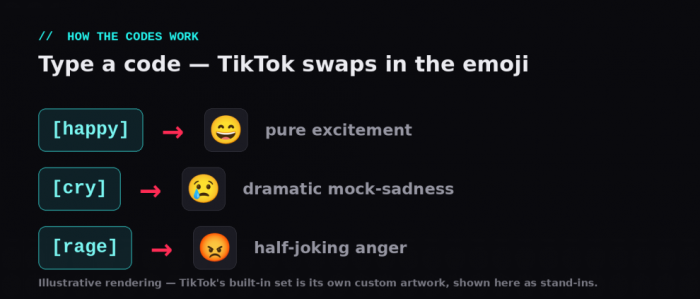
That detail carries more weight than it first appears. Because these emojis are drawn from TikTok's own files rather than the phone's emoji font, they render pixel-for-pixel identically on every device. An iPhone and a budget Android show the exact same face. Standard emojis almost never manage this; the same code can appear as three different expressions across platforms, which is how a perfectly friendly message can arrive looking cold. TikTok's set skips the whole problem. It is one shared picture, everywhere.
The trade-off shows up the second a code leaves the app. Dropped into an Instagram caption or a text thread, [wronged] stays exactly that: literal characters, brackets and all. The emoji exists only while it is living inside TikTok.
So why build a private emoji set at all? Branding is part of it, a small, sticky thing that belongs to TikTok and nowhere else. But the bigger pull is the code itself. When a keyword has to be known before the emoji appears, using it fluently becomes a quiet signal of membership. The barrier is the point.
The codes worth knowing
Nobody needs all 46. A working handful covers most of what shows up, and the codes ignore capitalization [Smile] and [smile] both fire. The ones below are the regulars, sorted by the mood they carry.
Happy, playful, affectionate
| Code | What it looks like | When it gets used |
| [smile] | Small round pink smiling face | A soft, polite smile mild approval or a friendly "aw" |
| [happy] | Peach face, squinty eyes, big open grin | Real excitement, the video properly landing |
| [joyful] | Beaming, laughing face | Something is genuinely funny |
| [loveface] | Face with heart eyes | Adoration "obsessed with this" |
| [cute] | Bright-eyed, delighted face | Finding something adorable or wholesome |
| [cool] | Face in sunglasses | Playing it unbothered |
| [wicked] | Sly, scheming grin | Playful mischief |
| [proud] | Smug, chin-up face | Quiet self-satisfaction a soft "told you so" |
Sad, angry, shocked, awkward
| Code | What it looks like | When it gets used |
| [angry] | Red face, furrowed brow, stress marks | Displeasure or frustration |
| [rage] | Red face mid-yell | A step past annoyed usually half-joking |
| [cry] | Teary, downturned face | Sadness, or the mock-sadness that's more common |
| [wronged] | Sad eyes, two fingers pointing together | Feeling hurt or hard-done-by, often for comedy |
| [shock] | Wide-eyed, stunned face | Disbelief "no way" |
| [flushed] | Red-cheeked, flustered face | Embarrassment, or being caught off guard |
| [speechless] | Blank face with flat lines | "No words" secondhand cringe, quiet judgment |
| [drool] | Face drooling | Wanting something badly food, usually |
Reactions and the rest
| Code | What it looks like | When it gets used |
| [funnyface] | Goofy, exaggerated face | Clowning around, being deliberately silly |
| [thinking] | Hand-on-chin pondering face | Skepticism, or making a show of "hmm" |
| [greedy] | Wide grin, hungry-eyed | Wanting more snacks, money, attention |
| [complacent] | Smug, self-satisfied smile | Pleased with oneself, unbothered |
| [excited] | Star-eyed, buzzing face | Hype, anticipation |
| [yummy] | Tongue-out, savouring face | Delicious or "delicious" as a joke |
| [nap] | Dozing face | Bored, sleepy, or checked out |
| [angel] | Haloed, innocent face | Feigned innocence "who, me?" |
Six or eight of these are enough to reply in TikTok's native handwriting rather than the generic keyboard set everyone else defaults to.
Why the same emoji wears different faces
The uniformity of TikTok's built-in set is stranger than it sounds, because ordinary emojis are a mess of mismatched artwork. Every operating system draws its own version of each Unicode character, and the results routinely disagree. For years the "grimacing face" looked like a nervous grin on one platform and a pained clench on another; the pistol emoji started life as a realistic revolver before every major vendor quietly redrew it as a bright green water gun.
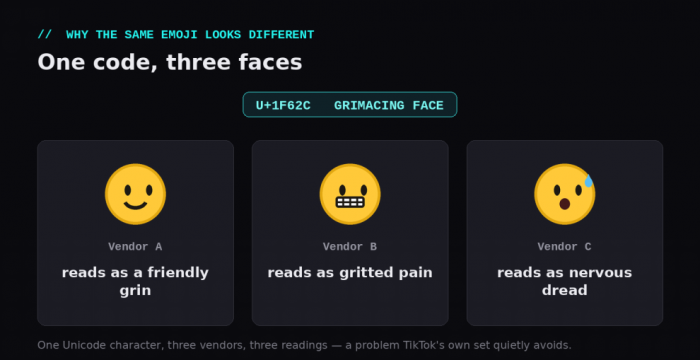
The gap matters because tone rides on those tiny drawings. A message meant warmly on an iPhone can arrive cold on an Android, and neither person ever sees the mismatch each just sees a slightly different face. Plenty of small misunderstandings trace straight back to a codepoint two vendors interpreted differently. Against that backdrop, a platform that guarantees one fixed picture for everyone is doing something quietly radical, even if the guarantee only holds inside its own walls.
The emojis TikTok didn't build
Then there is the harder half plain keyboard emojis, the same ones already sitting in a text to a parent, that mean something specific and often unrecognizable the moment they hit a TikTok comment. Taken literally, they mislead.
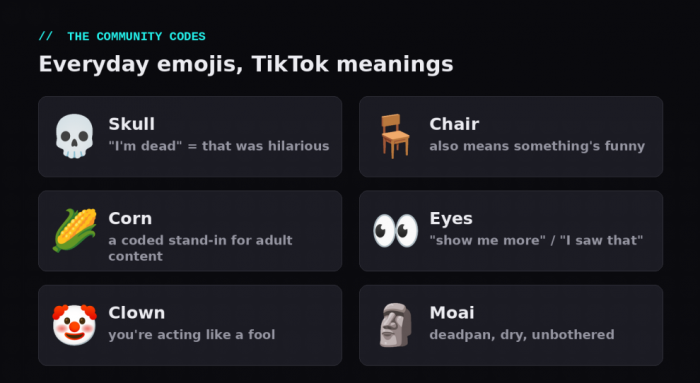
• Skull "I'm dead": something so funny it killed the viewer. Among younger users it has almost entirely replaced the crying-laughing face, which now reads as faintly dated.
• Chair also just means something is hilarious. It grew out of a running joke that the chair should replace the laughing emoji, and stuck around as pure absurdist shorthand.
• Corn a stand-in for "porn" or adult content. TikTok's filters suppress the actual word, so a soundalike symbol gets drafted in instead the same instinct behind "unalive" for "kill."
• Eyes "watching this," "show me more," or "I saw that." It turns up whenever something is juicy, suspicious, or gossip-adjacent.
• Clown "acting like a fool," and usually aimed inward: an admission of getting played or believing something naive.
• Moai (the stone head) deadpan, dry, unbothered. The visual equivalent of a blank stare at a bad joke.
• Tea gossip, plainly. "Spill the tea" means share everything; the cup on its own carries the same charge.
One thread runs under a lot of this, and it deserves naming: content moderation is the engine. When TikTok's automated systems flag or throttle a word, a substitute has to fill the gap so a symbol gets pressed into service. Corn for adult content is the cleanest case, but the same reflex shapes a large slice of the platform's slang. The workaround hardens into the norm, and the emoji outlives the rule that created it.
The wider coded language
Those emoji swaps are one corner of a much bigger phenomenon with a name: algospeak, a mash-up of "algorithm" and "speak." The term surfaced online in late 2021 and reached the mainstream through a 2022 Washington Post piece. The practice itself is simple coded language built to slip past automated moderation.
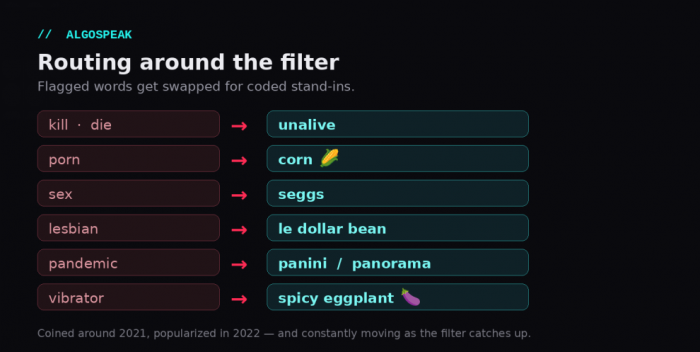
The examples give away how it works. "Unalive" stands in for kill, die, or suicide. "Seggs" covers sex. "Le dollar bean" means lesbian a spelling born from the way TikTok's text-to-speech read "le$bian" aloud. Pandemic became "panini" or "panorama"; a vibrator turned into a "spicy eggplant." Some of it dodges genuine censorship of dark subjects. A lot of it guards against the softer penalty: being quietly demonetized or buried.
The strange part is the treadmill. Filters learn the euphemisms, so the euphemisms keep moving "unalive" has already spawned successors like "perished." Bland words get swept up too; creators report trouble over terms as harmless as "weird" or "thick." The result is a vocabulary that mutates faster than any dictionary can follow, shaped less by what people mean than by what a moderation system will tolerate this month.
The same pattern shows up in abbreviations that can mean completely different things depending on where they appear. SSA meaning on TikTok is a useful example: the letters can function as reversed slang in social-media conversations while carrying entirely different definitions elsewhere. It is another reminder that understanding internet language increasingly requires reading the platform, audience and surrounding conversation rather than decoding the word alone.
One emoji, two readings
None of this lands the same way across age groups, which is where the real confusion lives. The clearest fault line is laughter. The crying-laughing face Oxford's word of the year in 2015, once the most-used emoji on earth got quietly retired by younger users around 2020 for looking tryhard. The skull took its place: "I'm dead," meaning hilarious, not fatal. The loudly-crying face pulls similar duty now, closer to "so real" than to actual grief.
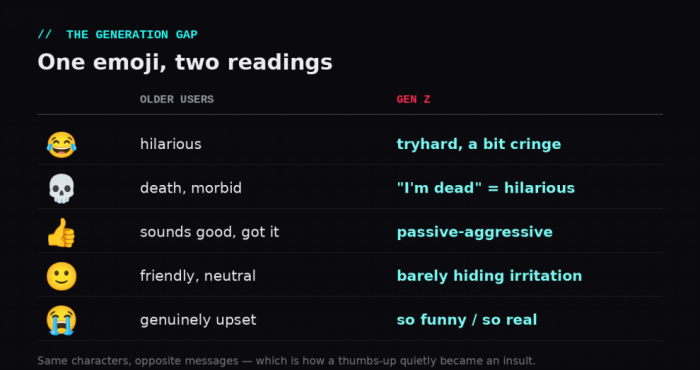
Then there is the thumbs-up, which has quietly become a generational trap. To most people over thirty-five it is a friendly "sounds good." To a lot of younger users it reads as curt, sarcastic, even hostile the digital equivalent of a flat "sure." The plainly-smiling face carries the same passive-aggressive charge. The characters have not changed; the social contract around them has, and the two readings pass each other without either side noticing.
Context bends it further still. A thumbs-up from a manager is unremarkable; the same emoji from a new romantic interest, sent right after a risky text, can trigger genuine dread. Emojis, in other words, do not carry fixed meanings so much as meanings on loan from a particular group, a particular platform, a particular moment.
What all this says about language
It is tempting to file emoji codes under harmless internet trivia. But a couple of deeper things are going on, and they are why the topic outlasts the novelty.
The first is belonging. Slang has always doubled as a membership test: the right word at the right moment marks a person as one of the group. Emoji codes just move that test into pictures. Placing the correct skull on the correct beat signals a native rather than a visitor, and that signal does real social work.
A skull stopped being about death. A chair was never about furniture.
The second is stranger: the meaning floats free of the picture. Once enough people agree that a skull means laughter, the original image barely registers nobody is picturing mortality. That is exactly how language has always drifted; the only new thing is the speed, fast enough now to watch a symbol change jobs inside a single season. Emojis looked at first like a universal picture-language, identical for everyone. They turned out to be the opposite: dialect, all the way down.
Fluency without the cringe
Knowing the codes is only half of it; using them so they land is the rest. A few rules separate fluent from try-hard:
• Match the emoji to the register of the comment. A [wronged] under a genuinely sad video reads as mockery the cartoon undercuts the moment.
• Keep it to one or two. A wall of codes reads as spam and buries whatever point was being made.
• Expect them to vanish off-platform. Screenshotting a comment or reposting it elsewhere collapses the emoji back into literal text like [happy], which looks broken to anyone who wasn't on TikTok.
• For graphics, use the PNG. Slotting a TikTok emoji into a thumbnail means downloading a transparent version; the shortcode does nothing in an image editor.
• With a repurposed emoji, watch before wading in. Meanings shift fast, and reaching for last year's version of a symbol dates the sender instantly.
A note for the marketing department
This is also where corporate accounts go to embarrass themselves. Emoji fluency is a strong tell for whether an account actually lives on the platform, and nothing broadcasts "meeting-room social strategy" faster than a brand deploying a skull or a corn slightly wrong. The vocabulary rewards people who absorbed it by osmosis and punishes anyone reaching for it on purpose. For a marketing team, the safer read is usually restraint, understanding the codes well enough to follow the comments, and think hard before joining in with them.
That restraint applies to the rest of a post as well. Emojis can reinforce a tone, but they cannot create the missing context around it, which is why understanding what a social caption is actually meant to do matters just as much as knowing which symbols are currently popular. The wording around an emoji determines whether it feels natural, sarcastic, awkward or obviously inserted by someone trying too hard to sound current.
The catch
Any guide to this is a snapshot, and honesty demands saying so. The built-in codes are stable. TikTok owns them, so [smile] will keep being a smile. The cultural layer is the opposite: it turns over on a rolling basis, sometimes within weeks, pushed by trends and by whatever the moderation system is flagging that month. What corn means today may not be what it means next year. There is no shortcut to fluency except the slow one watching how real people actually use these things in context.
The bottom line
TikTok emojis aren't decoration, and they aren't a gimmick. They are a working dialect with two grammars, one written by the company, one written by the crowd that rarely get explained in the same place. The bracketed codes say things the standard keyboard can't. The community meanings turn the comments from baffling into readable. Missing both leaves roughly half of every comment section in a language that stays locked. The skull isn't going anywhere; better to know what it's laughing at.
Comments