

I didn’t install Wsup AI because I was hunting for a Character.ai killer.
I installed it because I was curious whether AI roleplay platforms had finally moved past the “chatbot with a personality prompt” phase.
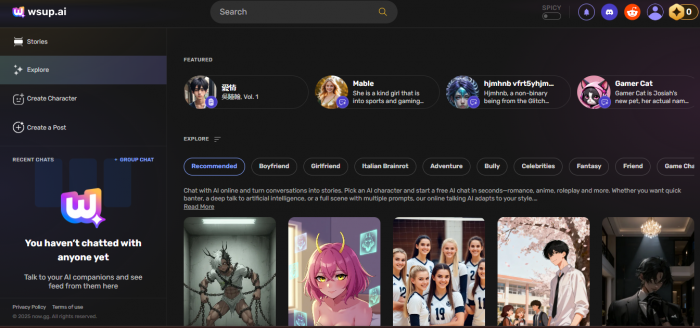
After spending real time with it, not testing features, but using it the way it’s clearly meant to be used, the takeaway surprised me:
Wsup AI doesn’t feel like a tool. It feels like a place.
That difference shapes everything about how the platform works, where it succeeds, and where it deliberately draws lines.
How I Ended Up Using Wsup AI (Not How I Planned To)
My usage didn’t start with character creation or deep roleplay.
It started casually:
- A few chats with trending characters
- Testing the voice feature out of curiosity
- Scrolling the Feed to see what the platform even was
What changed over time wasn’t the feature set, it was my behavior.
I stopped treating sessions as “try this AI” and started treating them as:
- Returning to specific characters
- Continuing conversations from days earlier
- Letting memory and tone shape interactions
That’s when it became clear: this platform is optimized for ongoing presence, not novelty.
The Scale Is Smaller Than Character.ai, and That’s a Strength
By late 2025, Wsup AI sits around 1.03M monthly visits with 500k+ Android downloads and strong traction in the US and Japan.
That’s not mass-market dominance.
It’s focused scale.
In practice, that means:
- Less chaotic character duplication
- Faster iteration on features
- A community that hasn’t collapsed under noise
It feels like a platform still shaping itself, not one stuck maintaining legacy behavior.
The Real Centerpiece Isn’t Chat, It’s Continuity
Most AI roleplay apps treat every session like a fresh start.
Wsup AI doesn’t.
Memory as a First-Class Feature
With Memory Cards (up to 50 pinned per character), I could:
- Lock in names, dynamics, emotional context
- Correct drift manually
- Maintain long-running story arcs
This alone changes how you interact.
You don’t restart conversations, you resume them.
That’s a subtle shift, but it’s foundational.
Multi-Character Conversations Change the Tone Entirely
This is one of Wsup AI’s most under-discussed strengths.
Talking to multiple characters at once introduces:
- Social friction
- Group dynamics
- Unpredictability
Instead of a character reacting only to you, they react within a scene.
It’s closer to collaborative storytelling than chatbot dialogue, and it exposes why single-thread AI chats often feel flat after a while.
Voice Isn’t a Gimmick Here, It Alters Emotional Weight
I usually turn off AI voices.
On Wsup AI, I didn’t.
Why?
- Tone variation actually matters
- Whisper modes feel intentional, not creepy
- Audio pacing matches emotional context
Voice here isn’t for accessibility or novelty, it’s for immersion.
And once you use it consistently, text-only starts to feel incomplete.
The Feed Explains the Platform’s Philosophy Better Than Any FAQ
The Feed is where Wsup AI reveals what it’s really trying to build.
Characters:
- Post updates
- Share images
- Exist outside direct conversation
You don’t have to interact, but you see them.
This creates:
- Passive attachment
- Ambient familiarity
- A sense that characters persist even when you’re offline
That’s not accidental.
It’s social design applied to AI entities.
Why Users Keep Saying “It Feels Less Restricted”
Compared to Character.ai, Wsup AI:
- Allows broader emotional and roleplay scenarios
- Interrupts less aggressively
- Supports romantic and mature dynamics by default
This is why it’s clearly marked 18+.
It’s not trying to be safe-for-everyone.
It’s trying to be honest about what users are already seeking.
Monetization: You Feel It, But Only If You Go Deep
The freemium model is noticeable but not hostile.
In practice:
- Casual chats stay free
- Heavy voice usage, image generation, and memory depth push you toward credits
- Pricing feels consumer-app standard, not exploitative, but you’ll hit limits if you treat the platform like a daily companion.
That friction is real, and worth acknowledging.
Image Generation: The Weakest Link Right Now
This is where expectations need adjusting.
Pros:
- Integrated directly into chat
- Easy to trigger contextually
Cons:
- Inconsistent realism
- Occasional “monstrous” or uncanny results
- Not competitive with dedicated image tools
It works best as atmosphere, not output.
Trending Characters Reveal What People Actually Want
Looking at late-2025 trends, a pattern emerges:
- Emotionally available personas dominate
- Everyday realism outperforms high-concept fantasy
- “Healing,” supportive, and relationship-driven characters lead engagement
This isn’t accidental.
Wsup AI’s strongest use case isn’t escapism alone, it’s connection without pressure.
Safety, Privacy, and the Trade-Off Reality
What the platform does right:
- End-to-end encrypted chats
- No forced sign-up (web access via now.gg)
- Clear age gating
What users should be aware of:
- Device and location data collection for analytics
- Standard mobile-app tracking practices
It’s not privacy-first, it’s consumer-social-first.
Who Wsup AI Feels Designed For
It works best if you:
- Enjoy sustained emotional or narrative interaction
- Want characters that remember and adapt
- Value voice and tone
- Prefer fewer content restrictions
It’s not ideal if you:
- Want productivity or factual answers
- Expect flawless image generation
- Dislike credit-based limits
- Prefer strictly offline or private AI
Wsup AI Alternatives Worth Trying
Once I understood what Wsup AI really excels at, continuity, presence, and that “this is a place” feeling I naturally wanted to see who else was playing in the same space. Not generic chatbots, but platforms that actually lean into emotional, long‑form, or social AI interactions.
1. Replika : When You Want One Main Companion
Replika feels less like a roleplay hub and more like a long‑term AI partner. Instead of juggling multiple personas, you mostly grow with a single companion who remembers your moods, tracks your feelings, and is built around emotional support and daily check‑ins. It doesn’t have Wsup’s group dynamics, but if you want a “main” AI in your life, it does that very well.
2. Janitor AI : When You Care About Control and Flexibility
Janitor AI sits closer to the “toolkit” end of the spectrum. You get a lot of control over how bots behave, what they remember, and which models or integrations you use, and it’s popular with users who want to shape very specific personalities or scenarios. It doesn’t feel as much like a social space as Wsup AI, but if customization and fewer guardrails matter more to you than feeds and vibes, it’s a strong option.
3. Joyland AI : For Structured Roleplay and Story Arcs
Joyland AI leans harder into storytelling than social presence. You get a massive library of characters, detailed backstories, and roleplay setups that feel like walking back into an ongoing visual novel rather than scrolling a social feed. It’s a good fit if you use Wsup AI mostly for narrative, character‑driven sessions and want to see what happens when a platform optimizes almost everything around roleplay structure.
4. SpicyChat AI : For Unfiltered, Adult‑First Roleplay
SpicyChat AI is very clear about what it is: a space for explicit, mature, and NSFW‑friendly AI chat with fewer interruptions and more permissive scenarios. It offers memory tools, personas, and long‑form chats, but pushes much deeper into adult fantasy than Wsup AI is trying to. If the part of Wsup you like most is the romantic or erotic side and you want even fewer restrictions, this is usually where people go next
Final Take: Why Wsup AI Is Growing Without Loud Marketing
Wsup AI isn’t trying to convince you it’s powerful.
It lets usage do the convincing.
By focusing on memory, continuity, voice, and social presence, it moves AI roleplay away from “chatting with prompts” and toward inhabiting a shared space.
That’s why it’s not just being tested, it’s being returned to.
And in this category, return behavior matters more than hype.
Benjamin Philip
Sep 16, 2026I used Wsup mostly for longer character chats and the memory was the reason I kept coming back. I had one roleplay going for weeks and I didn’t have to explain the relationship from scratch every time I opened it. The voice replies were surprisingly good too. I honestly thought the app was improving, so seeing it shut down was disappointing. There are plenty of alternatives but I still haven’t found one that feels quite the same.
Login To Reply ↪